What's Really Happening in Your Body
What's Really Happening in Your Body
Before we begin — how would you rate your understanding of why your desire has changed?
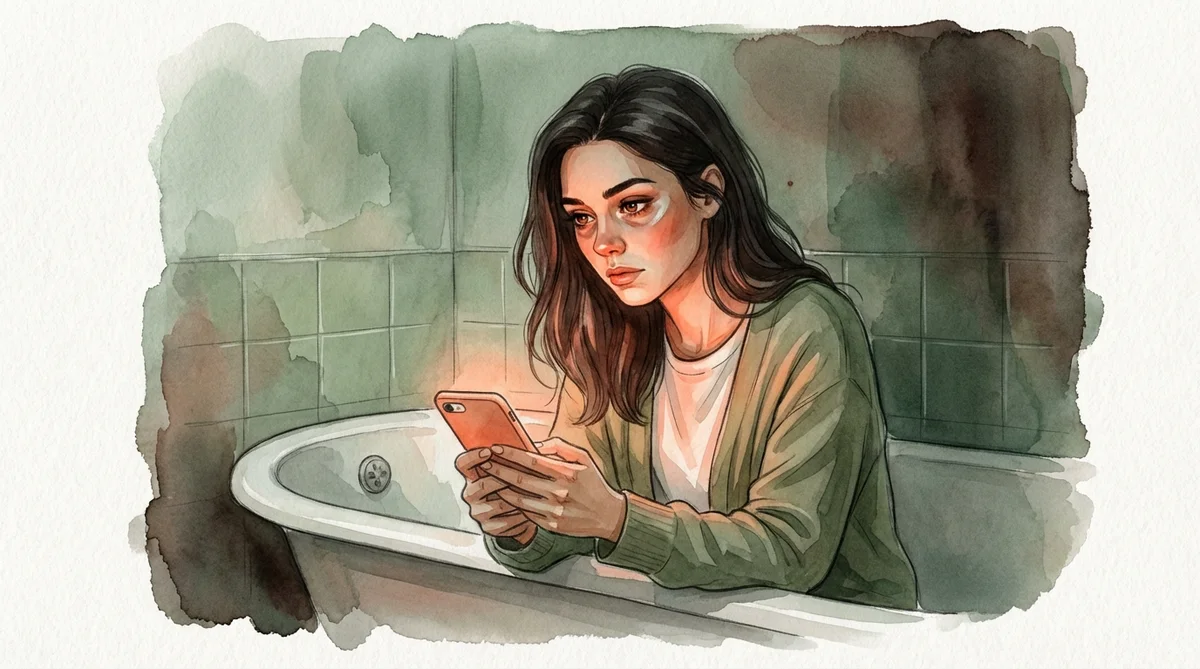
Mara, 39, is sitting on the bathroom floor at 11 PM on a Tuesday. David's breathing changed beside her two minutes ago — the rhythm that used to mean something, that now makes her whole body brace. She slipped out of bed. Cold tiles under her bare feet. Phone glow on her face. She types: "why don't I want sex anymore." She is a project manager. She runs complex projects for a living. But this — her own body turning unfamiliar — has no Gantt chart. She sits on the edge of the tub and reads for 40 minutes. Most of what the internet offers is garbage. Then she finds something that sounds like it was written by someone who actually talked to women. Something shifts. Not hope. Just the first hairline fracture in the wall of self-blame.
You didn't wake up one morning and decide to stop wanting sex. Something shifted — quietly, perhaps years ago — and now you're here, searching for answers. Let's start with what's actually happening in your body, because understanding it is the first step to reclaiming it.
"I felt numb. Didn't have any desire — I had no libido — I thought I was crazy." — Woman, TikTok (2.03 engagement z-score)
The Relief No One Has Given You Yet
There is nothing psychologically wrong with you. Your loss of desire has a precise biological architecture, and once you see it, you will stop blaming yourself.
Female sexual desire is not a simple on/off switch. It is a complex interplay of hormones, neurotransmitters, context, and psychology that shifts across your lifespan. And right now, multiple systems are working against you — not because you are broken, but because your biology is responding to real changes.
In our community of 217 women reporting low libido, 57% are in perimenopause or menopause. But here is what surprised us: women in their early 30s report it too, often with the highest emotional intensity. This is not an "old woman's problem." It is a biological reality that can begin decades before your last period.
A woman in her 30s discovering that her low desire had biological explanations
“I felt like something was fundamentally broken in me. Turns out my body was just responding to a dozen things I didn't know were happening.”
— Reddit community member, r/AskWomenOver30
Your Brain's Accelerator and Brake
Research from the Kinsey Institute reveals something that changes everything: your brain runs two competing sexual systems simultaneously.
The Sexual Excitation System (SES) — think of it as your accelerator — scans for sexually relevant cues and drives arousal forward. A partner's touch, an erotic thought, feeling desired.
The Sexual Inhibition System (SIS) — your brake — scans for every reason NOT to be aroused. Stress. Pain. Exhaustion. Body shame. Resentment. The mental load of managing a household. That fight you had last Tuesday.
The Dual Control Model from the Kinsey Institute is the most influential framework in modern sexual science. It explains why most desire problems are not about "too little gas" but about "too much brake."
Here is the critical insight from the Dual Control Model: most desire problems are not a broken accelerator. They are an overactive brake. In women with low desire, the brakes are being pressed by multiple forces at once, and each one alone would be enough to suppress wanting.
This reframe matters because it changes the question entirely. Instead of asking "What's wrong with my desire?" you start asking "What's pressing on my brakes?" — and that question has answers you can actually do something about.
The Hormonal Theft
Your body needs three key hormones for desire to function:
- •Estrogen maintains vaginal tissue health, pelvic blood flow, and contributes to central desire in the brain
- •Testosterone drives baseline desire intensity — yes, women need it too
- •DHEA serves as the precursor for both estrogen and testosterone
During perimenopause, all three decline. But here's what most women don't know: testosterone drops approximately 50% between ages 20 and 40 — well before menopause begins. The Seattle Midlife Women's Health Study tracked this in real time and found that sexual desire significantly dropped during late menopausal transition and continued falling into early postmenopause, correlating with declining estradiol and rising FSH (Woods et al., PMC2834444).
But hormonal decline is rarely the whole story. Cortisol — the stress hormone — is literally stealing your sex hormone building blocks. This is called the pregnenolone steal: your adrenal glands divert the raw material (pregnenolone) away from estrogen and testosterone production and toward cortisol. When you are chronically stressed, your body prioritizes survival over reproduction. It is not a design flaw — it is biology doing exactly what it evolved to do.
Women with persistently low sexual desire show measurably different hormonal patterns — lower morning cortisol, lower DHEA, and flatter diurnal cortisol slopes (PMC7343293). Your body is not broken. It is redirecting resources.
That was a lot of science. Let’s pause and take three slow breaths together. You are not broken — your body is responding to real biological changes.
The Neurotransmitter War
Beyond hormones, your brain's chemical messengers are also involved:
Dopamine drives wanting, motivation, and the reward anticipation that pulls you toward sex. Serotonin, paradoxically, can suppress desire when elevated — which is exactly what SSRIs do. If you are on an antidepressant and your desire vanished, this is why: 40-65% of women on SSRIs experience sexual dysfunction because serotonin actively inhibits dopamine and norepinephrine, the neurotransmitters most associated with desire and arousal (PMC6832699).
Meanwhile, oxytocin — released during breastfeeding and constant childcare — can saturate the bonding system while depleting the novelty-seeking dopamine that fuels sexual interest. If you've been "touched out" by the end of the day, this is the biochemistry behind that feeling.
50%
Testosterone decline by age 40
Testosterone drops approximately 50% between ages 20 and 40, well before menopause begins — explaining why desire loss can start in your early 30s.
The Context Equation
Perhaps the most important finding in modern sexual health research: context is the single strongest predictor of women's sexual desire, outweighing hormones in most cases.
Relationship quality. Emotional safety. Stress levels. Physical comfort. Feeling desired versus feeling demanded upon. These contextual factors determine whether your accelerator gets activated or your brake stays pressed.
The amygdala — your brain's threat detector — processes emotional memory. When a partner becomes associated with feeling unseen, overburdened, or pressured, the amygdala can override sexual circuits entirely. Chronic resentment keeps your nervous system in fight-or-flight mode, and arousal requires the opposite: parasympathetic safety.
In our data, low libido correlates with irritability at a measurable weight of 0.013 — a signal that the anger underneath desire loss is real. And the correlation between dead bedrooms and divorce consideration is 0.094, the highest non-sexual correlation in our entire dataset.
In our community of 217 women reporting low libido, 57% are in perimenopause or menopause. But women in their early 30s report it too — often with the highest emotional intensity. This is not an "old woman's problem."
What This Means for You
Your desire did not vanish. It is buried under a convergence of biological forces — each one measurable, each one addressable:
- •Hormones declining (addressable through lifestyle and medical intervention)
- •Cortisol stealing building blocks (addressable through stress management)
- •Neurotransmitters imbalanced (addressable through exercise, nutrition, medication review)
- •Context working against you (addressable through communication, boundaries, self-care)
- •Brakes stuck on (addressable by identifying and releasing each one)
Once you stop treating this as a personal failing and start treating it as biology, the path forward becomes clear. Over the next 12 weeks, we will address each of these systems — one pillar at a time.
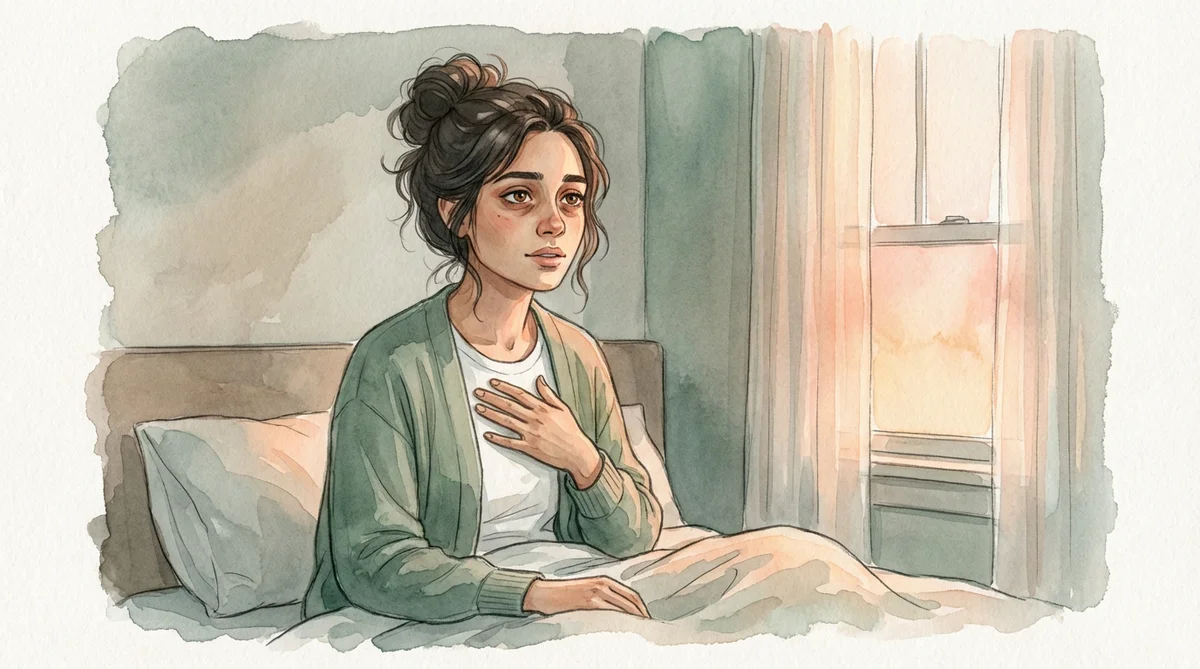
Mara closes the article on her phone. For the first time in months, she doesn't feel broken. She feels... studied. Someone looked at this. Someone measured it. That helps. She slips back into bed. David is asleep. The bathroom tiles are still cold in her memory. But something is different — the furrow between her brows has softened. One hand rests on her own chest. She isn't searching anymore. Not tonight.
You showed up today. That takes courage.
Seeking answers about your body is not a sign of weakness — it’s the first step toward reclaiming something that matters to you.
The Hormonal Map
Next, we’ll map the five distinct patterns that drive low libido — and you’ll discover which ones apply to you.
Key Takeaways
- Low desire is usually an overactive brake, not a broken accelerator — the Dual Control Model from the Kinsey Institute explains why
- Testosterone drops 50% between ages 20-40, well before menopause — desire loss can begin in your early 30s
- Cortisol literally steals the raw materials your body needs to make sex hormones (pregnenolone steal)
- Context — relationship quality, stress, safety — is the strongest predictor of women's desire, outweighing hormones
- This is biology, not a character flaw, and every contributing factor is addressable
Sources
Seattle Midlife Women's Health Study
Woods et al., PMC2834444 (2010)
Sexual desire significantly dropped during late menopausal transition and early postmenopause, correlating with declining estradiol and rising FSH
HPA Axis Dysregulation in Women with Low Sexual Desire
PMC7343293 (2020)
Women with persistently low sexual desire show lower morning cortisol, lower DHEA, and flatter diurnal cortisol slopes
Dual Control Model
Bancroft & Janssen, Kinsey Institute (2002)
Sexual response is the product of simultaneous activation and inhibition processes; most desire problems are inhibition problems
Management Strategies for Antidepressant-Related Sexual Dysfunction
PMC6832699 (2019)
40-65% of individuals on SSRIs experience sexual dysfunction through serotonergic inhibition of dopaminergic pathways
Come As You Are
Emily Nagoski, Simon & Schuster (2015)
Context — including relationship quality, trust, and emotional safety — is the strongest predictor of women's sexual desire
Practice: Mirror Moment Practice
5 min · reflectionStand in front of a mirror — clothed or unclothed, your choice. Set a timer for 3 minutes. Look at your body without assessing, judging, or cataloging flaws. Instead, notice what your body has done for you today: carried you, breathed for you, digested food, kept your heart beating. Place one hand on your heart and say — out loud or silently — 'This body is not broken. It is responding to real changes, and I am learning to support it.' Notice any emotions that arise without trying to fix them. This practice begins rebuilding the body-self connection that desire requires.
You just finished your first lesson
17 more lessons in Overcoming Low Libido — 12-Week Lifestyle Medicine Program are waiting for you.
Cancel anytime. 30-day money-back guarantee.