What Is Happening to Me
What Is Happening to Me
Before we begin, how are you feeling right now?
Let us start with one breath together. You do not need to be calm. Just present.
Why sudden anxiety hits women in perimenopause — and what's actually behind it
It starts at 3 AM on a Tuesday.
Not with a panic attack. Not with anything dramatic enough to name. Just your eyes opening in the dark and your heart already running. You lie there. Catalogue every sound. Calculate whether the weird feeling in your chest is anxiety or cardiac. Google symptoms under the covers like a teenager hiding something shameful.
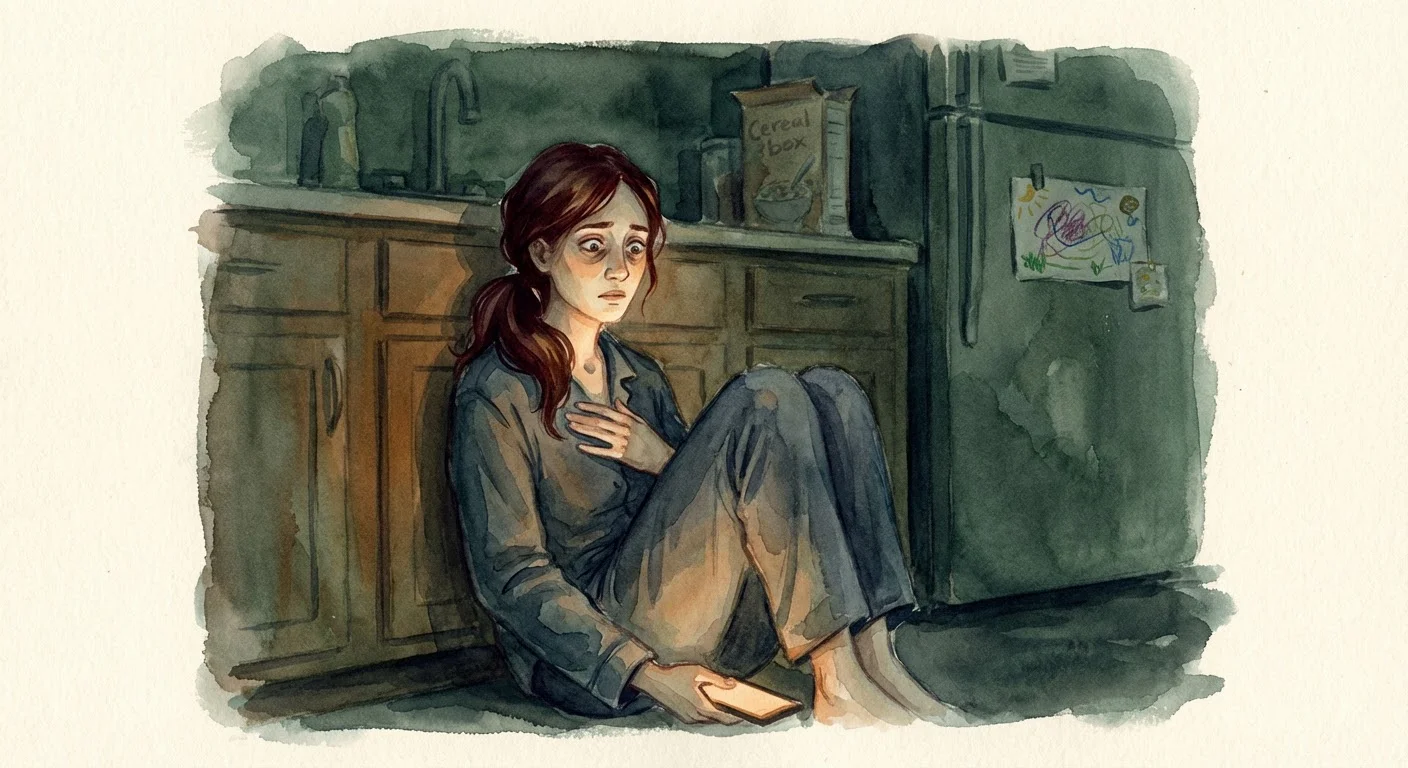
A woman I will call Nadia knows this ritual by heart. She is 36, a clinical pharmacist, single mom to a five-year-old. She fills 47 prescriptions for benzodiazepines every month. She counts them. She knows the half-life of lorazepam, the binding affinity of alprazolam, the receptor kinetics of diazepam. And she is sitting on her kitchen floor at 3 AM, back against the cabinet, phone light on her face, searching "sudden anxiety for no reason women 30s."
Her hands are shaking. She dispensed Xanax to six women today. She cannot fix herself.
The Number That Should Make You Furious
Here is what stopped me when I first pulled this from the research data: 51% of women experience clinically significant anxiety during the menopausal transition. Half. And it often starts years before your period changes. Years before anyone thinks to check.
Fifty-one percent.
I want to sit with that because the implications are staggering. This is not a rare condition. This is not a personality flaw. This is the single most common neuropsychiatric presentation of hormonal change in women, and the majority of doctors still call it "stress."
In our community data, 469 women across four platforms described their anxiety. The average severity was 3.28 out of 5, which sounds moderate until you realize the women scoring 4 and 5 were describing emergency room visits, inability to leave the house, and the conviction that they were dying. Nineteen percent of those posts expressed desperation. Not frustration. Desperation.
And 52% of them were in their thirties. Not their forties. Their thirties.
Your Brain Had a Built-In Sedative
I need to tell you something that is going to change how you understand what is happening to you.
Your body manufactures its own benzodiazepine. Its own Valium, essentially. A compound called allopregnanolone, which is a metabolite of progesterone, binds to the exact same GABA-A receptor sites that Xanax targets. Jerilynn Prior at the University of British Columbia has been documenting this for decades. Progesterone is not just a reproductive hormone. It is your brain's primary anxiolytic system.
And it is the first hormone to decline. Sometimes starting in your mid-thirties. While your cycles still look perfectly normal on the calendar.
So your brain's natural sedative disappears, your doctor tells you it is probably stress, and you end up on a kitchen floor at 3 AM wondering what happened to the person you used to be.
That person is still there. Your neurochemistry changed. That is a very different problem with very different solutions.
Nadia knows the GABA mechanism. She learned it in pharmacy school. She has never once connected it to what is happening inside her own body. The pharmacist who cannot heal herself. I find that irony so specific it hurts.
51%
of women experience clinically significant anxiety during the menopausal transition. You are not imagining this.
Population prevalence data
What This Course Is and What It Is Not
This is not a meditation app. This is not "10 tips for anxiety relief." This is an 8-week evidence-based program built on CBT, MBSR, movement science, and hormonal education. The research backing it includes meta-analyses showing exercise effect sizes comparable to medication (Stubbs et al., 2017), an 8-week mindfulness protocol with 67% anxiety reduction in a randomized trial (Brewer, Brown University), and a targeted perimenopause CBT protocol showing significant improvement in just 8 sessions (Hantsoo et al., 2025).
I am not going to promise you a cure. Some women do everything right and the anxiety persists. I refuse to participate in false hope because false hope is its own form of cruelty.
What I can promise is this: by Module 3, you will have a body-based toolkit that works faster than any pill. By Module 6, you will understand your nervous system well enough to know when you need professional help and when you need a physiological sigh and a walk around the block.
Let me teach you that sigh right now. One tool. Thirty seconds. Because you came here needing something immediate.
Double inhale through your nose. Two quick breaths in, one stacked on top of the other. Then one long, slow exhale through your mouth. Andrew Huberman's lab at Stanford documented this. It activates the parasympathetic nervous system faster than any other voluntary breathing pattern.
Try it. Right now. I will wait.
That is yours. Nobody can take it from you. Use it at 3 AM. Use it in the pharmacy bathroom. Use it in the car before you walk into the house.
The 4 AM waking terror with cascading life impact — fear of death, loss of joy, complete overwhelm.
“Anxiety. Waking at 4am several days in a row with crippling fear of life. I am terrified of dying, terrified of my husband or kids dying. Depression, fatigue, joint pain, the constant hot flashes. I have no joy for my small business. Frankly I'm a mess of a human being.”
— Woman, 40s, r/Perimenopause
Try the physiological sigh right now. Double inhale through your nose, then one long exhale through your mouth. Do it three times.
This is the single fastest voluntary anxiety reduction technique documented in clinical research.
What Comes Next
Module 1 shows you what anxiety actually is, why it arrived now, and why your doctor got it wrong. Module 2 explains the hormonal mechanism that nobody checked. Module 3 gives you movement tools. Module 4 addresses the sleep-anxiety loop. Module 5 covers nutrition, gut health, and the people who calm your nervous system. Module 6 is integration: what you do with everything you have learned.
Nadia is going to walk with you through all of it. So is a woman named Jolene, 44, an art teacher with health anxiety who has been to the ER three times. Their stories are composites drawn from real women in our data, and they will make you feel less alone in this.
You are not going crazy. You are not weak. Your alarm system lost its off switch and nobody told you where it went.
We are going to find it.
You showed up. That is the hardest part. Everything from here builds on the fact that you refused to keep suffering in silence.
You are not going crazy. Your neurochemistry changed.
The Alarm That Will Not Stop
Next, we look at what your nervous system is actually doing when the panic hits, and why Jolene ended up in the ER three times before anyone checked her hormones.
What if your anxiety is not a malfunction but a real alarm responding to a real biochemical change?
Key Takeaways
- 51% of women experience clinically significant anxiety during menopausal transition, often starting in the 30s
- Progesterone metabolizes into allopregnanolone, your brain's natural benzodiazepine, and it declines first
- The physiological sigh (double inhale, long exhale) activates parasympathetic response in under 60 seconds
- This course uses CBT, MBSR, movement science, and hormonal education across 8 weeks
- Anxiety in midlife is not a character flaw. It is a measurable neurochemical shift.
- If you've been asking "why do I have anxiety all of a sudden" — progesterone decline may have started years before your period changed
- Anxiety with perimenopause affects women as early as their mid-thirties, driven by the collapse of your brain's built-in GABA sedative system
Sources
Progesterone for treatment of symptomatic menopausal women
Prior JC, University of British Columbia, PMID 29962247 (2018)
Progesterone acts as natural anxiolytic through allopregnanolone-GABA-A modulation; decline begins years before menstrual irregularity
Anxiety and exercise meta-analysis
Stubbs B et al., King's College London, PMID 28088704 (2017)
Exercise significantly reduces anxiety symptoms with effect size SMD=-0.582 across 6 RCTs
Unwinding Anxiety RCT
Brewer JA et al., Brown University, PMC8686411 (2021)
Mindfulness-based app produced 67% GAD-7 reduction vs 14% control, NNT=1.6
CBT for perimenopause anxiety
Hantsoo L et al., PMID 41589872 (2025)
8-session manualized CBT showed significant improvement in anxiety and depression in perimenopausal women
Physiological sigh research
Huberman Lab, Stanford University (2023)
Cyclic physiological sighing activates parasympathetic nervous system faster than other voluntary breathing techniques
Wellls Community Analysis
469 posts across 4 platforms (2026)
52% of anxiety posts from women in 30s; severity 3.28/5; 19% express desperation
Practice: Anxiety Pattern Self-Assessment
10 min · reflectionMap your anxiety triggers across the last 7 days. Note time of day, cycle day, sleep quality, and intensity (1-5). Look for clusters. Most women find their anxiety peaks at the same times and around the same triggers. That pattern is the beginning of control.
You just finished your first lesson
17 more lessons in Anxiety in Perimenopause — 8-Week Evidence-Based Program are waiting for you.
Cancel anytime. 30-day money-back guarantee.