3:47 AM
3:47 AM
How are you feeling right now about your sleep?
A perimenopause insomnia story — and the science behind why you keep waking up
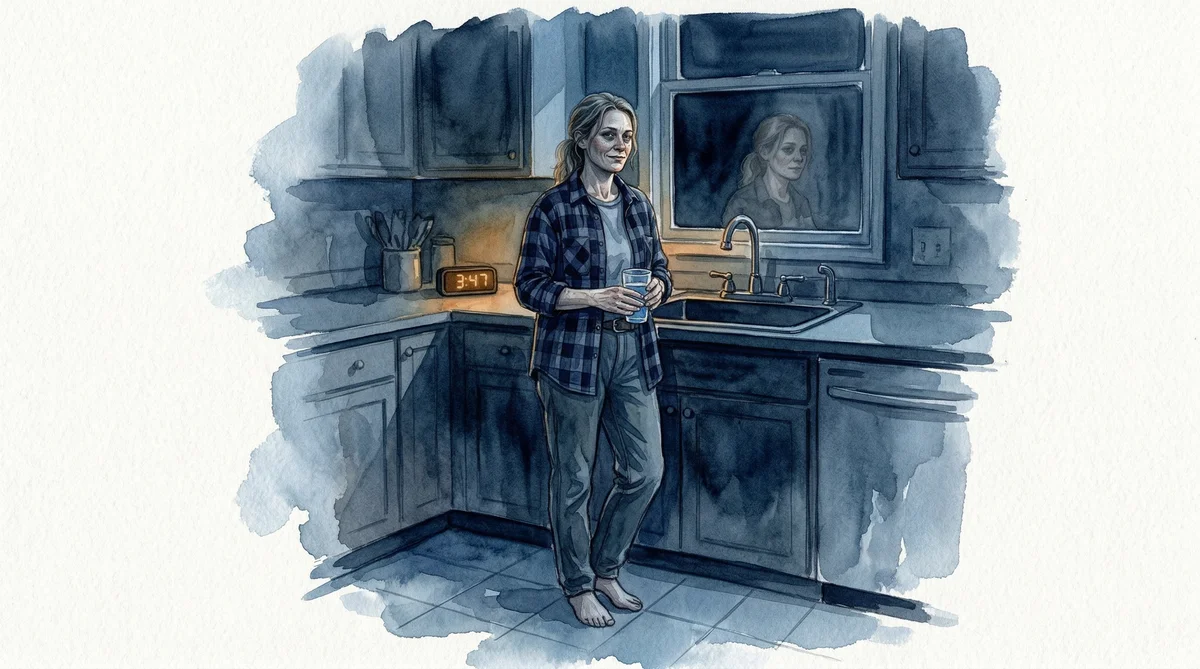
It is 3:47 on a Wednesday and Grace already knows the time without checking.
She wakes between 3:40 and 3:50 every single night. Has for seven months. Tom is breathing beside her, steady and maddening, the breathing of a man who has never once calculated how many hours remain before the alarm. She stares at the ceiling fan. Counts rotations. Loses count. Starts over.
She gets up. Kitchen. Sink. Fills a glass of water she does not want. Catches her reflection in the dark window — under-eye circles she stopped concealing three months ago.
Grace is 42. She is an ER nurse. She has triaged patients with insomnia complaints and handed them the sleep hygiene pamphlet she no longer believes in. She knows the pharmacology of every sleep medication in the hospital formulary. She will not take any of them because she has seen dependency up close, in patients who started with "just one Ambien."
If this sounds familiar, you are not reading at 3 AM by accident.
Perimenopause Insomnia: The Problem Nobody Named
Perimenopause insomnia affects 40 to 60 percent of women during the menopausal transition. I want that number to land before we move on. Not 10 percent. Not a rare side effect whispered about in forums. Four to six out of every ten women going through this hormonal shift will develop sleep disruption significant enough to wreck their days, their moods, their ability to think straight.
Baker and colleagues at the University of Melbourne documented this in a landmark 2018 review: sleep disturbances are among the most prevalent and disruptive symptoms of the menopausal transition, driven by vasomotor events and hormonal fluctuations that directly alter sleep architecture. And yet. When I searched for perimenopause-specific insomnia treatment protocols, I found a handful of academic papers, a few clinic websites, and an ocean of generic sleep hygiene advice clearly written for people whose sleep systems are still intact.
That gap, between how common this is and how poorly it is addressed, is why this course exists.
What You Already Tried (And Why It Failed)
No screens before bed. Cool room. Consistent bedtime. Lavender spray. Weighted blanket. Magnesium. Melatonin. The meditation app you downloaded, used twice, and forgot about.
You did the checklist. The checklist was designed for people whose sleep architecture is fundamentally working. Yours is being rewired from the inside by hormonal changes that a cool pillow cannot reach.
One woman in our community data put it with a precision that stopped me: "Exercise does not help my insomnia at all. It is a very common condition of perimenopause and menopause, don't let anyone tell you that you aren't exercising enough or drinking enough water or some other bullshit."
She is not wrong. She is incomplete. Exercise does help (Baron's 2023 randomized trial proved it), but it takes 16 weeks of consistency, and it addresses one mechanism out of three. The pamphlet treats insomnia like a single problem. It is not. It is three problems wearing one mask. And until someone names all three, the pamphlet will keep failing.
40-60%
of women experience significant sleep disruption during the menopausal transition
Baker FC et al., 2018, Nat Sci Sleep
Three Broken Systems, One Sleepless Night
Here is what is actually happening. I am going to give you the short version now and the full science in tomorrow's lesson because Grace, the nurse, would want me to be precise. But tonight's version is this:
Your body stopped making its own sleep medication. Progesterone, which your ovaries produce in declining quantities starting in your mid-thirties, metabolizes into allopregnanolone, a neurosteroid that binds to the same brain receptors targeted by Ambien. Jerilynn Prior at the University of British Columbia has documented this pathway for decades. Your endogenous sedative is disappearing, and nobody mentioned it at your last check-up.
Your thermostat broke. Estrogen modulates the thermoneutral zone in your hypothalamus. As estrogen fluctuates, that zone narrows to almost nothing. A half-degree temperature shift your body would have ignored five years ago now triggers a full vasomotor response: sweating, flushing, waking. The 3 AM drenched sheets are not random. They are a thermoregulatory failure with a specific mechanism.
Your cortisol clock shifted. The cortisol awakening response, which should peak 30 minutes after you wake up, is now firing at 3 or 4 AM. That is why you wake at the same time every night. It is not worry. It is not your bladder. It is a hormonal alarm clock set to the wrong hour.
Three systems. All failing simultaneously. And the pamphlet said to try chamomile tea.
One of 248 women in our insomnia community data. Only 8.5% described themselves as hopeful.
“I'm so ill with insomnia. I've had enough. I just can't sleep night after night, it's been going on for years. It's debilitating and I'm literally disabled with it.”
— Woman, Reddit
This is a lot to take in. Let's pause for a moment before we continue.
Prepare for your next doctor visit
- 1.Before your next appointment, use our free Doctor Visit Checklist —conversation scripts, the exact hormone tests to request, and red flags that signal dismissal.
What This Course Is (And What It Is Not)
This is not another list of sleep tips. This is an 8-week protocol built on the same evidence base as clinical CBT-I, the gold-standard insomnia treatment that the American Academy of Sleep Medicine recommends ahead of every medication on the market. Moon, Yu, and Hur confirmed it in a 2025 meta-analysis: CBT significantly improves both sleep quality and insomnia severity in menopausal women.
We adapted it for the specific hormonal reality of perimenopause. We added the nutrition, movement, and stress management pillars that CBT-I alone does not address. And we built it around real women — 248 of them from our community data — because clinical protocols work better when you recognize yourself in them.
You will meet Grace throughout this course. And Priya, a 47-year-old software architect in Austin whose ex-husband told her she was "impossible to sleep next to." That sentence lives in her like a splinter.
You are not broken. Your neurochemistry shifted, and nobody handed you the manual.
This is the manual.
If you are in crisis: Chronic sleep deprivation can produce thoughts that feel permanent but are not. If exhaustion has taken you to a place where you are questioning whether life is worth living, please reach out. Call or text 988 (Suicide & Crisis Lifeline) or text HOME to 741741 (Crisis Text Line). That thought is a symptom of deprivation, not a reflection of reality.
Which of the three broken systems —progesterone decline, thermostat narrowing, or cortisol clock shift —do you suspect is most active in your insomnia? What makes you think so?
Key Takeaways
- Perimenopause insomnia affects 40-60% of women —this is not rare or 'in your head'
- Three hormonal systems drive it: progesterone-GABA decline, thermoneutral zone narrowing, cortisol clock shift
- Sleep hygiene alone is insufficient for hormonal insomnia —the pamphlet was designed for a different problem
- CBT-I is the gold-standard treatment, recommended by the AASM ahead of medication
- If you're waking up at 3am during perimenopause, it's likely a cortisol awakening response firing at the wrong hour — not worry or your bladder
- Perimenopause sleep problems require a hormone-aware protocol, not generic sleep hygiene tips designed for intact sleep systems
Sources
Sleep problems during the menopausal transition: prevalence, impact, and management
Baker FC et al., Nat Sci Sleep, PMC6298219 (2018)
Sleep disturbances affect 40-60% of women during the menopausal transition, driven by vasomotor symptoms and hormonal fluctuations.
Progesterone for symptomatic menopausal women
Prior JC, Climacteric, PMID 29962247 (2018)
Progesterone metabolizes into allopregnanolone, a GABA-A receptor modulator functioning as endogenous anxiolytic and sedative.
Effects of CBT on sleep quality and insomnia severity in menopausal women: meta-analysis
Moon HJ et al., Menopause, PMID 41531400 (2025)
CBT significantly improved both PSQI scores and ISI scores across multiple RCTs in menopausal women.
Aerobic Exercise, Sleep, and Core Temperature in Middle-Aged Women
Baron PE et al., PMID 37107734 (2023)
16-week aerobic exercise improved sleep quality and core temperature regulation in middle-aged women with chronic insomnia.
AASM Clinical Practice Guideline for Chronic Insomnia
American Academy of Sleep Medicine (2021)
CBT-I recommended as first-line treatment for chronic insomnia disorder ahead of pharmacological interventions.
The role of ovarian hormones in perimenopausal sleep disturbances
Haufe A et al., Systematic Review, PMID pending (2024)
Systematic review of 86 studies confirming ovarian hormone decline as primary driver of perimenopausal sleep disruption.
Practice: Sleep Pattern Mapping
5 min · journalFor three nights this week, note: what time you wake, what your first thought is, and where you feel tension in your body. Do not judge the answers. Just collect data.
You just finished your first lesson
17 more lessons in Perimenopause Insomnia — 8-Week Program are waiting for you.
Cancel anytime. 30-day money-back guarantee.