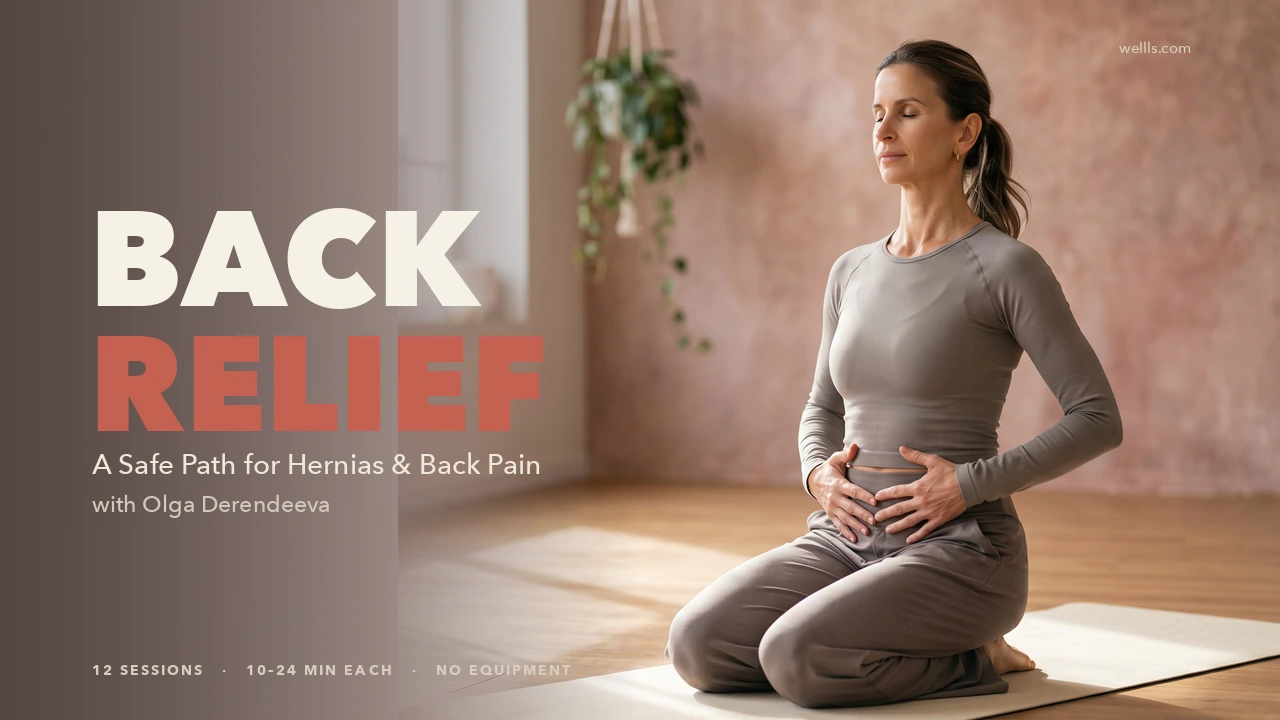
Back Relief: 12-Session Program for Back Pain
A 12-session rehabilitation movement program by Olga Derendeeva for spinal hernias, protrusions, and chronic back pain. Safe, no equipment. This is a 3-week video course with 12 lessons designed for women. Created by Olga Derendeeva. Back Relief is a 12-session rehabilitation movement program by Olga Derendeeva (20+ years clinical experience) for women living with spinal hernias, protrusions, and chronic back pain. The program begins with a theory introduction, then progresses through 10 workouts — lying-down spasm release, thoracic mobility, deep-stabilizer reactivation, and standing integration. Designed to complement, not replace, medical care.
Topics covered: what exercises are safe with a spinal hernia, how to safely move with a disc protrusion, rehabilitation program for chronic back pain at home, lumbar hernia, disc protrusion.
Course Outline
Module 1: Foundation & Theory
Before any movement: the theory. Why your back hurts, what hernias and protrusions are, and why generic exercise has been making things worse. Plus a 55-second preview of what your back will be capable of by Workout 10.
- Course Trailer: A 55-Second Preview (0.9 min)
- What the standing-position exercises look like once you've built the foundation
- How Olga adapts each move for hernias and protrusions
- What this program is — and what it is not
- Workout 0 — The Theory You Must Hear First (7.8 min)
- Why this program is built around Olga's own clinical experience — 20+ years working with tens of thousands of patients told to rest indefinitely, plus her own spinal diagnosis recovery
- The single biggest mistake people make with back pain: stretching muscles that are in spasm
- Why you must obtain medical clearance before beginning — and what to ask your doctor
Module 2: Release the Spasm
Workouts 1-3. Lying on the floor. Breathing. Pelvic tilts. The lower-back muscles that have been in spasm for months — for the first time — let go.
- Workout 1 — Lying-Down Spasm Release (15.9 min)
- How to safely lie down and get up with a hernia (the single most ignored skill)
- Diaphragmatic breathing as the first input — releasing the muscles before stretching them
- Why pelvic tilts produce immediate relief without any 'super amplitude'
- Workout 2 — Releasing the Lower Back (20.1 min)
- How hip-joint mobility directly reduces lumbar compression
- The 'soft knee fall-out' move that releases deep spasm without loading the disc
- Why slow, small, breath-led movement beats long static stretching
- Workout 3 — Opening the Hips (21.4 min)
- The deep hip-opener Olga uses to relieve sciatic pressure
- Why fear of movement is itself part of the spasm pattern
- How to know the difference between productive sensation and warning pain
Module 3: Reawaken the Stabilizers
Workouts 4-7. The deep core, the thoracic spine, the obliques, the bird-dog pattern. The spine starts to feel supported from the inside.
- Workout 4 — Engaging the Deep Stabilizers (19.2 min)
- Why the deep core — not the surface abs — supports your spine
- The cough-test for finding your own transverse abdominis
- How to engage the stabilizers without bracing or breath-holding
- Workout 5 — Thoracic Spine on a Bolster (21.7 min)
- How to position the bolster safely (off the spine, not on it)
- Why thoracic stiffness drives lumbar pain — and how releasing it relieves the lower back
- The 'first relaxation, then stretching, then strengthening' order Olga teaches throughout
- Workout 6 — Side-Lying Stabilization (20.1 min)
- Side-lying as the safest position to load the obliques without spinal compression
- The micro-leg-lift that builds gluteal support for the lumbar spine
- Why the body's stabilizers respond to small, precise input — not big effort
- Workout 7 — Quadruped Coordination (20.2 min)
- Why quadruped is the gold-standard rehab position for disc conditions
- The neutral-spine principle that protects the disc during loaded movement
- How cross-pattern movement (opposite arm + leg) rewires deep postural reflexes
Module 4: Standing Integration
Workouts 8-10. Up off the floor. Your spine learns to take its new support with you — into how you walk, sit, lift, and live.
- Workout 8 — Standing Foundations (20.1 min)
- Standing alignment: how to find a true neutral spine on your feet
- Why standing exercises are safer than they look — when the foundation is ready
- The breath-and-brace pattern that protects you during everyday lifting
- Workout 9 — Hip Mobility on Your Feet (20.4 min)
- Wall-supported single-leg work to retrain balance without falling risk
- Why standing hip mobility is the missing link in most home back-rehab programs
- How to use a wall, a doorway, or a chair as your safest first piece of equipment
- Workout 10 — Active Integration (23.9 min)
- Active core integration: breathing under load, stabilizing under movement
- Why this is the end of this program — and the beginning of a maintenance practice
- Where to go next: gentler ongoing courses or graduating to general fitness