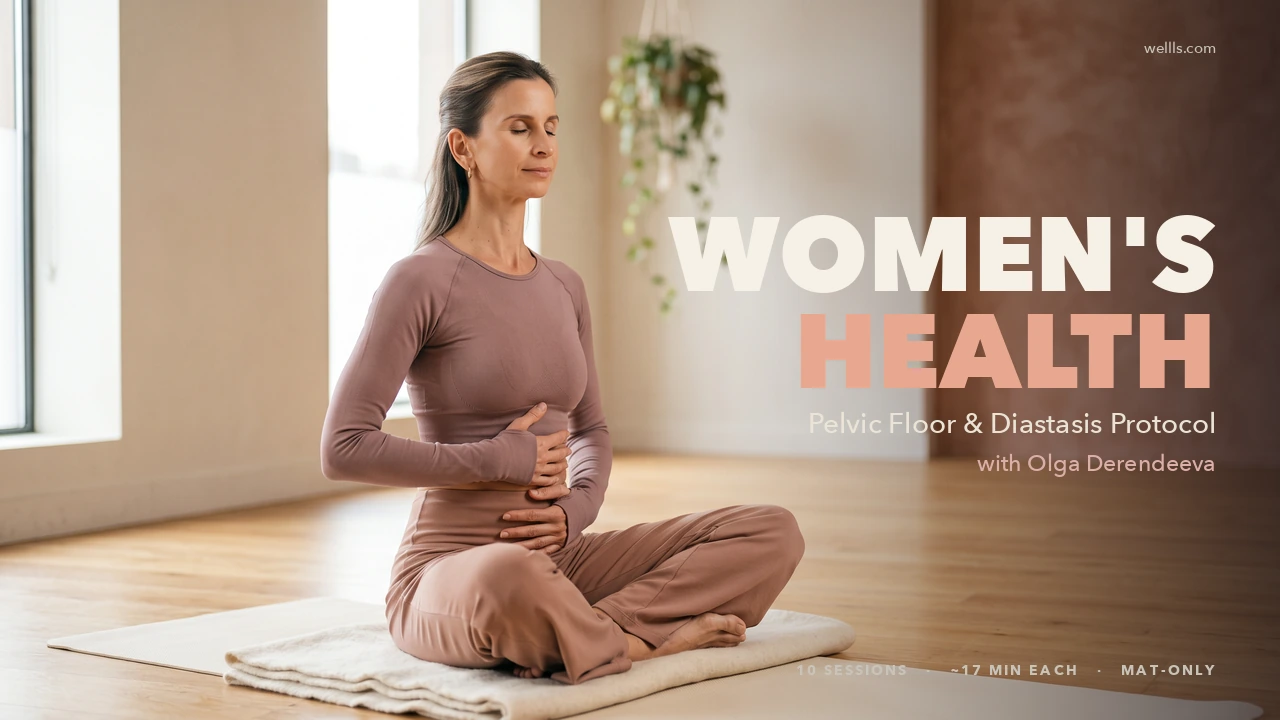
Women's Health: Pelvic Floor & Diastasis Protocol

Ten-session pelvic floor and diastasis protocol with rehabilitation specialist Olga Derendeeva. Anatomy, breath, and integrated practice. No equipment. This is a 3-week video course with 10 lessons designed for women. Created by Olga Derendeeva. Women's Health is a ten-session pelvic floor and diastasis recti protocol led by Russian rehabilitation specialist Olga Derendeeva (17+ years of experience). The course teaches pelvic anatomy, diastasis recti self-assessment and safe movement, conscious pelvic floor engagement and relaxation, diaphragm-and-pelvic-floor breath coordination, and integrated practices in supine, seated, and quadruped positions. No equipment is required beyond a yoga mat. Total runtime is approximately 167 minutes across 10 sessions, designed for daily or alternate-day practice across roughly three weeks. Suitable for women with chronic pelvic tension, postpartum diastasis (after medical clearance), pelvic floor weakness or hypertonicity, and women who have never been taught their own pelvic anatomy.

Topics covered: how to find and engage the pelvic floor at home, ten session pelvic floor and diastasis program for women, is my ab routine making diastasis worse, pelvic anatomy, linea alba.

Course Outline

Module 1: Women's Health: Pelvic Floor, Core & Diastasis — Complete Protocol

Ten sessions, in sequence. The first five lessons build awareness and anatomy — pelvic structure, diastasis safety, finding the pelvic floor, lying-down engagement and release, and the diaphragm-breath connection. The remaining five are integrated practices that progress from gentle pelvic-clock work to quadruped, asymmetric, and refined supine sequences. Designed for daily or alternate-day practice across roughly three weeks.

  • Pelvic Anatomy — Understanding What You're About to Train (10 min)
    • Locate the two pelvic bones, pubic symphysis, sacrum, and sit bones on your own body.
    • Understand the four layers of pelvic-floor musculature and what each layer does.
    • Identify the urogenital diaphragm and why it matters for continence and intra-abdominal pressure.
    • Learn why the pelvic floor cannot be trained in isolation from the diaphragm.
    • See why most generic core programs miss this entire system.
  • Diastasis Recti — How to Identify and Work With It Safely (7 min)
    • Understand diastasis as a connective-tissue separation, not a muscle tear.
    • Perform the self-check protocol Olga demonstrates step by step.
    • Recognise which everyday movements quietly worsen diastasis.
    • Learn which classical ab exercises to remove from your routine.
    • Understand why progress is non-linear and what realistic timelines look like.
  • Finding Your Pelvic Floor — A Seated Introduction (8 min)
    • Locate your sit bones (ischial tuberosities) by rocking side to side on a firm chair.
    • Map the diamond-shaped region of the pelvic floor between sit bones, pubic bone, and tailbone.
    • Practise a first conscious contraction without bracing the abdomen or holding the breath.
    • Learn the most common mistakes — squeezing glutes, bearing down, gripping the inner thighs.
    • Build the body-awareness foundation every later session relies on.
  • Pelvic Floor While Lying Down — Engagement and Relaxation (17 min)
    • Translate the seated awareness from lesson 3 into supine engagement.
    • Learn full, complete relaxation between contractions — the half almost no program teaches.
    • Modify for back issues and early postpartum with the side-lying variation.
    • Understand why a chronically gripped pelvic floor produces the same symptoms as a weak one.
    • Begin to identify whether your pattern is under-active, over-active, or both.
  • Diaphragm and Breath — The System Your Pelvic Floor Lives Inside (14 min)
    • Understand the diaphragm as a tendon-and-muscle structure, not just a 'breathing muscle'.
    • See the diaphragm and pelvic floor as ceiling and floor of one pressurised abdominal cavity.
    • Practise inhale-descend / exhale-engage coordination — the core breathing pattern of the course.
    • Recognise paradoxical breathing patterns (chest-only, reverse) that disrupt the system.
    • Understand why poor breathing mechanics directly cause pelvic floor and core dysfunction.
  • Pelvic Clocks and the First Integrated Workout (15 min)
    • Move through the pelvic clock pattern (tailbone forward / back / side to side).
    • Coordinate inhale-descend, exhale-engage through every position.
    • Connect lumbar relaxation to pelvic floor sequencing.
    • Integrate the awareness from sessions 1–5 into your first complete practice.
    • Establish the rhythm and pace of the remaining four workouts.
  • Complex Training — Quadruped Variations and Progressions (21 min)
    • Take the pelvic floor work from supine and seated into quadruped (all fours).
    • Add coordination challenges: opposite-arm-and-leg, contralateral patterns.
    • Maintain the breath-floor link under load.
    • Use the progression scale to choose the right difficulty for today.
    • Recognise when to drop back to lesson 6 if a movement falls apart.
  • Cross-Legged Training — Working One Half at a Time (25 min)
    • Sit cross-legged or modify (legs straight, chair-supported) for hip range.
    • Learn to engage one half of the pelvic floor independently.
    • Build the fine control that bilateral exercises miss.
    • Translate left-right asymmetric work into a more functional, integrated pelvis.
    • Notice and address side-to-side differences in your own activation.
  • Advanced Supine Work — Sacrum, Sit Bones, and Refined Coordination (22 min)
    • Return to supine with sacral and sit-bone awareness as cues.
    • Layer breath, sacral nutation, and pelvic floor sequencing.
    • Choose the appropriate progression based on how the session feels in your body today.
    • Address common mistakes — pushing through, bracing, holding the breath.
    • Begin building the maintenance practice you will keep after the course ends.
  • Final Workout — Bringing the Whole System Together (28 min)
    • Bring the full sequence together — quadruped, seated, supine — in one practice.
    • Demonstrate the breath-pelvic-floor coordination as automatic, not effortful.
    • Apply the principles you have learned without external cues.
    • Identify your three or four anchor exercises for ongoing daily practice.
    • Close the program with a clear maintenance plan.
Women's Health: A Complete Protocol for Your Pelvic Floor, Hormones, Posture & the Body You've Been Ignoring

4.9(213 ratings)

Women's bodies are not smaller versions of men's bodies. They have specific anatomical systems, specific hormonal patterns, specific movement needs — and almost no fitness program was designed with any of that in mind.

The pelvic floor is the most undertrained and least understood muscle group in the female body. It supports every internal organ. It controls continence, sexual function, core stability, and the pressure dynamics of the entire abdominal cavity. When it doesn't function correctly — when it's too weak, too tight, or simply disconnected from conscious awareness — the effects show up everywhere: in your back, your posture, your digestion, your energy, your relationship with your own body.

Most women have never been taught that it exists. Almost none have been taught how to train it.

Women's Health is a comprehensive course guided by Olga Derendeeva — rehabilitation specialist, adaptive movement expert, and one of FitStars' most trusted voices on women's physiology — that addresses the female body as the integrated system it actually is.

$19$19990% off
10 video lessons — yours forever
Dr. Wellls — AI wellness companion
14-day money-back guarantee
Special price ends in:--:--:--

One-time payment · No subscription

14-day money-backSecure payment

This course includes

10 video lessons
2h 47min total
1 structured modules
Certificate of completion
AI wellness companion
Watch on any device

This course is for you if...

You have lower back pain, pelvic tension, or core weakness that generic exercise hasn't resolved
You leak when you cough, laugh, or jump — and you have accepted this as 'just what happens after having children'
You have diastasis recti and don't know what is safe to do or what to avoid

What Changes

Milestones from across the program — what to expect, in the instructor's own words.

  1. 1
    After the first section

    You understand your pelvic floor for the first time — not as an abstract concept but as a physical structure you can locate, activate, and consciously work with. This understanding alone changes how you move, how you exercise, and how you inhabit your own body.

  2. 2
    After the movement sessions

    The connection between your pelvic floor, your core, and your breathing becomes physical — not theoretical. Exercises that previously felt disconnected from anything real now have a target. Lower back tension begins to ease as the base that should be supporting it starts to do its job.

  3. 3
    After the hormonal and nutritional sections

    Your cycle becomes information rather than inconvenience. You understand what your body is doing in each phase and why — and you have the practical tools to work with those phases rather than push through them. For women approaching perimenopause, the clarity that comes from understanding what is actually happening is itself therapeutic.

  4. 4
    After the complete course

    You have a different relationship with your body. Not a perfect one — but an informed one. You know what your pelvic floor is doing. You know how your posture and your internal pressure system are connected. You know how to train with your cycle. You know what the transition ahead looks like and how to navigate it.

This is the education most women's health systems failed to provide.

14-Day Money-Back Guarantee

Risk-free. 100% refund, no questions asked.

Take the full course. Do every lesson. If it doesn't move the needle for you, email [email protected] within 14 days and we'll refund every cent.

Full refund
No questions asked
Email support

Real Results from Real Women

What participants experienced during their journey

Marina S.
Marina S.

I had a 'leaking' problem for four years after my second child. I was told it was normal. After module three I understood it was a dysfunction — and a treatable one. Six weeks later it was gone.

Elena P.
Elena P.

The cycle training module alone was worth the entire course. I spent twenty years fighting my body every month. Now I work with it. Everything — workouts, energy, productivity — improved.

Tatiana K.
Tatiana K.

I have diastasis recti. I was terrified to exercise. Olga explains exactly what is safe, what makes it worse, and why. For the first time I feel safe in my own body again.

10
Progressive sessions from anatomy to integrated practice
17+
Years of Olga's rehabilitation experience
~167
Minutes of active content total

Stats describe the structure of the program and Olga's clinical experience. Individual results vary. This is educational movement content, not medical care — consult your doctor before beginning if you are postpartum, have a diagnosed pelvic floor or spinal condition, or have any acute pelvic pain.

Course Content

10 lessons · 1 modules · 2h 47min total

Ten sessions, in sequence. The first five lessons build awareness and anatomy — pelvic structure, diastasis safety, finding the pelvic floor, lying-down engagement and release, and the diaphragm-breath connection. The remaining five are integrated practices that progress from gentle pelvic-clock work to quadruped, asymmetric, and refined supine sequences. Designed for daily or alternate-day practice across roughly three weeks.

Meet Your Instructor

Olga Derendeeva

Olga Derendeeva

Rehabilitation Specialist · Adaptive Movement & Women's Physiology

17+ years practice

Rehabilitation specialist, adaptive movement expert, and certified personal trainer with 17+ years of experience working specifically with women's bodies — through pregnancy, postpartum recovery, injury rehabilitation, postural correction, and the hormonal transitions of perimenopause and beyond. Certified practitioner of Italian Bioginnastica. Her work on pelvic floor health has supported thousands of women in resolving issues — incontinence, chronic pelvic tension, diastasis recti, lower back pain with no clear structural cause — by addressing the functional system rather than the surface symptoms.

How to get started

1

Click "Get Access"

Enter your email for secure access to all lessons.

2

Complete the setup

Receive a password to your personal account in seconds.

3

Start learning

Watch lessons, complete exercises, and track your progress.

Frequently Asked Questions

Ten sessions. One pelvis. Everything you should have been taught years ago.

Free preview unlocked. Then one session at a time, at your pace — daily, alternate days, whatever fits.

One-time payment · No subscription

14-day money-back guarantee
Emma — Customer Happiness Manager

Emma — Customer Happiness Manager

Our care and customer support team is ready to help at any time. If you have any questions, just email [email protected]

© 2026 FITSTARS FZCO. All rights reserved.
This program is for educational purposes only and is not intended to diagnose, treat, cure, or prevent any disease.

100% secure paymentSSL encrypted14-day refund