Single Leg Circles: How-to, Benefits & Variations
Leg circles strengthen hip flexors and core stability. Lie on your back, draw circles with one leg. A Pilates staple for hip mobility.
Single Leg Circles: How-to, Benefits & Variations
Stiff joints and weak muscles. That nagging tightness that shows up every morning and does not fully leave. The single leg circles addresses this pattern directly.
Most people skip this exercise because it does not look impressive. No heavy weights, no dramatic movement. But Amelia Jane includes it in workout after workout for a reason: it works the muscles and movement patterns that everything else misses.
Pilates: Pilates Sculpt 7 Days Challenge 1
Amelia Jane
How to Do Leg Circles
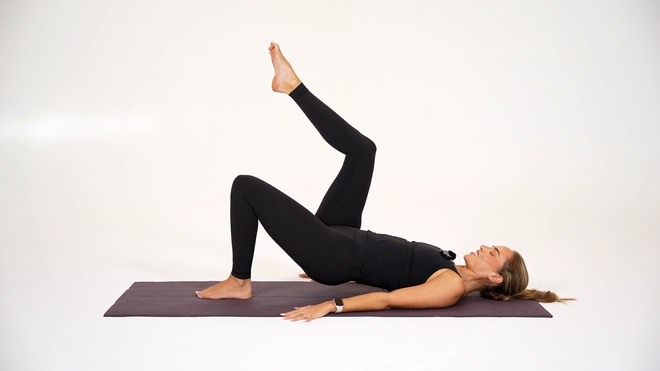
Lie on your back with your left leg extended on the floor. Raise your right leg toward the ceiling.
Keep your pelvis stable and anchored to the floor. Engage your core gently.
Draw small circles with your right leg, moving from the hip joint. Circle clockwise for 8-10 reps.
Reverse direction and circle counterclockwise for 8-10 reps. Keep the circles controlled and precise.
Switch legs and repeat. The circles should be small enough that your pelvis does not rock. Precision over size.
Muscles Worked
Primary
Primary muscles
Main muscles targeted by the single leg circles.
Secondary
Stabilizer muscles
Support primary movers and maintain joint alignment.
Why this matters in perimenopause
Women lose lean muscle mass from their 30s, accelerating during perimenopause as estrogen drops. Regular Pilates counteracts this by preparing the body for movement and reducing injury risk.
Coach's Tips
"Left hand on left hip to make sure hips aren't moving." That is Amelia Jane's cue. This detail makes the difference between an effective rep and a wasted one.
Amelia Jane
"Take right leg out to side, down, and back up to center." That is Amelia Jane's cue. This detail makes the difference between an effective rep and a wasted one.
Amelia Jane
If anything feels sharp rather than challenging, stop immediately. Back off the depth and reassess your alignment. Discomfort is fine. Pain is a message.
Reduce speed or range of motion until your body adapts.
Why This Matters for You
Pilates is uniquely suited to perimenopause because it trains the deep stabilizers and pelvic floor muscles that hormonal changes weaken first. The single leg circles builds control through precise movement, which protects joints that declining estrogen makes more vulnerable.
A 2022 systematic review found that Pilates significantly improved body composition, physical fitness, and quality of life in perimenopausal and postmenopausal women. The controlled, low-impact nature of Pilates makes it sustainable during a life stage when high-impact exercise may aggravate joint stiffness.
Variations & Modifications
Single Leg Circles (Right)
lowVariation of the single leg circles that modifies the standard movement pattern for different training emphasis.
Single Leg Circles (Left)
lowVariation of the single leg circles that modifies the standard movement pattern for different training emphasis.
Benefits
Builds core control, not just core strength
The single leg circles trains your deep stabilizers to fire in sequence. Strength without control is just force. Control is what prevents injury.
Restores the mind-body connection
Pilates demands attention. Every movement is deliberate. That focus trains neural pathways that become sharper with practice.
Gentle on joints, demanding on muscles
No impact, no heavy loading. But the precision and sustained holds create a deep burn that builds real stability.
Supports pelvic floor health
Pilates directly trains the deep core and pelvic floor muscles that perimenopause weakens.
Common Mistakes to Avoid
Using momentum instead of control
Pilates is about precision. If you cannot control the movement slowly, reduce the range.
Forgetting to breathe laterally
Breathe into your ribcage, not your belly. Lateral breathing maintains core engagement.
Letting the lower back arch off the floor
Imprint your lower back into the mat. If it lifts, your core has lost control of the movement.
Gripping with the hip flexors
If your hip flexors cramp, your core is not doing its job. Reset and re-engage your deep abdominals.
Workouts Featuring This Exercise
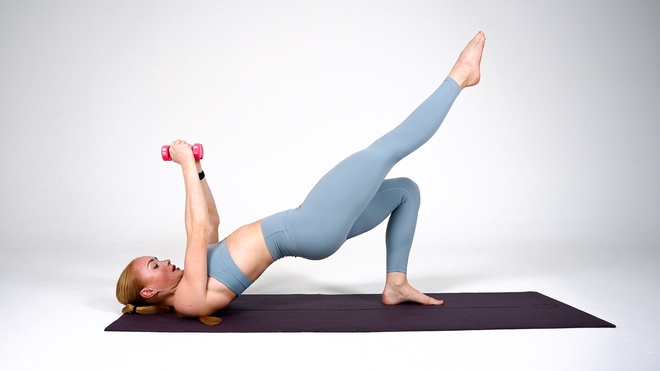
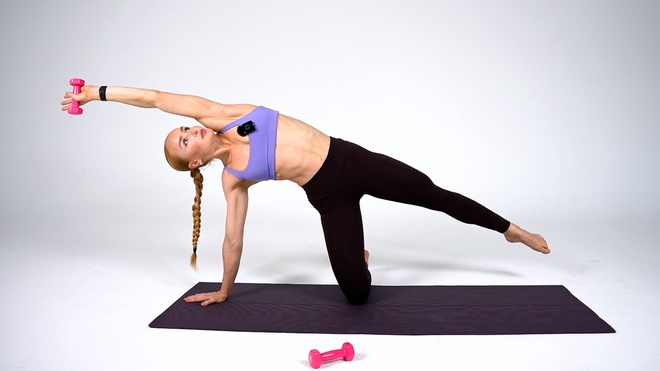
Join women building health and resilience with certified trainers
Frequently Asked Questions
Related Exercises
The Hundred
Complements the single leg circles by targeting related muscle groups and movement patterns.
Roll Up
Complements the single leg circles by targeting related muscle groups and movement patterns.
Pilates Roll-Up
Complements the single leg circles by targeting related muscle groups and movement patterns.
Supine Toe Taps
Complements the single leg circles by targeting related muscle groups and movement patterns.
Seated C-Curve
Complements the single leg circles by targeting related muscle groups and movement patterns.
Get leg circles in a guided workout
Access 3 workouts featuring this exercise, plus personalized plans from Dr. Wellls.
Join women building health and resilience with certified trainers
Your membership funds independent women's health research