Banded Lateral Walks: How-to, Benefits & Muscles Worked
Banded lateral walks: place a resistance band around ankles, half squat, step sideways keeping toes forward and constant band tension. Targets gluteus medius for hip stability and knee health.
Banded Lateral Walks: How-to, Benefits & Muscles Worked
The most effective glute activation tool in your gym bag costs about three dollars. A loop resistance band around your ankles and ten lateral steps will wake up your gluteus medius faster than any machine in a commercial gym.
I pulled the data on banded lateral walks across our workout library. Four occurrences, two trainers, two very different programming contexts. Danielle Harrison uses them in her prenatal fitness series as a hip stabiliser. Sophie Jones programs them in Peach Project as a high-intensity glute burner with three progressive rounds. Same exercise. Completely different intent.
That tells you something about banded lateral walks. They scale. A beginner does 12 controlled steps with a light band around the knees. An intermediate athlete does three rounds with a heavy band at the ankles and a deep half-squat hold. The resistance is external but the real challenge is internal: keeping your pelvis level, your toes forward, and your knees from caving while you fight the band's pull inward on every single step.
A 2023 study ranked the banded side step among exercises generating meaningful gluteal muscle force. Not the highest on the list. But uniquely positioned for the gluteus medius, which is the muscle most responsible for pelvic stability during single-leg activities like walking, climbing stairs, and standing on one foot. Most glute exercises hammer the maximus. Lateral band walks go after the medius. That is a different job entirely.
Grow & Glow: Positive Prenatal Fitness Workout 2
Danielle Harrison
How to Do Banded Lateral Walks
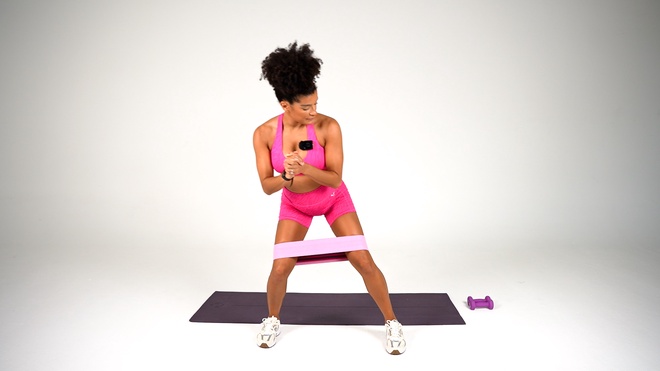
Place a loop resistance band around your ankles. Sophie Jones cues: band around the ankles, slight flexion in the knees. Stand with feet hip-width apart so there is already some tension on the band before you take a single step. If the band is loose at your starting position, it is too long or too light.
Lower into a partial squat. Not deep. Danielle Harrison: half squat, so it's not fully down. Keep that tension. Your knees should be slightly bent, hips pushed back, chest lifted. This position pre-loads your glutes so they fire from the first step instead of your quads taking over.
Step sideways with one foot, pushing through the heel. Lead with the outside edge of your foot. Sophie: taking it across, keeping that core nice and tight. The step should be controlled, roughly shoulder-width. Do not lunge sideways. The goal is lateral glute engagement, not hip adductor stretching.
Bring the trailing foot in to return to hip-width stance. This is where most people lose tension. Sophie: my band is nice and tight. It doesn't get baggy at any point. If the band goes slack between steps, you stepped too far with the trailing foot. Keep a fist-width gap of tension at all times.
Keep your toes pointed straight ahead throughout. Sophie drives this home: toes should be facing forward at all times. I don't want to see any of this twisting feet out. When the toes rotate outward, the tensor fasciae latae takes over from the gluteus medius. You lose the entire point of the exercise.
Exhale on the step out, inhale as you bring the trailing foot in. Complete your target reps in one direction, then reverse. Danielle programs 12 steps per direction. Sophie programs three progressive rounds with increasing intensity. Start with 10-12 steps each way.
Muscles Worked
Primary
Gluteus medius
The gluteus medius is why banded lateral walks exist. It sits on the outer surface of your pelvis and its primary job is hip abduction: pulling your leg away from the midline. During banded lateral walks, it fires on the stepping leg to push against the band resistance and on the standing leg to stabilise the pelvis against the lateral shift. A 2023 study examining gluteal muscle forces found that hip-focused exercises like banded side steps produced meaningful gluteus medius activation, particularly when performed with external resistance. This is the muscle that keeps your pelvis level when you walk up stairs. When it is weak, knees cave inward. Hips drop. Lower back compensates.
Gluteus minimus
The gluteus minimus sits directly beneath the medius and works as a synergist during hip abduction. It contributes to internal rotation of the hip and provides deep stabilisation of the femoral head in the hip socket. During banded lateral walks, the minimus fires to control pelvic tilt and prevent the hip from dropping on the non-stepping side. It is a small muscle but its contribution to single-leg stability is disproportionately large.
Tensor fasciae latae (TFL)
The TFL assists hip abduction and connects to the IT band running down the outside of the thigh. During lateral band walks, the TFL fires alongside the gluteus medius. The key coaching point, toes forward, exists specifically to bias the glutes over the TFL. When the foot rotates outward, the TFL dominates. Toes forward shifts the load back to the gluteus medius where you want it.
Secondary
Core (transversus abdominis, obliques)
Sophie cues: keeping that core nice and tight. The lateral stepping pattern creates asymmetric loading. Your core fires to prevent your torso from swaying side to side with each step. In the half-squat position, your transversus abdominis and obliques maintain pelvic neutrality against the band's constant medial pull.
Quadriceps
Maintaining the half-squat position throughout the set creates an isometric demand on the quads. They hold your knee angle steady while the glutes handle the lateral movement. Danielle cues the half-squat specifically: it's not fully down. Keep that tension. The quad isometric hold adds a significant burn by the second round.
Why this matters in perimenopause
The banded lateral walk muscles worked include the gluteus medius and minimus, two muscles critical for pelvic stability during the hormonal transition. As estrogen declines, connective tissue laxity increases. Joints become less passively stable. Active muscular stabilisation picks up the slack. The gluteus medius is the primary active stabiliser of the pelvis. A 2022 systematic review found hip strengthening exercises, specifically targeting abductors and extensors, reduced knee load and pain. Pelvic floor function is also linked to hip abductor strength: a study found hip abductor training improved outcomes in women with stress urinary incontinence. Building gluteus medius strength through banded lateral walks is not about aesthetics. It is structural maintenance.
Coach's Tips
"Toes should be facing forward at all times. I don't want to see any of this twisting feet out." Sophie Jones repeats this cue more than any other during banded lateral walks. When the foot rotates externally, the tensor fasciae latae takes over hip abduction from the gluteus medius. You are doing the movement but missing the muscle. Point your toes at the wall in front of you. Lock them there. If your feet naturally splay outward, consciously turn them inward until they feel parallel. That slight discomfort means the right muscle is working.
Sophie Jones
"My band is nice and tight. It doesn't get baggy at any point." Sophie hammers this because constant tension is the entire mechanism of the exercise. If the band goes slack between steps, you just gave your glutes a micro-rest they did not earn. Step out wide enough to stretch the band, then bring the trailing foot only close enough to maintain tension. Never let the feet touch. A fist-width gap minimum.
Sophie Jones
"Half squat, so it's not fully down. Keep that tension." Danielle Harrison programs this in her prenatal series where deep squats are contraindicated. But the half-squat cue applies to everyone. Too upright and the glutes are disengaged. Too deep and your quads take over while your lower back rounds. Find the position where your glutes feel loaded and your chest stays lifted. That is your working depth.
Danielle Harrison
"Taking it across, keeping that core nice and tight." Sophie links core engagement directly to the lateral stepping pattern. Without conscious core bracing, the torso sways with each step. That lateral sway dissipates the force that should be going through your hip abductors. Brace your core like someone is about to poke you in the stomach. Then step. The difference in glute engagement is immediate.
Sophie Jones
"Ensure your knees stay aligned over your mid-foot and do not cave inward." This is the most common error and the most consequential. Knee valgus during banded lateral walks, where the knees collapse toward each other, puts shearing force on the medial knee ligaments. A 2022 study on knee valgus in women found that weak hip abductors were the primary risk factor. The band provides resistance to abduction but it also pulls the knees inward. Fight that pull. Push your knees outward over the middle of each foot with every step.
Danielle Harrison
If the band around your ankles is too challenging, move it up to just above your knees. This shortens the lever arm and reduces the resistance by roughly 30-40% without changing the movement pattern. Sophie programs ankle-band lateral walks for her intermediate Peach Project clients. Danielle uses the same exercise with beginners. The difference is band placement and depth of the squat hold. Start where you can maintain perfect form for all 12 steps.
Multiple trainers
To increase difficulty, lower deeper into the squat, use a heavier band, or add a 2-second pause at the widest point of each step. Sophie programs three progressive rounds in Peach Project. By the third round, the burn is significant. Another option: perform the exercise on a slight incline or with a dumbbell held at chest height to add trunk loading to the hip abduction pattern.
Sophie Jones
Why This Matters for You
Banded lateral walks address three things that quietly deteriorate during perimenopause, and none of them get enough attention.
First, pelvic stability. The gluteus medius is the primary muscular stabiliser of the pelvis during single-leg activities. Walking. Stairs. Getting out of a car. As connective tissue laxity increases with declining estrogen, passive joint stability decreases. The muscles that actively hold things together become more important, not less. A weak gluteus medius means a pelvis that shifts, drops, and destabilises with every step.
Second, knee health. A 2022 systematic review found hip abductor strengthening reduced knee load and pain in people with osteoarthritis. Knee problems are common during perimenopause, partly from joint changes and partly because the hip abductors that protect the knee have been neglected for years. Lateral band walks build those abductors directly.
Third, pelvic floor support. Research found hip abductor training improved outcomes in women with stress urinary incontinence. The pelvic floor and hip abductors work as a system. Strengthening one without the other leaves gaps. Kegels get all the attention. The gluteus medius gets none. Banded lateral walks fill that gap.
Three systems. One exercise. A three-dollar band.
Variations & Modifications
Band Above Knees Lateral Walk
low-mediumSame lateral stepping pattern with the band placed just above the knees instead of at the ankles. The shorter lever arm reduces resistance significantly, making this the default starting point for anyone new to lateral band walks. Focus on the same cues: toes forward, constant tension, half-squat hold. You should feel the outer hip working by step 6. If you do not, the band is too light.
Banded Lateral Walk with Pulse
medium-highAdd a small pulse squat after each lateral step. Step out, pulse down an inch, return to half-squat, bring trailing foot in. The pulse adds a concentric quad and glute contraction on top of the isometric hold and lateral abduction. Doubles the time under tension per set. Sophie Jones programs this style of escalation in her third round of Peach Project.
Banded Lateral Walk with Overhead Hold
medium-highHold a light dumbbell or plate overhead while performing banded lateral walks. The overhead load challenges your core anti-lateral flexion while the band challenges hip abduction. Two stabilisation demands at once. Start light. If the weight shifts your torso sideways, it is too heavy.
Banded Lateral Walk in Deep Squat
highLower into a deeper squat position, approximately parallel or just above. Danielle's prenatal modification goes the opposite direction, but Sophie's Peach Project rounds progressively increase depth. Deeper squat means longer muscle length in the gluteus medius and greater mechanical disadvantage. Fewer steps, more burn. Use this only after mastering the half-squat version with perfect form.
Benefits
Gluteus medius isolation
Most glute exercises target the gluteus maximus. Squats, deadlifts, hip thrusts. Banded lateral walks are one of a small handful of exercises that preferentially target the gluteus medius, the muscle responsible for pelvic stability during walking, running, and single-leg balance. A 2023 study ranked banded side steps among exercises producing meaningful gluteus medius force. If your training programme has squats and bridges but no lateral work, your medius is being neglected.
Knee protection through hip strength
A 2022 systematic review found that strengthening hip abductors and extensors reduced knee load and pain. Knee valgus, where the knee collapses inward during squats and lunges, is driven primarily by weak hip abductors. Lateral band walks directly train the muscles that resist that collapse. For women with knee sensitivity, building gluteus medius strength through banded lateral walks is preventive maintenance for every other lower body exercise in your programme.
Pelvic stability and continence support
The pelvic floor does not work in isolation. Hip abductor strength is directly linked to pelvic floor function. Research found hip abductor training improved outcomes in women with stress urinary incontinence. Banded lateral walks strengthen the gluteus medius, which stabilises the pelvis from the outside. A stable pelvis gives the pelvic floor muscles a solid foundation to contract against. If pelvic floor exercises alone are not working, hip abductor strengthening may be the missing piece.
Ascending resistance profile
A 2023 study on band-resisted exercise found that elastic bands provide ascending resistance that matches human strength curves. Translation: the band gets harder as you push further, which means peak resistance coincides with peak muscle activation. Free weights are heaviest at the bottom and lightest at the top. Bands are the opposite. For hip abduction, this ascending profile means maximum load at maximum abduction angle, which is exactly where the gluteus medius generates its highest force.
Zero impact, maximal relevance
Resistance band lateral walks generate zero ground reaction force. No jumping. No pounding. No joint compression beyond what the half-squat provides. For anyone managing joint sensitivity, recovering from injury, or working through a pregnancy, this exercise delivers serious glute work without a single impact. Danielle Harrison programs them in prenatal fitness. Sophie programs them in an intermediate muscle-building series. Same exercise. Zero impact in both contexts.
Common Mistakes to Avoid
Toes rotating outward with each step
Sophie: toes should be facing forward at all times. When the toes flare out, the tensor fasciae latae takes over the movement from the gluteus medius. You will feel the outside of your thigh burning instead of the outer hip. That is the wrong muscle. Internally rotate your feet until they are parallel. It feels awkward at first. That awkwardness is the correction working.
Band going slack between steps
Sophie: my band is nice and tight. It doesn't get baggy at any point. Every moment of slack is a moment your glutes are not working. The trailing foot should never fully close the gap to the leading foot. Maintain a minimum fist-width distance between feet at all times. If you catch the band sagging, widen your base stance before starting the next step.
Standing too upright instead of holding a half-squat
Danielle: half squat, so it's not fully down. Keep that tension. Standing straight during banded lateral walks turns this into a hip exercise with minimal glute engagement. The squat position pre-loads the gluteus medius and puts it in a mechanically advantageous position for the lateral step. If your thighs are not burning slightly from the static hold, you are too upright.
Knees caving inward on the stepping leg
The band pulls your knees toward the midline. That is its job. Your job is to resist it. If your knees collapse inward during the step, the band is too heavy or your gluteus medius is too weak for that resistance level. Move the band up to above the knees and reduce the squat depth. Rebuilding medial knee stability starts with an honest assessment of where your abductors are right now.
Workouts Featuring This Exercise
Join women building hip stability and knee health with certified trainers across targeted glute workouts
Frequently Asked Questions
Related Exercises
Clamshell
The other gluteus medius isolation exercise. Clamshells work hip external rotation in a side-lying position. Banded lateral walks work hip abduction in standing. Different planes, same target muscle, complementary loading patterns.
Fire Hydrant
Quadruped hip abduction targeting the gluteus medius. Fire hydrants remove the balance challenge of standing lateral walks and allow you to isolate each side without compensating. Good pairing for superset programming.
Glute Kickback
Hip extension targeting the gluteus maximus. Pair with lateral band walks to cover both major glute functions: abduction (medius) and extension (maximus). Most programmes need both.
Sumo Squat
Wide-stance squat that recruits the hip abductors through a larger range of motion. Combines the squat hold component of lateral band walks with additional adductor and quad loading.
Curtsy Lunge
Lunge variation that crosses behind the body, demanding significant gluteus medius activation to stabilise the pelvis. A more dynamic, higher-load progression from banded lateral walks.
This exercise helps with
Get banded lateral walks in a guided workout
Access 2 workouts featuring this exercise, plus personalized plans from Dr. Wellls.
Join women building hip stability and knee health with certified trainers across targeted glute workouts
Your membership funds independent women's health research