Glute Bridge: How-to, Benefits & Variations
The glute bridge targets glutes, hamstrings, and core. Lie face-up, feet flat, drive hips to ceiling, squeeze at top. Builds bone density, relieves back pain, and strengthens pelvic floor.
Glute Bridge: How-to, Benefits & Variations
Someone sits at a desk for a decade, then wonders why their back aches every morning. Someone else says they "can't feel their glutes" during squats or lunges. Both problems land on the same exercise: the glute bridge.
Here's why. The glute bridge isolates hip extension without loading the spine. You lie on your back, press through your heels, and lift. That's it. But the simplicity is deceptive. EMG research comparing the glute bridge to the hip thrust found significant gluteus maximus activation even without external load. Add a band above the knees and the gluteus medius lights up too. For women dealing with lower back pain, weakened pelvic floors, or the early creep of bone density loss, this one exercise checks three boxes at once.
Fix Your Posture: Workout 2
Sophie Jones
How to Do Glute Bridge
Lie face-up on a mat with your knees bent and feet flat on the floor, hip-width apart. Your heels should be close enough that your fingertips can graze them. Arms flat at your sides, palms down.
Tuck your pelvis slightly and press your lower back into the mat. Sophie Jones cues this as pushing your belly button toward the floor. This eliminates the arch and protects your lumbar spine before you lift.
Exhale and drive through your heels to peel your spine off the mat one vertebra at a time. Bonnie Lyall calls this an articulating bridge. Don't rush it. Your hips, then lower back, then mid-back lift sequentially.
At the top, your body should form a straight line from knees to shoulders. Squeeze your glutes hard and hold for two seconds. Linda Chambers cues: hold that squeeze, engaging through the whole posterior chain.
Inhale as you reverse the movement, lowering from your upper back down to your hips, one vertebra at a time. Don't let your hips drop and bounce off the floor between reps. Control the descent.
Keep your upper body and shoulders flat on the mat throughout. If you feel tension in your neck, you're pushing through your shoulders instead of your heels. Reset your foot position closer to your glutes.
Muscles Worked
Primary
Gluteus maximus
The main driver of hip extension. A 2023 EMG comparison found the glute bridge produces significant gluteus maximus activation, particularly in the top-range squeeze. The wider your feet, the more the outer fibers engage.
Hamstrings
Assist hip extension and stabilize the knee joint. Placing your feet farther from your glutes shifts more work to the hamstrings. Lifting your toes and driving through heels amplifies this.
Core (transverse abdominis, rectus abdominis)
Stabilize the pelvis and prevent lumbar hyperextension at the top. Lianna Brice cues pulling ribs down and in to maintain a flat line from knees to shoulders. Without core engagement, the lower back takes over.
Secondary
Erector spinae (lower back)
Work eccentrically to control the articulating descent. The glute bridge actually deloads the spine compared to standing exercises, making it therapeutic for back pain.
Hip adductors
Stabilize the pelvis during single-leg variations. When one foot lifts, these muscles prevent lateral hip drop.
Pelvic floor muscles
Co-contract with the deep core during the exhale-and-lift phase. Research shows pelvic floor exercises improve quality of life in postmenopausal women, and the glute bridge breathing pattern naturally trains this coordination.
Why this matters in perimenopause
Gluteal amnesia is real. Prolonged sitting switches off the gluteus maximus and forces the lower back to compensate. A 2022 assessment of lower crossed syndrome found that corrective glute activation exercises reversed pain patterns in chronic sitters. During perimenopause, estrogen decline accelerates muscle wasting. A meta-analysis of 27 RCTs (1,989 participants) showed resistance training improved lean body mass and lower-body strength in menopausal women. The glute bridge is the lowest-barrier entry point to that evidence.
Coach's Tips
"Pushing the tummy button to the floor, pressing my feet into the floor as I lift, squeezing those butt cheeks together." That's Sophie Jones, and it's the most efficient three-cue sequence I've heard. Belly button down sets the pelvis. Feet pressed sets the drive. Glute squeeze finishes the rep. Memorize those three words: tuck, press, squeeze.
Sophie Jones
"Tuck your pelvis under, drive through your heels, roll your spine all the way up... and then slowly articulate the spine one vertebra at a time." Bonnie Lyall's articulation cue makes this a completely different exercise. Rolling vertebra-by-vertebra teaches spinal segmentation that most people haven't accessed since childhood.
Bonnie Lyall
"Pull our ribs down and in, so you have a nice flat line here from your knees all the way up towards your shoulders." Lianna Brice catches the mistake I see constantly. People arch their back at the top to get more height. More height is not the goal. A flat line from knees to shoulders is.
Lianna Brice
"Hold for two seconds at the top, squeezing and engaging through that whole posterior chain." Linda Chambers doesn't let anyone rush the top position. That two-second hold is where the real glute work happens. Without it, momentum does the lifting and your glutes coast.
Linda Chambers
"Exhale as you lift your hips up and inhale as you slowly lower back down to the mat." Every single trainer cues this the same way. Exhale on the lift, inhale on the lower. The exhale activates your deep core and pelvic floor. Holding your breath at the top is the most common breathing mistake I correct.
Bonnie Lyall
"I want you to keep that tension... little squeeze at the top, hold it for a couple of seconds before you release." Danielle Harrison adds a resistance band above the knees for her banded glute bridges. That band forces abduction against resistance, which fires the gluteus medius. It's a completely different burn. If standard bridges feel too easy, the band is your first progression.
Danielle Harrison
If you feel this in your lower back instead of your glutes, two things are wrong. First: your feet are too far from your body. Scoot them closer until your fingertips touch your heels. Second: you're not tucking your pelvis before you lift. That pelvic tilt eliminates the lumbar arch. Fix those two things and the lower back pain disappears.
Why This Matters for You
The glute bridge sits at the intersection of three things that change during perimenopause. Bone density drops. Muscle mass declines. The pelvic floor weakens. One exercise addresses all three.
Resistance training improves bone mineral density at the femoral neck and lumbar spine — exactly where the glute bridge loads. Three sessions per week for six weeks is the minimum effective dose backed by a meta-analysis of 27 RCTs.
And the pelvic floor piece. I used to think of bridges and Kegels as separate exercises. They're not. The exhale-and-squeeze pattern during a glute bridge naturally engages the deep pelvic floor. Research shows learning that pelvic floor engagement first, then adding load, reduces stress incontinence better than either approach alone.
The women I work with who stick with daily bridges for three months don't just get stronger glutes. They report less back pain. Better posture. Fewer leaking incidents. Those aren't separate outcomes. They're all downstream of the same muscle firing properly.
Variations & Modifications
Basic Glute Bridge (no band, no weight)
lowBoth feet flat, arms by your sides, lift and lower with control. This is the starting point. If you can do 3 sets of 15 with a full two-second squeeze at the top and zero lower back involvement, you're ready to progress. Most people aren't ready as fast as they think.
Banded Glute Bridge
mediumPlace a mini-band just above both knees. Now you push up AND out simultaneously. EMG research on mini-band exercises shows significantly higher gluteus medius activation compared to unbanded versions. Danielle Harrison programs these in rounds of 15. Sophie Jones uses them in her Peach Project series. If your knees tend to cave inward during squats, this variation fixes the root cause.
Glute Bridge March
mediumHold the top position and alternate lifting each knee toward your chest without letting your hips drop. Sophie cues: don't let the hips come down as soon as you lift the leg off the floor. This turns a bilateral exercise into a unilateral stability challenge. Your obliques and hip stabilizers have to fight to keep you level. Glute bridge marches carry over directly to walking and running mechanics.
Single-Leg Glute Bridge
medium-highExtend one leg toward the ceiling (or hold it in tabletop position) and bridge on a single foot. This instantly doubles the load on the working glute and exposes any side-to-side imbalance. Natalia cues: inhale lower the bum all the way down, exhale lift. If one side is noticeably weaker, do an extra set on that side. Don't let your stronger leg compensate forever.
Weighted Glute Bridge
highPlace a dumbbell across your hip creases (not your stomach). Hold it with both hands. Sophie programs these in her strength fundamentals series with progressive overload across weeks. The external load drives more gluteus maximus recruitment and increases the bone-loading stimulus on your pelvis and femoral neck. Start with a weight you can control for 12 reps with perfect form.
Benefits
Builds glutes without spinal compression
Unlike squats or deadlifts, the glute bridge loads your hips while your spine is fully supported by the floor. This makes it the go-to glute bridge exercise for anyone with disc issues, spinal stenosis, or a history of back injuries. You get posterior chain strength without the compressive trade-off.
Reverses gluteal amnesia from sitting
A 2022 study on gluteal amnesia and lower crossed syndrome found that prolonged sitting inhibits the gluteus maximus and tightens the hip flexors, creating a pain cycle in the lower back. The glute bridge directly reactivates the muscle that sitting switches off. I've seen desk workers go from zero glute engagement to full activation in two weeks of daily bridges.
Protects bone density at the hip and spine
A 2025 meta-analysis found resistance training significantly improved bone mineral density at the femoral neck and lumbar spine in postmenopausal women. The glute bridge loads exactly those skeletal sites. Weighted and single-leg variations increase the mechanical stimulus further.
Trains pelvic floor coordination
The exhale-on-lift pattern teaches your pelvic floor to co-contract with your deep core under load. A 2025 meta-analysis of RCTs found pelvic floor exercises significantly improved quality of life in postmenopausal women. The glute bridge builds this coordination without needing a separate Kegel program.
Fits anywhere your day takes you
A mat. A floor. That's it. You can do glute bridges in a hotel room, between meetings, or on your living room floor while dinner cooks. The glute bridge benefits compound over time because the exercise is simple enough to actually do consistently. No gym card. No class schedule. Just consistency.
Common Mistakes to Avoid
Hyperextending the lower back at the top
This is the number one mistake and it hurts. If you push your hips too high, your lower back arches and takes the load off your glutes. Lianna Brice's cue fixes it: pull your ribs down and in so there's a flat line from knees to shoulders. If your ribs are flaring, you've gone too high.
Driving through the toes instead of the heels
When your weight shifts to your toes, the quads and calves take over. The glutes barely fire. Press through your heels. Some trainers even cue lifting your toes off the floor to force the weight back. Your hamstrings should feel the effort alongside your glutes.
Feet too far from or too close to the glutes
Too far and your hamstrings dominate. Too close and your quads take over. The sweet spot: you should be able to graze your heels with your fingertips when lying flat. Danielle Harrison cues: I can touch my heels with the tip of my nails.
Letting the hips drop between reps
Bouncing your hips off the floor uses momentum, not muscle. Sophie cues: we are not letting those hips touch the floor. Lower with control and stop just above the mat before driving back up. If you need a rest, take an actual rest. Don't cheat the range.
Workouts Featuring This Exercise

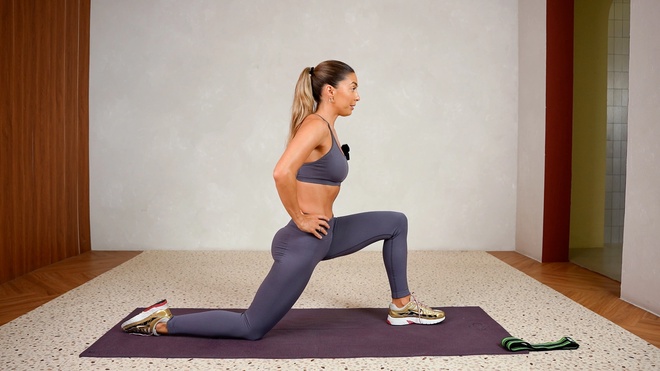
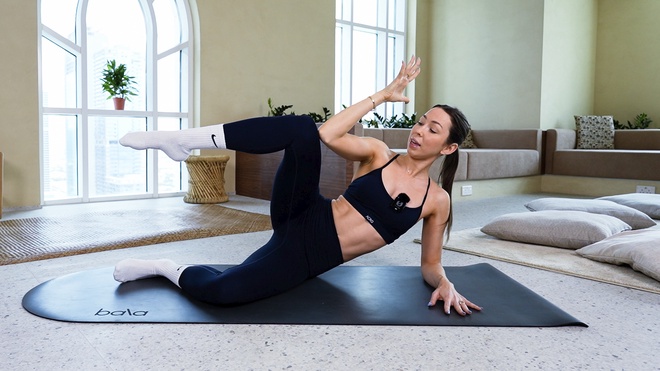
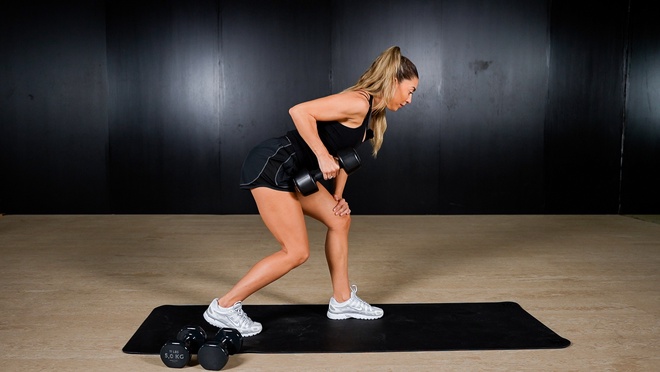
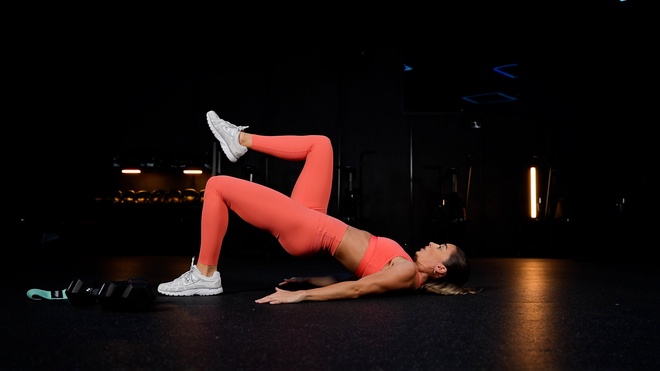
Join women building strength, bone density, and better backs with certified trainers
Frequently Asked Questions
Related Exercises
Hip Thrust
The glute bridge's bigger sibling. Greater range of motion and higher gluteus maximus activation. Progress to this once bodyweight bridges feel easy.
Hip Flexor Stretch
Tight hip flexors inhibit glute activation. Stretching them first makes bridges immediately more effective.
Clamshell
Targets gluteus medius directly. Pairs with bridges for complete glute development and knee stability.
Fire Hydrant
Another gluteus medius isolation exercise. Combine with bridges in a superset for a complete glute warm-up.
Dead Bug
Trains the same core-bracing pattern from a supine position. Perfect complement to bridges for spine health.
This exercise helps with
Get glute bridge in a guided workout
Access 5 workouts featuring this exercise, plus personalized plans from Dr. Wellls.
Join women building strength, bone density, and better backs with certified trainers
Your membership funds independent women's health research