Dead Bug Exercise: How-to, Benefits & Variations
The dead bug exercise targets core and lower back. Lie face up, arms up, knees at 90 degrees, lower opposite arm and leg while keeping your back flat. Builds spinal stability.
Dead Bug Exercise: How-to, Benefits & Variations
Try this. Lie on your back. Arms pointing at the ceiling. Knees at 90 degrees. Now lower your right arm and left leg toward the floor without your lower back peeling off the mat. Most people fail within three reps. Not because they're weak. Because they've been compensating with their hip flexors and lower back for years and never realized it.
The dead bug exercise exposes that truth faster than any other move. A 2025 systematic review of 57 RCTs and 7,705 participants found core stabilization training significantly reduced pain and improved function in chronic low back pain patients. The dead bug is one of Dr. Stuart McGill's recommended anti-extension patterns alongside the bird dog and curl-up. It teaches your transverse abdominis to brace while your limbs move independently. That's the definition of functional core strength.
Yoga for Back Relief: Workout 4
Petra Kapiciakova
How to Do Dead Bug Exercise
Lie on your back with both arms reaching straight toward the ceiling, wrists stacked over your shoulders. Bend your knees to 90 degrees with your shins parallel to the floor. This is your starting position. Linda Chambers cues: keep the toes higher than the knees so the core is actually working.
Press your lower back firmly into the mat. Sophie Jones says it best: push that tummy button right down towards the floor, no gap between the back and the mat. If you can slide a hand under your lower back, you're not bracing hard enough.
Exhale and slowly extend your right arm overhead while straightening your left leg toward the floor. Both limbs move at the same time, same speed. Petra Kapiciakova cues: think slow, controlled movement. Speed kills the dead bug.
Lower your arm and leg as far as you can WITHOUT your lower back lifting off the floor. That's your range. It might be six inches from the floor or two feet. Doesn't matter. The back stays down. Period.
Inhale and return both limbs to the starting position. Switch sides: left arm, right leg. That's one rep.
Repeat for 8-12 reps per side. Sophie cues: match the breath to the movement so you can really get tight in those core muscles.
Muscles Worked
Primary
Transverse abdominis
The deepest core muscle. Acts like a natural weight belt, wrapping around your spine to stabilize it while your limbs move. A 2022 systematic review of core muscle activation found anti-extension exercises like the dead bug produce high transverse abdominis recruitment compared to traditional crunches.
Rectus abdominis
Works isometrically to prevent your ribcage from flaring upward as you extend your arms. It's resisting extension, not creating flexion. That distinction matters.
Internal and external obliques
Stabilize against rotation when opposite limbs move at different speeds or weights. The obliques prevent your torso from twisting toward the heavier or faster side.
Secondary
Hip flexors (iliopsoas)
Control the lowering of each leg. Overactive hip flexors are the main reason people arch their backs during dead bugs. Learning to control them here teaches your body to decouple hip movement from spinal movement.
Erector spinae
Co-contracts with the deep core to maintain spinal neutral. The dead bug trains these muscles eccentrically, which is why it's one of the first exercises prescribed after back injuries.
Anterior deltoids
Control the overhead arm lowering. Light work, but it adds a coordination challenge that makes the core work harder to stabilize.
Why this matters in perimenopause
Core stability matters more during perimenopause than most women realize. Estrogen plays a direct role in collagen synthesis for tendons and ligaments. When levels drop, the connective tissue supporting your spine weakens. A 2022 systematic review found that core stability exercises reduced pain and disability in patients with non-specific low back pain, and a separate 2025 pilot study found Pilates-style core training improved sleep quality and reduced menopausal symptoms. The dead bug muscles worked are exactly the deep stabilizers that protect your spine as these hormonal shifts happen.
Coach's Tips
"Pushing that tummy button right down towards the floor... no gap between the back and the mat." That's Sophie Jones, and she says it in almost every dead bug set across her workouts. I've counted. This single cue fixes the most common dead bug form mistake. If your back lifts, you've gone too far.
Sophie Jones
"You always want the toes higher than the knees, so that we are actually working the core." Linda Chambers drops this cue and it changed how I teach the setup. When knees drift toward your chest, gravity does the work for you. Toes above knees means your core has to hold those legs in position. Big difference.
Linda Chambers
"Think of slow, controlled movement. We don't want to go fast." Petra Kapiciakova nails this. Speed is the enemy of the dead bug exercise. The moment you rush, momentum takes over and your deep core shuts off. I tell clients to count three seconds down, three seconds back. If they can't, the range is too big.
Petra Kapiciakova
"Your knees shouldn't be low. You wanna keep that nice right angle in the knees." Sophie again, during banded dead bugs. The 90-degree knee position isn't arbitrary. It creates a lever arm that forces your core to work against gravity. Let the knees drift lower and your hip flexors take over.
Sophie Jones
"Match the breath to the movement so you can really get tight in those core muscles." Sophie cues this during the banded variation. A 2023 systematic review confirmed the link between diaphragmatic breathing and core stability. Exhale as you extend the limbs. The exhale activates your transverse abdominis reflexively. Inhale on the return. Don't hold your breath.
Sophie Jones
"If you have ankle weights, you can put ankle weights on... It does make this a lot more challenging." Linda Chambers offers this progression for people who've mastered the bodyweight version. But I'd add: before you add external load, try the straight-leg variation first. If you can't do 10 reps of straight-leg dead bugs with your back flat, weights will just reinforce bad patterns.
Linda Chambers
"Press your lower back gently down to the mat. Try to not keep much space in between." Natalia Gunnlaugs uses a soft cue here, but the message is critical. If your lower back arches during dead bugs, you're loading your lumbar spine under extension. That's the opposite of what we want. Shorten the range of motion until your back stays planted. Nobody cares how far your leg goes.
Natalia Gunnlaugs
Why This Matters for You
I get asked constantly why core exercises matter more during perimenopause than at any other time. Here's the short version: your spine's support system is weakening on multiple fronts simultaneously.
Estrogen decline reduces collagen in the ligaments and discs that hold your vertebrae in place. Lean muscle mass drops, taking the muscular corset with it. A 2025 pilot study found that Pilates-based core training improved not just stability but also sleep quality and reduced menopausal symptoms in perimenopausal women. The dead bug is the entry point for all of that.
There's also the pelvic floor connection that nobody talks about enough. A 2025 meta-analysis showed postpartum exercise improved pelvic floor outcomes and diastasis recti. The dead bug's bracing pattern recruits the pelvic floor automatically when done with proper exhale timing. And a separate 2025 meta-analysis of pelvic floor training found it improved quality of life in postmenopausal women. So this one exercise feeds into a chain of benefits: core stability, pelvic floor health, back pain prevention, and better sleep. For the cost of lying on your back for five minutes.
Variations & Modifications
Legs-Only Dead Bug
lowArms stay reaching toward the ceiling. Only your legs move. This removes the coordination challenge and lets you focus entirely on keeping the lower back down. Beth Hannam programs this as the entry point in her 7-Day Bodyweight Challenge. If your back arches during the full dead bug, start here.
Arms-Only Dead Bug
low-mediumLegs stay in tabletop. Both arms reach overhead alternately. Sophie Jones uses this variation in Fix Your Posture to focus on shoulder mobility without the hip flexor challenge. The cue: as your arms come back, don't let the lower back peel off the mat.
Dead Bug Static Hold
mediumExtend one arm and the opposite leg, then hold. Jessica Casalegno cues: hover and hold. The isometric version builds endurance in the deep stabilizers. Hold each side for 10-15 seconds. Your core will shake. That shaking means the stabilizers are working.
Banded Dead Bug
medium-highBand placed above the knees. Sophie Jones programs three rounds of these in Body by Band. The band adds hip abduction demand on top of the core anti-extension pattern. Your gluteus medius has to fire throughout, which makes this secretly one of the best hip stability exercises disguised as a core move.
Straight-Leg Dead Bug
highStraighten the extending leg completely instead of keeping the knee bent. Beth Hannam calls this the straight-leg scissor variation. The longer lever arm creates substantially more demand on your core. If your back lifts off at all, go back to the bent-knee version. No shame in that.
Weighted Dead Bug
highHold a dumbbell in each hand or one dumbbell in both hands overhead. Danielle Harrison programs weighted dead bugs in her Boxing Full-Body Burn. The added load means your core has to generate more force to keep the spine neutral. Only progress here after you can do 15 clean reps of the straight-leg version.
Benefits
Protects the lower back
A 2025 meta-analysis of 57 RCTs (7,705 participants) found core stabilization exercises reduced pain and improved function in chronic low back pain. The dead bug exercise benefits your spine by teaching the deep core to brace against extension force. That's the exact pattern your back needs when you pick up a grocery bag, lift a child, or sit at a desk for eight hours.
Teaches true core stability
Most ab exercises create movement. The dead bug resists it. Anti-extension exercises like dead bugs and bird dogs activate the transverse abdominis and internal obliques more effectively than flexion exercises like crunches. A 2022 systematic review confirmed this pattern. You're training your core to do what it was designed for: keep your spine stable while everything else moves.
Safe for diastasis recti
The dead bug doesn't increase intra-abdominal pressure the way crunches and sit-ups do. A 2023 rehabilitation review for diastasis recti recommended core exercises that maintain abdominal wall tension without bulging, which is exactly what the dead bug does. I've watched women who couldn't do a single crunch without their belly doming do 15 clean dead bugs on day one.
Builds coordination that transfers to real life
Opposite arm and leg. Same speed. While bracing. Linda Chambers cues it directly: coordination, it's really important that we exercise our minds as well. The dead bug is a motor control exercise as much as a strength exercise. That contralateral pattern is the same one your body uses when you walk, climb stairs, and carry things.
Zero impact on joints
No load on the knees. No compression on the spine. No impact on the wrists. The dead bug is one of the only effective core exercises that puts almost no stress on any joint. If you've got bad knees, sore wrists, or a cranky lower back, this is where you start.
Common Mistakes to Avoid
Lower back arching off the floor
The number one dead bug form error. Sophie cues it relentlessly: pushing that belly button into the floor. If your lower back lifts even slightly, shorten the range of motion. Lower your leg less. Reach your arm less. The range where your back stays flat is your working range. Everything beyond that is ego.
Moving too fast
Speed kills the dead bug. Petra Kapiciakova says slow, controlled movement. When you rush, momentum does the work and your stabilizers turn off. Count three seconds on the way out, three seconds on the way back. If you can't maintain that tempo, the exercise is too hard for you right now.
Knees drifting toward the chest
Linda Chambers catches this constantly: toes higher than knees. When your knees pull in toward your body, gravity is helping you hold them there. Push the knees back so shins are parallel to the floor. Your core has to fight to maintain that position.
Holding your breath
Sophie's cue: match the breath to the movement. Exhale as you extend. Inhale as you return. A 2023 systematic review linked diaphragmatic breathing directly to improved core stability. When you hold your breath, you substitute pressure for stability. It works short-term but teaches nothing.
Workouts Featuring This Exercise

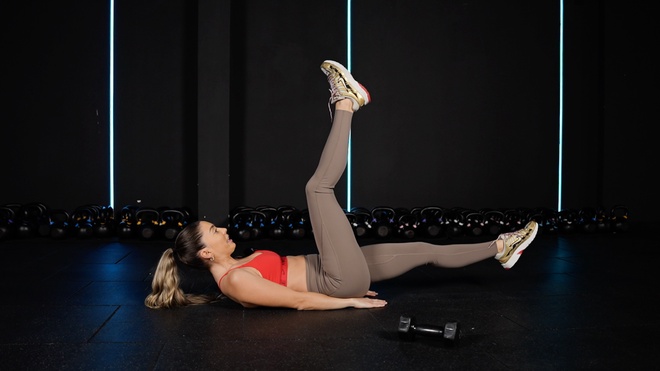
Join women building core strength and protecting their backs with certified trainers
Frequently Asked Questions
Related Exercises
Bird Dog
Same contralateral pattern as the dead bug but prone. Together they form two of McGill's Big 3 for spinal stability.
Plank
Isometric core hold that complements the dead bug's dynamic stability pattern. Progress from dead bug to plank.
Hollow Body Hold
Another anti-extension core exercise. Harder than the dead bug because all four limbs are extended simultaneously.
Glute Bridge
Pairs with dead bugs for a complete back-health routine. Dead bug stabilizes the front, bridge strengthens the back.
Crunches
Core flexion exercise to pair with the dead bug's anti-extension pattern. Different movement, complementary benefit.
Get dead bug exercise in a guided workout
Access 5 workouts featuring this exercise, plus personalized plans from Dr. Wellls.
Join women building core strength and protecting their backs with certified trainers
Your membership funds independent women's health research