Hollow Body Hold: How-to, Benefits & Variations
The hollow body hold targets rectus abdominis, transversus abdominis, obliques, hip flexors, and glutes. Lie face up, press lower back flat, lift shoulders and legs, hold the C-curve position.
Hollow Body Hold: How-to, Benefits & Variations
I thought my core was strong. I could hold a standard isometric position for two minutes without shaking. Then I tried holding a hollow body position for twenty seconds and my entire midsection collapsed.
Not collapsed dramatically. Collapsed quietly. My lower back peeled off the floor. My legs dropped. My shoulders curled forward instead of lifting. Everything I thought I knew about core strength turned out to be half the picture.
The hollow body hold is a Pilates and gymnastics staple that exposes the gap between superficial abdominal strength and actual deep-core control. You lie on your back, press your lower back into the floor, lift your shoulders and legs simultaneously, and hold a shallow C-curve with every muscle in your trunk firing at once. No movement. No momentum to hide behind. Just tension.
Jessica Casalegno programs the hollow body hold into four of her Full Body Pilates workouts at Wellls. She cues it the same way every time: hold it out, point toes, ten, nine, eight. Sophie Jones takes a different approach in her Peach Project and Athlete Mode sessions, focusing obsessively on the lower back position. Pushing my tummy button in towards the mat, she says. So I don't wanna see this arch here. That single cue is the difference between training your core and straining your spine.
Full Body Pilates: Workout 4
Jessica Casalegno
How to Do Hollow Body Hold
Lie face up on a mat with your legs fully extended, arms by your sides. Before anything moves, press your lower back firmly into the floor. Sophie Jones cues: pushing that tummy button in towards the mat. If you can slide your hand under your lower back, you are not pressing hard enough. Tilt your pelvis by tucking your tailbone slightly. The lumbar spine must stay glued down for the entire hold.
Engage your glutes. Sophie Jones cues: squeezing my glutes as well, posterior chain. Most people forget the glutes during a hollow body hold exercise. They matter. Glute contraction stabilizes the pelvis from below, preventing the anterior tilt that arches your back. Squeeze before you lift anything.
Lift your shoulders off the floor by reaching your arms forward and long. Keep your neck neutral. Jessica Casalegno cues: lift the arms so the shoulders are off the floor. Do not yank your chin toward your chest. Think about lifting your chest toward the ceiling, not curling your head toward your knees.
Extend your legs and lift both feet off the mat. Point your toes. Start with legs at a 45-degree angle. Jessica Casalegno cues: get the legs to hover above the mat, keep them as long as possible, as low as possible. Lower your legs only as far as your lower back stays pressed into the floor. The moment it arches, raise your legs higher.
Hold the hollow body position. Arms extended, shoulders lifted, legs hovering, lower back pinned down. Breathe with shallow, steady breaths. Do not hold your breath. Jessica Casalegno cues in a steady countdown: hold it out, hollow body hold, ten, nine, eight, point toes. Aim for 10-20 seconds to start. Build to 30 seconds over weeks.
Lower everything with control. Do not let your legs drop. Do not let your shoulders crash down. Reverse the setup: legs down first, then shoulders. Rest for 15-30 seconds. Repeat for 3-4 sets.
Muscles Worked
Primary
Rectus abdominis (full length)
The six-pack muscle runs from your rib cage to your pelvis. Most exercises target either the upper or lower portion. The hollow body hold muscles worked include the entire rectus abdominis because both ends are loaded simultaneously. Your shoulders lift off the floor, shortening the upper fibers. Your legs hover, loading the lower fibers against gravity. A 2023 systematic review of core muscle activation found that exercises demanding simultaneous upper and lower trunk engagement produce higher overall rectus abdominis EMG activity than isolated crunch or leg-raise patterns.
Transversus abdominis
The deepest abdominal layer. It wraps around your torso like a compression bandage. During the hollow body hold, the TA must fire continuously to maintain intra-abdominal pressure and keep the lower back from arching. Every time Sophie Jones cues pushing that tummy button in towards the mat, she is cueing TA engagement. A systematic review linking diaphragmatic breathing to core stability confirmed that the exhale-brace pattern specifically drives TA activation. This muscle does not produce visible movement. It produces the stability that makes every other movement possible.
Internal and external obliques
The obliques work as stabilizers during the hollow body hold, preventing your torso from rotating or laterally tilting. They are not the primary movers, but they fire continuously to maintain the C-curve shape. In a position where both arms and legs are extended and elevated, any rotational drift gets amplified. The obliques prevent it.
Secondary
Hip flexors (iliopsoas)
Holding your legs off the ground requires sustained hip flexor contraction. The iliopsoas works isometrically to maintain leg position while the abdominals handle spinal stabilization. If your hip flexors burn before your abs, your legs are too low for your current strength. Raise them higher.
Quadriceps
Keeping your legs straight and extended demands continuous quadriceps contraction. The rectus femoris crosses both the hip and knee joints, working double duty in the hollow body position. Point your toes to maximize the full-leg tension chain.
Glutes
Sophie Jones specifically cues glute engagement during the hold: squeezing my glutes as well, posterior chain. Glute contraction tilts the pelvis posteriorly, which is exactly the direction you need to keep the lower back flat. The glutes are the unsung muscle of this exercise. Most people forget them. Sophie does not.
Why this matters in perimenopause
Hollow body hold muscles worked span the entire anterior core chain. This matters as hormones shift because estrogen decline accelerates two things: visceral fat accumulation around the midsection and reduction in core muscle quality. A 2023 international expert panel on resistance training for menopausal women recommended exercises targeting core stability as a priority. The TA, which the hollow body hold demands intensely, is a primary stabilizer for the pelvic organs. A 2025 RCT with 70 postmenopausal women found that Kegel exercises combined with abdominal exercises produced significantly better incontinence outcomes than Kegels alone. The hollow body hold creates exactly the kind of deep TA contraction that supports pelvic floor function. Not as a replacement for pelvic floor training. As a partner.
Coach's Tips
"Pushing my tummy button in towards the mat. So I don't wanna see this arch here." Sophie Jones delivers this cue while demonstrating in Peach Project 8. She physically shows the arch, then corrects it. The lower back press is the single most important element of the hollow body hold. If you remember one cue, remember this one. Everything else is secondary.
Sophie Jones
"Get the legs to hover above the mat. Keep them as long as possible, as low as possible." Jessica Casalegno uses this in Full Body Pilates 9. The tension between as long as possible and as low as possible is the entire challenge. Longer legs mean a bigger lever arm. Lower legs mean more gravitational demand on the core. Find the height where your back stays flat and your abs shake.
Jessica Casalegno
"Lift your shoulders off the floor and reach your arms long to engage the upper abs." This cue appears in Jessica Casalegno's Pilates programming. The shoulder lift is not about crunching upward. It is about reaching forward, lengthening the torso into the C-curve. Your arms stay straight. Your chest lifts. Your upper abs contract to hold the position.
Jessica Casalegno
"Squeezing my glutes as well... posterior chain." Sophie Jones adds this in Athlete Mode 4 and it changes everything about the hold. When you squeeze the glutes, the pelvis tucks posteriorly. That tuck makes it physically easier to keep the lower back pinned. The glute engagement is not an afterthought. It is a structural support for the entire hollow body position.
Sophie Jones
"Press that lower back down to the floor." Natalia Gunnlaugs keeps it simple in Strong Pilates 2. No elaborate explanation. Just a direct instruction. If your lower back is not on the floor, you are not doing a hollow body hold. You are doing a back extension pretending to be a core exercise.
Natalia Gunnlaugs
"Belly button should be down, so I can't get anything underneath my back." Sophie Jones uses this self-test in Peach Project 8. Slide your hand under your lower back before you begin. If it fits, adjust. If you cannot maintain this position once your legs lift, your legs are too low. Raise them. This is not optional. An arched lower back during a hollow body hold exercise loads the lumbar discs instead of the abdominals.
Sophie Jones
"Those of you that can't, you're gonna come here... arms underneath your legs." Sophie Jones offers this regression without apology during Peach Project 8. Placing your hands underneath your thighs shortens the lever arm and makes the position accessible for beginners. She follows up: either hollow body hold with the arms up, or hold with the arms down. Two versions, same exercise. Pick the one your back tolerates.
Sophie Jones
"If you need to, you can keep a bend in the knees." Natalia Gunnlaugs says this in Strong Pilates 2 and repeats it in HIIT Blast 3: you might even need to bend the knees, that's okay. Bent-knee hollow body hold for beginners cuts the lever arm significantly. Your hip flexors take less load. Your core still has to stabilize. For anyone building baseline strength or managing lower back sensitivity, bent knees are the smart starting point.
Natalia Gunnlaugs
Why This Matters for You
The hollow body hold addresses three things that quietly shift as hormones change.
Deep core stability. The transversus abdominis wraps around the trunk and creates the pressure that supports your spine and pelvic organs. As estrogen fluctuates, core muscle quality declines. A 2023 international expert panel specifically recommended core stability exercises for women during the menopausal transition. The hollow body hold forces the TA to fire at near-maximum for the entire duration. Not intermittently. Continuously.
Pelvic floor integration. The pelvic floor does not work alone. It co-contracts with the TA during exhale-brace patterns. A 2025 RCT found that postmenopausal women who combined abdominal exercises with pelvic floor exercises had significantly better incontinence outcomes than those doing pelvic floor work alone. The hollow body hold, performed with steady breathing, creates exactly the kind of deep TA engagement that partners with pelvic floor function.
Posture correction. As estrogen drops, many women notice increased thoracic kyphosis, that forward-rounded upper back. The hollow body hold trains the anterior core to resist extension while the upper body lifts. This anti-extension strength directly counteracts the postural drift that accelerates during the menopausal transition. Not by pulling you upright. By making the muscles that hold you upright actually strong enough to do their job.
Variations & Modifications
Bent-Knee Hollow Body Hold
low-mediumSame upper body position but with knees bent at 90 degrees instead of legs extended. Natalia Gunnlaugs programs this as the default regression across her Strong Pilates and HIIT Blast sessions. She cues: if you need to, you can have a little bit of a bend. The bent-knee position reduces hip flexor demand by about half and makes the hollow body position accessible for anyone recovering from lower back issues or building initial core strength. Start here if the full version breaks your form.
Arms-Down Hollow Body Hold
mediumHold the hollow body position with arms by your sides or hands tucked under your thighs. Sophie Jones demonstrates both options in Peach Project 8: those of you that can't, you're gonna come here, arms underneath your legs. Removing the overhead arm position eliminates the upper-body lever arm and reduces total demand on the rectus abdominis. Legs stay extended. Lower back stays flat. This is the middle ground between bent-knee and full hollow.
Full Hollow Body Hold (Arms Overhead)
highArms extended overhead behind you, legs hovering just inches above the mat. This is the complete hollow body hold exercise as performed in gymnastics. The arms-overhead position maximizes the lever arm on the upper body. Combined with low legs, every inch of the rectus abdominis works at near-maximum. Sophie Jones programs this as the advanced option: either hollow body hold with the arms up, or with the arms down. If you can hold this version for 30 seconds with a flat back, your core strength is genuinely advanced.
Hollow Body Hold with Scissor Kicks
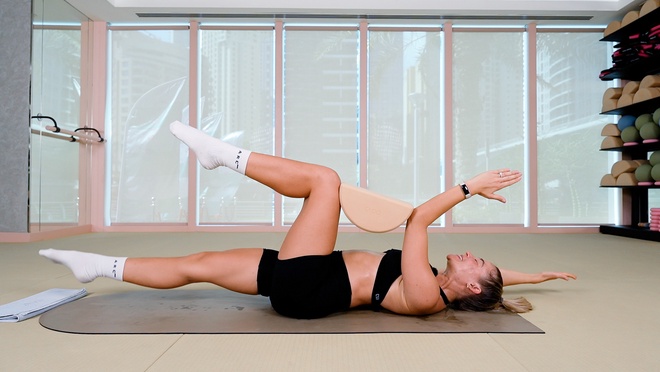
highHold the hollow body position while adding small alternating scissor kicks. Sophie Jones programs this in Athlete Mode 4 with the cue: scissor legs. The static hold becomes dynamic. Your core must stabilize against the leg movement while maintaining the C-curve. This bridges the gap between the hollow body hold and flutter kicks. If the standard hold feels manageable for 30 seconds, adding kicks is the next step.
Benefits
Trains the full core as one unit, not in pieces
Crunches work the upper abs. Leg raises hit the lower abs. Hollow body hold benefits include simultaneous activation of the entire rectus abdominis, transversus abdominis, obliques, and hip flexors. A 2023 systematic review of core muscle activation found that exercises demanding multi-segment stabilization produce higher total core EMG output than isolated movements. Your core does not work in segments during real life. It works as a unit. The hollow body hold trains it that way.
Exposes and corrects the weak link in your core
You can hide weak core muscles during crunches by using momentum. You can compensate during exercises by shifting to stronger muscle groups. The hollow body hold has nowhere to hide. If your transversus abdominis is weak, your back arches. If your lower abs are underdeveloped, your legs drop. If your hip flexors are tight, the position feels impossible. Every weakness announces itself within seconds.
Zero equipment, massive carry-over to other exercises
Gymnasts use the hollow body position as the foundation for handstands, ring work, and tumbling. In a fitness context, the hollow body hold builds the anti-extension strength that protects your spine during every loaded exercise. Deadlifts, overhead presses, even running. The ability to resist lumbar extension under load starts with this position. A mat. Your body. That is the equipment list.
Isometric core endurance that protects the spine
Your core's primary job is not to crunch or twist. It is to resist movement. A 2022 systematic review confirmed that core stability exercises produced significant pain reduction for non-specific low back pain. The hollow body hold is pure stability work. No spinal flexion. No rotation. Just anti-extension against gravity. The kind of core endurance that keeps your spine safe when you carry groceries, lift children, or stand for hours.
Common Mistakes to Avoid
Lower back lifting off the floor
The most common and most dangerous form failure. Sophie Jones addresses it directly: belly button should be down, so I can't get anything underneath my back. If your lower back arches, your legs are too low for your current strength. Raise them to 60 or 70 degrees. Place your hands under your thighs. Squeeze your glutes to tuck the pelvis. The back must stay flat. If it lifts, the load shifts from your abs to your lumbar discs. Stop the set immediately and reset.
Letting the shoulders collapse instead of staying lifted
The C-curve requires both ends to be elevated. Some people lift their legs but let their upper back rest on the floor. That is a leg hold, not a hollow body hold. Jessica Casalegno cues: lift the arms so the shoulders are off the floor. Keep your chest lifting toward the ceiling. Your shoulder blades should hover. If your neck strains, you are pulling with your head instead of lifting with your upper abs.
Holding the breath
Twenty seconds of maximum tension invites breath-holding. Your face turns red. Your blood pressure spikes. Your core actually gets less stable because the diaphragm locks. A systematic review of diaphragmatic breathing and core stability confirmed that steady exhale patterns produce better TA activation than holding breath. Breathe with shallow, controlled breaths. Not deep belly breaths, which would release the abdominal brace. Steady, shallow, and continuous.
Rushing through the countdown
Jessica Casalegno counts down from ten. Some people race through the numbers to get it over with. The hollow body hold form matters more than the duration. A shaky 10-second hold with perfect back position beats a 30-second hold where your spine arches at second five. Slow down. If you cannot hold the position for the full countdown, hold for as long as your form allows. Stop. Rest. Go again.
Workouts Featuring This Exercise
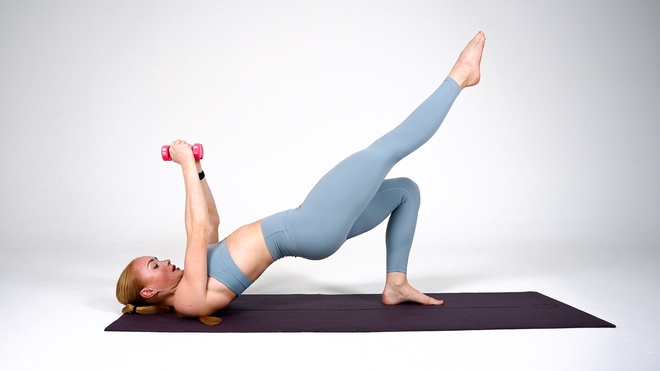
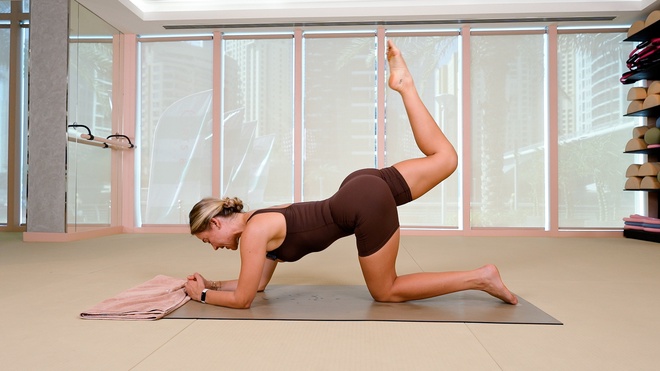
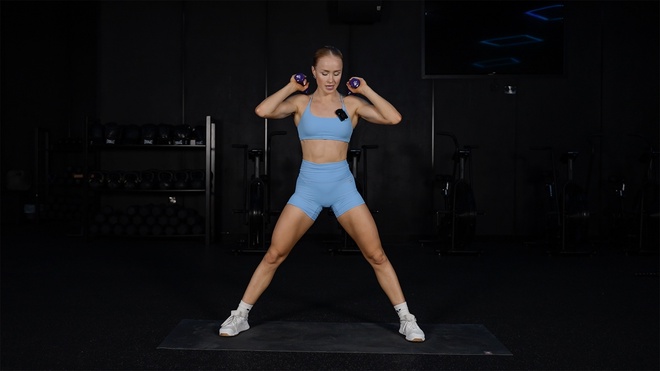
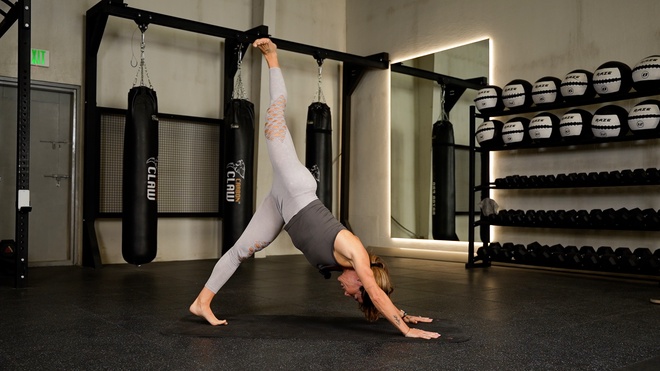
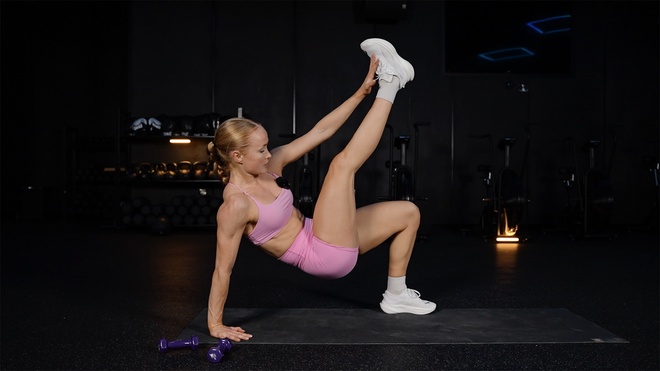
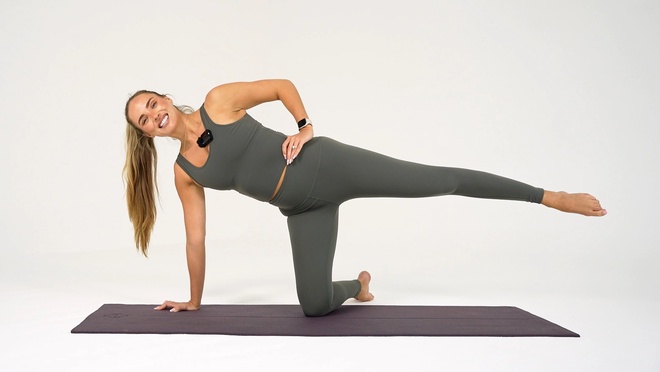
Join women building deep core strength with 5 certified trainers across 12 hollow body hold workouts
Frequently Asked Questions
Related Exercises
Dead Bug
Another supine core exercise that trains anti-extension with contralateral limb movement. Dead bugs are more dynamic and slightly easier to maintain proper form. If the hollow body hold breaks your back position, dead bugs build the prerequisite stability.
Bird Dog
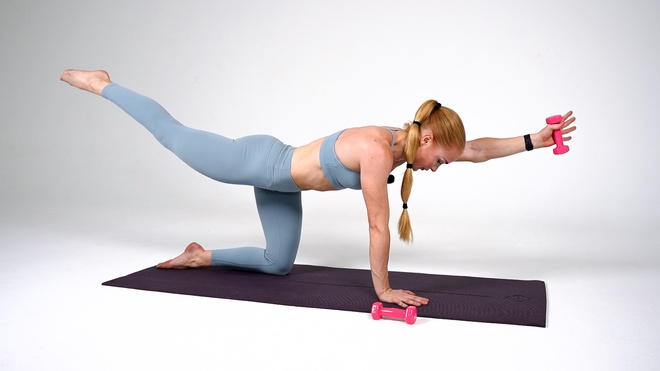
Trains anti-extension from a quadruped position instead of supine. Same deep core activation pattern. Different gravity relationship. A natural complement to hollow body work in a core circuit.
The Hundred
Another Pilates staple that uses the same hollow body position as its base. Adds rhythmic arm pumping and forced breathing. The hollow body hold is the static foundation. The Hundred is the dynamic progression.
V-Sit
A more advanced core hold that lifts both the torso and legs into a V shape. Demands more hip flexor strength and upper-ab power. If the hollow body hold feels manageable at 30 seconds, the V-sit is the next challenge.
Forearm Plank
Trains anti-extension in a prone position. The hollow body hold does it supine. Together, they cover the two directions your spine most commonly extends under load. Pair them for complete anti-extension training.
This exercise helps with
Get hollow body hold in a guided workout
Access 10 workouts featuring this exercise, plus personalized plans from Dr. Wellls.
Join women building deep core strength with 5 certified trainers across 12 hollow body hold workouts
Your membership funds independent women's health research