V Sits: How-to, Benefits & Variations
V sits target the rectus abdominis, hip flexors, and deep core. Sit on floor, lean back, extend legs to form a V, pull knees toward chin. Bodyweight only. Builds lower-ab strength and balance.
V Sits: How-to, Benefits & Variations
Try this. Sit on the floor. Lean back until your abs switch on. Now lift both feet off the ground and try to hold that position for ten seconds without your hands touching anything.
Most people collapse at second three. Not because they lack core strength. Because they lack the specific kind of core strength that the v sit exercise demands: simultaneous upper and lower abdominal contraction while balancing on your sit bones with zero external support.
Sophie Jones programs v sits into 38 of her workout segments at Wellls. Thirty-eight. That is not a random inclusion. She returns to this exercise across her Core Sweat series, her Glow Up challenges, her Bringing Sexy Back program, her Peach Project, and her Total Body Conditioning workouts. When a trainer with 95 workouts keeps coming back to one movement, the movement earns its reputation.
Her cue is consistent every time: drive the knees toward the chin, not the chest. That distinction matters more than it sounds. Pulling knees to the chest loads your hip flexors. Pulling knees toward the chin forces the lower abdominals to contract deeper. She says it plainly: "It's almost like the knees are coming higher, 'cause that's really gonna get that nice, deep, lower core contraction." That deep lower-core contraction is the entire point of v sits. And it is the reason this exercise shows up in Pilates, barre, bodyweight training, and calisthenics programming alike.
Core Sweat: Workout 8
Sophie Jones
How to Do V Sits
Sit on the floor with your knees tucked toward your chest and feet flat. Place your fingertips lightly on the floor behind you, fingers pointing forward. Sophie Jones is specific about hand position: "Fingers facing forward... hands are literally just for guidance." Your hands are stabilizers, not lifters. Do not push off the floor with them.
Lean back slightly until you feel your core engage. Roll your shoulders back and away from your ears. Natalia Gunnlaugs cues this posture in her Strong Pilates sessions: "Leaning back, roll the shoulders back away from the ears." The lean-back angle should be about 45 degrees from upright. If you round your upper back, you lose the abdominal engagement and put pressure on your lumbar spine.
Lift both feet off the floor and extend your legs forward and slightly upward while simultaneously leaning your torso back. Your body should form a V shape balanced on your sit bones. Sophie Jones describes the dynamic version: "Crunching in and then extending out." Control the extension. Do not kick your legs forward. Slow the movement down.
Pull your knees back toward your chin in a controlled crunch. This is where the real work happens. Sophie Jones cues: "Try and drive the knees in towards the chin. That's gonna get that nice, deep core contraction." She repeats this across multiple workouts because the knee-to-chin direction targets the lower rectus abdominis more aggressively than knee-to-chest.
Exhale as you pull your knees in, inhale as you extend. Sophie Jones cues the breathing rhythm: "Driving those knees in, pushing that tummy button in towards my spine." The exhale-brace pattern activates the transversus abdominis, which stabilizes the lumbar spine during the movement. Without it, your lower back takes the strain instead of your abs.
Repeat for 8-15 reps per set. 3-4 sets. For the v-sit hold variant, skip the crunch and simply hold the V position. Sophie Jones programs 30-40 second rounds in her Core Sweat and Glow Up workouts. Quality always beats speed: "Don't worry about speed here, I want control."
Muscles Worked
Primary
Rectus abdominis (upper and lower fibers)
The v sit exercise loads both the upper and lower portions of the rectus abdominis simultaneously. When you lean back, the upper fibers contract to maintain the trunk angle. When you extend and retract your legs, the lower fibers work to control hip flexion against gravity. A 2023 systematic review of core muscle activation found that exercises requiring concurrent upper and lower trunk stabilization produce higher total rectus abdominis EMG activity than isolated crunch or leg-raise patterns. V sits demand both ends at once.
Hip flexors (iliopsoas, rectus femoris)
Your hip flexors hold your legs off the floor and drive the knee-to-chin movement. Sophie Jones specifically addresses this: "Try not to use the hip flexors on this, so try and engage through the core." She is not saying the hip flexors should not work. They will. She is saying the core should be the driver, with the hip flexors assisting. When the hip flexors dominate, you feel burning in the front of your thighs instead of deep in your abs.
Secondary
Transversus abdominis
The deepest abdominal layer acts as a natural compression belt during v sits. Every time Sophie Jones cues "pushing that tummy button in towards my spine," she is cueing the TA to brace. A systematic review of diaphragmatic breathing and core stability confirmed that the exhale-brace pattern specifically activates the TA. This muscle does not produce the visible crunch movement. It produces the spinal stability that makes the crunch movement safe.
Quadriceps
Keeping your legs extended during the reach phase demands continuous quadriceps contraction. The rectus femoris crosses both the hip and knee joints, working to maintain leg extension while the hip flexors hold elevation. During the v-sit hold, this sustained contraction becomes isometric. Your quads burn quietly while your abs do the loud work.
Erector spinae (stabilizer)
The spinal erectors work isometrically to prevent excessive rounding of the lower back during the lean-back phase. They co-contract with the abdominals to create a rigid trunk. If your erectors are weak, your back rounds and the exercise shifts from a core exercise to a hip flexor exercise.
Why this matters in perimenopause
V sits muscles worked span the entire anterior core chain plus the hip flexors. This matters as hormones shift because estrogen decline accelerates visceral fat accumulation around the midsection and reduces core muscle quality. A 2023 international expert consensus recommended core stability exercises as a priority for women during the menopausal transition. The TA engagement that v sits demand also supports pelvic floor function. A 2025 RCT with 70 postmenopausal women found that combining abdominal exercises with pelvic floor exercises produced significantly better incontinence outcomes than pelvic floor work alone. V sits build exactly the kind of deep abdominal bracing that partners with the pelvic floor, particularly during the exhale phase when Sophie Jones cues that belly button draw-in.
Coach's Tips
"It's almost like the knees are coming higher, 'cause that's really gonna get that nice, deep, lower core contraction." Sophie Jones returns to this cue across Core Sweat 8, Bringing Sexy Back 7, and the Glow Up Challenge. Chin, not chest. The difference in knee trajectory is maybe three inches. The difference in lower abdominal activation is significant. If your knees stop at chest height, you are leaving the deepest part of the contraction on the table.
Sophie Jones
"Don't push off the elbows, just use them to guide you." Sophie Jones repeats this in every v sit segment. Your hands and elbows are on the floor for balance reference only. The moment you push off them to lift your torso, your core stops doing its job. She follows up: "Fingers facing forward... hands are literally just for guidance." If you catch yourself pushing, take your hands off the floor entirely. That will tell you immediately whether your core is strong enough.
Sophie Jones
"Don't worry about speed here, I want control." Sophie Jones says this during the V-Sits Round 2 segment. Speed masks weakness. A slow, controlled v sit where you pause at full extension and pause at the crunch will fatigue the rectus abdominis far more than 20 fast reps where momentum does the work. She cues: "Steady on the extend. Controlled." If you cannot control the extension phase, you are going too far.
Sophie Jones
"Controlling your abs wall here... needs to be strong and flat." Anastasia Zavistovskaya cues this during Barre 7's seated v-sit prep. The abdominal wall should feel like a firm surface, not a collapsing balloon. Strong and flat means the TA is actively bracing while the rectus abdominis handles the crunch. If your belly pouches forward during the movement, you have lost the brace.
Anastasia Zavistovskaya
"Get that nice little pause, drive." Sophie Jones uses this pause-drive cue in her Round 3 segments. The pause at the top of the crunch, when your knees are closest to your chin, maximizes the peak contraction of the lower rectus abdominis. Hold for one count. Do not rush through it. That one-second pause turns a 10-rep set into something your abs remember the next morning.
Sophie Jones
"Driving those knees in, pushing that tummy button in towards my spine." Sophie Jones pairs the crunch with an active belly-button draw-in. The draw-in protects the lower back by engaging the transversus abdominis before the rectus abdominis generates force. If you feel your lower back arching or aching during v sits, you have lost this brace. Stop the set, reset your pelvis, and re-engage the TA before continuing.
Sophie Jones
Place your hands or elbows on the floor for support, or tap your feet down between reps to reset your form. This is the beginner entry point that appears in every trainer's programming. Sophie Jones and Beth Hannam both program foot taps as the standard regression. If you cannot complete 8 reps without your lower back arching, use the foot tap version until your deep core catches up. Tapping is not cheating. Tapping is building the control that full v sits demand.
Sophie Jones
"Leaning back, you should feel it here in your thighs, your core." Natalia Gunnlaugs teaches the v-sit overhead press variant in Strong Pilates 2, adding dumbbells to the hold position. For anyone finding bodyweight v sits too easy after several weeks, adding a weighted overhead press while holding the V-position increases both core and shoulder demand. Lianna Brice programs the v-sit hold variant in Barre Burn 1 as an isometric challenge. Two different progressions for two different goals: strength or endurance.
Natalia Gunnlaugs
Why This Matters for You
V sits address two shifts that happen as estrogen fluctuates.
The first is core muscle quality. Not just strength, quality. The type of fiber recruitment, the speed of contraction, the ability to sustain engagement under load. A 2023 international expert panel of researchers and clinicians specifically recommended resistance exercises targeting core stability for women during the menopausal transition. V sits check that box with zero equipment because they demand sustained contraction of the entire anterior chain, including the deep transversus abdominis that most ab exercises barely touch.
The second is pelvic floor integration. The pelvic floor does not work in isolation. It co-contracts with the TA during the exhale-brace pattern that Sophie Jones cues in every v sit segment: pushing that tummy button in towards my spine. A 2025 randomized controlled trial found that postmenopausal women who combined abdominal exercises with pelvic floor training had significantly better incontinence outcomes than those doing pelvic floor work alone. The deep core engagement v sits produce is exactly the kind of abdominal bracing that partners with pelvic floor function. Not a replacement for dedicated pelvic floor work. A partner.
Practically, v sits also train the balance and proprioception that keeps you confident on uneven ground, carrying heavy shopping bags, or catching yourself when a surface is slipperier than expected.
Variations & Modifications
V-Sit Hold (Isometric)
mediumHold the V-position without the crunching motion. Lianna Brice programs this in Barre Burn 1. Balance on your sit bones with your legs extended and torso leaned back. Hold for 20-40 seconds. The v-sit hold removes the dynamic component and turns the exercise into pure isometric endurance. Your core has to sustain the contraction without any momentum to help. This is the variation that reveals whether your core is genuinely strong or just fast.
V-Sit Single Leg Extensions
medium-highBeth Hannam programs this in the 7-Day Bodyweight Challenge: extend one leg at a time while keeping the other tucked. The single-leg version introduces an anti-rotation demand. When one leg extends, it pulls the torso toward that side. Your obliques have to fire to keep the trunk centered. Good progression for anyone who has mastered the bilateral v sit but wants more oblique involvement.
V-Sit Heel Taps
mediumBeth Hannam includes this in the 7-Day Bodyweight Challenge Day 2. Hold the leaned-back V-position and alternately tap each heel to the floor. The tapping provides a brief moment of stability with one foot grounded while the other hovers. Excellent bridge between the foot-tap beginner modification and the full unsupported v sit. The alternating pattern also adds a rotational stability challenge.
V-Sit Arm Scissors
medium-highNatalia Gunnlaugs teaches this in Strong Pilates 1: hold the v-sit position while scissoring your arms up and down. The arm movement shifts your center of gravity with each scissor, demanding continuous core adjustment. Your abs have to stabilize a moving target. She cues: "Leaning back, roll the shoulders back away from the ears. Bring one arm up, one arm down." The Pilates precision makes this harder than it looks.
V-Sit Overhead Press
highNatalia Gunnlaugs programs this in Strong Pilates 2 with light dumbbells. Hold the V-position and press dumbbells overhead, then lower to shoulders. She cues: "Press the dumbbells overhead and then down to the shoulders. Leaning back, you should feel it here in your thighs, your core." The v-sit calisthenics crowd will appreciate this progression. It turns a bodyweight core exercise into an integrated core-and-shoulder strength movement.
Seated V-Sit Prep (Beginner)
low-mediumAnastasia Zavistovskaya teaches this foundation version in Barre 7. Sit upright, extend legs forward on a diagonal, and focus on maintaining a flat abdominal wall. She cues: "Reach your legs forward diagonal. Controlling your abs wall here... needs to be strong and flat." No crunching. No leaning back far. Just the position. This is the entry point for anyone whose core is not yet ready for the dynamic v sit.
Benefits
Builds the lower-ab strength that other core exercises skip
V sits target the lower portion of the rectus abdominis more aggressively than standard crunches because your legs are the primary resistance. Every time you extend and retract, the lower fibers work against gravity to control your leg position. Sophie Jones specifically cues the knee-to-chin direction to maximize this lower-ab recruitment. A 2023 systematic review found that exercises demanding both upper and lower trunk engagement produce higher overall EMG output than isolated movements. V sit ups deliver both simultaneously.
Teaches real balance on an unstable base
Balancing on your sit bones with nothing else touching the floor is a proprioceptive challenge most exercises avoid. Your deep stabilizers, including the transversus abdominis and multifidus, have to fire continuously to keep you upright. A 2023 systematic review of balance interventions for community-dwelling adults found that balance-challenging exercises improve postural control across multiple movement patterns. V sits build balance from a seated position, which transfers to stability in standing, walking, and single-leg activities.
No equipment, fits into any workout structure
Sophie Jones programs v sits in strength workouts, Pilates sessions, barre classes, bodyweight challenges, and conditioning circuits. 44 appearances across 17 workouts with 4 different trainers. The v sit exercise works as a warm-up activation drill, a main-set core movement, or a finisher. All you need is a flat surface and your bodyweight. The versatility is why every training style keeps borrowing it.
Connects core strength to pelvic floor function
The belly-button draw-in that Sophie Jones cues during v sits activates the transversus abdominis, which co-contracts with the pelvic floor during the exhale-brace pattern. A 2025 RCT found that postmenopausal women who combined abdominal exercises with pelvic floor work had significantly better incontinence outcomes than those doing pelvic floor exercises alone. V sits are not a pelvic floor exercise. But the deep core engagement they produce is exactly the kind of abdominal work that supports pelvic floor health.
Common Mistakes to Avoid
Pushing off the elbows to lift the torso
Sophie Jones catches this repeatedly: "Don't push off the elbows. I don't wanna see anyone pushing off, just a light little tap." When your elbows push, your triceps do the work instead of your core. Test yourself: lift your hands completely off the floor for one rep. If you collapse, you have been relying on your arms. Scale back to the seated prep version until your core can hold the position independently.
Pulling knees to the chest instead of toward the chin
Chest-height knees engage the hip flexors predominantly. Chin-height knees shift the load to the lower rectus abdominis. Sophie Jones cues this distinction in almost every v sit segment: "Try and drive the knees in towards the chin." The correction is small in distance but large in muscle activation. Aim the kneecaps at your chin on every rep.
Rounding the upper back and dropping the chest
Natalia Gunnlaugs cues: "Roll the shoulders back away from the ears." A rounded upper back collapses the V shape into a C shape, shifting the load from the abdominals to the hip flexors and making the movement less effective. Keep your chest lifted and your shoulder blades drawn together throughout the movement. If you cannot maintain an open chest, the lean-back angle is too steep for your current strength.
Using momentum instead of controlled movement
Sophie Jones is direct: "Don't worry about speed here, I want control. Steady on the extend. Controlled." Fast reps let momentum carry you through the hardest parts of the range. Slow reps force your muscles to manage every degree of the extension and retraction. If you cannot pause for one full second at both the extended position and the crunched position, you are moving too fast.
Workouts Featuring This Exercise
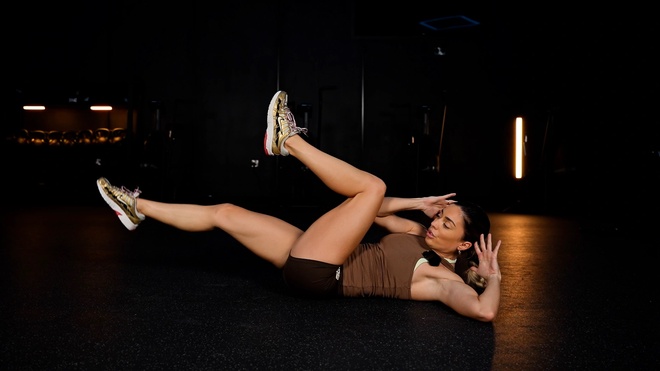
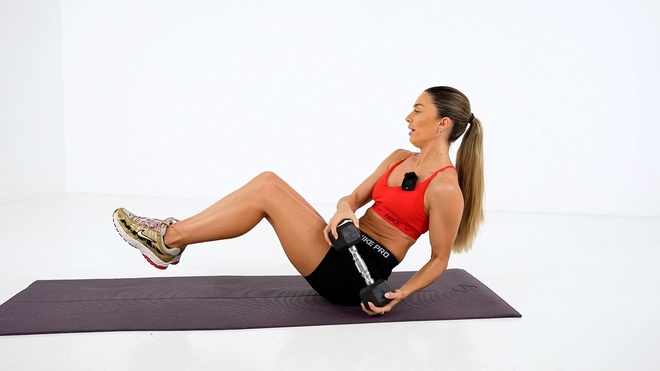
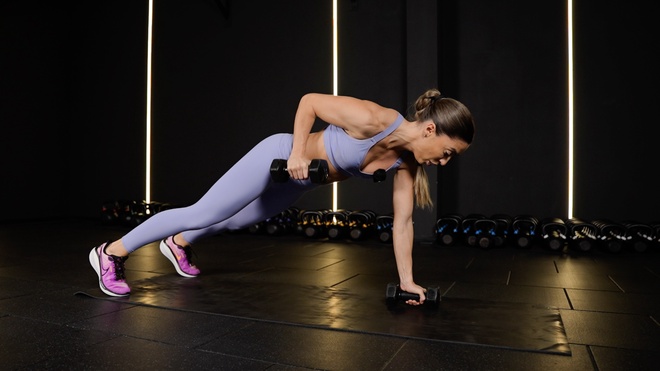
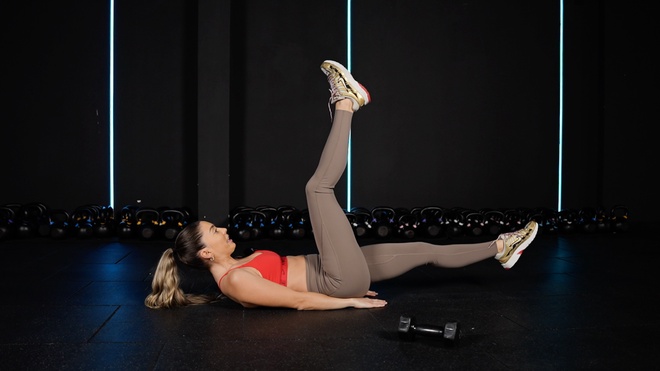
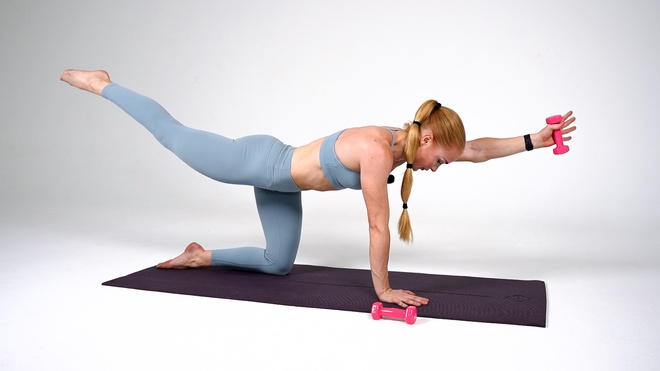
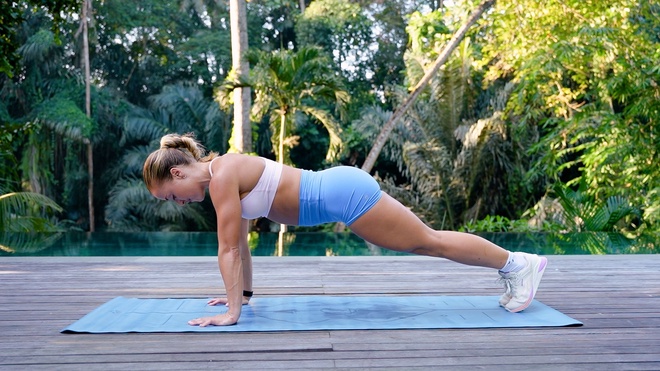
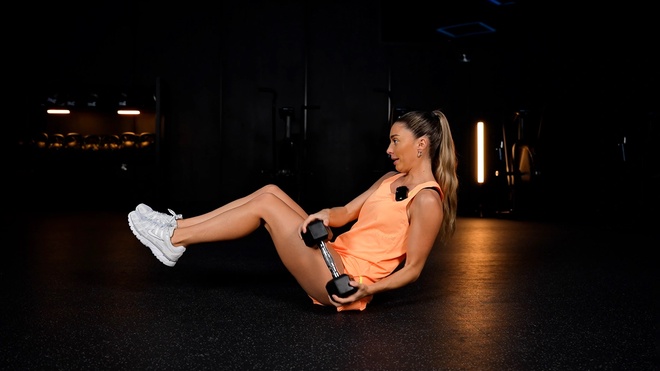
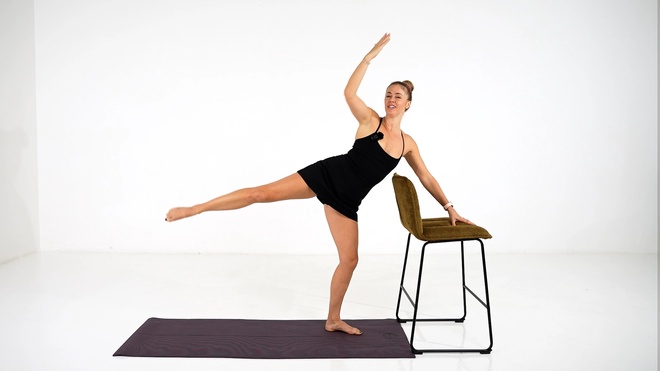
Join women building deep core strength with 4 certified trainers across 17 v sit workouts
Frequently Asked Questions
Related Exercises
Crunches
Crunches isolate the upper rectus abdominis through spinal flexion. V sits add lower-ab and hip flexor demand. If v sits are too challenging, crunches build the upper-ab foundation you need first.
Bicycle Crunches
Adds rotational demand to a similar supine crunch pattern. Bicycle crunches target the obliques more directly than v sits. Pair them in a circuit for full core coverage.
Leg Raises
Leg raises isolate the lower rectus abdominis through hip flexion against gravity. V sits combine this lower-ab demand with upper-ab engagement. If the lower-ab component of v sits is the weak link, leg raises build it specifically.
Dead Bug
Trains anti-extension core stability with contralateral limb movement. A gentler entry point to the kind of lower-back stabilization v sits demand. If v sits compromise your back position, dead bugs build the prerequisite control.
Hollow Body Hold
The isometric cousin of the v-sit. Same anterior chain activation, different challenge: pure hold versus dynamic crunch. The hollow body hold trains core endurance. V sits train core strength through range of motion.
This exercise helps with
Get v sits in a guided workout
Access 10 workouts featuring this exercise, plus personalized plans from Dr. Wellls.
Join women building deep core strength with 4 certified trainers across 17 v sit workouts
Your membership funds independent women's health research