Bicycle Crunches: How-to, Benefits & Variations
Bicycle crunches target obliques, rectus abdominis, and hip flexors. Lie face up, rotate elbow to opposite knee while extending the other leg. Builds rotational core strength for back health.
Bicycle Crunches: How-to, Benefits & Variations
Most ab exercises lie to you by omission. They flex your trunk forward — crunches, sit-ups, leg raises — and call it core training. But your core doesn't work that way in real life. It rotates. It braces against rotation. It does both simultaneously. Bicycle crunches force all of that under control.
The rotation is what trains your obliques, the muscles that wrap your torso like a corset and keep your spine from buckling when you carry groceries, twist to check a blind spot, or brace yourself catching a stumble. A 2025 systematic review of 57 RCTs (7,705 participants) found core resistance training produced the most stable improvements in functional status for people with chronic back pain. Bicycle crunches are exactly that kind of work.
Tone and Stretch: Workout 9
Mish Naidoo
How to Do Bicycle Crunches
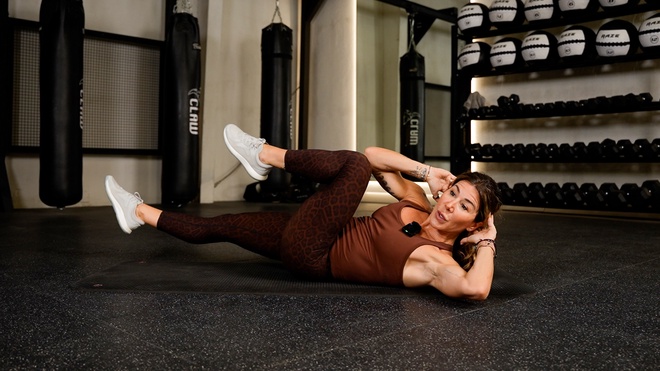
Lie on your back on a mat. Press your lower back into the floor. Sophie Jones cues this repeatedly: "Push that tummy button down towards the floor." If there's a gap between your lower back and the mat, your core isn't engaged yet.
Place your fingertips lightly at your temples. Not behind your head. Not laced together. Linda Chambers cues: "Bring the fingertips to our temples." Your hands are there for awareness, not to yank your neck forward.
Tuck your pelvis under slightly. Lift your head and shoulders just off the mat. Sophie's cue: "My upper body, I wanna just lift off ever so slightly." Think half an inch, not a full sit-up.
Bring both knees to tabletop position (shins parallel to the ceiling). Now extend your right leg straight while rotating your left elbow toward your right knee. Sophie's most repeated cue across 16 workouts: "Opposite knee to elbow, and I'm opening out here."
Return through center and switch sides. Extend the left leg, rotate the right elbow toward the left knee. One full cycle (both sides) counts as one rep.
Exhale on every rotation. Linda Chambers: "Exhale as you rotate, making sure that this does feel like hard work." Don't hold your breath. In through the nose as you pass through center, out through the mouth as you twist.
Muscles Worked
Primary
Obliques (internal and external)
Drive the rotation that defines bicycle crunches. The external obliques on the side you're twisting away from fire hardest, while the internal obliques on the side you're twisting toward do the pulling. A systematic review of EMG studies across common therapeutic exercises confirmed that rotational movements produce significantly higher oblique activation than straight flexion.
Rectus abdominis
Controls the flexion component, keeping your shoulders lifted off the mat throughout the entire set. The bicycle crunch hits both the upper and lower portions because you're simultaneously curling your torso and controlling leg movement.
Hip flexors (iliopsoas, rectus femoris)
Drive the pedaling motion of your legs. The alternating leg extension and retraction demand constant hip flexor engagement. Multiple DB entries tag "hip_flexors" as a working muscle group for this exercise.
Secondary
Transverse abdominis
The deepest abdominal layer. It braces your spine while everything else rotates around it. Sophie's belly-button-to-floor cue directly activates this muscle.
Quadriceps
Extend the straightened leg. The longer you reach that leg out, the harder your quads work and the more demand on your lower abs.
Spinal erectors
Stabilize the pelvis against the rotation forces. Without them, you'd rock side to side instead of twisting cleanly.
Why this matters in perimenopause
Lean muscle mass starts declining earlier than most people realize, and estrogen loss during perimenopause accelerates it by dampening growth hormone secretion. The obliques and deep core are often the first casualties because most daily activities don't challenge them. A 2023 meta-analysis of 27 RCTs (1,989 participants) showed resistance training improved lean body mass, grip strength, and knee extension strength in menopausal women. Three sessions per week, 20-90 minutes, for at least 6 weeks. Bicycle crunches target the rotational muscles that standard gym machines completely ignore.
Coach's Tips
"Don't cut it short. Extend all the way out. Really hit those obliques as you twist." That's Sophie Jones, and she says some version of this in nearly every bicycle crunch set I've reviewed. The full leg extension is where half the benefit lives. If you're doing tiny half-pedals, you're getting a tiny half-exercise.
Sophie Jones
"Opening the chest, twisting across, core nice and tight." Another Sophie cue. Think about opening your rib cage as you rotate, not closing it. If your elbows collapse inward, you're pulling with your arms instead of rotating with your trunk. The twist should come from your thoracic spine, not your neck.
Sophie Jones
"Focus on trying to get this elbow down to the floor on the rotation, so you feel it more through the obliques." Linda Chambers gives the deepest rotation cue I've heard. Most people stop the twist halfway. Aiming your elbow toward the floor (you won't actually get there) forces a fuller rotation that lights up the obliques completely.
Linda Chambers
"Don't worry about speed here. Keep it controlled." Sophie cues this often enough that I've lost count. An EMG study on mind-muscle connection showed internal focus significantly increased muscle activation during resistance exercises. Slow bicycle crunches with deliberate rotation beat fast ones every time.
Sophie Jones
"Don't hold your breath on these... In through the nose, out through the mouth." Sophie's breathing cue is deceptively simple. Exhaling on the rotation engages your deep core and supports your pelvic floor. Holding your breath spikes intra-abdominal pressure, which is exactly what you don't want if pelvic floor health is a concern.
Sophie Jones
"Lift my neck and shoulders up, and then use your hands to support." Mish Naidoo's cue addresses the biggest bicycle crunches form mistake: neck strain. Your hands are a shelf for your head, not a lever. If your chin is jamming into your chest or your neck aches before your abs, lighten the lift. Barely off the mat is enough.
Mish Naidoo
"If it's too much... Bend the knees and rotate right and left." Linda Chambers offers the best regression. Keep both feet on the floor, knees bent, and just do the upper body rotation. You still train the obliques. You still learn the twist pattern. You just remove the hip flexor demand and lower ab load until you're ready.
Linda Chambers
Why This Matters for You
Here's what most people miss about core training during perimenopause. The hormonal shift that causes brain fog and disrupted sleep also weakens the deep stabilizing muscles around your spine. Not the mirror muscles. The ones you can't see. The transverse abdominis, the internal obliques, the multifidus. These are the muscles that bicycle crunches train.
A systematic review of exercise in perimenopause found regular activity improved hot flushes, insomnia, fatigue, depression, myalgia, and headache. But the specific benefit of rotational core work goes beyond symptom management. It maintains the spinal stability that keeps you moving confidently on uneven ground, wet surfaces, and the general chaos of daily life.
I've watched women who thought core training meant planks and nothing else. Planks are fine. But they only train anti-extension. Bicycle crunches train anti-rotation AND rotation. That's the movement pattern that keeps you upright when the ground is uneven, when you trip on a curb, when life throws something at you from the side.
Variations & Modifications
Feet-Down Bicycle Crunches
lowKeep both feet flat on the floor with knees bent. Only your upper body rotates. Linda Chambers recommends this as the starting point: "If it's too much, bend the knees and rotate right and left." This strips away the hip flexor demand and lets you focus entirely on learning the trunk rotation pattern.
Bent-Knee Bicycle Crunches
low-mediumKeep both knees bent at 90 degrees throughout. Don't extend the straight leg. This reduces lower ab load while keeping the rotation challenge. Perfect if you feel your lower back lifting off the floor during the standard version.
Slow Tempo Bicycle Crunches
medium-highHold each rotation for 3 seconds at peak contraction before switching. Sophie Jones cues: "I'm not going fast here. Extend and twist." The hold eliminates momentum entirely, which is where most people cheat. Your obliques will fatigue in half the reps.
Straight-Leg Bicycle Crunches
highInstead of bending the approaching knee, keep both legs straight and lift each one as you rotate. Massively increases hip flexor and lower ab demand. Only try this if you can hold the standard version for 20+ reps with your lower back glued to the floor.
Pilates Bicycle (Lianna Brice style)
mediumLianna Brice teaches this as "adding your twist to the single leg stretch." Slower, more controlled, with emphasis on breath timing and rib cage expansion. Pilates-trained bicycle crunches emphasize spinal articulation over speed, which research shows produces superior pain relief for chronic back pain.
Benefits
Trains rotation, not just flexion
Most ab exercises (crunches, sit-ups, planks) work in a single plane. Bicycle crunches force your torso to rotate while stabilizing, which is how your core actually functions in real life: reaching across your body, twisting to grab a child, turning in your seat. A systematic review of core muscle activation confirmed rotational exercises produce higher oblique recruitment than linear movements.
Protects your lower back
A 2025 meta-analysis of 57 RCTs found core resistance training significantly reduced pain and improved function in people with chronic non-specific low back pain. The bicycle crunch trains the exact muscles (obliques, transverse abdominis, multifidus co-activation) that stabilize the lumbar spine. Three to four sessions per week, 30-45 minutes, was the optimal dose.
No equipment required
A mat. A floor. That's the entire equipment list. Bicycle crunches benefits stack up fast when the barrier to entry is this low. You can do them in a hotel room, in your living room, or between sets of anything else.
Hits the whole core in one move
The bicycle crunches muscles worked include obliques (rotation), rectus abdominis (flexion), hip flexors (leg drive), and transverse abdominis (stability). Most exercises isolate one of these. Bicycle crunches demand all four simultaneously.
Perimenopause-specific payoff
Core muscle atrophy accelerates during perimenopause as estrogen declines. A 2023 meta-analysis of 12 RCTs showed resistance training improved functional capacity, bone mineral density, and reduced fat mass in postmenopausal women with no serious adverse events. Bicycle crunches are a zero-impact way to maintain the rotational core strength that keeps your spine healthy and your balance sharp.
Common Mistakes to Avoid
Yanking on the neck
This is the number one bicycle crunches form mistake. Fingertips at your temples, not laced behind your head. Mish Naidoo cues: "Use your hands to support." If your neck hurts before your abs, you're pulling with your arms. Drop the lift height. Your shoulders barely need to clear the mat.
Rushing through reps
Sophie Jones says it across 16 workouts: "Don't worry about speed here. Keep it controlled." Fast bicycle crunches use momentum, not muscle. Slow down. Hold the twist. If you can't feel your obliques burning by rep 10, you're going too fast.
Not fully extending the straight leg
"Don't cut it off short, extending it out." Sophie's cue addresses the most common cheat. If the extending leg stays bent, you're dodging the lower ab work. Straighten it fully. If your back arches when you do, raise the leg higher toward the ceiling.
Lower back lifting off the floor
"Push that tummy button down towards the floor." Sophie repeats this in virtually every set. If your lower back arches, your core has disengaged and your hip flexors are taking over. Press your navel into the mat before every single rep. If it still lifts, raise your extended leg higher or switch to the bent-knee variation.
Workouts Featuring This Exercise
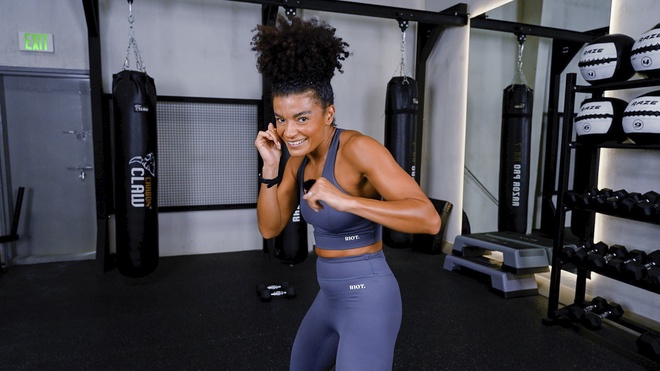
Join women building core strength and back health with certified trainers
Frequently Asked Questions
Related Exercises
Crunches
Standard crunch trains flexion only. Bicycle crunches add the rotation component.
Russian Twist
Another rotational core exercise. Seated position vs. supine in bicycle crunches.
Plank
Trains anti-extension and isometric core stability. Pairs with bicycle crunches for complete core work.
Dead Bug
Supine core exercise with opposite arm-leg coordination. Easier regression that builds the same pattern.
Side Plank
Isometric oblique training. Complements the dynamic oblique work of bicycle crunches.
This exercise helps with
Get bicycle crunches in a guided workout
Access 5 workouts featuring this exercise, plus personalized plans from Dr. Wellls.
Join women building core strength and back health with certified trainers
Your membership funds independent women's health research