Side Plank: How-to, Benefits & Variations
The side plank targets obliques, gluteus medius, and quadratus lumborum. Prop on one forearm, lift hips to form a straight line. Builds lateral core stability and prevents back pain.
Side Plank: How-to, Benefits & Variations
The first thing I notice when someone does a side plank is whether their hips are sagging. Nine times out of ten, they are. The bottom hip creeps toward the floor, the shoulder crumbles inward, and the entire point of the exercise disappears.
The side plank is the only common core exercise that trains anti-lateral flexion. That is your body's ability to resist being pulled sideways. Every time you carry a suitcase in one hand, hike a child onto your hip, or catch yourself on an uneven step, your obliques fire to keep your spine from buckling. Crunches do not train this. Standard planks barely touch it. The side plank is the move.
Stuart McGill, the spine biomechanics researcher behind the 'Big 3' protocol, included the side plank (he calls it the side bridge) alongside the curl-up and bird dog as one of only three exercises needed for complete spinal stability. That is not marketing. That is decades of laboratory research on cadaveric spines and live EMG data.
Rise and Shine: Workout 8
Sophie Jones
How to Do Side Plank
Lie on your side with your bottom elbow directly underneath your shoulder. Sophie Jones repeats this in nearly every workout: elbow directly under the shoulder. Not in front of it. Not behind it. Directly below. This protects your rotator cuff from taking all the load.
Stack your hips and shoulders vertically. Place your top hand on your hip or extend it toward the ceiling. Beth Hannam cues: core is nice and tight. Your body should feel like a wall, not a wet noodle.
Exhale and lift your hips off the mat until your body forms one straight line from head to feet. Jessica Casalegno cues: every exhale you take, really lifting those hips off the mat. That exhale engages the deep obliques before you even lift.
Hold the position. Your bottom oblique is doing the heavy lifting. Mish Naidoo cues: shoulder over the elbow, lift up out of the shoulder so you don't have any pressure. Push the floor away with your supporting arm.
Keep your gaze forward or slightly upward if you have your top arm raised. Avoid looking down at the floor. A neutral neck keeps your cervical spine aligned with the rest of your body.
Lower with control on an inhale. Do not drop. Linda Chambers cues this as a slow descent, checking that the shoulder stays above the elbow the entire way down.
Muscles Worked
Primary
Internal and external obliques
The stars of the side plank. The bottom-side obliques fire at high intensity to resist gravity pulling your torso toward the floor. This is anti-lateral flexion, a pattern the obliques were designed for but rarely get to train in isolation. A 2020 meta-analysis of gluteus medius activation exercises found that side plank variations also produced significant oblique EMG readings, confirming the dual recruitment pattern.
Quadratus lumborum
A deep muscle connecting your lowest rib to your pelvis on each side. During a side plank, the bottom-side QL works overtime to prevent your torso from collapsing. This muscle is often implicated in one-sided lower back pain. Training it through the side plank can address asymmetric weakness that standard bilateral exercises miss entirely.
Gluteus medius
The hip stabilizer on your top side fires to keep your pelvis level. A meta-analysis of therapeutic exercises for the gluteus medius found that side-lying and side-support positions produced among the highest activation levels. The side plank trains glute-med without any fancy equipment or cable machines.
Secondary
Transversus abdominis
The deepest layer of your core wall. Co-contracts with the obliques to create intra-abdominal pressure. You cannot hold a side plank without your TA engaging. A systematic review linking diaphragmatic breathing to core stability confirmed that the exhale-brace mechanism activates the TA even before the obliques fire.
Deltoid and scapular stabilizers
Your bottom shoulder holds your entire upper body off the ground. The deltoid and serratus anterior work isometrically. Anastasia Zavistovskaya cues: keep pushing the floor with your supportive arm, give some space to your shoulder joint. If your shoulder fatigues before your core, widen your elbow position or switch to a knee-down modification.
Adductors (inner thigh)
When your feet are stacked, the bottom leg's adductors engage to maintain balance. In side plank variations where you lift the top leg, the bottom adductors work even harder. An underappreciated muscle group that contributes to pelvic stability during gait.
Why this matters in perimenopause
Side plank muscles worked include the obliques, gluteus medius, and quadratus lumborum. These lateral stabilizers weaken faster than the big movers during hormonal transitions because they rarely get trained in isolation. A 2023 international expert position statement on resistance training for menopausal women recommended exercises targeting core stability and hip strength. The side plank hits both. The gluteus medius specifically protects against Trendelenburg gait, the hip-drop pattern that increases fall risk. A 2023 meta-analysis found balance training improves stability outcomes, and lateral stability is the specific component most often missing from standard exercise routines.
Coach's Tips
"Keep your hips as high up as possible. Don't let yourself sink." Aylar Fetrati said this while demonstrating, and then added something I love: "I always suggest filming yourself, because that's how you can go back and check your form." She is right. You cannot feel whether your hips are sagging. You think you are straight. You are not. Film yourself from the front. The footage does not lie.
Aylar Fetrati
"Lift your hips toward the ceiling to fully engage the underside of your waist." That underside-of-your-waist cue is better than saying obliques for most people. Jessica Casalegno takes it further: squeeze through the left oblique to lift. Different words. Same muscle. Find the language that clicks in your body.
Jessica Casalegno
"Elbow directly under the shoulder" appears in the cue database for Sophie Jones, Bonnie Lyall, Linda Chambers, Mish Naidoo, and Beth Hannam. Five different trainers, same instruction. When everyone says the same thing, listen. Misaligned elbows shift your bodyweight into the shoulder joint instead of through the core. That is how rotator cuff irritation starts.
Sophie Jones
"Keep pushing the floor with your supportive arm. Give some space to your shoulder joint." Anastasia Zavistovskaya's cue addresses a problem most people ignore: collapsing into the shoulder. Actively pushing the floor away engages your serratus anterior and protects the labrum. Think of it as making yourself taller through the bottom arm.
Anastasia Zavistovskaya
"Exhale deeply to engage the deep core and obliques as you lift or crunch." The exhale is not optional decoration. A 2023 systematic review confirmed that diaphragmatic exhale patterns directly drive intra-abdominal pressure and pelvic floor engagement. Breathe in gently. Breathe out hard through the effort. Every exhale deepens oblique contraction.
Sophie Jones
"If this is too much for you, you can always drop the lower knee to the ground." Linda Chambers delivers this without a trace of condescension. Bottom knee down cuts the lever arm nearly in half. You still train the obliques. You still build lateral stability. Sophie Jones echoes this: "If you can't do it here, drop onto that bottom leg." Start where you are.
Linda Chambers
"If you feel that you don't have enough balance, you're welcome to bring one leg in front of the other." Mish Naidoo's staggered-foot option is genius for anyone whose ankles or hips are not ready for a stacked position. Top foot in front gives you a wider base without reducing the oblique demand. Jessica Casalegno uses the same setup in her Yogalates classes.
Mish Naidoo
Why This Matters for You
The side plank hits three perimenopause vulnerabilities that most exercise routines ignore.
Lateral stability. As estrogen fluctuates, the deep stabilizers around the spine and pelvis weaken before the large muscles do. The quadratus lumborum and obliques are lateral stabilizers. They keep you from collapsing sideways when you carry groceries in one hand or catch yourself on an uneven surface. A 2023 meta-analysis confirmed that lateral balance training improves stability, and lateral balance is the specific component most undertrained.
Hip strength. The gluteus medius fires hard during a side plank to keep the pelvis level. Gluteus medius weakness causes Trendelenburg gait, the hip-drop pattern that physiotherapists flag as a fall risk indicator. A meta-analysis of glute-med exercises found side-lying positions produce among the highest EMG activation levels.
Pelvic floor integration. The exhale-brace mechanism during any plank variant activates the transversus abdominis and pelvic floor as co-contractors. A systematic review confirmed this diaphragmatic breathing link. If stress incontinence is part of the perimenopause picture, the side plank trains the exact muscular chain that supports the pelvic organs. No Kegel machine needed.
Variations & Modifications
Modified Side Plank (Knee Down)
low-mediumBottom knee stays on the mat. Top leg extends. Linda Chambers and Sophie Jones both default to this for beginners, and neither makes it feel like a consolation prize. The oblique still fires. The shoulder still stabilizes. You just cut the lever arm so your body can learn the pattern before loading it fully. 31 occurrences in our workout library. It is that common.
Side Plank with Leg Lift
medium-highHold the side plank and lift your top leg toward the ceiling. Bonnie Lyall cues: rotate now towards that front position, lift up, lower back down. This fires the gluteus medius on the top side while the bottom obliques hold you steady. 11 occurrences in our library. Jessica Casalegno adds: exhale to raise your left foot up, inhale to tap left toe down. The breathing rhythm turns a static hold into controlled dynamic work.
Side Plank Thread the Needle
medium-highStart in a side plank, top arm extended. Sweep your top arm underneath your body in a rotation, then return to the start. Amelia Jane cues: side plank, left arm goes high, exhale, scoop under. This adds thoracic rotation to the lateral stability demand. Your obliques work concentrically during the scoop and eccentrically on the return. Five occurrences across Pilates and yoga programs.
Side Plank Star Hold
highFull side plank with top arm and top leg both extended away from your body. Lianna Brice cues: reach your arm up to the sky, having this big star position. The wider your limbs extend, the longer the lever arm, and the harder your obliques work to prevent collapse. This is an advanced side plank variation. If your hips drop, you are not ready for it yet.
Side Plank with Rotation (Wraps)
mediumReach your top arm up, then wrap it underneath your body. Anastasia Zavistovskaya cues: reach your arm up, inhale, wrap yourself, exhale. Try to stabilize your pelvis. The pelvis instruction is critical. If your hips rotate with your torso, the obliques stop working against resistance and the exercise loses its point.
Side Plank with Pulses
medium-highHold a side plank and pulse your hips up and down through a small range. Amelia Jane cues: pulse hips up. Sophie Jones adds: if you wanna make it harder, you're gonna add in some little pulses. The pulses convert a static hold into dynamic work, targeting the obliques through concentric and eccentric phases rather than isometric only.
Side Plank Tree Variation
mediumPlace the sole of your top foot on your inner thigh while holding a side plank. Mish Naidoo cues: you can even take this foot and hold it, place it in position for tree. This opens the hip while challenging balance. Two occurrences in our yoga programs. Jessica Casalegno builds on it: option three, left foot to the inner right thigh.
Side Plank with Dumbbell Press
highHold a side plank with a dumbbell in your top hand. Press it toward the ceiling. Natalia Gunnlaugs cues: if you wanna make it even spicier, you reach with the dumbbells. The added load makes your core work asymmetrically under external weight. Only attempt this after you can hold a bodyweight side plank for 30+ seconds with zero hip sag.
Benefits
Trains anti-lateral flexion, a pattern nothing else targets
Your core resists movement in three planes: anti-extension (front plank), anti-rotation (Pallof press, bird dog), and anti-lateral flexion (side plank). Most people only train the first two. The side plank is the primary exercise for lateral stability. McGill's Big 3 protocol includes it specifically because the quadratus lumborum and obliques cannot be adequately trained by bilateral exercises alone.
Identifies and corrects left-right asymmetry
Everyone has a weaker side. You will discover yours the first time you hold a side plank for equal time on both sides. One side holds steady. The other shakes. This imbalance contributes to one-sided back pain, hip drops during walking, and compensatory movement patterns. The side plank is both the diagnostic tool and the treatment.
Gluteus medius activation without machines
A 2020 meta-analysis of gluteus medius and minimus exercises found that side-lying positions rank among the highest for glute-med EMG activation. The side plank loads the top hip's gluteus medius to stabilize the pelvis. Side plank exercise benefits include stronger hips, reduced knee valgus during squats, and better single-leg balance. No cable machine or gym required.
Shoulder stability from a unique loading angle
During a side plank, your bottom shoulder supports your entire upper body weight from a lateral position. This trains the deltoid, rotator cuff, and serratus anterior in a way that overhead pressing and bench pressing do not. Anastasia Zavistovskaya's cue to push the floor away activates the serratus anterior, the muscle that keeps your shoulder blade flush against your ribcage.
Spinal health backed by research
Stuart McGill spent decades studying spinal biomechanics. His Big 3 protocol includes the side bridge specifically because lateral trunk endurance is one of the strongest predictors of future back pain. A 2025 meta-analysis of 57 RCTs confirmed that core training reduces chronic low back pain with a large clinical effect. The side plank contributes to that effect by strengthening the lateral stabilizer chain that bilateral exercises miss.
Common Mistakes to Avoid
Hips sagging toward the floor
The most universal mistake. Beth Hannam cues: if you feel those hips dipping like this, scoop them back up. Aylar Fetrati says it plainly: try to keep your hip as high up as possible. If you cannot maintain the line, drop your bottom knee. A modified side plank with lifted hips beats a full side plank with collapsed hips every time.
Elbow positioned too far in front of the shoulder
Sophie Jones, Linda Chambers, Bonnie Lyall, Mish Naidoo, and Beth Hannam all cue elbow directly under the shoulder. When the elbow drifts forward, your shoulder joint absorbs force your muscles should be handling. Check from above: your forearm should point straight ahead, elbow directly below the bony tip of your shoulder.
Rotating the torso forward or backward
Jessica Casalegno cues: keeping shoulders stacked. If your chest rotates toward the floor, your pectorals take over and the obliques disengage. If you rotate backward, you lose balance. Place your top hand on your hip as a check. If your hand stays facing forward throughout the hold, your alignment is good.
Holding your breath
Isometric holds invite breath-holding. The cue database has multiple breathing reminders: exhale deeply to engage the deep core and obliques. A systematic review confirmed that exhale patterns drive deeper muscle activation. Breathe in gently through the nose. Breathe out firmly through the mouth. The exhale is where the core contraction intensifies.
Workouts Featuring This Exercise
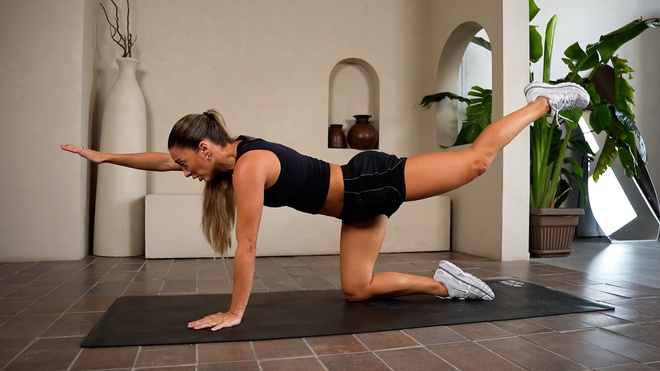
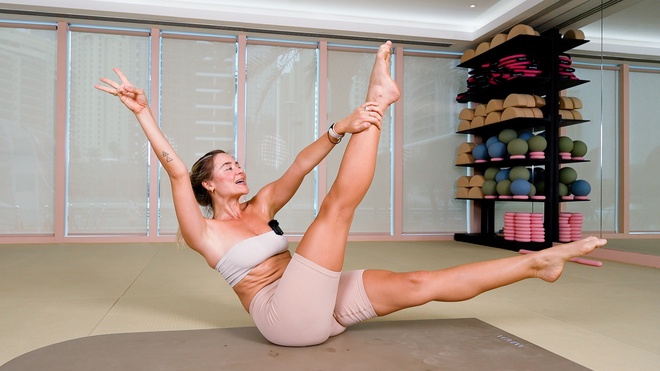
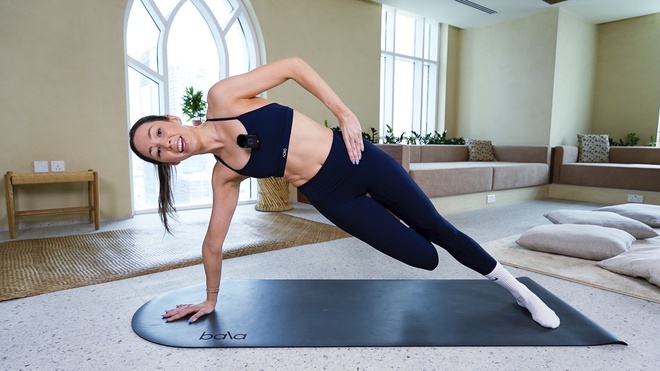
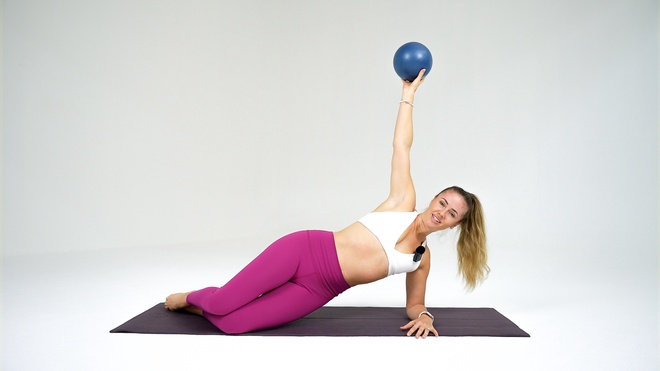

Join women building lateral core strength and stability with 11 certified trainers
Frequently Asked Questions
Related Exercises
Plank
The bilateral version. Trains anti-extension while the side plank trains anti-lateral flexion. Together they cover two of three core stability planes.
Russian Twist
Rotational oblique exercise. The side plank trains obliques isometrically. The Russian twist trains them dynamically through rotation.
Bicycle Crunches
Another oblique-dominant exercise. Combines rotation with flexion. Pairs well with the side plank for complete oblique training.
Bird Dog
The other McGill Big 3 exercise in our library. Trains anti-rotation and anti-extension. Combined with side plank and curl-up, completes McGill's spinal stability protocol.
Crab Walks
Gluteus medius-focused movement. Complements the hip stabilization benefits of the side plank with a dynamic pattern.
This exercise helps with
Get side plank in a guided workout
Access 10 workouts featuring this exercise, plus personalized plans from Dr. Wellls.
Join women building lateral core strength and stability with 11 certified trainers
Your membership funds independent women's health research