Crab Walks: How-to, Benefits & Variations
Crab walks target the gluteus medius by stepping laterally in a quarter squat with a resistance band around the ankles. Keep toes forward and band taut. Builds hip stability and reduces knee pain.
Crab Walks: How-to, Benefits & Variations
Crab walks look ridiculous. I need to say that upfront because if you have never done them, the first thing you will think when you see someone shuffling sideways in a half-squat with a band around their ankles is: that looks like a game we played in primary school. And you would be right. It does look like a playground drill. Except this particular drill activates the gluteus medius at rates that make most standing exercises look lazy by comparison.
I teach crab walks differently than trainers who treat them as a warm-up throwaway. Sophie Jones, who leads all 7 of our crab walk workouts, programs them as a core movement in Strength Fundamentals, Athlete Mode, and her 14-Day Glow Up Challenge. She does not toss them in for 30 seconds as an afterthought. She builds entire circuits around them: crab walks into shoulder presses, crab walks into squat jumps, speed rounds where the band never goes slack.
The reason the crab walks exercise works is biomechanics. Your gluteus medius, that muscle on the side of your hip, is responsible for every single lateral movement your body makes. Stepping sideways to avoid a puddle. Catching your balance when someone bumps into you on a crowded train. Stabilizing your pelvis so your knees do not cave inward during squats. When this muscle weakens, your knees drift in, your hips ache, and your lower back picks up the slack. Crab walks are the most direct way to load it.
Full Workout
Sophie Jones
How to Do Crab Walks
Place a resistance band around your ankles. Sophie Jones cues: band goes around the ankles. The ankles, not above the knees. Ankle placement creates a longer lever arm, which means the band has to work harder against every step you take. If you are new to crab walks, you can start with the band above the knees and graduate to the ankles.
Stand with feet hip-width apart, knees slightly bent, and sit your hips back into a quarter squat. Sophie: slight flex in the knees, core engaged, glutes engaged. Your chest stays upright, your weight shifts into your heels, and you feel tension in the band before you even take a step. If the band is loose in this position, it is too light.
Step your right foot out to the right, leading with the heel. Keep your toes pointing straight forward. Sophie hammers this: keeping my toes forward, I'm not twisting my foot out and leading with my toe. The moment your toes angle outward, your hip rotators take over and the gluteus medius checks out. Toes forward. Every step.
Follow with your left foot, stepping in just enough to restore tension but never so much that the band goes slack. Sophie: band stays tight, no wrinkles in the band. This is the critical detail. If your feet come too close together between steps, you lose resistance and the exercise becomes a shuffle with extra steps.
Continue stepping laterally for 8-12 steps, then reverse direction. Maintain that quarter squat depth throughout. The burn should live in the side of your hips, not your quads. If your quads are screaming, you are sitting too deep. If you feel nothing in your hips, the band is too loose or your steps are too narrow.
Keep your feet flat on the floor. Sophie: keep your feet nice and flat, just scoot along the floor. You are not marching sideways. You are scooting. Low to the ground. Controlled. The less your body bobs up and down, the more constant the tension stays on the gluteus medius.
Muscles Worked
Primary
Gluteus medius
The gluteus medius is the star of the crab walks exercise. It sits on the outer surface of your pelvis and produces hip abduction, the movement of stepping your leg away from your midline. A meta-analysis of therapeutic exercises found that lateral band walks generate among the highest EMG activity in the gluteus medius of any commonly prescribed exercise. Every lateral step against the band is a concentric contraction. Every controlled follow-step is an eccentric brake. The muscle never rests during a set of crab walks.
Gluteus minimus
Sitting beneath the medius, the gluteus minimus assists with hip abduction and internal rotation. It fires continuously during banded crab walks to stabilize the pelvis with each lateral step. Research on hip-focused rehabilitation exercises confirms the minimus works in concert with the medius during lateral stepping patterns. When both muscles are strong, your pelvis stays level during single-leg activities like walking, climbing stairs, and running.
Gluteus maximus
The largest glute muscle maintains the quarter-squat position throughout the movement. While the medius handles the lateral stepping, the maximus fires isometrically to keep your hips hinged and your knees tracking over your toes. Sophie Jones' cue captures it: core engaged, glutes engaged. The maximus engagement increases substantially in the squat jump variation, where it produces the explosive hip extension.
Secondary
Tensor fasciae latae (TFL) and IT band complex
The TFL assists the gluteus medius during hip abduction. In crab walks, it fires with each lateral step. However, the goal is for the glute medius to dominate. If you feel the burn primarily on the front-outside of your hip rather than the side, the TFL is compensating. Wider steps and a slightly deeper squat shift the load back to the medius.
Quadriceps
Your quads maintain the quarter-squat position throughout the exercise. They work isometrically to keep your knees bent at roughly 30-45 degrees. The deeper you squat, the more quad involvement. Sophie keeps the squat relatively shallow for crab walks because the focus is the lateral hip, not the thigh.
Core (transversus abdominis, obliques)
Your core stabilizes the trunk against the lateral pull of the band. Without core engagement, you would lean toward the stepping leg with every rep. Sophie cues this directly: I'm engaging the core, I'm engaging my glutes. The anti-lateral-flexion demand on the core is subtle but constant.
Why this matters in perimenopause
The gluteus medius weakens faster than most muscles during perimenopause because daily life rarely demands lateral movement. You walk forward. You sit down. You stand up. Almost nothing in a typical day asks you to step sideways against resistance. Declining estrogen accelerates this disuse atrophy. Research on exercise adaptations in perimenopause confirms that targeted resistance training reverses muscle loss in specific muscle groups, but only if those groups are actually loaded. Crab walks load the medius directly. That matters because a weak gluteus medius is implicated in knee pain, IT band syndrome, hip bursitis, and pelvic instability. A systematic review of hip strengthening for knee osteoarthritis found that hip abductor exercises significantly reduced pain and improved function. Bone density matters here too. Weight-bearing lateral movement loads the femoral neck, one of the primary fracture sites in osteoporosis.
Coach's Tips
"Keeping my toes forward, I'm not twisting my foot out and leading with my toe." Sophie Jones repeats this cue in every crab walk segment across all 7 workouts. It is the single most common mistake. When your toes rotate outward during the step, the hip external rotators take over and the gluteus medius does significantly less work. Watch your feet. If you catch them angling out, pause, reset, and step with intention. Toes forward. Always.
Sophie Jones
"Band stays tight, no wrinkles in the band." The band must stay under tension for the entire set. If it bags between steps, you are bringing your feet too close together. Sophie: don't make it bag. Think of the band as a visual cue for quality. Wrinkles in the band mean wrinkles in your form. Tight band, tight glutes, tight core. That is the standard.
Sophie Jones
"No letting the knees come in. Squeeze. No chicken knees." Sophie's nickname for valgus knee collapse. When the band pulls your knees inward and you stop fighting it, you have lost the entire point of the exercise. Actively push your knees outward against the band. The resistance should feel like a tug-of-war between the band pulling in and your hips pushing out.
Sophie Jones
"If the band starts to roll or twist, pause and reset it around your ankles to maintain proper resistance." A twisted band digs into the skin and distributes force unevenly. It also changes the resistance angle. Sophie pauses mid-workout to fix this. You should too. The 5 seconds you spend resetting the band saves you from 30 seconds of compromised form.
Sophie Jones
"Small little movements." Sophie cues this in Total Body Conditioning, where crab walks lead into squat jumps. The tendency when you speed up is to take giant strides. Resist that. Banded crab walks are about controlled, consistent lateral steps. Small steps keep the band taut. Large steps create momentum that the band cannot control.
Sophie Jones
"Exhale as you press the weights overhead or jump to maintain intra-abdominal pressure." In the shoulder press and squat jump variations, the breathing pattern matters. Exhale on the effort. For standard crab walks, breathe steadily and continuously. Do not hold your breath. The movement is sustained, not explosive, so your breathing should match.
Sophie Jones
"Move the resistance band from the ankles to just above the knees to reduce the lever length and focus more on the hip abductors." This is the easiest regression. Above-the-knee placement cuts the resistance roughly in half because the lever arm is shorter. Start here if you are new to banded work, recovering from a hip or knee issue, or the ankle placement causes discomfort on your Achilles tendon.
Sophie Jones
"If you wanna spice it up, guess what? You're gonna do three squat jumps." Sophie's progression for Athlete Mode and Total Body Conditioning. After each length of crab walks, drop into a squat and explode upward for 1-3 jumps. This converts the exercise from a pure lateral stability drill into a metabolic conditioning combo. Only attempt this once standard crab walks feel easy at the ankle level.
Sophie Jones
Why This Matters for You
Crab walks target the exact weakness pattern that perimenopause creates. Here is what happens: estrogen drops, muscle recovery slows, and the muscles you do not actively load start losing mass first. The gluteus medius qualifies because nothing in a typical desk-and-commute day demands lateral hip movement. Research on exercise adaptations in perimenopause confirms that resistance training targeted at specific muscle groups reverses this decline, but only if you actually train those muscles. Squats and lunges train the maximus. Crab walks train the medius. They are not interchangeable.
The knee protection angle is significant. Hip abductor weakness is one of the strongest predictors of knee pain in women. A systematic review found that hip strengthening exercises reduced knee osteoarthritis pain more effectively than quadriceps strengthening alone. Your hips and your knees are mechanically linked. Weak hips equal stressed knees.
And there is the pelvic stability connection. The gluteus medius supports pelvic alignment during single-leg stance, which is what walking fundamentally is. When this muscle weakens, your pelvis drops on the non-stance side with every step. That pelvic drop cascades into lower back strain, SI joint irritation, and altered gait. Building medius strength with crab walks directly addresses this chain.
Variations & Modifications
Banded Crab Walks
mediumThe standard version and the one Sophie programs most frequently. Band around the ankles, quarter squat, lateral steps. This is the baseline. All 15 occurrences in our library use a band because without one, there is no progressive resistance against the lateral step.
Crab Walk with Shoulder Press
medium-highCrab walk to the end of the mat, then perform a standing double shoulder press. Sophie programs this in Total Body Conditioning: stepping across, get to the end of the mat, and then you're gonna go into a double shoulder press. The press adds upper body work and creates a full-body combination from a lower-body drill. Sophie cues: make sure we're not arching forward as we push, abs tight, butt tight.
Crab Walk + Squat Jump
highCrab walk one length, then explode into 1-3 squat jumps. Sophie: small little movements, when I get to the end, I'm gonna go here, squat jump. Really try and push through the toes as you lift. This is the highest intensity version in our library and turns crab walks into a metabolic conditioning exercise. Land softly with knees tracking over toes.
Speed Round Crab Walks
highSame movement, faster tempo. Sophie programs this as a finisher in Body by Band: just 'cause we're going a bit faster, don't forget the band, that still needs to stay super tight. Speed rounds test whether you can maintain form under fatigue. The band wants to go slack. Your toes want to twist. Your knees want to cave. Fighting all three at speed is the real challenge.
Benefits
Common Mistakes to Avoid
Workouts Featuring This Exercise
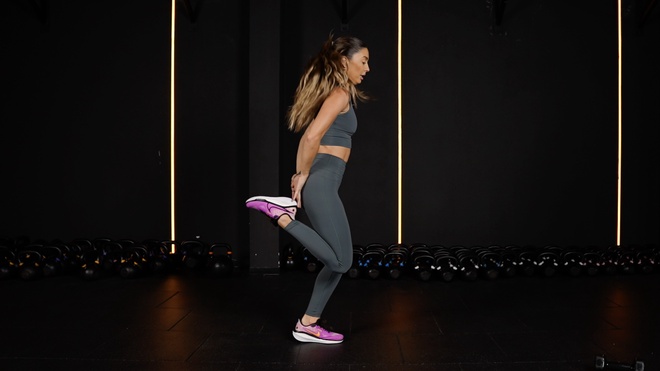
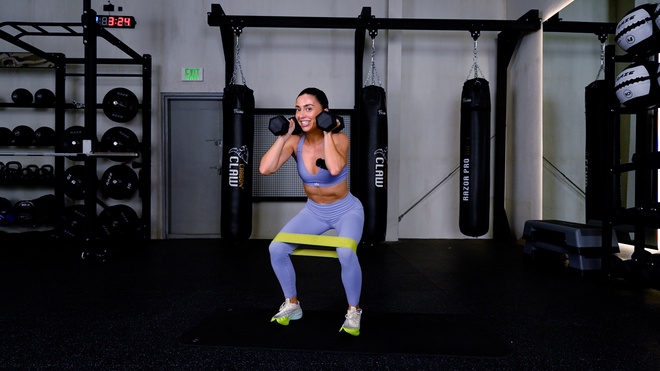
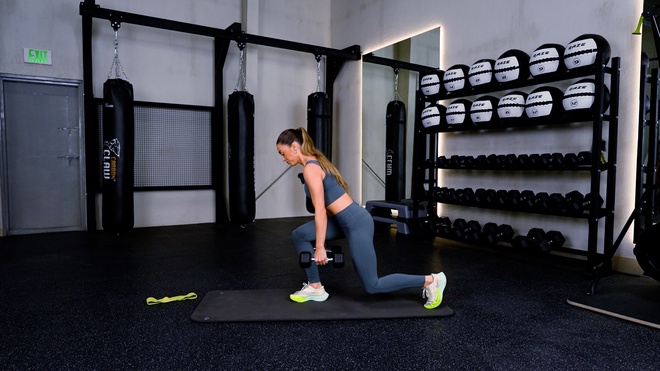
Join women building hip stability and reducing knee pain with Sophie Jones across 7 workouts
Frequently Asked Questions
Related Exercises
Banded Lateral Walk
The closest sibling exercise. Both use a band for lateral stepping. The difference: banded lateral walks are typically performed in a more upright stance with the band above the knees. Crab walks use a deeper squat with the band at the ankles. Together they hit the gluteus medius from two different joint angles.
Monster Walk
Combines forward stepping with lateral stepping against band resistance. Monster walks add hip flexion to the abduction pattern, loading the gluteus medius in a different plane. A natural progression once crab walks feel comfortable.
Fire Hydrant
Another gluteus medius isolation exercise, performed on all fours. Fire hydrants train hip abduction through a different range of motion and position. Pair them with crab walks for complete medius coverage from both standing and quadruped positions.
Clamshell
The classic side-lying hip abduction exercise. EMG analysis confirms high gluteus medius activation during clamshells. Clamshells work the medius in external rotation, while crab walks work it in pure abduction. Different vectors, same muscle.
Glute Bridge
Targets the gluteus maximus through hip extension, complementing the medius focus of crab walks. Together they form a complete glute activation sequence: bridge for the maximus, crab walks for the medius.
This exercise helps with
Get crab walks in a guided workout
Access 7 workouts featuring this exercise, plus personalized plans from Dr. Wellls.
Join women building hip stability and reducing knee pain with Sophie Jones across 7 workouts
Your membership funds independent women's health research