Crunches: How-to, Benefits & Variations
Crunches target the rectus abdominis, obliques, and transverse abdominis. Lie face up, knees bent, curl shoulders 4 inches off the mat while exhaling. Builds core strength and reduces back pain risk.
Crunches: How-to, Benefits & Variations
I teach crunches differently than most trainers. Not harder. Not with more reps. Just correctly. Because the standard crunch that most people grind through, neck straining, hip flexors hijacking the movement, is barely an ab exercise at all.
The real crunch is a small, controlled curl. Maybe four inches of movement. That's it. Bonnie Lyall puts it best: "Think about using your core muscles to lift you up, rather than pulling yourself up with your head." When you get this right, 15 reps will burn more than 50 sloppy ones ever could.
A 2025 meta-analysis of 57 RCTs found core training reduced chronic low back pain with an effect size of 0.70. Crunches are one of the most accessible entry points into that evidence base. No equipment. No gym. Just your body, the floor, and the willingness to move four inches with intention.
Energize Your Day: Workout 5
Mish Naidoo
How to Do Crunches
Lie on your back with your knees bent, feet flat on the floor about hip-width apart. Place your hands lightly behind your head, fingertips touching, elbows wide. Mish Naidoo cues: "Feet flat on the floor, arms support the neck and head."
Press your lower back into the mat. This is non-negotiable. If there's a gap between your spine and the floor, your core isn't engaged yet. Lianna Brice checks for this: "Rather than tuck your pelvis, I want you to only move in your rib cage."
Exhale and slowly curl your head, neck, and shoulders off the mat. Think of sliding your ribs toward your hip bones. The lift is small. Maybe four inches. Mish cues: "Give me tiny lifts with the upper body, gazing up."
Hold the top for one beat. Bonnie Lyall's cue: "Think about your ribs and your hips sliding towards each other." You should feel a deep contraction just below your sternum. If you feel it in your neck, you've gone too far.
Inhale and lower back down with control. Don't drop. The lowering phase matters as much as the lift. Jessica Casalegno cues: "Inhale to lower down." Each rep should take about 3 seconds total.
Keep your elbows wide throughout. Lianna cues: "Lift your elbows just away from the floor so you can see them out of the corners of your eyes." If your elbows collapse inward, your hands are pulling your head, not supporting it.
Muscles Worked
Primary
Rectus abdominis
The main mover. Curls the rib cage toward the pelvis through spinal flexion. A systematic review of EMG studies found crunches consistently activate the upper portion of the rectus abdominis at high levels compared to other core exercises.
Obliques (internal and external)
Stabilize the trunk during the curl and rotate the torso in twisting variations. Cross-body crunches increase oblique activation significantly. Bonnie cues: "Really focus on twisting from above your belly button."
Transverse abdominis
The deep corset muscle. Engages isometrically to stabilize the spine before and during the curl. Research on chronic low back pain patients shows this muscle's anticipatory firing pattern is disrupted, and core exercises like crunches help retrain it.
Secondary
Hip flexors (iliopsoas)
Assist with trunk flexion, especially in variations where feet are unsupported. Keeping feet flat and knees bent reduces their involvement, keeping the load on the abs.
Upper back (erector spinae)
Eccentrically controls the lowering phase. Works against gravity to prevent you from dropping back to the mat.
Neck flexors (sternocleidomastoid)
Initiate the head lift. Overuse causes neck pain, which is why proper hand placement behind the head matters. The hands support, they don't pull.
Why this matters in perimenopause
Core strength isn't vanity work during perimenopause. It's structural medicine. A 2022 systematic review confirmed core stability exercises effectively manage non-specific low back pain, the exact kind of lower back ache that escalates when estrogen drops and spinal ligament laxity increases. The transverse abdominis and pelvic floor work as a unit. When one weakens, the other compensates poorly. Crunches done correctly train the upper layer (rectus abdominis) while the deep core fires underneath. A 2023 meta-analysis of 27 RCTs showed resistance training improved lean body mass and functional strength in menopausal women. Three sessions per week, 20-90 minutes. Crunches are part of that prescription.
Coach's Tips
"Think about using your core muscles to lift you up, rather than pulling yourself up with your head." That's Bonnie Lyall, and it fixes the number one crunch mistake I see. If your neck hurts after crunches, your hands are doing the work. Fingertips touch behind the head. That's all. No interlocking, no gripping, no yanking.
Bonnie Lyall
"Think about your ribs and your hips sliding towards each other." Another Bonnie cue. This reframes the whole movement. You're not lifting your head toward the ceiling. You're shortening the distance between your rib cage and your pelvis. Completely different feeling once it clicks.
Bonnie Lyall
"Lift your elbows just away from the floor so you can see them out of the corners of your eyes." Lianna Brice's elbow cue solves neck strain instantly. Wide elbows force your chest to stay open and prevent your shoulders from rounding forward. If you can't see your elbows in your peripheral vision, they're too closed.
Lianna Brice
"Rather than tuck your pelvis, I want you to only move in your rib cage." Lianna again. Pelvis stays flat and quiet. The movement happens above the belly button. I've watched people do hundreds of crunches by rocking their hips. Zero ab work. All momentum. Keep the pelvis still.
Lianna Brice
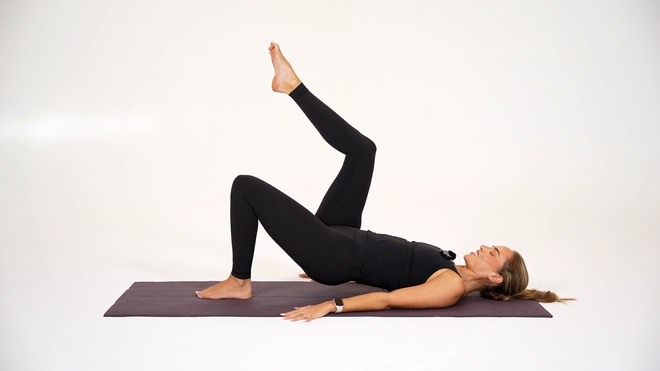
"Make sure that when you're lifting that leg to tabletop, you're not rocking your hips from side to side." Bonnie catches this in her Pilates classes. Hip rocking during crunch variations means your deep core isn't stabilizing. If your hips shift, drop back to basic crunches with feet flat until you can hold the pelvis dead still.
Bonnie Lyall
"Exhale as you lift the neck, as you lift the shoulders." Mish Naidoo's breathing pattern. Exhale on the curl, inhale on the lower. This isn't optional. The exhale compresses your abdominal cavity, driving deeper core engagement and supporting your pelvic floor under the contraction.
Mish Naidoo
If your neck fatigues before your abs, you're compensating. Drop your hands to your sides and reach them along the mat toward your feet as you curl. Removes the neck load entirely. Build neck endurance separately. Then graduate back to hands behind the head.
Why This Matters for You
Here's something that gets buried in most exercise guides. The core isn't just about aesthetics. During perimenopause, declining estrogen weakens the connective tissue around your spine, your pelvic floor, and your deep stabilizing muscles. The result? More lower back pain. More incontinence. More instability during daily movements.
A 2022 systematic review confirmed core stability exercises effectively manage non-specific low back pain. That's the chronic, nagging kind that has no single clear cause but gets worse with hormonal shifts. A separate 2025 meta-analysis of 57 RCTs found that core resistance training, the category crunches belong to, produced the most stable functional improvements across all core training types.
The pelvic floor connection matters here too. Crunches done with a proper exhale pattern teach your abdominal wall and pelvic floor to co-contract. That's not a Kegel. It's a whole-system bracing pattern that you need every time you cough, sneeze, lift a suitcase, or pick up a toddler. A 2025 systematic review found pelvic floor training reduced urinary incontinence by 37%. The breathing mechanics in a well-executed crunch follow the same logic.
And then there's sarcopenia. A 2023 meta-analysis of 27 RCTs showed resistance training improved lean body mass and grip strength in menopausal women. Three sessions per week. The core muscles are part of that lean mass. They atrophy too. Crunches are one of the lowest-barrier entries into maintaining them.
Variations & Modifications
Basic Crunches (Feet Down)
lowThe foundation. Feet flat, knees bent, hands behind head or by your sides. Small curl, small lower. Master this before anything else. If you can do 15 perfect reps without your neck aching, your form is locked in. Lianna teaches this in her Barre Burn series as the starting point for every core block.
Crunch Pulses
mediumCurl up to the top position and hold. Now pulse: tiny lifts, half an inch, staying in the burn zone. Mish cues: "Hold it up. From here, we lift, and we lower." The constant tension eliminates momentum. Your rectus abdominis has nowhere to hide. Twenty pulses will humble anyone who thinks crunches are easy.
Cross-Body Crunch
mediumOpposite elbow to opposite knee. Mish cues: "Find that crunch, your shoulder is lifting off the mat. Drawing the navel in to the spine." This shifts the load to the obliques. The crunches muscles worked change dramatically with this single rotation. Do equal reps on both sides.
Single Leg Crunch with Twist
medium-highOne knee draws in while you crunch and twist toward it. The other leg stays extended or hovers above the floor. Lianna programs this in her Barre Burn workouts as a progression from basic crunches. The single-leg position challenges your pelvis to stay neutral while your torso rotates. Two stability demands at once.
Crunch with Leg Abduction Reach
highLegs vertical, resistance band around ankles. Open your legs against the band while crunching up and reaching hands through. Linda Chambers cues this in her Abs & Glutes series. It loads the outer thighs and deep core simultaneously. A full abdominal assault that disguises itself as a simple crunch.
Tabletop Crunches
mediumSame curl, but with legs lifted to a 90-degree tabletop position. Bonnie cues: "Bring your right leg to tabletop, then we lower the head down, lower the foot. We lift up, opposite leg." Lifting the feet removes the hip flexor anchor, forcing your abs to stabilize both the curl and the leg position.
Benefits
Strengthens the anterior core without equipment
Crunches target the rectus abdominis and obliques with zero equipment. A mat. A floor. That's the full shopping list. A 2022 systematic review of EMG studies confirmed crunches produce high rectus abdominis activation compared to many other common core exercises. The simplicity is the point.
Reduces lower back pain risk
A 2025 meta-analysis of 57 RCTs found core training significantly reduced chronic low back pain (effect size 0.70). Core resistance training, the category crunches fall into, showed the most stable effects on functional improvement. Your abs and back muscles work as opposing partners. When one side weakens, the other suffers.
Builds the deep core stabilization pattern
Research shows that people with low back pain lose the anticipatory firing of their transverse abdominis. The deep core stops bracing before movement. Crunches retrain that pattern. When you press your lower back into the mat and exhale into the curl, you're teaching your core to fire in the right sequence.
Protects the pelvic floor when done correctly
Crunches with a proper exhale-on-exertion pattern teach your pelvic floor to co-contract with your abdominal wall. A 2025 systematic review showed pelvic floor muscle training reduced postpartum urinary incontinence by 37%. The breathing pattern in crunches mirrors that same co-contraction mechanics.
Adaptable to any fitness level
I've programmed crunches for someone recovering from a C-section and for a competitive powerlifter in the same week. Feet down, arms by your sides: gentlest version. Band around ankles, legs vertical, pulsing with a hold: that'll challenge anyone. The crunches variations are practically endless, and every one of them starts from the same floor position.
Common Mistakes to Avoid
Pulling the head forward with the hands
The most common mistake and the reason people say crunches hurt their neck. Fingertips touch behind your head. That's it. No interlacing, no gripping, no pulling. Bonnie's cue: use your core to lift you up, not your hands. If your neck tires before your abs, drop your hands to your sides.
Using hip flexor momentum instead of abdominal contraction
Lianna catches this constantly: "Rather than tuck your pelvis, I want you to only move in your rib cage." If your pelvis rocks or your lower back lifts off the mat, your hip flexors have taken over. Press the lower back down. Keep the pelvis still. The movement is smaller than you think.
Sitting all the way up (turning crunches into sit-ups)
A crunch is not a sit-up. You lift your shoulders maybe four inches off the mat. That's it. The rectus abdominis only produces spinal flexion through about 30 degrees. Going higher shifts the work to your hip flexors and compresses your lumbar discs. Small movement. Big results.
Holding your breath throughout the rep
Mish cues: "Exhale as you lift the neck, as you lift the shoulders." Breath-holding spikes intra-abdominal pressure in a way that bears down on the pelvic floor. Exhale on the curl, inhale on the lower. The exhale actually deepens the abdominal contraction.
Workouts Featuring This Exercise
Join women building core strength and back resilience with certified trainers
Frequently Asked Questions
Related Exercises
Bicycle Crunches
The natural progression from basic crunches. Adds rotation and hip flexor coordination.
Leg Raises
Targets the lower portion of the rectus abdominis that crunches miss.
Dead Bug
Teaches anti-extension core stability. Pairs perfectly with crunches for a complete core session.
Plank
Isometric hold that complements the dynamic contraction of crunches.
Russian Twist
Targets oblique rotation from a similar floor position. Good superset pairing.
This exercise helps with
Get crunches in a guided workout
Access 5 workouts featuring this exercise, plus personalized plans from Dr. Wellls.
Join women building core strength and back resilience with certified trainers
Your membership funds independent women's health research