Leg Raises: How-to, Benefits & Variations
Leg raises target lower abs, hip flexors, and deep core. Lie flat, press back into the mat, lift legs to vertical, lower slowly. Builds core strength and protects the lower back.
Leg Raises: How-to, Benefits & Variations
When was the last time you asked your lower abs to actually work? Not crunch. Not twist. Just lift.
Most core exercises skip the part below the belly button. Crunches target the upper rectus abdominis. Planks train isometric endurance. But leg raises force the lower fibers of your abdominal wall to fight gravity while your lower back screams at you to cheat. I have watched hundreds of women attempt this exercise, and the first thing almost every one of them does wrong is the same: they let their lower back pop off the mat. Sophie Jones catches it instantly. "I don't wanna see this back arch, okay? So we're pushing, pressing the back down into the mat."
That one cue separates a leg raise that builds your core from a leg raise that wrecks your spine.
Core Sweat: Workout 8
Sophie Jones
How to Do Leg Raises
Lie flat on your back with your legs straight and arms by your sides. Press your lower back firmly into the mat. Sophie Jones cues: "Lie flat on the back, core pushed down." If there's a gap between your lower back and the floor, you're already in trouble. Roll your pelvis under until the gap disappears.
Place your hands underneath your glutes for extra stability, or keep them flat on the floor by your hips. Linda Chambers offers both options in her classes. Tucking your hands under gives your pelvis something to anchor against. "Tuck those hands underneath your butt, bringing the legs down," Sophie cues in her Core Sweat workouts.
Exhale and engage your deep core. Pull your belly button toward the floor. Linda describes it: "When we breathe out, we tighten through all of those deep core muscles to lift the legs." You should feel your transverse abdominis brace before your legs move a centimeter.
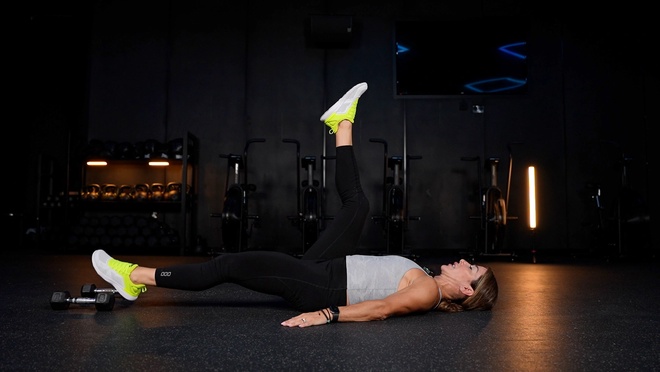
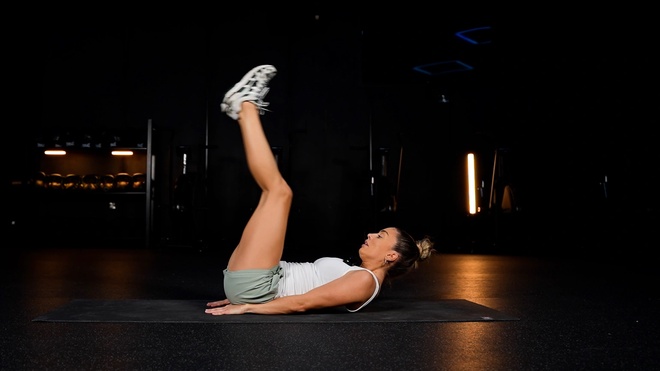
Keeping your legs as straight as possible, slowly lift both legs toward the ceiling until they're perpendicular to the floor. Beth Hannam cues: "Legs go up towards the sky." Flex your feet and reach your toes toward the ceiling at the top.
Inhale and lower your legs toward the floor with control. This is where the exercise actually happens. Sophie is clear: "We're gonna slowly, slowly, slowly lower both legs down." Resist gravity. Don't let them drop. Lower only as far as you can while keeping total spinal contact with the mat.
Exhale and use your core to drive the legs back up. Sophie cues: "Squeeze them abs." That's one rep. Repeat for 8-12 reps per set, 2-3 sets.
Muscles Worked
Primary
Rectus abdominis, especially lower fibers
Controls the raising and lowering of both legs against gravity. During the eccentric (lowering) phase, the lower fibers work hardest to prevent lumbar hyperextension. A 2022 systematic review of core therapeutic exercises confirmed that supine leg raise variations produced high rectus abdominis activation, particularly in the lower portion that crunches barely touch.
Hip flexors (iliopsoas, rectus femoris)
The primary movers for lifting the legs. The iliopsoas generates the hip flexion force. The rectus femoris assists because the knee stays extended. Some trainers dismiss leg raises as 'just a hip flexor exercise.' That's a misunderstanding. The core fights to stabilize while the hip flexors move. Both groups work, and both matter.
Transverse abdominis (deep core)
Braces the spine against the enormous lever of two straight legs. Without TA activation, the lower back arches and the exercise becomes dangerous. Sophie Jones cues this constantly: "Roll the pelvis under, belly button to the spine." That's TA engagement in plain language.
Secondary
Obliques (internal and external)
Stabilize the torso against lateral forces. When one leg is slightly stronger than the other, the obliques prevent your pelvis from tilting. You won't feel them burning, but they're working.
Lower back (erector spinae)
Eccentrically loaded during the lowering phase. The lower back has to stay neutral under significant mechanical load. This is why proper leg raises form requires constant spinal awareness. Linda Chambers cues: "It's not about touching the floor... a range of motion that you are able to maintain without that lower back popping off the ground."
Pelvic floor muscles
Co-activate with the transverse abdominis during the exhale-and-lift phase. A 2025 meta-analysis on pelvic floor exercises in postmenopausal women found that integrating core bracing patterns improved continence outcomes. Leg raises, done correctly with breathing, engage this system.
Why this matters in perimenopause
Here's something that stopped me cold when I first read the research: women lose approximately 1-2% of muscle mass per year during perimenopause, and the core is one of the first areas hit. A 2023 meta-analysis (27 RCTs, 1,989 menopausal women) found that resistance training three times weekly improved lean body mass and functional strength. But here's the part that matters for leg raises specifically. The lower abdominal wall and hip flexors are postural muscles. They hold you upright. When they weaken, your pelvis tips forward, your lower back compresses, and standing for more than twenty minutes starts to ache. Leg raises muscles worked include exactly the fibers that prevent this cascade.
Coach's Tips
"Roll the pelvis under, belly button to the spine." Sophie Jones says this before every single set. It's not a suggestion. Until your pelvis is tilted posteriorly and your lower back is glued to the mat, you haven't started the exercise. I've watched her demonstrate the wrong way on camera, back arched, belly popping out, and then show the correction. Night and day difference in core activation.
Sophie Jones
"Head and shoulders stay down, legs go up in the air." Linda Chambers keeps the upper body completely still. Some trainers lift the head and shoulders (Sophie does this for added difficulty), but Linda's method isolates the lower abs and hip flexors. If you're new to leg raises, her approach is the one I'd follow first.
Linda Chambers
"Get that nice little lift off that upper body so we can really get that nice core contraction." This is Sophie's advanced cue. Lifting your head and shoulders engages the upper rectus abdominis too, turning the leg raise into a full-abdominal exercise. But only use this if you can maintain a flat back with your head down first. Skip the progression if your neck complains.
Sophie Jones
"I don't wanna see this, arched backs." Sophie doesn't mince words. She says it in nearly every workout where leg raises appear. If your lower back lifts off the mat when your legs descend, you've gone too far. Full stop. Reduce your range of motion. Your ego will recover faster than a herniated disc.
Sophie Jones
"Finding a range of motion where you feel the challenge, but you don't feel strain through the lower back." Linda Chambers is specific about this. The goal is not to touch the floor with your feet. It never was. Lower to wherever you can keep your spine flat. For some women that's 45 degrees. For others it's barely below perpendicular. Both are correct.
Linda Chambers
"If it's too much, we can just keep the knees bent. Tap and lift." Linda offers this in her Functional Full Body class. Bending the knees shortens the lever arm, which cuts the load on your lower abs and hip flexors roughly in half. It's not a lesser version. It's the smart version for anyone building back up after pregnancy, surgery, or a long break from training.
Linda Chambers
"If it's too challenging, just stop halfway and then bring those legs back up." Beth Hannam gives permission to not finish the rep. I love this cue because it removes the all-or-nothing mentality. A half-range leg raise with perfect form builds more core strength than a full-range rep with your back flying off the mat.
Beth Hannam
"Inhale on the way down, exhale as we shorten and bring those legs back up." Linda Chambers teaches breathing as structure, not decoration. The exhale on the lift creates intra-abdominal pressure that protects your spine and amplifies core engagement. The inhale on the descent helps you control the eccentric phase. Reverse this pattern and you lose both benefits.
Linda Chambers
Why This Matters for You
I program leg raises for my perimenopause clients because this exercise hits three things that decline simultaneously during the hormonal transition. Core strength. Hip flexor function. Pelvic floor co-activation.
The research on muscle loss in menopausal women is stark. A 2023 meta-analysis of 27 RCTs (1,989 participants) showed that resistance training improved lean body mass and functional capacity. But the specific muscles that leg raises target have outsized importance for daily life. Your lower abs and hip flexors are postural muscles. When they weaken, your pelvis tips, your lower back compresses, and basic movements like walking or getting out of a car become labored.
A separate 2025 meta-analysis (57 RCTs, 7,705 participants) found core stabilization exercises more effective than general exercise for chronic low back pain. And a systematic review on diaphragmatic breathing and core stability confirmed that the exhale-and-brace pattern used during leg raises directly engages the pelvic floor.
None of this means leg raises are magic. They're not. But three sets, three times a week, on the floor of your living room, targeting muscles that most women don't even realize they're losing. That's worth the five minutes.
Variations & Modifications
Bent-Knee Leg Raise (Toe Taps)
lowBend your knees to 90 degrees and lower your feet toward the floor in a tapping motion. Linda Chambers programs this as the entry point: "If it's too much, we can just keep the knees bent. Tap and lift." Shorter lever arm means less load on the lower back and core. I start every postpartum client here. No exceptions.
Single Leg Raise
low-mediumAlternate legs instead of raising both together. Linda Chambers offers this in her Functional Full Body class: "If two legs is too much for you, you can give me a single leg raise instead." Halves the load while teaching your pelvis to stay neutral under asymmetric force. A surprisingly honest test of left-right imbalances.
Leg Lowers
mediumStart with legs vertical and only perform the lowering phase. Beth Hannam cues: "Legs go up towards the sky. We're gonna slowly, slowly, slowly lower both legs down." The eccentric portion is where the lower abs work hardest. Jessica Casalegno programs this with a stability ball in her Pilates workouts for added proprioceptive challenge.
Leg Raises with Head Lift
medium-highLift your head and shoulders slightly off the mat while performing the leg raise. Sophie cues: "Get that nice little lift off that upper body so we can really get that nice core contraction." This version engages both upper and lower rectus abdominis simultaneously. Only progress here after you can do 12 standard reps with a perfectly flat back.
Core Ladder Leg Raises
highA progressive ladder format where you perform increasing rounds without rest. Sophie Jones programs this in her Core Sweat series. The longest clip in our library is over five minutes of continuous leg raises with ladder progressions. It's brutal. She says it herself: "Bringing your legs as far down as you can, driving back up." No breaks. No mercy.
Benefits
Targets the lower abs that crunches miss
Crunches primarily work the upper rectus abdominis through spinal flexion. Leg raises work the lower fibers through hip flexion against gravity while the core stabilizes. A 2022 systematic review of core therapeutic exercises confirmed that supine leg raise variations activated the lower abdominal wall at higher levels than traditional crunches. If your "ab routine" is just crunches, you've been training half the muscle.
Builds hip flexor strength for daily function
Your hip flexors lift your legs every time you walk, climb stairs, or get out of a chair. The leg raise exercise loads these muscles through a full range of motion with control. Weak hip flexors contribute to an anterior pelvic tilt, which compresses the lumbar spine. This matters more as you age, not less.
Protects the lower back when done correctly
I know that sounds contradictory. Leg raises have a reputation for causing back pain. But that's only when form breaks down. Done right, with the pelvis posteriorly tilted and the core braced, leg raises train the exact pattern that prevents lumbar hyperextension in real life. A 2025 meta-analysis of core training for chronic low back pain (57 RCTs, 7,705 participants) found core stabilization exercises superior to general exercise for pain reduction.
Zero equipment, high payoff
A mat. That's it. Sophie Jones programs leg raises in workouts labeled Weight Loss, Muscle Tone, and Strength Training because the exercise crosses categories. You can do three sets of twelve in under five minutes. The leg raises benefits stack up because there's nothing preventing you from doing them today. Right now. On whatever surface you're near.
Engages the pelvic floor through core co-activation
The exhale-and-brace pattern during leg raises activates the pelvic floor along with the transverse abdominis. A 2025 meta-analysis found that pelvic floor muscle training improved quality of life in postmenopausal women. Leg raises are not a pelvic floor exercise per se, but the bracing pattern reinforces the same neuromuscular pathway. Two birds.
Common Mistakes to Avoid
Lower back arching off the mat
This is the mistake. Sophie Jones catches it in every single workout: "I don't wanna see this back arch, okay? So we're pushing, pressing the back down into the mat." If your back leaves the floor, your core has lost the fight. Reduce your range of motion immediately. Only lower your legs as far as your back stays flat. For some women that's barely past vertical. That's fine.
Lowering legs too fast
Gravity does the work on the way down if you let it. The entire point of leg raises is resisting that descent. Beth Hannam cues: "Slowly, slowly, slowly." Three seconds down, one second up. The moment your legs drop, you've turned a core exercise into a hip flexor fling. Control the eccentric.
Holding the breath
Your natural instinct under load is to hold your breath. Fight that. Linda Chambers is explicit: "Inhale on the way down, exhale as we shorten and bring those legs back up." Breath holding spikes intra-abdominal pressure in an uncontrolled way and can stress the pelvic floor. The exhale on the lift is what makes the core engagement happen.
Using momentum instead of muscle
Swinging the legs up using hip flexor momentum defeats the purpose. Linda Chambers wants you to "find a range of motion where you feel the challenge, but you don't feel strain." Pause briefly at the top of each rep. If you can't pause, you're swinging. Slow down or bend your knees.
Workouts Featuring This Exercise
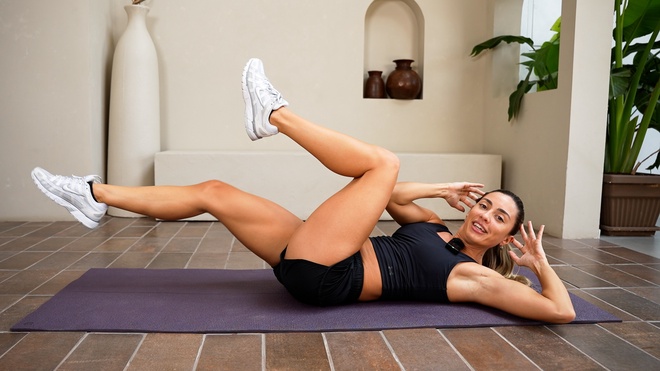
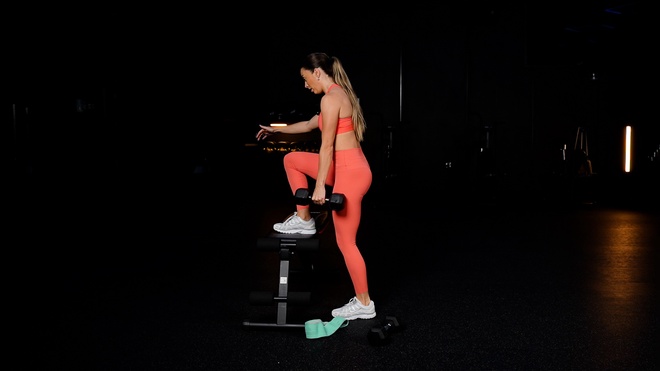
Join women building core strength with certified trainers in guided video workouts
Frequently Asked Questions
Related Exercises
Crunches
Targets the upper rectus abdominis. Pair with leg raises for complete abdominal coverage.
Bicycle Crunches
Combines upper ab crunch with leg movement. More dynamic than standard leg raises, targets obliques harder.
Dead Bug
Same supine position, same anti-extension demand. Easier to control the lower back because limbs move independently.
Hollow Body Hold
Isometric version of the leg raise bottom position. Teaches the posterior pelvic tilt that makes leg raises safe.
Hollow Hold
A gymnastics staple that reinforces the bracing pattern. If you can hold this for 30 seconds, your leg raises form will improve overnight.
This exercise helps with
Get leg raises in a guided workout
Access 10 workouts featuring this exercise, plus personalized plans from Dr. Wellls.
Join women building core strength with certified trainers in guided video workouts
Your membership funds independent women's health research