Shoulder Press: How-to, Benefits & Variations
The overhead press builds shoulder and tricep strength. Press dumbbells from shoulder height to overhead. Key for bone density and functional pressing.
Shoulder Press: How-to, Benefits & Variations
Reach for a high shelf. Push a suitcase into an overhead bin. Lift your child above your head and make them laugh. Every one of these is an overhead press, and most women cannot do them without wincing by age 45.
The overhead press is the most honest upper body exercise. There is nowhere to hide. Your core braces, your shoulders stabilize, your triceps lock out. If anything in that chain is weak, the weight does not go up. That's why I start every upper body program with it.
Muscle Tone: 14 Days Glow Up Challenge 8
Danielle Harrison
How to Do Overhead Press
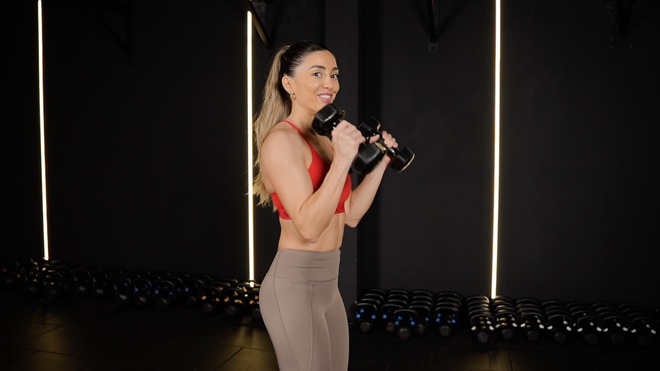
Hold a dumbbell in each hand at shoulder height. Palms can face forward (traditional) or toward each other (neutral grip, easier on the shoulders).
Stand with feet hip-width apart, core braced. Slight bend in the knees. Squeeze your glutes to lock your pelvis in place.
Press both dumbbells straight overhead. The path should be slightly inward so the weights nearly touch at the top.
Fully extend your arms without locking the elbows hard. Your biceps should be near your ears at the top.
Lower the dumbbells back to shoulder height with control. Do not let them drop. The lowering phase builds as much strength as the pressing phase.
Exhale on the press, inhale on the descent. Keep your chin tucked slightly to avoid jutting your head forward.
Muscles Worked
Primary
Anterior deltoid
Primary driver of the overhead pressing motion. Handles most of the load during the bottom half of the press.
Medial deltoid
Assists with the pressing motion and stabilizes the shoulder joint throughout the movement.
Triceps
Takes over as the primary mover in the top half of the press, extending the elbows to lockout.
Secondary
Upper trapezius
Stabilizes and upwardly rotates the scapulae as the arms move overhead.
Core
Prevents spinal extension under load. Without core bracing, the lower back absorbs forces meant for the shoulders.
Why this matters in perimenopause
Women lose lean muscle mass progressively from their 30s, and the decline accelerates during perimenopause as estrogen levels drop. Regular resistance training directly counteracts this decline by stimulating muscle protein synthesis and providing mechanical loading for bone health.
Coach's Tips
"Dumbbells coming up to your shoulders, open up the chest, elbows out." That's Danielle Harrison's cue. This detail makes the difference between an effective rep and a wasted one.
Danielle Harrison
"Drive up, full extension." That's Danielle Harrison's cue. This detail makes the difference between an effective rep and a wasted one.
Danielle Harrison
If anything feels sharp rather than challenging, stop immediately. Drop the weight and check your form. Discomfort is fine. Pain is a message.
Start with bodyweight only until the movement feels natural. Add resistance gradually.
Why This Matters for You
The shoulder press directly addresses three perimenopause priorities: muscle preservation, bone loading, and metabolic health. Estrogen decline after 40 accelerates sarcopenia, the age-related loss of lean muscle that changes body composition, weakens joints, and slows metabolism. Resistance training is the strongest evidence-backed countermeasure.
A 2023 network meta-analysis of 19 RCTs involving 919 postmenopausal women found moderate-intensity resistance training 3 days per week significantly improved lumbar spine and femoral neck bone mineral density. The effect was most pronounced during the first 48 weeks, meaning early adoption matters. The shoulder press loads the exact skeletal sites and muscle groups that perimenopause targets first.
Variations & Modifications
Standing Shoulder Press (Round 3)
mediumVariation of the shoulder press that modifies the standard movement pattern for different training emphasis.
Standing Shoulder Press (Round 2)
mediumVariation of the shoulder press that modifies the standard movement pattern for different training emphasis.
Alternating Single Arm Shoulder Press (Round 3)
mediumVariation of the shoulder press that modifies the standard movement pattern for different training emphasis.
Alternating Single Arm Shoulder Press (Round 2)
mediumVariation of the shoulder press that modifies the standard movement pattern for different training emphasis.
Benefits
Builds overhead pressing strength
Overhead pressing is a fundamental human movement pattern. You use it every time you put something on a shelf, lift a child, or push a heavy door overhead. Strong shoulders make daily life easier.
Protects the shoulder joint
The shoulder is the most mobile and least stable joint in the body. Pressing under load strengthens the rotator cuff muscles and deltoids that keep the joint safe during movement.
Corrects desk posture
Hours of sitting with arms forward weakens the posterior shoulder muscles. Overhead pressing re-trains the shoulders to retract and depress, counteracting rounded-shoulder posture.
Bone density at a critical site
The proximal humerus (upper arm bone near the shoulder) is an osteoporotic fracture site. Loading it through overhead pressing provides the mechanical stimulus for bone remodeling.
Common Mistakes to Avoid
Leaning back to press heavier weight
This turns a shoulder press into an incline chest press and loads your lower back. If you catch yourself leaning, drop the weight 20%.
Pressing the dumbbells too far forward
The press should travel straight up, not out in front. Think about pushing the ceiling away, not pushing a wall.
Shrugging the shoulders up
Depress your shoulder blades before you start pressing. The cue is shoulders away from your ears.
Incomplete range of motion
Lower until the dumbbells reach shoulder height and press until your arms are fully extended. Cutting either end reduces deltoid engagement.
Workouts Featuring This Exercise
Join women building strength and bone density with certified trainers
Frequently Asked Questions
Related Exercises
Lateral Raise
Complements the shoulder press by targeting related muscle groups and movement patterns.
Shoulder Stretch
Complements the shoulder press by targeting related muscle groups and movement patterns.
Standing Shoulder Press
Complements the shoulder press by targeting related muscle groups and movement patterns.
Arm Rotation
Complements the shoulder press by targeting related muscle groups and movement patterns.
Standing Shoulder Stretch
Complements the shoulder press by targeting related muscle groups and movement patterns.
This exercise helps with
Get overhead press in a guided workout
Access 4 workouts featuring this exercise, plus personalized plans from Dr. Wellls.
Join women building strength and bone density with certified trainers
Your membership funds independent women's health research