Lateral Raises: How-to, Benefits & Variations
Lateral raises target the medial deltoid and supraspinatus. Stand, raise dumbbells to shoulder height with arms slightly forward, lower slowly. Builds shoulder stability.
Lateral Raises: How-to, Benefits & Variations
Rounded shoulders from years at a desk. That nagging ache between your shoulder blades. The slow erosion of overhead reach that nobody warns you about until you can't grab a mug from the top shelf without wincing.
The lateral raise fixes all three. It targets your medial deltoid, the muscle responsible for shoulder width and stability. A 2023 systematic review of shoulder EMG data found that abduction movements like lateral raises produce the highest medial deltoid activation of any common strength exercise. That matters because the deltoid is a primary stabilizer of the glenohumeral joint, and when it weakens, your rotator cuff picks up the slack. Badly. Women during perimenopause face a double hit: estrogen loss accelerates both muscle wasting and connective tissue changes in the shoulder capsule. One study linked declining estrogen to increased adhesive capsulitis (frozen shoulder) risk. Lateral raises are cheap insurance against that.
14-Day Glow Up Challenge: Day 9
Sophie Jones
How to Do Lateral Raises
Stand with your feet hip-width apart, a slight bend in both knees. Hold a dumbbell in each hand at your sides with palms facing inward. Sophie Jones cues: slight flexion in the knees, never locking out.
Squeeze your glutes and brace your core. This is not optional. Sophie specifically cues glute engagement to prevent your lower back from arching when the weights go up. If your hips drift forward, the load transfers to your spine.
Raise both arms out to your sides, keeping them slightly in front of your body. Sophie's exact cue: arms in your peripheral vision, not directly to the side, slightly in front. This protects the shoulder joint by keeping the movement in the scapular plane.
Stop at shoulder height. Not above. Sophie is adamant about this: coming just to shoulder height, no higher. Going past horizontal jams the supraspinatus tendon against the acromion. That's how impingement starts.
Lower the dumbbells slowly, resisting gravity the entire way down. Sophie cues: control that movement more than anything. If the weights swing you on the descent, they're too heavy. Drop the weight, own the control.
Exhale as you lift, inhale as you lower. Keep a soft, relaxed bend in your elbows throughout. Not locked straight, not bent at 90 degrees. Think of pouring water from a pitcher at the top.
Muscles Worked
Primary
Medial deltoid
The main mover. Responsible for shoulder abduction, which is the arm-lifting-away-from-body motion. A systematic review of EMG data confirmed that lateral raises are among the top exercises for medial deltoid activation, producing higher recruitment than overhead presses for this specific head.
Anterior deltoid
Assists the medial deltoid, especially during the first 30 degrees of the raise and when arms are positioned slightly forward in the scapular plane.
Supraspinatus (rotator cuff)
Initiates the first 15 degrees of abduction. This small rotator cuff muscle is the spark plug of the movement. It's also the most commonly injured shoulder muscle, which is why stopping at shoulder height matters so much.
Secondary
Upper trapezius
Wants to take over. Sophie cues against this constantly: don't pull through the traps, relax the shoulders, keep them down. If your shoulders shrug toward your ears, traps are doing the work instead of deltoids.
Core (transverse abdominis, obliques)
Stabilizes the trunk against the lateral force. Sophie specifically cues core engagement and glute squeeze to protect the lower back during lateral raises.
Serratus anterior
Stabilizes the scapula against the rib cage. Weak serratus = winging scapula = shoulder impingement over time.
Why this matters in perimenopause
Women lose 30-40% of lean muscle mass relative to total body weight as they age, and the process starts around 30. Estrogen decline during perimenopause accelerates this. A 2020 meta-analysis found that resistance training produced large effect sizes for upper body strength in women (Hedges' g = 1.70). The shoulders respond particularly well because the deltoids are rich in androgen receptors. A 2023 meta-analysis of 27 RCTs (1,989 participants) showed resistance training improved lean body mass, grip strength, and knee extension strength in menopausal women. Three sessions per week, 20-90 minutes, for at least 6 weeks. The lateral raise exercise hits the exact muscle group that deteriorates fastest in the upper body.
Coach's Tips
"Arms in peripheral vision, though, so I'm not going directly here, slightly in front of me." That's Sophie Jones, coaching lateral raises form in real time. This single cue prevents 90% of shoulder injuries from this exercise. Lifting directly to the side externally rotates the humerus and narrows the subacromial space. Keeping your arms slightly forward, maybe 15-20 degrees, keeps the joint open. I teach this to every single client.
Sophie Jones
"Imagine you're trying to stretch to the sides of your room." Sophie's width cue changes how people think about the movement. Instead of lifting up, you're reaching out. This shifts the emphasis from the traps (which shrug up) to the delts (which push out). The difference in muscle activation is night and day.
Sophie Jones
"We're not pulling up through the traps. Relax the shoulders." Sophie repeats this in nearly every lateral raise set she teaches. I counted. She says some version of 'keep the traps down' in 6 out of 7 recorded sets. That's because the upper trapezius is a hijacker. It wants to take over the movement, and unless you consciously depress your shoulders before each rep, it will.
Sophie Jones
"Don't let the weight swing you. If it's swinging you, it's too heavy." I've lost count of how many women I've seen muscling through lateral raises with dumbbells that are 3-5 pounds too heavy. The result? Momentum does the lifting, traps do the stabilizing, and deltoids get nothing. Drop to a weight where you can pause at the top for a full second without anything shaking.
Sophie Jones
"Even squeeze hold of those glutes in that position, so we're not taking any pressure into that lower back." This cue surprised me the first time I heard it. But Sophie's right. Without glute engagement, your pelvis tilts forward when the arms lift, and your lower back hyperextends to compensate. Squeeze your glutes before each set. Keep them contracted throughout.
Sophie Jones
"Breathe out when I end up doing lifting the weight." Exhale on the raise, inhale on the lower. The exhale engages your deep core stabilizers and creates intra-abdominal pressure that supports your spine. If you're holding your breath the entire rep, you're building tension in the wrong places.
Sophie Jones
If full lateral raises aggravate your shoulder, try the scapular plane variation: angle your arms about 30 degrees forward instead of straight to the side. This reduces subacromial compression significantly. A 2022 systematic review on scapular stabilization exercises found that scapular-plane movements reduce impingement stress while maintaining deltoid activation. Sophie naturally teaches this plane without naming it.
Why This Matters for You
Here's something most fitness content won't tell you. The shoulder is one of the first joints to degrade during perimenopause, and most women don't notice until it's a problem.
Estrogen receptors in the shoulder capsule influence collagen turnover and inflammation. When estrogen drops, the capsule stiffens. Frozen shoulder peaks in women between 40-60, and the hormonal connection is now well-documented. A Duke University pilot study found that hormone therapy may help prevent adhesive capsulitis, which suggests the hormonal mechanism is real.
Meanwhile, the deltoids are losing mass. That 2020 meta-analysis of 24 studies on resistance training in women found large effect sizes for upper body strength (Hedges' g = 1.70). But here's the key finding: supervised training produced significantly better results than unsupervised. Having a trainer cue your form, which is exactly what our workout videos provide, isn't a luxury. It's a measurable performance multiplier.
Lateral raises directly address three perimenopause priorities: shoulder mobility preservation, upper body muscle mass retention, and posture correction. A 2024 study found that higher-volume resistance training significantly enhanced muscle hypertrophy in postmenopausal women. Two to three sets of 10-15 reps, three times per week. That's the dose. It's not complicated. It just has to be consistent.
Variations & Modifications
Bent-Elbow Lateral Raise
lowBend your elbows to 90 degrees, then raise. This shortens the lever arm, which cuts the effective weight roughly in half. Start here if full lateral raises feel too heavy or if you have any shoulder discomfort. Same muscles, less joint stress. It's the variation I give to every returning-to-exercise client for the first two weeks.
Seated Lateral Raise
mediumSit on a bench or sturdy chair. Now do lateral raises. Removing your legs from the equation eliminates momentum cheating entirely. Your hips can't swing, your knees can't bounce, and your core has to work harder to keep you upright. If you catch yourself swaying during standing lateral raises, sit down. Problem solved.
Pause-at-Top Lateral Raise
highStandard lateral raise, but hold for a full 2 seconds at shoulder height before lowering. The pause eliminates every last shred of momentum. Your medial deltoid has to sustain the contraction under load. Drop the weight by 20-30% from your normal working weight. Sophie programs this into her Bringing Sexy Back series.
Single-Arm Lateral Raise
mediumOne arm at a time, free hand holding a doorframe or rack for balance. This isolates each shoulder independently and reveals imbalances you'd never notice with two arms working together. Most people have a dominant side that's 10-15% stronger. Single-arm work closes that gap.
Resistance Band Lateral Raise
low-mediumStand on the middle of a band, one handle in each hand. The resistance increases as your arms rise, which is the opposite of gravity-based loading. This means peak resistance hits at shoulder height where the deltoid is fully shortened. Great for home workouts. Great for travel. Great lateral raises alternative if you don't have dumbbells.
Benefits
Builds the shoulder stabilizers that protect your rotator cuff
The medial deltoid is the primary dynamic stabilizer of the glenohumeral joint. When it's strong, your rotator cuff muscles work less. When it's weak, the supraspinatus and infraspinatus compensate, and that's how tendinopathy starts. A 2024 clinical practice guideline on rotator cuff rehab emphasized progressive loading of the deltoid as a first-line intervention.
Fights frozen shoulder risk during perimenopause
Adhesive capsulitis (frozen shoulder) disproportionately affects women during the perimenopausal window. Estrogen receptors exist in the shoulder capsule, and declining levels may trigger inflammatory changes. Regular lateral raises maintain range of motion and tissue health in the shoulder joint. It's prevention, not treatment.
Corrects desk-driven posture
Hours at a keyboard pull your shoulders forward and down. The lateral raise strengthens the medial and posterior deltoid, pulling the shoulder girdle back into alignment. Pair it with reverse flies and you've addressed the two biggest posture muscles that desk work destroys.
Preserves upper body muscle mass
A 2020 meta-analysis found resistance training produced large effect sizes for upper body strength in women (Hedges' g = 1.70). That's a stronger effect than lower body training (0.52 after bias correction). The shoulders respond fast to progressive loading. Lateral raises benefits include visible results in 3-4 weeks.
Low equipment, high return
Two dumbbells. Standing room. That's the entire setup. Or one resistance band. Or two water bottles. The lateral raise exercise is one of the most equipment-flexible strength moves that exists, which makes it ideal for home training.
Common Mistakes to Avoid
Shrugging the shoulders (trap takeover)
Before each rep, actively pull your shoulders down and away from your ears. Sophie cues this in almost every set: don't pull through the traps, keep them down. If you can't stop shrugging, the weight is too heavy.
Lifting above shoulder height
Going past horizontal jams the supraspinatus tendon into the acromion bone. That's impingement. Sophie cues: coming just to shoulder height. Film yourself from the side. Your arms should make a T, not a Y.
Swinging the hips for momentum
"No swinging of the hips. Pull the weight outwards." That's Sophie's cue. If your body is rocking back and forth, you're using momentum, not muscle. Drop the weight by 2-3 pounds. Or switch to seated lateral raises to remove the temptation entirely.
Locking the elbows straight
Locked elbows put maximum stress on the shoulder joint but minimum load on the deltoid muscle. Keep a slight, soft bend. Sophie cues: nice relaxed elbow. Not 90 degrees bent, not ramrod straight. Think gentle curve.
Workouts Featuring This Exercise

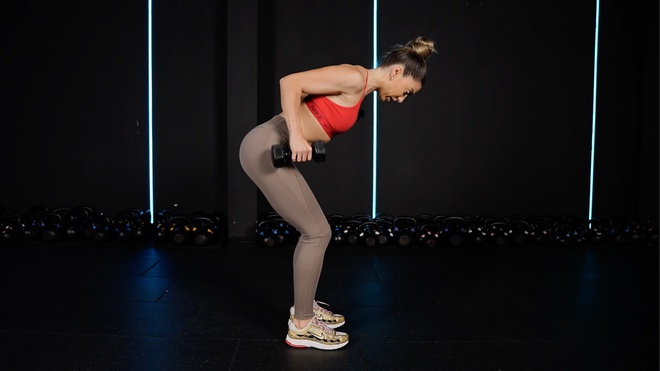

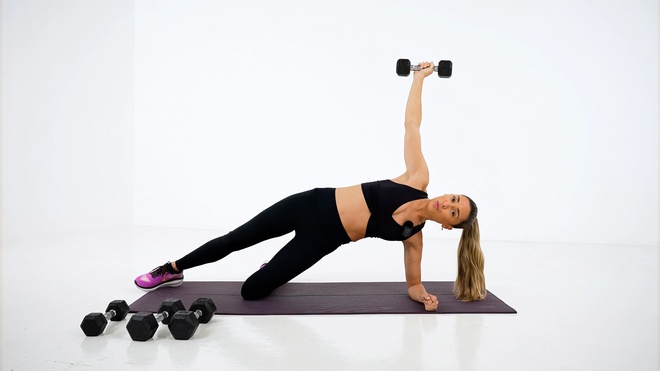
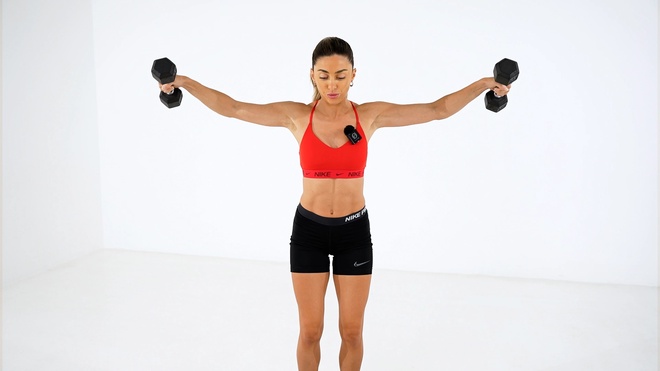
Join women building shoulder strength and posture with certified trainers
Frequently Asked Questions
Related Exercises
Overhead Press
Compounds the shoulder work that lateral raises isolate. Together they cover pressing and abduction.
Reverse Fly
Targets the posterior deltoid and rhomboids. Pair with lateral raises for complete shoulder coverage.
Bent Over Row
Strengthens the upper back muscles that support good shoulder mechanics.
Banded Pull Aparts
Warm-up or finisher that activates posterior deltoid and external rotators before lateral raises.
Front Raise
Targets the anterior deltoid. Combined with lateral raises, covers both front and side shoulder heads.
This exercise helps with
Get lateral raises in a guided workout
Access 5 workouts featuring this exercise, plus personalized plans from Dr. Wellls.
Join women building shoulder strength and posture with certified trainers
Your membership funds independent women's health research