Bent Over Row: How-to, Benefits & Variations
The bent over row targets lats, rhomboids, and rear delts. Hinge forward with a flat back, pull dumbbells toward hips, squeeze shoulder blades. Builds posture, back strength, and bone density.
Bent Over Row: How-to, Benefits & Variations
Every woman who walks into my sessions has the same posture story: weak upper back, rounded shoulders, neck that aches by 3pm. The bent over row fixes all three at once.
This is the exercise that builds the muscles you can't see in the mirror but feel every single day. Your lats. Your rhomboids. The rear delts that pull your shoulders back where they belong. A 2023 systematic review on posture correction found that targeted upper back strengthening significantly reduced forward head posture and thoracic kyphosis. The bent over row is exactly that kind of targeted strengthening. Two dumbbells, a flat back, and 45 seconds of work that changes how you carry yourself for the other 23 hours.
Fix Your Posture: Workout 6
Sophie Jones
How to Do Bent Over Row
Stand with feet hip-width apart, a dumbbell in each hand. Push your hips back like you're closing a car door with your butt. Bend your knees slightly. Your torso should be roughly 45 degrees to the floor. Sophie Jones cues this: stick that bum back, nice flat back.
Let your arms hang straight down from your shoulders, palms facing each other. Pull your shoulder blades down and away from your ears before you start rowing. This is the position you maintain the entire time.
Exhale and drive your elbows back toward your hips. Not up toward your ears. Sophie's cue is gold here: imagine squeezing a lemon between your armpits. That mental image activates your lats instead of your traps.
Squeeze at the top for one full second. You should feel your shoulder blades pinch together like you're holding a pencil between them. Sophie literally says: pinch a pencil between the shoulder blades.
Lower the dumbbells with control. Full stretch at the bottom, arms extended. Don't just drop the weight. Danielle Harrison cues: draw the dumbbells up to the chest, just above the hips, back down, little squeeze. That controlled lowering phase is where a lot of the muscle-building happens.
Keep your core braced the entire time. If your core loosens, your lower back takes over. Sophie warns: if your core's not tight, your back will start to ache. That's your cue to reset.
Muscles Worked
Primary
Latissimus dorsi
The biggest muscle in your back. Powers the pulling motion and controls shoulder extension. The bent over row targets the lats through their full range, from stretched at the bottom to contracted at the top.
Rhomboids (major and minor)
Retract your shoulder blades. These are the muscles that pull your shoulders back and counteract the forward-hunch from sitting. If you feel a squeeze between your shoulder blades at the top of each rep, your rhomboids are firing.
Rear deltoids
Sophie cues keeping shoulders retracted to engage the rear delts throughout the movement. These small muscles are chronically weak in anyone who works at a desk. The bent over row hits them hard.
Secondary
Biceps
Assist with elbow flexion during the pull. They work, but they shouldn't dominate. If you feel this mostly in your biceps, you're pulling too much with your arms and not enough with your back.
Core (transverse abdominis, obliques)
Stabilize the spine in the hinged position. This is an isometric core workout disguised as a back exercise. Your abs hold everything in place while the back muscles do the pulling.
Erector spinae (lower back)
Maintain the flat-back hinge position against gravity. Not the target, but they're working. If they fatigue first, the weight is too heavy or your hinge angle is too steep.
Trapezius (mid and lower fibers)
Assist with scapular retraction and depression. The goal is mid-trap engagement, not upper-trap shrugging. Sophie specifically cues: release that tension through any of those upper trap muscles.
Why this matters in perimenopause
Upper back strength declines faster than most people realize. A 2021 meta-analysis of 26 studies (745 postmenopausal women) found resistance training produced small-to-moderate increases in lean body mass regardless of age, intervention period, or weekly training frequency. That matters because the muscles the bent over row targets, your lats, rhomboids, and rear delts, are the same muscles that prevent the hunched posture associated with thoracic kyphosis. Estrogen loss accelerates bone density decline in the thoracic spine. Loading those muscles through rowing movements helps maintain spinal density and postural integrity at the same time.
Coach's Tips
"Imagine squeezing a lemon between the armpits." Sophie says this in every single row set, and for good reason. This cue activates your lats instead of your traps. If you're shrugging the weight up toward your ears, you're doing a different exercise entirely. The lemon cue redirects the pull path through your back where it belongs.
Sophie Jones
"Dragging that elbow back, we're not pulling up here. I don't want the shoulders near the ears." Sophie's most repeated correction. The bent over row form mistake I see most often is turning it into an upright row. Your elbows drive back toward your hips in a half-moon arc, not up toward the ceiling.
Sophie Jones
"Pinch a pencil between the shoulder blades." This is Sophie's scapular retraction cue and it's brilliant. At the top of every rep, your shoulder blades should be close enough together that they could hold a pencil. If they can't, you're cutting the range of motion short.
Sophie Jones
"Shoulders back, chest pumped. Little squeeze." Danielle Harrison keeps it simple. Pump the chest out before you pull. This sets your thoracic spine in extension and prevents the rounded-shoulder position that turns the row into a trap exercise.
Danielle Harrison
"If you feel a pinch in that lower back, bring yourself up ever so slightly." Sophie says this every time, and it matters. A steeper hinge loads your lumbar spine more. Standing up even 10 degrees takes pressure off your lower back while still targeting the lats. There is no prize for being the most horizontal person in the room.
Sophie Jones
"If your core's not tight, your back will start to ache." Sophie's direct warning. The bent over position puts your lower back in a vulnerable spot. Your core is the insurance policy. Brace before every rep like someone's about to push you from behind.
Sophie Jones
"If you don't have that flexibility, you can stay up a little bit." Sophie gives this permission regularly. Not everyone has the hamstring flexibility or spinal mobility to hinge deeply. A more upright row still works the same muscles. The angle doesn't need to be perfect to be effective.
Sophie Jones
Why This Matters for You
I want to talk about the thing nobody connects to perimenopause: posture collapse. As estrogen drops, bone density in the thoracic spine decreases. The muscles that hold your shoulders back weaken from disuse and hormonal changes. The result is a gradual forward hunch that compresses your lungs, strains your neck, and makes you look and feel older than you are.
The bent over row fights this on every front. It loads the thoracic spine (bone density stimulus). It strengthens the rhomboids and rear delts (postural muscles). It teaches scapular retraction under load, which is what your body needs to resist the gravity-driven collapse.
The evidence is clear: resistance training improves bone density, functional capacity, and even reduces hot flash frequency in postmenopausal women — with no serious adverse events across thousands of study participants. Three sessions per week for at least six weeks. You don't need a gym. You need two dumbbells and the willingness to hinge forward three times a week.
The posture piece matters more than aesthetics. Better thoracic extension improves breathing capacity. Better breathing reduces cortisol. Lower cortisol helps with sleep, mood, and the 47 other things perimenopause is already disrupting.
Variations & Modifications
Single-Arm Bent Over Row
mediumOne arm at a time. Sophie programs these in Strength Fundamentals with three full rounds per side. The unilateral version exposes strength imbalances you'd never notice with both arms working together. Most people have one side significantly weaker. You can brace your free hand on your thigh or a bench for extra stability.
Resistance Band Bent Over Row
low-mediumStep on a band, hinge forward, row the same way. Sophie dedicates an entire workout to this in Body by Band. The band provides progressive resistance, meaning it gets harder at the top where your muscles are strongest. Great bent over row alternative when you're traveling or don't have dumbbells.
Bent Over Row to Reverse Fly
mediumLinda Chambers programs this combo in Functional Full Body. One row, then one reverse fly, alternating. It hits both the lats (row) and the rear delts (fly) in a single set. Linda cues: squeezing the shoulder blades together, but we're doing it in two slightly different ways. Drop the weight by 20-30% compared to your straight row.
Bent Over Row to Tricep Extension
mediumRow the weight up, then extend your arms straight back for a tricep kickback. Danielle Harrison programs this as a compound time-saver. You get back and arm work in one movement. The trick is keeping your upper arm locked after the row while only your forearm extends. Lock that back into position, Danielle cues.
Pause/Eccentric Bent Over Row
highSophie programs this as the final round in Strength Fundamentals 8. Row up, hold at the top for 2 seconds, then take 3 seconds to lower. She calls it time under tension, and it's brutal. You'll use less weight but the muscle stimulus is significantly greater. This is the progression when standard rows feel too easy.
Benefits
Corrects forward-shoulder posture
The bent over row directly strengthens the muscles that pull your shoulders back: rhomboids, mid-traps, and rear delts. A 2023 systematic review found that targeted strengthening exercises significantly improved forward head posture and Upper Cross Syndrome. If you sit at a desk, these are the muscles fighting gravity all day.
Builds the entire posterior chain
Your lats, rhomboids, rear delts, erector spinae, and even your glutes and hamstrings work during a bent over row. That's essentially your entire back side. Most daily activities are push-dominant (pushing doors, carts, strollers). The row restores muscular balance.
Protects against bone density loss
A 2025 meta-analysis of 17 RCTs (690 postmenopausal women) found resistance training significantly improved bone mineral density at the lumbar spine, femoral neck, and total hip. The bent over row loads the thoracic and lumbar spine under tension. Training three times per week was the minimum effective frequency.
Fights age-related muscle loss
The upper back is one of the first areas to lose definition and function. A 2023 meta-analysis of 27 RCTs (1,989 menopausal women) found resistance training improved lean body mass, handgrip strength, and knee extension strength. The bent over row hits the large back muscles that sarcopenia erodes fastest.
Two dumbbells, no gym required
You need a pair of dumbbells or a single resistance band. That's it. No bench, no cable machine. The bent over row benefits scale from a 3-pound weight for beginners to 30+ pounds for advanced. Sophie programs it in beginner, intermediate, and band-only formats.
Common Mistakes to Avoid
Pulling toward the chest instead of the hips
This turns the row into a trap shrug. Sophie cues it across dozens of sets: pulling in towards the hips, not up through the traps. Think about dragging the dumbbells along your thighs in a half-moon arc toward your hip bones.
Rounding the lower back
The single most dangerous form error. Sophie says: I don't want to see any flexed backs. Push your hips back further. Engage your glutes. If you can't maintain a flat back, the weight is too heavy or your hinge needs work. Reduce load before reducing range.
Using momentum to swing the weight up
Sophie cues: keeping the body nice and still. If you need to rock your torso to get the weight up, you're lifting too heavy. The row should come from your back muscles, not from a hip thrust. Lower the weight until you can pull without any body English.
Letting the shoulders roll forward at the bottom
Danielle cues: don't roll the shoulders, pump the chest out. At the bottom of each rep, your shoulders should still be retracted, not protracted. Think chest open, shoulder blades down. This protects your rotator cuff and keeps tension on the right muscles.
Workouts Featuring This Exercise
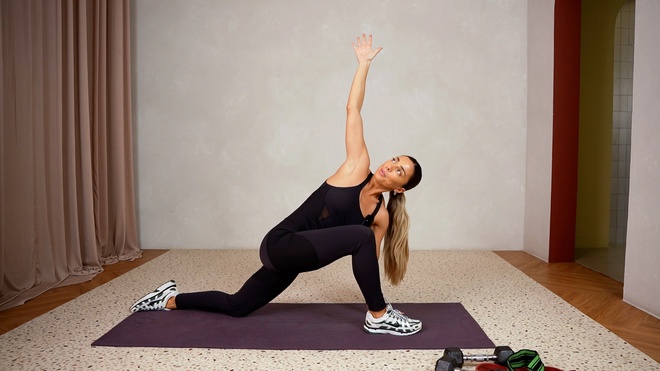
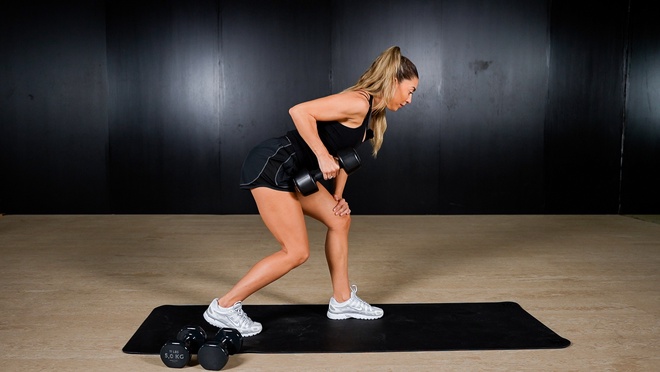
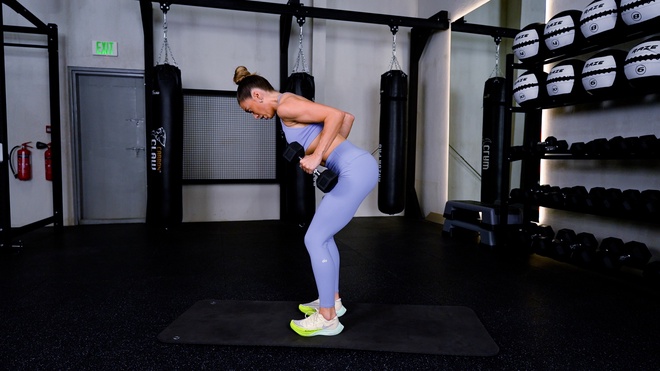
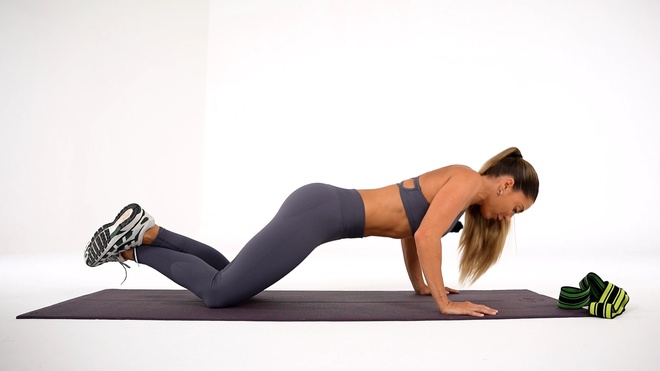
Join women building back strength and better posture with certified trainers
Frequently Asked Questions
Related Exercises
Lateral Raises
Pairs with rows for complete shoulder development. Rows pull, lateral raises push laterally.
Reverse Fly
Same hinge position, isolates the rear delts. Linda Chambers pairs row-to-fly in her programs.
Renegade Row
Row from a plank position. Adds core anti-rotation challenge to the rowing pattern.
Romanian Deadlift
Same hip hinge pattern. Sophie combines rows with RDLs in Total Body Conditioning.
Gorilla Rows
Alternating rows from a deep hinge. A natural bent over row alternative with more stability.
This exercise helps with
Get bent over row in a guided workout
Access 5 workouts featuring this exercise, plus personalized plans from Dr. Wellls.
Join women building back strength and better posture with certified trainers
Your membership funds independent women's health research