Renegade Row: How-to, Benefits & Variations
The renegade row is a plank-position dumbbell row that targets the upper back, core anti-rotation stabilizers, and shoulders. Row one dumbbell to your hip, keep hips level, switch sides.
Renegade Row: How-to, Benefits & Variations
Hold a plank. Now lift one hand off the floor. Feel your hips twist? That involuntary rotation is your core failing the test it was never trained for.
The renegade row asks you to hold a high plank and row a dumbbell to your hip, one arm at a time, without letting your torso rotate. Most people think this is a back exercise. It is not. Not primarily. The back does the pulling, sure. But your core does the real work. Every rep demands anti-rotation stability. Your obliques, transversus abdominis, and deep spinal stabilizers fire to keep your hips and shoulders parallel to the floor while one arm leaves the ground.
No other exercise combines a plank position, a unilateral pull, and an anti-rotation demand in a single movement. Bent-over rows train your back bilaterally. Planks train anti-extension. The renegade row forces your core to resist rotational forces under load while your lats and rhomboids pull a weight. That combination is why Sophie Jones programs it across seven different workout series in our library.
Total Body Conditioning: Workout 8
Sophie Jones
How to Do Renegade Row
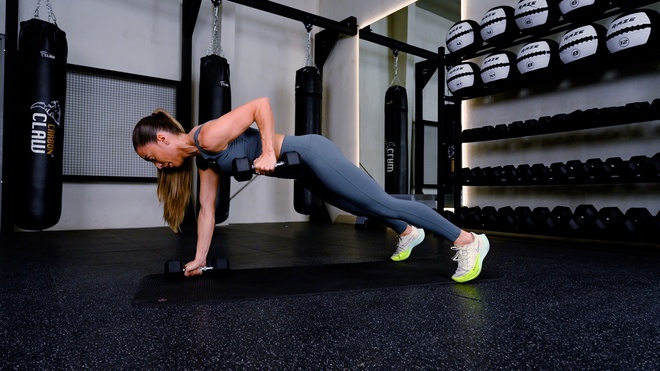
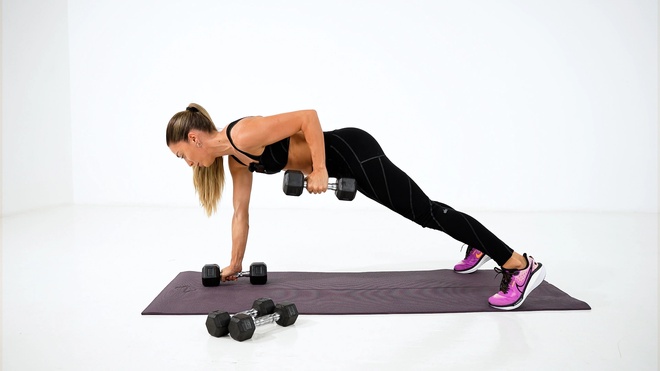
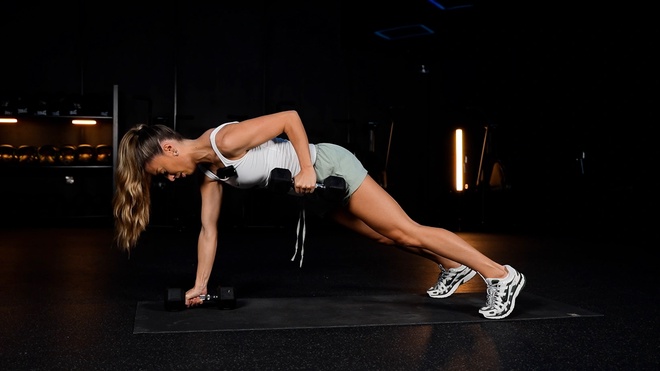
Set two dumbbells on the floor, shoulder-width apart, handles parallel. Get into a high plank position gripping the dumbbells. Hands directly under your shoulders. Sophie Jones cues this repeatedly: stack your wrists directly underneath your shoulders and keep your weight shifted forward. Not behind them. Over the top.
Set your feet wider than a standard push-up. This is non-negotiable. Sophie Jones says it every time: have a nice wide stance on your base. Wide feet create the stability platform your core needs. Narrow feet and you rock like a canoe in a storm.
Lock your core before you move anything. Draw your belly button toward your spine. Sophie cues: belly button towards the spine, squeezing it in to the sides of our body. Your lower back should not arch. Your hips should not pike upward. Straight line, head to heels.
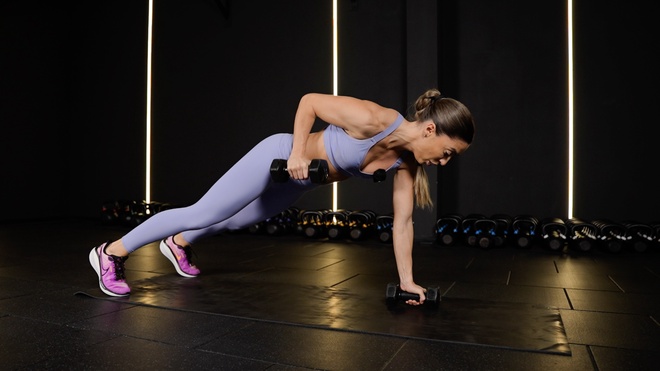
Row one dumbbell toward your hip. Not your shoulder. Not your chest. The hip. Sophie corrects this constantly: pulling the weight in towards the hips, not up through the traps. Imagine squeezing a lemon in your armpit. Keep the elbow tight to your body.
Lower the dumbbell with control to the floor. Exhale as you row up, inhale as you lower. Do not drop the weight. The eccentric phase trains your core just as much as the pull.
Repeat on the other side. Your hips and shoulders stay parallel to the floor at all times. Sophie Jones: my hips and my shoulders stay parallel to the floor at all times. If you feel yourself twisting, the weight is too heavy or your feet are too narrow.
Muscles Worked
Primary
Core (anti-rotation stabilizers)
Here is the part competitors get wrong. They list the lats first. But EMG data tells a different story. During a renegade row, your obliques, transversus abdominis, and quadratus lumborum fire at near-maximal intensity to prevent your torso from rotating toward the pulling arm. A 2022 systematic review of anti-rotation and anti-extension exercises confirmed that unilateral loading in plank positions creates some of the highest core activation levels measured. The core does not move during a renegade row. It resists movement. That is harder.
Latissimus dorsi and rhomboids
The pulling muscles. Your lat initiates the row from the bottom, your rhomboids squeeze the shoulder blade toward the spine at the top. Sophie Jones cues pulling toward the hip, not the shoulder, because the hip-directed pull path maximizes lat recruitment. Pulling toward the shoulder shifts the load into the upper traps. Different muscle, worse outcome for most people.
Posterior deltoid
Works alongside the rhomboids during the pulling phase. A scapular stabilization systematic review found that row-based movements significantly activate the posterior deltoid and lower trapezius. The renegade row version adds an isometric demand on the opposite shoulder, which is supporting your entire upper body weight while the other arm pulls.
Secondary
Gluteus maximus and medius
Your glutes co-contract with the core to maintain the plank position. The glute on the pulling side fires harder because that hip wants to rotate. A meta-analysis of gluteus medius exercises found that plank-based positions produce meaningful hip stabilizer activation. You are getting glute work without a single squat.
Triceps and forearm flexors
The supporting arm's triceps lock your elbow in extension while your forearm grips the dumbbell against the floor. The pulling arm's forearm flexors grip the weight through the entire row. If your grip fatigues before your core, try hex dumbbells. They sit flat and reduce the rolling.
Serratus anterior
The muscle that keeps your shoulder blades flush against your ribcage. Both sides work isometrically during the plank hold. The supporting side works harder because it bears full body weight. Weak serratus anterior leads to scapular winging, which compromises shoulder health during overhead movements.
Why this matters in perimenopause
The renegade row targets muscles that weaken in a specific pattern during hormonal transitions. The deep core stabilizers lose endurance before the big movers. You can still squat and deadlift fine, but your anti-rotation capacity quietly erodes. A 2022 systematic review of core stability exercises confirmed their effectiveness for back pain, and the renegade row is core stability under external load. A 2023 international expert position statement recommended resistance training with compound multi-joint exercises for menopausal women. The renegade row qualifies on every count: it loads the upper back for posture, the core for spinal protection, and the shoulders and hips for bone density. One exercise, multiple vulnerabilities addressed.
Coach's Tips
"Dragging back toward the hip, not up through the traps." Sophie Jones says this in nearly every renegade row set she teaches. The difference between a good and bad renegade row is the pull direction. Pulling toward your shoulder turns it into an upright row variant with terrible leverage. Pulling toward your hip engages the lat. Think of your elbow driving back along the side of your body, like starting a lawnmower.
Sophie Jones
"Imagine you're trying to pinch a lemon between your armpit." Sophie uses this cue to lock the elbow tight to the body. It works because it creates an image you can feel. If the lemon would fall out, your elbow is flaring. Squeeze that imaginary lemon and the lat activates harder. I have watched this cue fix sloppy rows in real time.
Sophie Jones
"I don't wanna be back here, you need to be over, over the top of those weights." Weight distribution matters. If your hips sit behind your shoulders, the plank collapses and the row becomes a cheat. Sophie demonstrates the wrong position, then shifts forward over the dumbbells. The difference is immediate. Forward position equals core engagement. Sitting back equals lower back strain.
Sophie Jones
"Open your legs a little bit wider than what you would do a press-up... so you can get that nice stability." Wide stance is the single most important setup detail. Every trainer who teaches renegade rows mentions it. Narrow feet create a balance problem that forces hip rotation. Wide feet create a stable base that lets your core do anti-rotation work instead of panic-balancing.
Sophie Jones
"Keeping the head facing down, we don't wanna have no necks up." Neutral neck. Eyes on the floor between your hands. Looking up compresses the cervical spine under load. Looking forward jams the back of the neck. Straight down. It feels unnatural at first. Your neck will thank you.
Sophie Jones
"Exhale as you row the weight up and inhale as you lower it back to the floor." The exhale on the pull phase is not decorative. A 2023 systematic review of diaphragmatic breathing confirmed that the exhale-brace mechanism activates the transversus abdominis and drives intra-abdominal pressure. That pressure is what keeps your spine stable while one arm lifts a weight. Breathe in on the lower. Breathe out hard on the row.
Sophie Jones
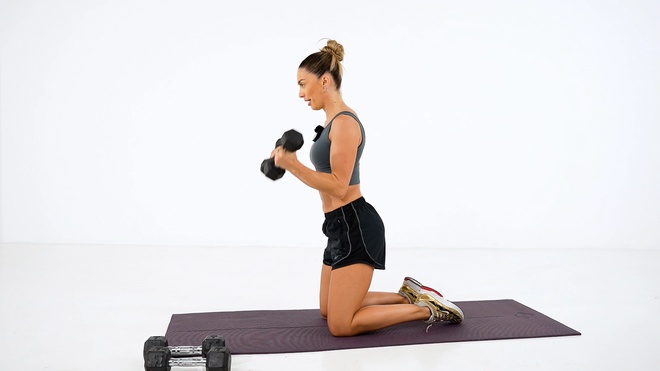
"If you really struggle with that, you drop it to the knees." Sophie Jones offers this without any hint of it being lesser. Knees down cuts the lever arm and reduces the anti-rotation demand by roughly half. You still train the back. You still train the core. Linda Chambers programs bodyweight renegade rows from the knees as a standalone exercise in her Functional Full Body series. It is a real exercise, not a consolation prize.
Sophie Jones
"Right hand lifts, left hand lifts. Imagine you have a weight in your hand." Linda Chambers teaches bodyweight renegade rows, where you lift one hand to your ribcage without holding a dumbbell. The anti-rotation demand remains. The rowing load disappears. This is the ideal entry point for anyone whose core is not yet strong enough to stabilize while pulling a weight.
Linda Chambers
Why This Matters for You
The renegade row targets three vulnerabilities that compound during hormonal transitions.
Core stability under load. As estrogen fluctuates, the deep stabilizers around the spine lose endurance before the big muscles show any change. You can still carry groceries. But the micro-stabilization that prevents your torso from rotating under asymmetric load quietly degrades. A 2022 systematic review confirmed core stability exercises reduce back pain, and the renegade row is core stability under external load. Not a crunch. Not a static hold. Dynamic, loaded, functional.
Upper back strength. Postural muscles weaken with desk work and hormonal shifts. The rhomboids and lower traps atrophy while the upper traps and pectorals tighten. The renegade row directly opposes this pattern by loading the posterior chain in a pulling motion. A scapular stabilization review confirmed row-based movements strengthen exactly these muscles.
Bone density maintenance. A 2025 meta-analysis of resistance training in postmenopausal women found that loaded compound exercises improve bone mineral density at the hip and spine. The renegade row loads the wrists, shoulders, and spine simultaneously. Weight-bearing through the arms while pulling is a stimulus most bodyweight exercises cannot replicate.
Variations & Modifications
Bodyweight Renegade Row
mediumLinda Chambers programs this in her Functional Full Body series. High plank position, lift one hand to your ribcage, lower it, switch sides. No dumbbells. The anti-rotation core demand remains because one arm still leaves the floor. Your body does not care that there is no weight in your hand. It cares that one support point just vanished. Two occurrences in our library.
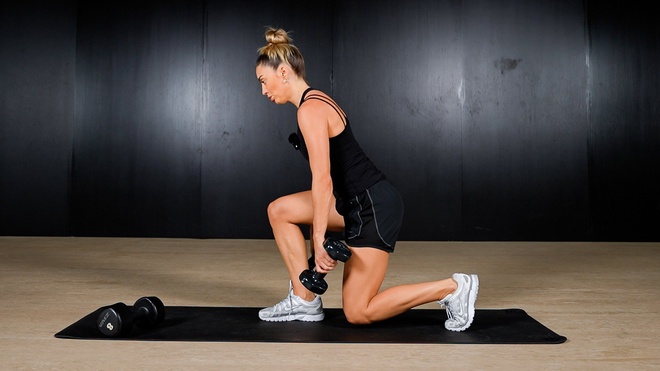
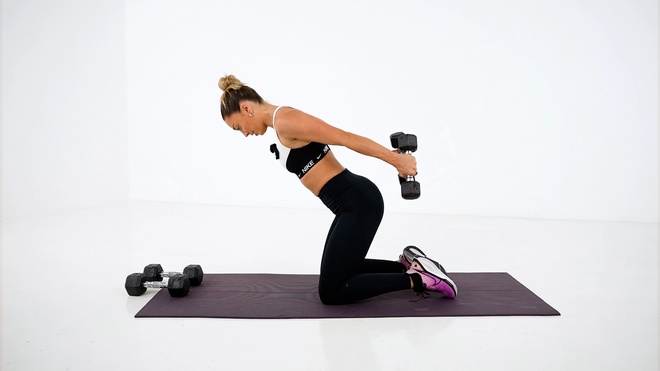
Renegade Row from Knees
low-mediumSophie Jones cues this as the first regression: drop to the knees while keeping your hips tucked. The shorter lever arm reduces core demand without eliminating it. Your lats still pull the dumbbell. Your core still fights rotation. The intensity drops enough that you can focus on the pull direction, the squeeze at the top, the controlled lower. Build here before graduating to full toes.
Renegade Row with Tuck In/Out
highAylar Fetrati's advanced combo. Renegade rows combined with a plank tuck, jumping both feet in toward your chest and back out between sets of rows. This adds an explosive hip flexion component and spikes the heart rate. Two occurrences in our library, both in her Full Body HIIT series. Not for beginners. Master the standard renegade row first.
Narrow Stance Renegade Row
highSame movement, feet closer together. Sophie Jones: perform on your toes with a narrower foot stance to increase the stability challenge for your core. A narrow base forces the anti-rotation muscles to work significantly harder because the lever arm of your body against the floor shrinks. Only attempt this after you can do 10 clean reps per side with a wide stance and zero hip twist.
Benefits
Anti-rotation core training under real load
Most core exercises work in one plane. Crunches flex the spine. Planks resist extension. The renegade row trains anti-rotation: your core resists the rotational force created when one arm lifts a weight while the other supports your body. A 2022 systematic review confirmed anti-rotation exercises generate some of the highest core EMG activation levels measured. The renegade row is anti-rotation with a dumbbell in your hand.
Full-body compound movement in a single exercise
Back, core, shoulders, glutes, grip. The renegade row loads all of them simultaneously. A 2023 international expert position statement recommended compound multi-joint resistance exercises for menopausal women because they deliver more stimulus per minute than isolation work. Time-efficient strength training matters when the schedule is already full.
Identifies left-right imbalances
Bilateral rows hide your weak side. The barbell does not care which arm pulls harder. The renegade row exposes it immediately. One side rows smoothly. The other side wobbles, the hip twists, the weight stalls halfway up. Now you know. Train the weaker side first each set until the imbalance closes.
Posture correction through upper back and scapular work
The pulling phase targets the rhomboids, lower traps, and posterior deltoid. These are the muscles that pull your shoulder blades back and down, the exact opposite of the desk-slump position. A systematic review of scapular stabilization exercises confirmed row-based movements strengthen the posterior chain responsible for upright posture. Renegade rows train posture muscles while simultaneously training the core to hold the body upright.
Functional strength that transfers to real life
Picking up a bag from the floor with one hand while your body stays stable. Pulling a heavy door open while carrying something in the other arm. Catching yourself from a fall with one arm planted. These are renegade row patterns. Unilateral pull plus anti-rotation stability. Life does not give you bilateral, stable conditions. This exercise trains you for the asymmetrical world you actually live in.
Common Mistakes to Avoid
Hips rocking side to side
The most common fault. Sophie Jones calls it out constantly: don't be rocking your hips side to side, keep as still as possible. Your hips twist because your feet are too narrow, the weight is too heavy, or both. Widen your stance first. If the rocking continues, drop the dumbbell weight. I would rather you go slow without movement than do these sloppy ones. That is a direct Sophie Jones quote.
Pulling the weight toward the shoulder instead of the hip
Sophie Jones corrects this in real time: don't bring it up high, we wanna keep it into the hip. Pulling high turns the renegade row into an upright row variant with poor mechanics. It shifts the load from the lat into the upper trap. Drag the dumbbell along your body toward the hip pocket. Squeeze a lemon in your armpit at the top.
Hips piked up with butt in the air
Sophie Jones catches this one too: I don't wanna see bums up, keep yourself down. No bums in the air, because that means you're pushing too much through the shoulders and have no core engagement. A piked position removes the plank demand entirely. Drop your hips until your body is a straight line. If you cannot maintain that line, take it to the knees.
Weight shifted too far back behind the shoulders
I don't wanna be back here, you need to be over, over the top of those weights. When your weight sits behind the dumbbells, you lose the forward lean that engages the core. Sophie demonstrates the wrong position, then the correct one: shifted forward, shoulders stacked over wrists. The correction is visible immediately.
Workouts Featuring This Exercise
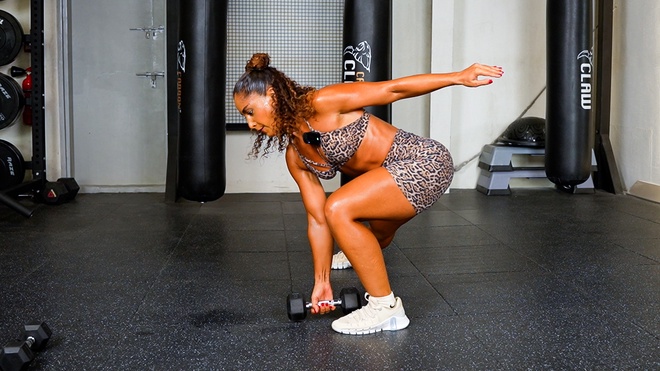
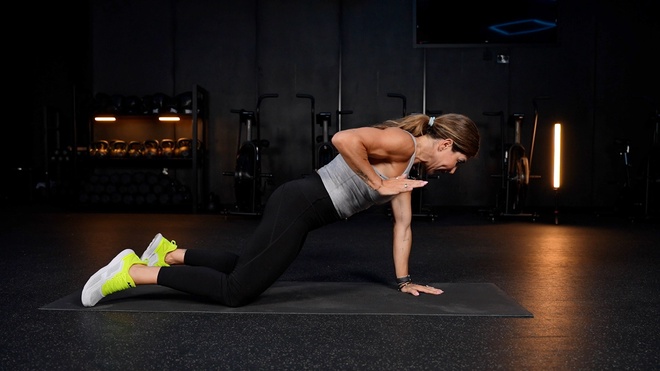
Join women building anti-rotation core strength with 3 certified trainers across 11 workouts
Frequently Asked Questions
Related Exercises
Bent Over Row
The bilateral pulling counterpart. Bent over rows load the back heavier because both feet stay grounded. Pair with renegade rows for complete back development: heavy bilateral plus stability-demanding unilateral.
Bird Dog
Another anti-rotation exercise. Both are plank-based and unilateral. The bird dog is bodyweight only, making it the perfect prerequisite before attempting renegade rows with dumbbells.
Plank
The renegade row starts in a high plank position. If you cannot hold a solid plank for 30 seconds, you are not ready for renegade rows. Build the base first.
Side Plank
Lateral anti-rotation complement. The renegade row resists rotation in the transverse plane. The side plank resists lateral flexion. Together they cover two planes of core stability.
Gorilla Row
Alternating dumbbell rows from a hinged position. Shares the unilateral pulling pattern but from a standing bent-over position instead of a plank. Lower core demand, heavier pulling potential.
This exercise helps with
Get renegade row in a guided workout
Access 10 workouts featuring this exercise, plus personalized plans from Dr. Wellls.
Join women building anti-rotation core strength with 3 certified trainers across 11 workouts
Your membership funds independent women's health research