Romanian Deadlift: How-to, Benefits & Variations
The romanian deadlift targets hamstrings, glutes, and lower back. Hinge at the hips, slide weights down your legs, squeeze glutes to stand. Builds bone density and prevents muscle loss.
Romanian Deadlift: How-to, Benefits & Variations
If you sit at a desk, drive a car, or spend hours looking at a phone, your hamstrings are shortening and your glutes are forgetting how to fire. Right now, as you read this. The romanian deadlift reverses that in one clean pattern.
I've watched hundreds of women pick up dumbbells for the first time and nail this within a single session. That almost never happens with conventional deadlifts. The romanian deadlift strips away the floor pull and isolates the hip hinge, the single most protective movement pattern your body can learn. A systematic review of deadlift biomechanics found that technique adjustments in the RDL reduce spinal loading while maintaining full posterior chain recruitment. Translation: same muscle work, less back stress.
And the bone-density angle matters here. A 2025 meta-analysis found that optimal resistance training significantly improved bone mineral density at the lumbar spine and femoral neck in postmenopausal women. The romanian deadlift loads both of those sites directly.
Strength Fundamentals: Workout 2
Sophie Jones
How to Do Romanian Deadlift
Stand with feet hip-width apart, dumbbells in front of your thighs, palms facing your body. Pull your shoulders back and down. Sophie Jones cues: slight flexion in the knees, never locked out.
Brace your core. Imagine someone is about to flick you in the stomach. This locks your spine in neutral before the weight moves.
Push your hips straight back, like a string is pulling your tailbone toward the wall behind you. The dumbbells slide down the front of your legs, staying close to your shins the entire time. Sophie cues: weights are not out in front, they literally follow the line of my leg.
Lower until you feel a deep stretch in the backs of your hamstrings. For most people, that is somewhere between knee height and mid-shin. Stop before your back starts rounding. Sophie says: just go to that point where you feel tight, and you can keep the back flat.
Squeeze your glutes hard to drive your hips forward and stand tall. Sophie's exact words: squeeze my butt cheeks together to pull myself up. The power comes from the glutes and hamstrings, never from your lower back.
At the top, stand straight without overarching your spine. Sophie is clear on this: no overarch at the top, just come nice and tight, neutral alignment. One rep done.
Muscles Worked
Primary
Hamstrings (biceps femoris, semitendinosus, semimembranosus)
Eccentrically control the lowering phase and concentrically drive hip extension on the way up. A deadlift biomechanics review confirmed the RDL produces peak hamstring activation during the eccentric stretch, making it one of the most effective hamstring strengtheners available.
Glutes (gluteus maximus)
Power the hip extension that drives you back to standing. The squeeze at the top is where the glutes work hardest. Sophie cues it every single time: squeeze the butt cheeks to pull you in.
Erector spinae (lower back)
Maintain spinal neutrality under load. They work isometrically, holding your back flat while gravity tries to round it. This is what makes the RDL such an effective back-strengthener without the compression risk of heavy back extensions.
Secondary
Core (transverse abdominis, obliques)
Stabilize the spine and pelvis throughout the hinge. Without core bracing, the lower back takes over.
Upper back (lats, rhomboids, traps)
Keep the dumbbells close to your body and prevent shoulder rounding. Sophie's lemon cue targets exactly this: squeeze a lemon between the armpits to engage the lats.
Forearms and grip
Hold the dumbbells for the duration of each set. Grip often becomes the limiting factor before hamstrings or glutes fatigue, especially with heavier loads.
Why this matters in perimenopause
The romanian deadlift muscles worked are the exact muscles that atrophy fastest during hormonal transitions. A 2023 meta-analysis of 27 RCTs (1,989 participants) found resistance training improved lean body mass, handgrip strength, and knee extension strength in menopausal women. The posterior chain, hamstrings, glutes, and lower back, is where sarcopenia hits first because these muscles are already underused in modern sitting-heavy lives. Three sessions a week for at least six weeks produced measurable results.
Coach's Tips
"Squeeze a lemon between your armpits." Sophie Jones says this in nearly every RDL set she teaches. It engages your lats, pins the dumbbells to your legs, and prevents your shoulders from folding forward. I borrowed this cue years ago and it fixed more romanian deadlift form issues than any other single correction.
Sophie Jones
"Weights are not out in front. They're literally just following the line of my leg." Sophie's teaching the bar path here. If the dumbbells drift forward even two inches, your lower back becomes the fulcrum. Keep them glued to your thighs and shins. Think about painting a line down the front of your legs with the dumbbell handles.
Sophie Jones
"I'm not pulling through my shoulders. Squeezing from my glutes." This is the cue that separates people who get back pain from RDLs and people who don't. The drive back to standing comes from your hips, not from yanking your upper body upright. If you feel it in your traps or shoulders at the top, you are pulling wrong.
Sophie Jones
"Pushing the bottom back, find that stretch, and then squeezing the butt cheeks as we pull through." Sophie describes the entire movement in one sentence. Hips back, stretch the hamstrings, glute squeeze to stand. That is the whole exercise. If you remember nothing else, remember this.
Sophie Jones
"I'm not overarching at the top. We don't wanna create any tight compression in the spine." Sophie catches this mistake constantly. Hyperextending at the lockout feels like you are finishing the rep strong. You are actually jamming your lumbar vertebrae together. Stand tall, neutral spine, done.
Sophie Jones
"Do not let the shoulders roll down. Gonna put too much pressure on your back." Danielle Harrison's warning. When the shoulders round, the load shifts from your hamstrings and glutes to your spinal discs. If you cannot keep your chest proud at your current weight, the weight is too heavy. Drop it.
Danielle Harrison
"Some of you might not be able to go as low as me on this. That's fine." Sophie gives this permission in almost every session. Depth is determined by hamstring flexibility, not effort. If your back starts rounding at knee height, that is YOUR bottom position today. It will get deeper over weeks. Forcing depth with a rounded spine is how injuries happen.
Sophie Jones
Why This Matters for You
I am going to be direct about this. The posterior chain, your hamstrings, glutes, and lower back, is the first system to break down when hormones shift and activity drops. A cross-sectional study of female athletes versus sedentary women found that the active group maintained lean mass and metabolic rate regardless of age. That is not genetics. That is training.
The romanian deadlift attacks three perimenopause priorities in a single movement. First, bone loading: the lumbar spine and femoral neck receive direct mechanical stress, and a 2025 meta-analysis confirmed this type of loading significantly improves BMD. Second, muscle preservation: a 2021 meta-analysis of postmenopausal women found resistance training improved lean body mass when performed at moderate-to-high intensity for 12+ weeks. The RDL is exactly that kind of load. Third, functional protection: every time you bend to pick something up off the floor, you are performing a hip hinge. Training that pattern under load means your body defaults to the safe version instead of the back-wrecking one.
One thing I want to mention. If pelvic floor concerns are on your radar, the RDL is actually one of the safer loaded movements because you exhale during the concentric (standing) phase, which naturally supports the pelvic floor. Breath-hold straining at the bottom is what causes issues. Breathe in on the way down, blow out on the way up.
Variations & Modifications
Bodyweight Hip Hinge
lowHands on your thighs, same hip hinge pattern, zero load. This is where I start every new client. You need to own the hinge pattern before adding weight. If you cannot push your hips back without your knees shooting forward or your back rounding, a dumbbell will only make those problems worse.
Banded Romanian Deadlift
mediumLoop a resistance band under your feet and hold the top with both hands. Sophie programs this into her Body by Band series. The band increases tension at the top of the movement where dumbbells feel lightest, which means your glutes work harder at lockout. Great romanian deadlift alternative if you only have bands at home.
1.5-Rep Romanian Deadlift
highFull rep down, halfway up, back down, then all the way up. That is one rep. Sophie uses these in her Peach Project program. The extra half-rep doubles your time under tension at the hardest part of the range. Your hamstrings will hate you during the set and thank you the next morning.
RDL to Upright Row
medium-highStandard RDL, but at the top you pull the dumbbells up to chest height with elbows out. Turns a lower body exercise into a full posterior chain movement. Danielle Harrison uses this combo in her HIIT circuits. The upright row adds shoulder and upper back work without needing a separate exercise.
Single-Leg Romanian Deadlift
highSame hinge, one foot. This is the progression that exposes every imbalance you have. Your standing hip has to stabilize in three planes while the hamstring stretches under load. I program these once someone can do 3 sets of 12 bilateral RDLs with clean form. Expect to use about half the weight.
Benefits
Builds the entire posterior chain
The romanian deadlift benefits start with what it trains: hamstrings, glutes, lower back, upper back, and core in one movement. A systematic review of deadlift biomechanics found the RDL produces peak hamstring activation during the eccentric phase while maintaining lower spinal loads than conventional deadlifts. Fewer exercises give you this much muscle work for this little joint stress.
Protects your lower back
Counterintuitive, I know. But the RDL teaches your body to hinge at the hips instead of bending through the spine. Every time you pick up a bag of groceries, lift a child, or bend to tie your shoes, you are performing a hip hinge. The romanian deadlift trains the exact pattern that prevents the back injuries most people get from daily life.
Builds bone density at the sites that matter
A 2025 meta-analysis found optimal resistance training significantly improved bone mineral density at the lumbar spine and femoral neck. The RDL directly loads both of these. The lumbar spine bears the isometric load of keeping your back flat. The femoral neck transfers force from your glutes and hamstrings through the hip joint. These are the exact sites where osteoporotic fractures happen most.
Prevents hamstring injuries
A 2023 systematic review on hamstring strain prevention found that eccentric strengthening significantly reduces injury risk. The lowering phase of the romanian deadlift is pure eccentric hamstring work. If you run, hike, play tennis, or do anything involving sudden starts and stops, this exercise is your insurance policy.
Fights muscle loss during hormonal changes
A meta-analysis of 27 RCTs found resistance training improved lean body mass and lower body strength in menopausal women. The posterior chain muscles targeted by the RDL are the first to atrophy from sedentary lifestyles and the hardest to rebuild once lost. Starting now is the single best investment you can make.
Common Mistakes to Avoid
Rounding the lower back
This is the mistake that causes injuries. Sophie says it plainly: do not round out the back, keep it locked in. If your back rounds before the dumbbells reach your knees, either your hamstrings are tight (stop higher) or the weight is too heavy (go lighter). There is no shame in a shorter range of motion.
Bending the knees too much
Soft knees, not bent knees. If your knees keep bending as you lower, you are doing a squat, not a hinge. Sophie cues slight flexion in the knees at the start, and that angle stays fixed the entire time. Think about pushing your hips back, not about bending your legs.
Letting the dumbbells drift away from the body
The instant the weights move away from your legs, your lower back becomes a lever arm. Use Sophie's lemon cue: squeeze a lemon between the armpits. This engages your lats and pins the dumbbells to your body. The weights should feel like they are sliding down your shins.
Hyperextending at the top
Sophie catches this one constantly: no overarch at the top, just nice and tight. Leaning back past neutral compresses your lumbar spine. Stand straight, squeeze your glutes, done. Think about making yourself as tall as possible, not about pushing your hips forward.
Workouts Featuring This Exercise
Join women building strength and bone density with certified trainers
Frequently Asked Questions
Related Exercises
Goblet Squat
Pairs perfectly with the RDL. Squats are quad-dominant, RDLs are hamstring-dominant. Do both and you have covered the entire lower body.
Bulgarian Split Squat
Single-leg squat that exposes the same imbalances as a single-leg RDL. Great progression pairing.
Hamstring Stretch
If your RDL depth is limited by hamstring flexibility, this is the fix.
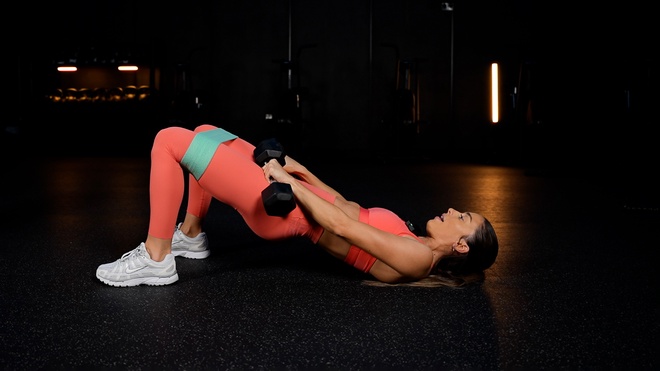
Glute Bridge
Isolates the glute squeeze that powers the top of the RDL. Use as a warm-up or superset.
Hip Thrust
Another hip extension movement that complements the RDL's stretch-focused pattern with a squeeze-focused one.
This exercise helps with
Get romanian deadlift in a guided workout
Access 5 workouts featuring this exercise, plus personalized plans from Dr. Wellls.
Join women building strength and bone density with certified trainers
Your membership funds independent women's health research