Reverse Fly: How-to, Benefits & Variations
The reverse fly targets rear delts, rhomboids, and mid-traps. Hinge forward, lift dumbbells out wide, squeeze shoulder blades. Corrects forward posture, strengthens upper back, protects shoulders.
Reverse Fly: How-to, Benefits & Variations
That burning line between your shoulder blades when you finally straighten up after hunching over your laptop for three hours. That deep ache where your bra strap sits. The tension you keep rolling out of your neck at traffic lights.
That's your upper back screaming for work it never gets.
The reverse fly is the exercise that talks back to your desk job. It targets the rear deltoids and upper back muscles that atrophy from forward-living: typing, scrolling, driving, holding groceries in front of your body. Every single one of those movements pulls you forward. The reverse fly pulls you back.
I've trained hundreds of women who can bench press and push-up all day but can't hold their shoulders back for thirty seconds without shaking. That's the imbalance the reverse fly fixes. Two light dumbbells, a hip hinge, and the willingness to train the muscles you can't see in the mirror.
Total Body Conditioning: Workout 6
Sophie Jones
How to Do Reverse Fly
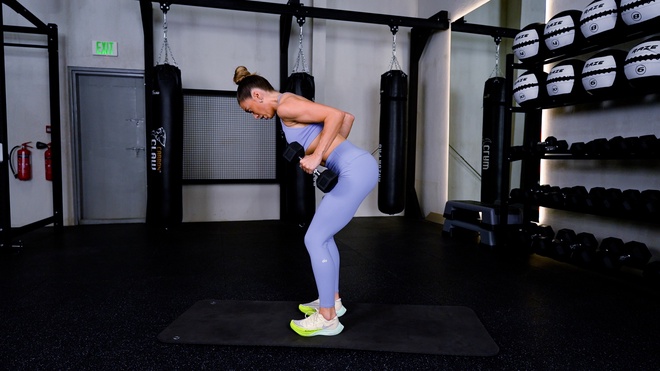
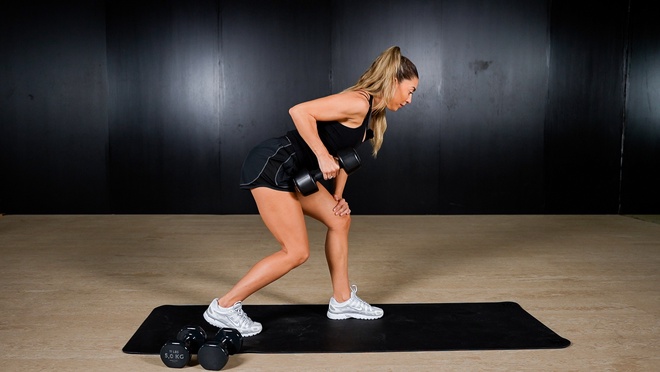
Stand with feet hip-width apart, a light dumbbell in each hand. Push your hips back and hinge forward until your torso is roughly 45 degrees from the floor. Slight bend in both knees. Sophie Jones cues it: squat down, hinge over, back straight, head in line.
Let your arms hang straight down, palms facing each other, with a soft bend in your elbows. Don't lock them out. Sophie says: I'm not locking my arms out either, nice relaxed elbow. This protects the joint and keeps the load in your back muscles.
Exhale and lift both arms out wide to the sides, like you're trying to touch opposite walls of the room. Sophie's favorite cue: stretching my arms from one side of the room to the other. The path is sideways, not backward. Think spread, not swing.
Squeeze your shoulder blades together at the top. Every trainer in our library uses the same image: pinch a pencil between your shoulder blades. Hold that squeeze for a beat. You should feel the contraction right between your shoulder blades and across the back of your shoulders.
Lower the dumbbells with control back to the starting position. Don't just drop them. The lowering phase builds muscle too. Danielle Harrison cues: coming up, controlling on the way down. That eccentric control is half the exercise.
Keep your core braced and glutes engaged the entire time. Sophie is direct about this: I actually squeeze my glutes when I'm in this position as well, so I'm kind of saving that lower back. If your lower back aches, you've lost core tension. Reset before the next rep.
Muscles Worked
Primary
Posterior deltoids (rear delts)
The stars of the reverse fly. These small muscles on the back of your shoulders do the heavy lifting during the outward arc. Sophie specifically cues: squeezing wide from my armpits, trying to pinch my rear delts together. Most people have chronically weak rear delts because virtually nothing in daily life works them. Desk work, driving, cooking, carrying children. All anterior-dominant activities.
Rhomboids (major and minor)
Retract your shoulder blades together at the top of each rep. These are the muscles that prevent your shoulders from rolling forward. If your shoulder blades can actually pinch a pencil at the top of the reverse fly, your rhomboids are firing correctly.
Middle trapezius
Works alongside the rhomboids to stabilize and retract the scapulae. Sophie cues: think about pinching out here as you come wide, not through the upper trap. That distinction matters. The upper traps shrug. The mid traps retract. You want retraction.
Secondary
Infraspinatus and teres minor (rotator cuff)
Stabilize the shoulder joint during the fly arc. A 2022 systematic review found scapular stabilization exercises like the reverse fly improve shoulder mechanics and help prevent rotator cuff dysfunction.
Erector spinae (lower back)
Hold the hinged position against gravity. Not the target, but they work isometrically the whole time. If these fatigue first, you've been hinging too deep or your core isn't bracing enough.
Core (transverse abdominis, obliques)
Anti-flexion stabilizers. Your abs prevent your spine from rounding under the weight of the dumbbells plus gravity. It's a stealth core exercise.
Glutes
Sophie engages them deliberately during every reverse fly set. They lock the pelvis in a neutral position and take load off the lumbar spine. Not glamorous, but essential.
Why this matters in perimenopause
The reverse fly muscles worked are exactly the muscles that weaken fastest during perimenopause and beyond. As estrogen declines, women lose muscle mass at an accelerated rate, and the small postural muscles of the upper back are among the first to go. A 2023 position statement from international experts recommended resistance training for menopausal women specifically to counteract this muscle loss, noting improvements in lean body mass, bone mineral density, and functional capacity with no serious adverse events. The reverse fly loads the posterior deltoids, rhomboids, and mid-traps, the exact muscles responsible for fighting the thoracic kyphosis (forward rounding) that accelerates with age. Loading these muscles regularly doesn't just maintain posture. It maintains the structural integrity of your upper spine.
Coach's Tips
"Stretching my arms from one side of the room to the other... not trying to come high, I'm trying to spread wide." Sophie says this constantly, and it's the single most important reverse fly form cue. The movement is horizontal, not vertical. If your hands are flying up behind you, you've turned the exercise into a shrug. Think wingspan. Think spreading your wings. Sophie even says: trying to spread those wings out.
Sophie Jones
"Imagine you're trying to pinch a pencil between your shoulder blades." Both Sophie and Danielle use this cue. It forces scapular retraction at the top, which is where the actual benefit happens. If you skip the squeeze, you're moving weight through space without engaging the target muscles. Hold the pencil pinch for a full second before lowering.
Sophie Jones
"Don't bring your shoulders up, stay down. Use that rear delt." Sophie catches this mistake in real time during her sessions. If your shoulders are climbing toward your ears, your upper traps have hijacked the movement. Drop your shoulders away from your ears before each rep. Then fly.
Sophie Jones
"I'm keeping it in my peripheral vision, rather than directly to the side." This is Sophie's range-of-motion guardrail. Your dumbbells should stay where you can still see them in your side vision. If they disappear behind you, you've gone too far back and your shoulder joint is in a compromised position. Danielle Harrison reinforces this: dumbbells don't fly all the way back, you can still see them in the corner of your eye.
Sophie Jones
"Anyone that feels a little bit of back discomfort here, make sure you're squeezing through your glutes." Sophie drops this mid-set. The hip hinge position loads the lower back by default. Glute engagement shifts that load to your pelvis, where it belongs. If your lower back still aches after engaging your glutes, stand a bit more upright. Danielle Harrison echoes: bending the knee slightly, hinging forward. That knee bend is your back's insurance policy.
Sophie Jones
"Not sticking my head up in the air. I don't want to get that arch in the neck." Your head stays neutral, an extension of your spine. Looking up compresses the cervical vertebrae. Looking down rounds your upper back. Sophie cues: head is nice and neutral, so my spine is straight. Danielle adds: keep your neck nice and strong, keep it in line.
Sophie Jones
"If it's too heavy, you could always drop one. Do one at a time." Sophie gives this permission mid-workout. The single-arm reverse fly is a legitimate variation, not a retreat. It lets you focus on one side at a time, brace your free hand on your thigh, and actually feel the muscle working. When both dumbbells are too much for proper form, one dumbbell with perfect form is worth more.
Sophie Jones
Why This Matters for You
Here's what nobody tells you about perimenopause and your upper back: it's where the posture collapse starts.
Estrogen doesn't just regulate your cycle. It maintains bone density in your thoracic spine and supports the connective tissue that holds your shoulder girdle together. When levels drop, the muscles that keep your shoulders back weaken. The bones they attach to lose density. The result is a gradual forward rounding that compresses your rib cage, restricts your breathing, and makes you look like you're perpetually tired. Which, fair enough, you probably are. But the posture piece makes it worse.
The reverse fly fights this on three fronts. It strengthens the posterior deltoids and rhomboids (the muscles that pull shoulders back). It loads the thoracic spine under tension (bone density stimulus). And it teaches scapular retraction as a motor pattern your body remembers between sessions.
A 2023 international position statement on resistance training for menopausal women specifically recommended upper body pulling exercises for postural maintenance and bone health. The reverse fly is about as targeted as it gets. A 2020 meta-analysis of exclusively female participants found large effect sizes for upper body strength (g=1.70) with resistance training. You don't need to be strong to start. You just need to start.
Better posture improves breathing capacity. Better breathing lowers cortisol. Lower cortisol helps with the sleep disruptions and mood shifts that perimenopause is already delivering. One exercise, cascading returns.
Variations & Modifications
Reverse Fly Step Out
mediumAdd a lateral step between reps. Sophie programs this in Bringing Sexy Back and 14-Day Glow Up. Step out to one side, perform the fly, step back, repeat on the other side. It adds a lower body stability challenge and keeps your heart rate elevated. Three rounds of this and your glutes are burning alongside your rear delts.
Reverse Fly with Pulse
medium-highSophie's finisher. Standard reverse fly, but at the top you add small pulses for 10 seconds before lowering. She cues: last 10 seconds, we're gonna pulse. It extends time under tension in the fully contracted position where the rear delts work hardest. Burns like nothing else. Use lighter weight than your standard reverse flys.
Pause/Eccentric Reverse Fly
highSophie programs this as the final round in Strength Fundamentals 8. Lift to the top, hold for 2 seconds, then take 3-4 seconds to lower. The slow eccentric phase forces your rear delts to control the weight against gravity for much longer than a standard rep. You'll use less weight. The muscle stimulus is significantly greater. This is the reverse fly variation that builds the most strength.
Side-Tapping Reverse Fly
mediumA Danielle Harrison creation from Boxing Full Body Burn. After the fly reaches the top, you tap the dumbbell out to the side before lowering. It adds a coordination element and changes the muscle recruitment pattern slightly, hitting the posterior chain from a different angle. Great reverse fly alternative when standard reps feel monotonous.
Banded Reverse Fly (Standing Upright)
lowHold a resistance band in both hands at chest height. Pull it apart horizontally, squeezing your shoulder blades together. No hinge required. This is the easiest reverse fly alternative and the one I recommend first for anyone with lower back sensitivity. The band provides progressive resistance: heavier at full stretch where your muscles are strongest. Sophie programs this regularly. It's also the only version you can do at your desk between meetings.
Benefits
The anti-desk exercise
The reverse fly directly reverses the forward-shoulder posture that desk work creates. A 2023 systematic review on posture correction found targeted upper back strengthening significantly reduced forward head posture and thoracic kyphosis. Every hour you spend typing rounds your shoulders forward. The reverse fly pulls them back. That makes this one of the highest-value exercises you can do for the hours you spend not exercising.
Targets muscles nothing else reaches
Your posterior deltoids are the most neglected muscles in most training programs. Push-ups, chest press, bench press, front raises: they all train the front of your shoulder. The reverse fly is one of the only exercises that isolates the back of your shoulder. And weak rear delts don't just look imbalanced. They create shoulder impingement, rotator cuff strain, and chronic neck tension.
Protects your shoulders from injury
A 2022 systematic review on scapular stabilization exercises found that movements involving shoulder blade retraction, exactly what the reverse fly demands, improve shoulder mechanics and reduce rotator cuff dysfunction. Every rep strengthens the stabilizers that keep your shoulder joint healthy under load.
Builds bone density in the thoracic spine
The LIFTMOR trial (2018) demonstrated that high-intensity resistance training significantly improved bone mineral density in postmenopausal women with osteopenia. The reverse fly loads the thoracic spine and shoulder girdle under muscular tension. A 2025 meta-analysis confirmed: resistance training 3x/week produced the most significant BMD improvements across lumbar spine, femoral neck, and total hip.
Light weight, massive payoff
You don't need heavy dumbbells for the reverse fly benefits to work. The rear delts are small muscles. Two to five kilos is plenty for most people starting out. Sophie programs reverse flys in beginner-level workouts with light dumbbells or bands. The benefit comes from the squeeze, not the load.
Common Mistakes to Avoid
Swinging the dumbbells with momentum
Sophie catches this constantly: don't wanna end up swinging the arms out. If you're rocking your torso to get the weights up, you're not doing a reverse fly. You're doing a weird standing row with a side effect. Lower the weight until you can lift with control and squeeze at the top. Danielle echoes: control the movement and avoid using momentum.
Lifting the arms too high behind you
This turns the reverse fly into a rear shrug and loads the shoulder joint in a vulnerable position. Sophie's peripheral vision rule solves it: keep the weights where you can still see them in the corner of your eye. The path is out to the sides, roughly level with your shoulders. Not up. Not back.
Rounding the back
Sophie says: find that flat back position, we don't wanna be rounded. A rounded thoracic spine shifts load from the rear delts to the upper traps and lower back. Push your hips back further. Stick your chest out. Danielle cues: don't let the shoulders roll over, stick that chest out a little bit.
Looking up or dropping the chin
Both extremes compress your cervical spine. Sophie and Danielle align perfectly here: head is nice and neutral, spine is straight. Find a spot on the floor about a meter ahead of you and keep your eyes fixed there. Your neck is a continuation of your spine, not an independent observer.
Workouts Featuring This Exercise
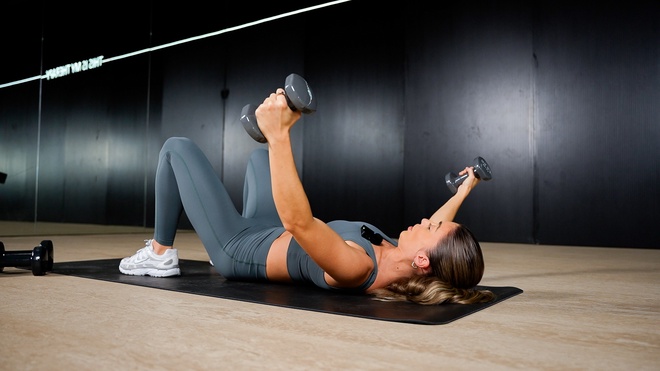
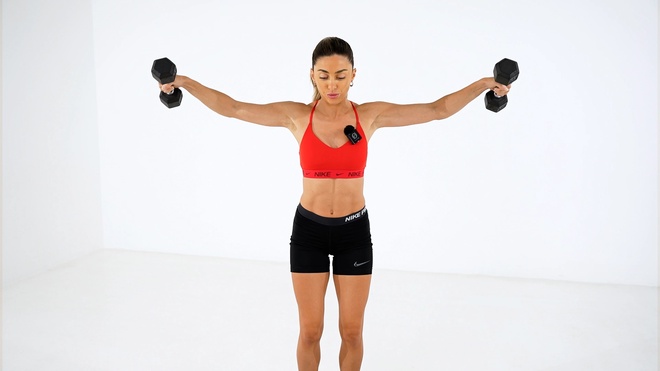
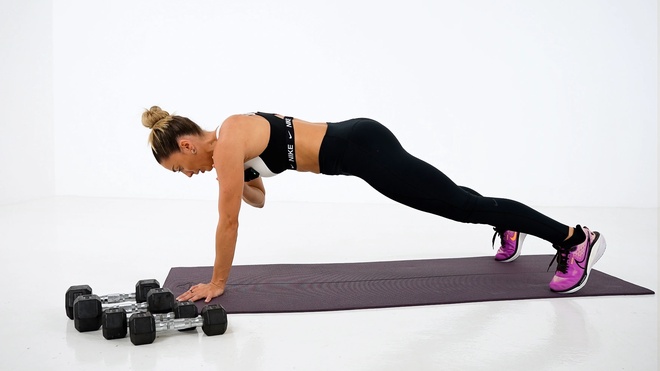
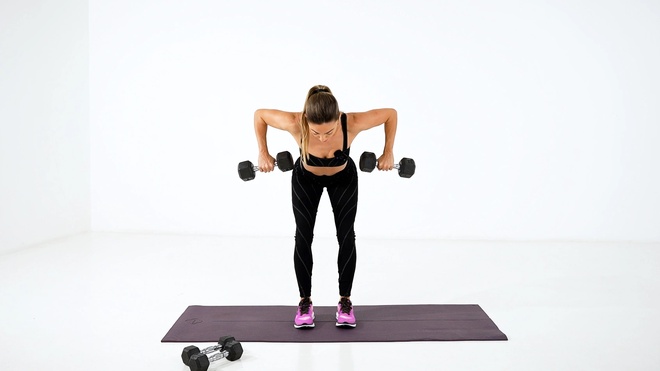
Join women building upper back strength and better posture with certified trainers
Frequently Asked Questions
Related Exercises
Bent Over Row
Same hip hinge position, compound pulling. The row is the power move; the reverse fly is the isolation finisher. Sophie programs them back-to-back in Total Body Conditioning.
Lateral Raises
Same movement plane, opposite direction. Lateral raises hit the side delts, reverse flys hit the rear delts. Together they build complete shoulder development.
Band Pull Aparts
The standing, no-hinge version of a reverse fly. Easier on the lower back, same scapular retraction benefit. The simplest reverse fly alternative when you can't hinge.
Renegade Row
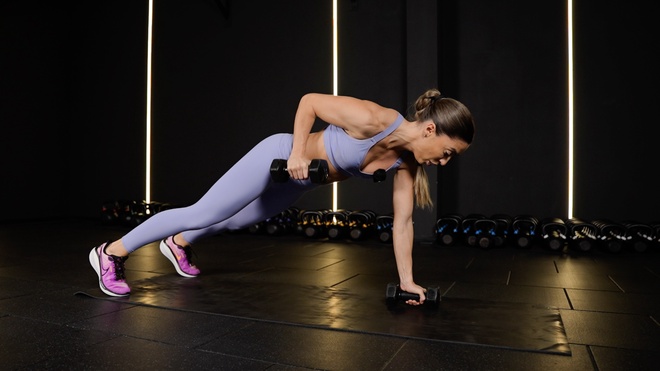
Upper back pulling from a plank position. Adds anti-rotation core challenge to the posterior chain work.
Push-Ups
The antagonist. Push-ups train the chest and front delts. Pair them with reverse flys to prevent the front-dominant imbalance that causes shoulder problems.
This exercise helps with
Get reverse fly in a guided workout
Access 10 workouts featuring this exercise, plus personalized plans from Dr. Wellls.
Join women building upper back strength and better posture with certified trainers
Your membership funds independent women's health research