Push-Ups: How-to, Benefits & Variations
Push-ups target chest, shoulders, triceps, and core. Place hands at armpit width, lower chest to floor with elbows at 45 degrees, push up. Builds upper body strength and bone density.
Push-Ups: How-to, Benefits & Variations
Women can't do push-ups. I have heard this lie so many times I have stopped counting. It shows up in gym culture, on social media, in the mouths of trainers who should know better. The truth is absurdly simple: most women were never taught how.
Push-ups are the single most efficient upper body exercise that exists. One movement. Chest, shoulders, triceps, core, serratus anterior, even your glutes if you are doing it right. No machine, no gym, no equipment. A 2023 systematic review of push-up variations and muscle activation confirmed that the standard push-up produces high-level activation across the pectoralis major, anterior deltoid, and triceps brachii simultaneously. No isolation exercise comes close to that kind of return on investment.
The push up exercise appears 95 times across our workout library, taught by 13 different certified trainers in 30 distinct variations. Sophie Jones alone programs push-ups into 76 workouts. That is not an accident. It is because push-ups work. And the idea that modified push-ups are somehow lesser? That is the second lie we need to bury.
Boxing Full Body Burn: Workout 2
Danielle Harrison
How to Do Push-ups
Start on the floor, hands slightly wider than shoulder-width apart, fingers spread. Danielle Harrison cues it plainly: we are going to drive forward, elbows are going to tuck in. Your hands should be roughly level with your armpits, not out in front of your face. Linda Chambers is strict on this: make sure your hands are not in front of your shoulders. Try and have your hands right by your armpits.
Set your feet hip-width apart and come up into a high plank position. Your body should be one straight line from head to heels. Sophie Jones's biggest pet peeve: I don't wanna end up leaving my hips, and then I'm just pushing through this arched back. Squeeze your glutes. Brace your core. If someone put a ruler on your back, it should touch your head, mid-back, and tailbone.
Lower yourself by bending your elbows, keeping them at roughly a 45-degree angle to your torso. Sophie cues: I'm not letting my elbows flare. Flaring puts your shoulder joint in a compromised position. Elbows skim the ribs, as Jessica Casalegno teaches in her chaturanga-style push-ups. Lower until your chest is a fist-width from the floor.
Push the floor away. Not yourself up. That mental shift changes everything. Sophie Jones: as soon as you've got those abs connected, you do feel like you are pushing that body weight away. Exhale hard on the way up. Linda Chambers cues: breathing out as we push the floor away. Lock out your arms at the top without hyperextending your elbows.
Reset your position before the next rep. Check: hips level? Core tight? Shoulders stacked over wrists? Sophie cues: I'm not overarching, I'm not pushing the hips forward, my abs and my glutes are nice and strong. One clean rep beats five sloppy ones.
Muscles Worked
Primary
Pectoralis major (chest)
The primary mover in push-ups. Responsible for horizontal adduction of the shoulder, which is the pressing motion that drives you off the floor. A systematic review of push-up EMG studies found consistent high activation of the pectoralis major across standard, wide, and narrow hand positions. The wide position emphasizes the sternal head; the narrow position shifts more load to the clavicular head.
Anterior deltoid (front shoulder)
Works alongside the chest to flex and adduct the shoulder during the pushing phase. Carries a larger share of the load as your hands narrow. This is why tricep push-ups burn your shoulders before your chest.
Triceps brachii
Extends your elbows to push you back to the top position. Narrow hand placement increases triceps demand significantly. Sophie Jones programs both standard and tricep push-ups in her muscle tone workouts for exactly this reason.
Secondary
Serratus anterior
Anchors your shoulder blade flat against your rib cage. Without it, your shoulder blades wing out and your push becomes unstable. Linda Chambers teaches scapular push-ups specifically to train this muscle: not actually doing a push-up with my hands, depressing the scapula and then elevating.
Core musculature (rectus abdominis, transversus abdominis, obliques)
The push-up is a moving plank. Your core fires isometrically the entire time to prevent spinal extension and rotation. Sophie: keeping that core nice and tight, that is what is going to help you move as one whole movement. Weak core equals sagging hips equals lower back strain.
Glutes
Lock your pelvis in neutral. Sophie cues glute engagement in nearly every push-up set she teaches. Without active glutes, the pelvis drops and the lower back takes the load.
Why this matters in perimenopause
Upper body strength declines faster than lower body strength as estrogen drops. A 2022 study on upper body strength deficits in women found that the disparity between male and female upper body strength is partly driven by hormonal differences in muscle protein synthesis, differences that widen during perimenopause. A 2023 international expert position statement on resistance training for menopausal women recommended compound upper body exercises, and push-ups check every box: multi-joint, load-bearing, progressive, and accessible. You do not need a gym to fight sarcopenia. You need the floor.
Coach's Tips
"Make sure your hands are not in front of your shoulders. Try and have your hands right by your armpits." Linda Chambers is laser-focused on hand position, and she is right. When your hands drift forward, you overload the front of the shoulder and take your chest out of the equation. Check from the side: wrists directly below shoulder joints.
Linda Chambers
"I'm not letting my elbows flare. I'm not bringing my chest first here and leaving my hips in the air." Sophie Jones catches the two biggest push-up form errors in one sentence. Flared elbows wreck your shoulder impingement risk. Chest-first-hips-last means your core checked out. Move as one solid piece.
Sophie Jones
"Elbows are gonna skim the ribs. As you inhale, bend the elbows... exhale, you press all the way up." Jessica Casalegno's chaturanga cue is the cleanest push ups form instruction I have heard. Ribs, not sides. Ribs. That elbow path protects your rotator cuff and maximizes triceps engagement.
Jessica Casalegno
"As soon as you've got those abs connected, you do feel like you are pushing that body weight away." Sophie Jones nails the core connection most people miss. A push-up without core bracing is just an arm exercise with a loose spine. Brace first. Then push. The difference is immediate.
Sophie Jones
"Breathing out as we push the floor away." Linda Chambers keeps it dead simple. Inhale on the way down. Exhale forcefully as you drive up. The exhale creates intra-abdominal pressure that stabilizes your lumbar spine and engages your pelvic floor. Stop holding your breath.
Linda Chambers
"If the push-up is looking a little bit like this... I'd rather you bring the knees down and really be able to bring the chest all the way down." Natalia Gunnlaugs does not sugarcoat it. If your form is gone, drop to knees. Full range of motion on your knees is harder than half range on your toes. That is not my opinion. That is physics. Moment arm matters.
Natalia Gunnlaugs
"Keep your elbows tucked in toward your sides rather than flaring them out to protect your shoulders." This cue appears in multiple trainers' coaching because the injury risk is real. Flared elbows at 90 degrees impinge the supraspinatus tendon against the acromion. A 45-degree elbow angle eliminates this. Every. Single. Rep.
Multiple trainers
"Hold onto dumbbells to keep your wrists straight if you experience joint pain." This solves the wrist problem entirely. Gripping dumbbells keeps the wrist in neutral extension instead of the 90-degree dorsiflexion a flat-floor push-up demands. Same exercise. Zero wrist pain.
Multiple trainers
Why This Matters for You
Push-ups address three things that quietly deteriorate during perimenopause, and nobody talks about two of them.
The first is upper body sarcopenia. Estrogen supports muscle protein synthesis. When estrogen drops, you lose muscle. But you do not lose it evenly. Upper body musculature declines faster than lower body, and most women do not notice until they cannot open a jar, push a suitcase into an overhead bin, or get off the floor without rolling to one side. A 2023 expert position statement from international researchers specifically recommended compound upper body resistance training for menopausal women. Push-ups are the compound upper body exercise.
The second is bone density at the wrist and spine. Osteoporotic fractures hit the wrist and vertebrae hard. A 2025 meta-analysis confirmed that resistance training improves bone mineral density in postmenopausal women. Push-ups load your wrists, shoulders, and thoracic spine under your own bodyweight on every rep. That loading stimulus is what triggers bone remodeling.
The third is posture. Weakened serratus anterior and mid-trapezius muscles lead to rounded shoulders and forward head position. The push-up trains the serratus anterior through its full range, protraction at the top and retraction at the bottom. Linda Chambers teaches scapular push-ups specifically for this. Hours at a desk plus weakening stabilizers equals postural collapse. Push-ups are the counterattack.
Variations & Modifications
Knee Push-Ups (Modified Push-Ups)
low-mediumSame movement, knees on the floor. Natalia Gunnlaugs is clear: I would rather you bring the knees down and really bring the chest all the way down. Modified push-ups are not easier. They are a different lever length. Full chest-to-floor range on knees builds more strength than half-reps on toes. One trainer cue: rest on the soft part above the kneecap, not the bone itself.
Eccentric Push-Ups (Negative Push-Ups)
mediumLower slowly on your toes for 3-5 seconds, then drop to knees to push back up. Beth Hannam programs these: we are gonna control down for one, two, three. The eccentric phase is where muscle damage and growth stimulus happen. Four eccentric push-ups produce more pectoral activation than eight fast reps. This is how you build toward full push-ups if you are not there yet.
Tricep Push-Ups
medium-highNarrow hand position, elbows glued to ribs. Shifts the primary load from chest to triceps and anterior deltoid. Sophie Jones and Jessica Casalegno both program these in upper body and Pilates workouts. Casalegno cues: elbows are gonna skim the ribs. If your elbows flare, widen your hands. This is the hardest standard push-up variation for most people.
Push-Up with Rotation (T Push-Up)
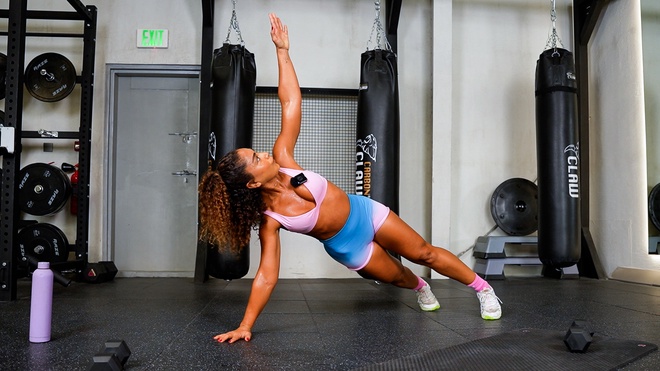
medium-highPush up, then rotate into a side plank, reaching one arm to the ceiling. Natalia Gunnlaugs programs these in HIIT workouts. The rotation adds an anti-rotation demand on the way up and an open-chain balance challenge at the top. Targets obliques, improves thoracic mobility, and builds shoulder stability. Two exercises in one rep.
Push-Up to Side Plank
highFull push-up, then rotate into a full side plank on one hand. Hold for a beat. Return. Repeat on the other side. This is an advanced variation that appears in Natalia's HIIT programming. Demands chest strength, core anti-rotation, shoulder stability, and balance simultaneously. Three occurrences in our workout library. Earn this one.
Wide to Narrow Push-Ups
medium-highAlternate between a wide hand position (chest emphasis) and a narrow position (triceps emphasis) on each rep or each set. Covers both movement patterns in one exercise. A systematic review confirmed that hand width significantly changes muscle activation: wider increases pectoralis major demand, narrower increases triceps brachii and anterior deltoid demand.
Walkout to Push-Up (Inchworm Push-Up)
mediumStand, fold forward, walk hands out to a plank, do a push-up, walk hands back, stand up. Sophie Jones loves this combination: sitting my hips right back into my heels, and then my core is nice and engaged as I come forward. Adds a hamstring stretch, a core challenge, and a brief cardiovascular element to every rep. Appears in 5 workouts.
Pulse Push-Ups
highLower halfway, pulse up and down 2-3 inches for 3 reps, then press all the way up. Time under tension skyrockets. The pectoral and triceps muscles stay under constant load with no lockout rest. Two occurrences in our library, both in muscle tone workouts. Brutal. Effective. Not for beginners.
Benefits
The most time-efficient upper body exercise
One push-up trains chest, shoulders, triceps, core, and serratus anterior in a single movement. A 2023 systematic review confirmed high-level EMG activation across the pectoralis major, anterior deltoid, and triceps simultaneously. No dumbbell press, cable fly, or machine can match that many muscles in one rep with zero equipment.
Fights upper body muscle loss during perimenopause
Upper body strength drops faster than lower body strength as estrogen fluctuates. A 2022 study on upper body strength deficits in women documented the physiological basis: hormonal contributions to muscle protein synthesis shift during menopause. Push-ups directly target the muscle groups most at risk. A 2024 study found higher volume resistance training enhances whole-body muscle hypertrophy in postmenopausal and older females. You do not need heavy weights. You need consistent push-ups.
Supports bone density at the wrist, shoulder, and spine
Push-ups are a weight-bearing exercise for your upper body. A 2025 meta-analysis found that resistance training improved bone mineral density in postmenopausal women, with upper body loading especially important since osteoporotic fractures commonly affect the wrist and spine. The push up exercise loads both sites on every single rep.
Core strength without spinal flexion
Every push-up is a moving plank. Your core works isometrically to prevent your spine from extending under load. Unlike crunches, there is no repeated lumbar flexion, no disc compression, no neck strain. Sophie Jones cues it every session: keeping that core nice and tight, that is what helps you move as one whole movement.
Infinite scalability with zero cost
Knee push-ups. Eccentric negatives. Standard reps. Tricep variations. Rotations. Walkouts. Pulse holds. You can progress push-ups for years without buying anything. Our library contains 30 distinct push-up variations across 95 workout appearances. There is always a harder version waiting.
Common Mistakes to Avoid
Flaring elbows out to 90 degrees
This is the injury factory. Elbows at 90 degrees to your torso impinge the supraspinatus tendon under the acromion. Sophie Jones is relentless about it: I'm not letting my elbows flare. Jessica Casalegno teaches elbows that skim the ribs. Keep your elbows at roughly 45 degrees. Your shoulders will thank you for the next 40 years.
Hips sagging or piking up
Sophie catches this constantly: I don't wanna end up leaving my hips and just pushing through an arched back. And: I'm not leaving that butt in the air. Your body is a plank. Squeeze your glutes, brace your core, and move as one unit. If you cannot maintain the line, drop to your knees.
Hands too far forward
Linda Chambers is specific: make sure your hands are not in front of your shoulders, try and have your hands right by your armpits. Hands in front shifts load entirely to the front deltoid and shortens your range of motion. Your chest never gets trained. Move your hands back.
Partial range of motion on toes instead of full range on knees
Natalia Gunnlaugs kills this ego trap: I would rather you bring the knees down and really bring the chest all the way down. Half a push-up on your toes is not harder than a full push-up on your knees. Full range of motion is where the strength adaptation happens. Full range, every rep.
Workouts Featuring This Exercise


Join women building upper body strength and confidence with certified trainers
Frequently Asked Questions
Related Exercises
Plank
The isometric foundation of the push-up. If your plank is weak, your push-up will collapse. Build here first.
Chest Press
Same pressing pattern with dumbbells. Allows you to load progressively when bodyweight push-ups become easy.
Skull Crushers
Isolates the triceps, one of three primary push-up movers. Strengthens the lockout phase specifically.
Tricep Push-Ups
Narrow-grip variation that shifts the emphasis to triceps and anterior deltoid. A natural push-up progression.
Renegade Row
Push-up position plus a row. Trains the opposing pulling muscles while maintaining core bracing.
This exercise helps with
Get push-ups in a guided workout
Access 10 workouts featuring this exercise, plus personalized plans from Dr. Wellls.
Join women building upper body strength and confidence with certified trainers
Your membership funds independent women's health research