Chest Press: How-to, Benefits & Variations
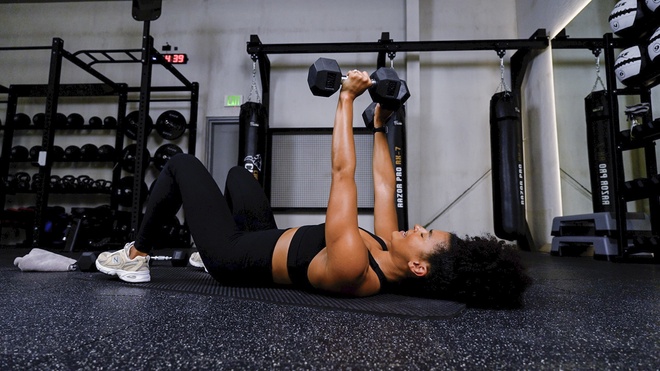
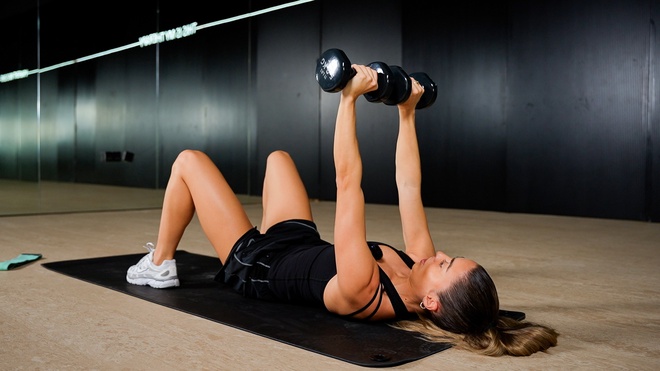
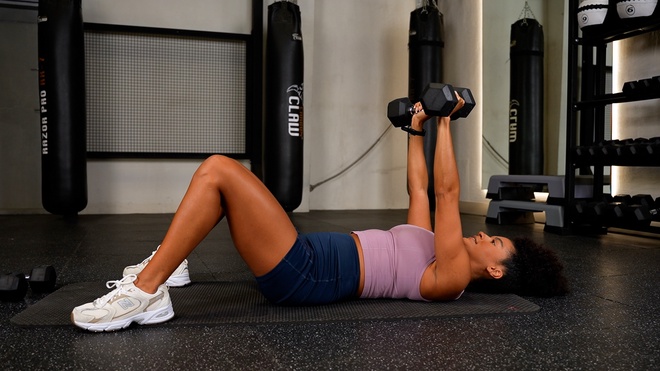
The chest press targets pectorals, anterior deltoids, and triceps. Lie flat, press dumbbells from chest to ceiling, lower slowly until elbows tap the floor. Builds upper body pressing strength.
Chest Press: How-to, Benefits & Variations
Here is what nobody tells you about upper body training: most women skip pressing entirely. Not on purpose. It just happens. You do squats, you do lunges, you might do a plank. But lying on your back and pushing weight toward the ceiling? That feels like it belongs to someone else's workout.
The chest press is the exercise that fixes that blind spot. It is the supine version of a push-up, which means your pectorals, anterior deltoids, and triceps do the work while your back is supported. But unlike a push-up, you control the load precisely. Five-pound dumbbells or thirty-pound dumbbells. Same movement pattern. Different challenge. That is the reframe: the chest press is not the easy version of a push-up. It is the version that lets you actually load your upper body without needing the wrist strength, shoulder stability, and core endurance a push-up demands.
Women lose muscle mass faster in the upper body than the lower body during perimenopause. A 2023 meta-analysis of sarcopenia prevention in menopausal women specifically recommended resistance training that includes horizontal pressing. The chest press is the most accessible horizontal press that exists.
Total Body Conditioning: Workout 6
Sophie Jones
How to Do Chest Press
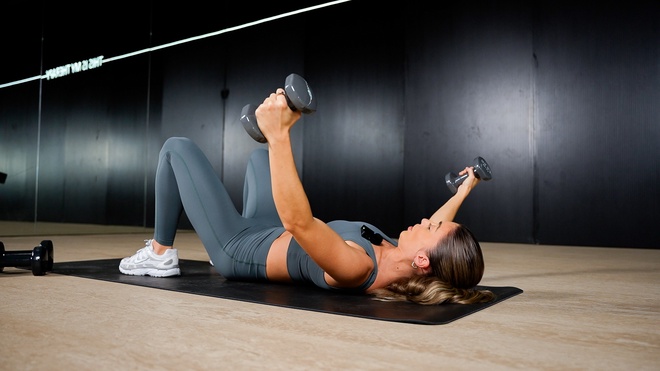
Lie flat on your back with knees bent and feet flat on the floor. Hold a dumbbell in each hand at chest height, elbows bent and resting lightly on the floor. Sophie Jones cues this position in every chest press segment: elbows find the floor before you start.
Press your lower back firmly into the mat. Sophie Jones is explicit about this: pushing my tummy button down towards the mat. This braces your core and prevents your ribcage from flaring open under load. If your lower back arches, the weight is too heavy.
Exhale and press both dumbbells toward the ceiling. Drive through your palms, not your wrists. Sophie cues: elbows are on the floor, drive up, they're gonna touch at the top. The dumbbells should nearly meet above your chest, not above your face.
At the top, squeeze your chest muscles together. Sophie describes this as hitting that triangle: the dumbbells follow an inward path, meeting above the center of your chest. Really over-exaggerate that squeeze. This peak contraction is where the pectorals work hardest.
Inhale and lower the dumbbells slowly until your elbows tap the floor. Sophie cues: slowly, slowly, slowly, and then drive. The descent should take twice as long as the press. The eccentric (lowering) phase builds more muscle than the concentric (pushing) phase. Fight against the weight on the way down.
Repeat for your target rep range. Both elbows should touch the floor at the same time. Sophie notes: try and control both arms at the same time. You want your elbows to tap the floor same time. If one elbow lands before the other, your stronger arm is compensating.
Muscles Worked
Primary
Pectoralis major
The chest press muscles worked start with the pectoralis major. This is the large fan-shaped muscle across your chest. During a dumbbell chest press, the sternal (lower) and clavicular (upper) fibers both contribute to horizontal adduction, pulling your arms from wide to narrow above your chest. A 2022 biomechanics study of bench press grip width and incline angle confirmed that the flat pressing position activates both pec heads significantly. Women have less baseline pec development than men, which makes intentional pressing even more important.
Anterior deltoid
The front portion of your shoulder assists every pressing movement. During a chest press, the anterior deltoid works alongside the pec to push the weight upward. Sophie Jones cues keeping shoulders relaxed and away from your ears. That cue matters because if the deltoids take over, the chest stops working. Elbows slightly tucked (not flared straight to the sides) keeps the load distributed properly between chest and shoulders.
Triceps brachii
The back of your upper arm extends your elbow at the top of every press. Without strong triceps, you cannot lock out. Sophie Jones programs chest press alongside skull crushers in her Strength Fundamentals series for this reason. The triceps provide the final push. If your arms give out before your chest burns, the triceps are the weak link.
Secondary
Serratus anterior
The 'boxer's muscle' wraps around your ribcage. It protracts your shoulder blades at the top of the press, pushing them apart. Without serratus engagement, your shoulder blades pinch together and limit your range of motion. Most people never think about this muscle, but it is working every rep.
Core (transversus abdominis, rectus abdominis)
When Sophie cues pressing the belly button toward the mat, she is activating the deep core to stabilize your spine under load. The core prevents your lower back from arching as the dumbbells descend. One instance in our database tags the exercise with core as a body part. It is not the primary target, but it is always working.
Why this matters in perimenopause
Upper body muscle mass declines faster than lower body during hormonal transitions. A 2023 meta-analysis on sarcopenia prevention in menopausal women found that resistance training preserves lean mass, and the chest press specifically targets the muscles most likely to atrophy from disuse: pectorals, deltoids, and triceps. A 2024 systematic review confirmed that resistance training in postmenopausal women improves body composition, and horizontal pressing is a standard component in every study protocol reviewed. Bone density in the spine and wrist also benefits from loaded pressing movements. The chest press applies compressive force through the shoulder joint and distributes it into the upper back, stimulating bone remodeling in areas vulnerable to osteoporosis.
Coach's Tips
"Think about squeezing the chest together as you press up towards the ceiling." Sophie Jones says this almost every time she programs the chest press. The squeeze cue shifts your focus from just moving weight upward to actively contracting the pectorals. Without it, the shoulders and triceps tend to dominate. Squeeze like you are trying to crack a walnut between your pecs at the top.
Sophie Jones
"I'm hitting that triangle. Top of the triangle, outside of the triangle." Sophie uses this visual to describe the dumbbell path: wide at the bottom (elbows on floor), narrow at the top (dumbbells nearly touching above chest). That triangle path maximizes pectoral fiber recruitment across the full range. Straight up-and-down pressing misses the adduction component where the chest works hardest.
Sophie Jones
"Focus on the negative of the movement." This means the lowering phase. Sophie also cues: slowly, slowly, slowly, and then drive. Eccentric loading builds more muscle fiber damage (the good kind that triggers growth) than the concentric press. A 3-second lower is a good starting target. If you cannot control the descent, the weight is too heavy. Drop down.
Sophie Jones
"Don't let them go too far back. Bring them in between shoulders and hips." Sophie's range-of-motion cue protects the shoulder joint. When dumbbells drift behind your head, the anterior capsule of the shoulder stretches under load. That is how impingement starts. Keep the weights in the zone between your shoulders and your ribcage.
Sophie Jones
"Maintain a slight tuck in your elbows rather than flaring them straight out to the sides." Elbows at 90 degrees from your torso put your shoulder in a compromised position under load. A slight tuck, maybe 45-60 degrees, distributes force through the chest and the shoulder joint evenly. The canonical cue says it plainly. Tucked elbows protect your rotator cuff.
Sophie Jones
"Exhale as you drive the weights up and inhale as you slowly lower them to the floor." This is not arbitrary. The exhale creates intra-abdominal pressure that stabilizes your spine under load. It also helps you push harder. Try pressing on an inhale sometime. You will immediately feel weaker. Exhale on effort. Inhale on the stretch. Every rep.
Sophie Jones
Perform an incline push-up against a sturdy bench or countertop if you do not have dumbbells. Same pressing pattern, reduced load, zero equipment. Or try the alternating-arm variation: keep one dumbbell extended toward the ceiling while the other arm presses. This increases core demand and lets you focus on one side at a time. Sophie Jones programs the eccentric-focus variation in Round 4, where you slow the lowering phase to a 3-second count and pause when elbows touch the floor.
Sophie Jones
Why This Matters for You
The chest press addresses a specific problem most women do not realize they have until it is too late: upper body muscle loss.
Estrogen plays a role in maintaining lean muscle mass, particularly in the upper body. A 2023 meta-analysis of non-pharmacological sarcopenia interventions in menopausal women found that resistance training was the single most effective strategy for preserving muscle. The pectorals, deltoids, and triceps are among the first muscles to atrophy when they are not trained, and most women never train them intentionally.
Bone density is the other piece. A 2025 meta-analysis of optimal resistance training parameters for bone mineral density in postmenopausal women confirmed that loaded multi-joint exercises improve BMD. The chest press creates compressive force through the shoulder girdle and upper spine, areas particularly vulnerable to osteoporotic fractures.
There is also a functional argument. Pushing a heavy door. Lifting a suitcase into an overhead bin. Getting up from the floor after playing with kids. These daily tasks require pressing strength. If you have never trained it, you will notice the decline. The chest press is the most direct way to build and maintain that capacity.
Variations & Modifications
Eccentric-Focus Chest Press
highSlow down the lowering phase to a 3-second count. Pause when elbows touch the floor. Then press up powerfully. Sophie Jones programs this as Round 4 in Strength Fundamentals 8. The pause eliminates momentum, which means your pectorals do all the work from a dead stop. Harder than it sounds. Drop your weight by 20-30% when you first try this.
Alternating Chest Press
medium-highKeep one dumbbell extended toward the ceiling while the other arm performs a full repetition. Then switch. This unilateral variation increases core demand because your body has to resist rotating toward the moving arm. It also exposes left-right strength imbalances. Sophie notes: you might feel like you have one arm stronger than the other... really try and balance it out.
Floor Chest Press
mediumSame movement, but performed on the floor without a bench. The floor limits your range of motion, which actually makes it shoulder-friendly for anyone with impingement or anterior capsule laxity. All 13 chest press occurrences in our workout library use the floor variation. We have a dedicated page for the floor chest press with more detail.
Benefits
Loads the upper body without demanding push-up prerequisites
A push-up requires wrist extension, shoulder stability, and core endurance before your chest even gets to work. The chest press strips all of that away. Your back is supported. Your wrists stay neutral. You isolate the pressing muscles. Chest press benefits include the ability to progressively overload with specific dumbbell increments, something bodyweight push-ups cannot offer until you are strong enough to add a weighted vest.
Targets the three muscles women under-train most
Pectorals, anterior deltoids, and triceps. These three muscle groups see the least intentional training in most women's routines. A 2020 meta-analysis comparing resistance training effects on body composition in different women groups found that upper body exercises produced the largest relative strength gains precisely because they started from the lowest baseline. The chest press exercise works all three in one movement.
Builds bone density in the upper body
A 2023 network meta-analysis of resistance training protocols for bone mineral density in postmenopausal women confirmed that multi-joint pressing exercises contribute to bone remodeling at the spine and hip. The chest press creates compressive force through the shoulder joint and upper spine. A 2025 meta-analysis found that optimal resistance training parameters improve bone mineral density in postmenopausal women. Pressing movements are included in virtually every study protocol.
Corrects forward-slouch posture when paired with pulling
Weak pectorals do not cause forward posture. Tight pectorals do. But here is the catch: pec tightness comes from weakness in the antagonist muscles (mid-back, rear delts), AND from never using the chest through its full range. A 2022 study on pectoral tightness and forward shoulder posture found that strengthening protocols combined with stretching produced better posture outcomes than stretching alone. The chest press through full range strengthens and lengthens simultaneously.
Common Mistakes to Avoid
Lower back arching off the mat
Sophie Jones is specific: think about pressing the back in towards the floor. Use them abs as well on this. If you see daylight between your lower back and the mat, the weight is too heavy or your core is not engaged. Press your belly button down. If your ribs still flare, reduce the weight.
Elbows flaring straight out to the sides
A 90-degree elbow flare turns the chest press into a shoulder-grinding movement. The canonical cue says: maintain a slight tuck in your elbows. Think 45-60 degrees from your torso. Sophie's triangle cue naturally creates this angle. If your elbows are level with your shoulders, tuck them closer to your ribs.
One arm pressing faster than the other
Sophie catches this in real time: try and control both arms at the same time. You want your elbows to tap the floor same time. If one side arrives first, your dominant arm is taking over. Slow down the fast arm. Match the tempo. This asymmetry is useful information. It tells you which side needs extra work.
Dropping the dumbbells instead of lowering them
Sophie cues: fight against it, hold it, hold it, hold it, push. The lowering phase is where muscle growth happens. Dropping the weight skips the entire eccentric benefit. A slow 3-second descent followed by a controlled floor touch makes every rep roughly twice as effective.
Workouts Featuring This Exercise

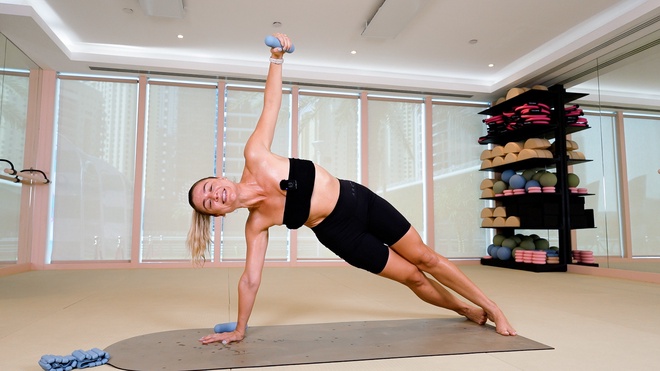
Join women building upper body pressing strength with certified trainers Sophie Jones and Danielle Harrison
Frequently Asked Questions
Related Exercises
Push-Up
The bodyweight counterpart to the chest press. Same muscles, different stability demand. If you cannot do push-ups yet, the chest press builds the pressing strength you need to get there.
Skull Crushers
Isolates the triceps, which are the weak link in most women's pressing. Pair with chest press to build lockout strength.
Reverse Fly
The antagonist to the chest press. Works the rear deltoids and mid-back. Pairing push with pull keeps the shoulder joint balanced.
Lateral Raises
Shoulder complement. Targets the medial deltoid, which the chest press does not. Together they build the full shoulder girdle.
Bent Over Row
Horizontal pull to balance the horizontal press. Strengthens the mid-back muscles that counterbalance pectoral tightness.
This exercise helps with
Get chest press in a guided workout
Access 10 workouts featuring this exercise, plus personalized plans from Dr. Wellls.
Join women building upper body pressing strength with certified trainers Sophie Jones and Danielle Harrison
Your membership funds independent women's health research