Skull Crusher: How-to, Benefits & Variations
Skull crushers target the triceps. Lie back, hold dumbbells above chest, bend at elbows to lower beside ears, extend back up. Builds arm strength and bone density during perimenopause.
Skull Crusher: How-to, Benefits & Variations
The name sounds violent. The exercise is one of the gentlest arm moves you can do lying down.
Skull crushers get skipped by women more than almost any other strength exercise. The name scares people off. Or they figure triceps are a vanity muscle, something for guys chasing sleeve-busting arms. Wrong on both counts. Your triceps make up roughly two-thirds of your upper arm mass. They're the muscle that pushes you up off the floor, lifts a suitcase into an overhead bin, hoists a toddler above your head. When those fibers weaken, and they will during perimenopause unless you load them, you lose functional independence in ways that creep up slowly and then hit all at once.
This is the only isolated tricep exercise in our entire workout library. Everything else that trains your arms bundles the triceps in with shoulders, chest, back. Skull crushers go straight to the source.
Bringing Sexy Back: Workout 1
Sophie Jones
How to Do Skull Crushers
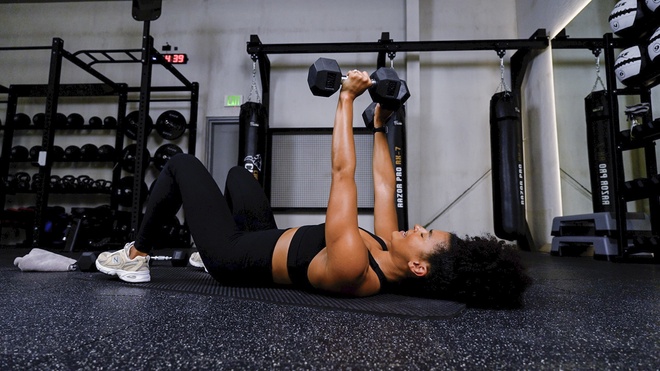
Lie on your back on a mat with your knees bent and feet flat on the floor. Hold a dumbbell in each hand. Press them straight up above your chest, arms fully extended, palms facing each other. This is your start position.
Press your belly button down toward the floor. Sophie Jones cues this in every lying exercise she teaches. It locks your core, protects your lower back, and stops your rib cage from flaring as the weights move.
Keeping your upper arms completely still and pointed at the ceiling, slowly bend at the elbows to lower the dumbbells toward either side of your head. Danielle Harrison's cue: hinge at the elbows, nice and slow, literally skimming either side of your head. The weights should travel in an arc, not straight down.
Pause briefly when the dumbbells reach ear level. Your forearms should be roughly parallel to the floor. Don't let the weights drift behind your head or touch the ground.
Exhale and extend your arms back to the starting position, squeezing your triceps at the top. Sophie cues: push the dumbbells to follow your elbows toward the ceiling. Both arms move at the same speed, same time. Fight for symmetry.
Keep your elbows tucked the entire time. The moment they flare outward, your shoulders steal the work from your triceps. If you can't keep them still, the weight is too heavy. Drop down. No shame in that.
Muscles Worked
Primary
Triceps brachii (all three heads)
The skull crushers exercise isolates the triceps through elbow extension against gravity. The long head, which crosses both the shoulder and elbow joints, gets the deepest stretch at the bottom of the movement. The lateral and medial heads handle the lockout at the top. No other exercise in a typical dumbbell routine isolates all three heads this effectively from a supine position.
Secondary
Anterior deltoid (front shoulder)
Stabilizes the shoulder joint to keep your upper arms vertical. Not a prime mover here, but it works isometrically the entire set. If your shoulders fatigue before your triceps, your elbows are probably drifting too far back.
Core (transverse abdominis, rectus abdominis)
Braces the torso against the shifting load. Sophie Jones cues pressing the belly button to the floor before every rep. Without that brace, your lower back arches as the weight moves overhead, and now you have a back exercise instead of a tricep exercise.
Why this matters in perimenopause
Here's what nobody tells you about arm strength during perimenopause. Estrogen decline accelerates sarcopenia, and it doesn't hit evenly. Women lose upper body muscle faster than lower body muscle. A 2024 meta-analysis of resistance training in postmenopausal women found upper extremity strength improved by a standardized mean difference of 7.42 when women actually trained those muscles. That's an enormous effect size. But most women focus exclusively on legs and glutes and ignore their arms entirely. The triceps are the largest muscle in your upper arm. Neglecting them means losing pushing strength, the exact capacity you need to get yourself off the floor, push a stroller uphill, or catch yourself during a fall.
Coach's Tips
"Hinge at the elbows, nice and slow, literally skimming either side of your head." That's Danielle Harrison. I replay this cue for every client who rushes the lowering phase. Slow means you control the weight. Fast means gravity controls you. If you can't lower for a count of three, you need lighter dumbbells. Period.
Danielle Harrison
"My elbows are up towards the ceiling, and then I push the dumbbells to follow." Sophie Jones teaches skull crushers in her Bringing Sexy Back series, and this cue reframes the whole movement. Stop thinking about pushing the weight up. Think about pushing your elbows toward the ceiling and letting the dumbbells chase them. Completely different feeling in the triceps.
Sophie Jones
"I don't bring them to here, I just bring them straight up above my chest." Another Sophie Jones detail that matters. The lockout happens directly above your chest, not above your face. Locking out over your face puts shear stress on the elbow joint. Over the chest keeps the tension on the triceps and the load path clean.
Sophie Jones
"Push that tummy button towards the floor." Core engagement is not optional on skull crushers. Without it, your lower back compensates for every rep. I've watched women arch so hard during this exercise that their rib cage lifts off the mat. That's a red flag. If your ribs pop up, squeeze your abs tighter and use lighter weight until you can keep your back flat through the full set.
Sophie Jones
"If you haven't got weights for these skull crushers, grab a chair. Give me tricep dips." Danielle Harrison says this mid-workout, casually, like it's obvious. And it is. Tricep dips on the floor or a chair hit the same muscle group with zero equipment. Slightly different angle, same result. If dips bother your wrists, try them with fists on the floor instead of flat palms.
Danielle Harrison
Why This Matters for You
Women lose upper body muscle faster than lower body muscle during perimenopause. That's not opinion. A 2023 meta-analysis of 27 RCTs found exercise improved lean body mass in menopausal women, but only when the muscles were actually trained. Sounds obvious. It isn't, because most women focus almost entirely on their legs.
I had a client, Megan, 46, who could squat her bodyweight but couldn't push herself up off the floor without her knees. She had zero isolated tricep training in her history. None. We added skull crushers twice a week with 3kg dumbbells. In six weeks, she could do a full push-up from the floor for the first time since her 20s.
The Stanford Lifestyle Medicine team recommends women in perimenopause prioritize heavy lifting over endurance exercise for body composition. Dr. Stacy Sims says it directly: lifting heavy will help most during this transitional period. Skull crushers with dumbbells are one of the simplest ways to add progressive resistance to your upper body without needing a gym, a barbell, or a spotter.
And there's a bone density angle too. Resistance training three times per week improved bone mineral density at key skeletal sites in a 2025 meta-analysis. Most of that research focuses on the hip and spine. But your wrists and forearms bear load during skull crushers, and those are exactly the bones that fracture first in a fall.
Variations & Modifications
Floor Tricep Dips
low-mediumSit on the floor with your hands behind you, fingers pointing toward your feet, hips lifted. Bend your elbows to lower, then press back up. This is Danielle Harrison's go-to swap when dumbbells aren't available. Less load than skull crushers, but the same elbow extension pattern. Start here if you're brand new to tricep training.
Chair Tricep Dips
mediumHands on the edge of a chair behind you, feet extended. Lower your body by bending your elbows to 90 degrees, then push back up. More range of motion than floor dips, more challenging. Keep your back close to the chair. The further your feet are from the chair, the harder it gets. If you feel it in your shoulders more than your triceps, bring your feet in closer.
Slow-Eccentric Skull Crushers
medium-highSame movement, 3-second lowering phase. That's it. The only difference. But a 3-second eccentric increases time under tension dramatically, which is the primary driver of muscle hypertrophy. Sophie Jones programs skull crushers in three rounds during Bringing Sexy Back. If the standard version starts feeling routine, slowing down the descent will humble you fast.
Benefits
Isolates the triceps like nothing else
Most upper body exercises spread the work across chest, shoulders, and triceps. Skull crushers go directly to the triceps with minimal help from other muscles. The lying position removes momentum, which means your triceps do all the work with nowhere to hide. This matters because isolated strength training produces targeted muscle growth that compound movements alone can't match.
Builds the pushing strength you actually need
Getting up off the floor. Pushing a grocery cart. Lifting a carry-on into an overhead bin. All pushing. All triceps. I talk to women who say they suddenly can't do these things as easily. Nobody tells them it's because they never trained the specific muscle responsible. Skull crushers build that strength directly, and it transfers into every push you'll make for the rest of your life.
Protects against age-related upper body muscle loss
A 2024 meta-analysis found that resistance training produced a standardized mean difference of 7.42 for upper extremity strength in postmenopausal women. That's not a subtle improvement. The catch is you have to actually train the upper body to get those gains. Most women don't. Skull crushers are a simple entry point that requires nothing but two dumbbells and the floor.
Loads the arm bones for density
Bones strengthen in response to mechanical stress. The wrist, forearm, and upper arm bear load during skull crushers. A 2025 meta-analysis found resistance training significantly improved bone mineral density at key skeletal sites in postmenopausal women, particularly with training frequencies of three times per week. Your arms need loading too, not just your hips and spine.
Teaches elbow joint control
The slow, controlled hinge at the elbow trains proprioception and joint stability. Women who start skull crushers often notice their elbows feel more stable during other exercises within weeks. If you've had tennis elbow or general elbow aches from desk work, controlled tricep loading can actually reduce symptoms over time by strengthening the tendons that cross the joint.
Common Mistakes to Avoid
Elbows flaring out to the sides
This is the most common skull crushers form error. When your elbows drift wide, the shoulders take over and the triceps disengage. Sophie Jones cues: isolate the triceps by keeping your elbows tucked in. Imagine your upper arms are glued in place. Only the forearms move. If you can't keep them still, the weight is too heavy.
Lowering the weights above the face instead of beside the head
The name 'skull crushers' exists because people drop weights on their face. Don't be that person. The arc goes beside your ears, not toward your forehead. Sophie's cue: just by the side of the head, and then extending towards the ceiling. Beside, not above.
Arching the lower back
As the weight moves overhead, your body wants to arch. Fight it. Press your belly button to the floor and keep your ribs down. If your back lifts off the mat, your core isn't braced or the weight is too heavy. Both problems have the same fix: lighter dumbbells, tighter abs.
Using momentum to swing the weights up
If you're swinging, you're not training. Danielle Harrison cues controlling both arms at the same time, fighting for it to come down and up at the same speed. The eccentric (lowering) phase should take at least two seconds. If you're bouncing at the bottom, you've lost the plot.
Workouts Featuring This Exercise
Join women building arm strength, bone density, and confidence with certified trainers
Frequently Asked Questions
Related Exercises
Lateral Raise
Targets the shoulders while skull crushers hit the triceps. Together they cover the two muscles most responsible for upper arm shape and pressing strength.
Bent-Over Row
Trains the pulling muscles (back, biceps) that balance the pushing muscles skull crushers develop. Pairing both prevents shoulder imbalances.
Plank
Isometric tricep engagement plus full core bracing. If your core gives out during skull crushers, planks will fix that.
Glute Bridge
Skull crushers handle upper body, glute bridges handle lower body. A superset of both covers the full body in under 10 minutes.
Crunches
Strengthens the core that stabilizes you during skull crushers. If your back arches during the exercise, your abs need work first.
This exercise helps with
Get skull crushers in a guided workout
Access 3 workouts featuring this exercise, plus personalized plans from Dr. Wellls.
Join women building arm strength, bone density, and confidence with certified trainers
Your membership funds independent women's health research