Shoulder Rolls: How-to, Benefits & Variations
Shoulder rolls: stand tall, draw shoulders up to ears, roll back squeezing shoulder blades, drop down. 3-4 circles backward then forward. Relieves tension, improves posture, prevents stiffness.
Shoulder Rolls: How-to, Benefits & Variations
Put your hand on your right shoulder. Now try to draw a circle with your elbow. Forward, up, back, down. How big was that circle? How smooth? If the answer is "small" and "crunchy," you already know why this page exists.
Twenty-six appearances across 26 workouts. Eight trainers. Shoulder rolls show up in boxing warm-ups, Pilates openings, yoga cool-downs, strength training prep, prenatal sessions, and bedtime stretching routines. Danielle Harrison programs them into 10 separate workouts. Petra Kapiciakova uses them in yoga-for-back-relief. Jessica Casalegno cues them in Pilates and prenatal Pilates. Sophie Jones opens strength sessions with them. Mish Naidoo weaves them through stretching and tone-and-stretch programs. Linda Chambers pairs them with chest openers in her functional work.
The shoulder roll exercise is the most universal warm-up movement in our entire library. It requires zero equipment, zero space, and zero fitness background. And it addresses the one position most bodies are stuck in: shoulders hunched, chest collapsed, upper back locked. Every hour at a desk tightens the anterior shoulder and compresses the thoracic spine. Shoulder rolls reverse that pattern in seconds.
Low Impact HIIT: Workout 4
Danielle Harrison
How to Do Shoulder Rolls
Stand tall with your feet hip-width apart and arms hanging naturally by your sides. Let your hands go completely slack. Danielle Harrison starts most of her shoulder roll sequences with a gentle walk in place, keeping the feet moving to maintain circulation. If you are seated, that is fine too. Amelia Jane programs standing shoulder rolls from a chair-height Pilates setup. The spine position matters more than the feet.
Inhale and draw your shoulders straight up toward your ears. Not a gentle lift. Danielle Harrison wants exaggeration: exaggerate those shoulder rolls. Pull them as high as they will go. Feel the upper trapezius contract. This is the loaded phase, and it should feel like effort. Amelia Jane cues the breath: inhale, bring the shoulders up to the ears.
Roll your shoulders back and squeeze your shoulder blades together as they pass behind you. Petra Kapiciakova is specific: try to squeeze the shoulder blades, so opening the chest and releasing any tension. This is where the stretch happens. Your chest opens, your pectorals lengthen, and the posterior shoulder muscles engage. Sophie Jones wants them big: big ones back.
Exhale and let your shoulders drop down and forward, completing the full circle. The exhale drives the release. Let gravity pull the shoulders down rather than muscling them into position. Jessica Casalegno: big breath to rotate shoulders back. The breath is not decoration. It is the mechanism that allows the muscles to release.
Repeat for three to four circles backward, then reverse direction and roll forward for three to four circles. Linda Chambers: draw three or four circles backwards and then three or four circles forwards. The forward direction stretches the posterior shoulder and upper back, the reverse direction opens the chest and front deltoids. Both directions matter. Mish Naidoo: sweep the shoulders up and over, roll it out.
Muscles Worked
Primary
Upper trapezius
The upper trap lifts the shoulder toward the ear at the top of each roll. It also controls the descent. Shoulder rolls exercises cycle this muscle through its full contraction-to-stretch range, which is something desk posture never does. The upper trap is the muscle that feels like concrete after a long day of work. Most people only ever use it in its shortened position. Shoulder rolls take it through full range.
Levator scapulae
This small muscle runs from the upper neck to the top of the shoulder blade. It elevates and downwardly rotates the scapula. When locked short from phone and laptop posture, it becomes a primary source of neck stiffness and cervicogenic headaches. Shoulder rolls mobilize the levator scapulae through its full excursion. Petra Kapiciakova: releasing any tension. That tension lives here.
Rhomboids (major and minor)
The rhomboids squeeze the shoulder blades together during the backward phase of the roll. They are chronically lengthened and weak in forward-head posture. Each backward roll activates them through a brief contraction, which is enough to break the neural pattern of constant stretch. Linda Chambers pairs shoulder rolls with chest openers for this exact reason.
Secondary
Pectoralis minor
The pec minor gets stretched during the backward roll phase when the shoulders pull behind the body. A tight pec minor tilts the scapula forward and contributes to rounded-shoulder posture. The rhythmic stretch of shoulder rolls is gentle enough for even the tightest pec minor to tolerate.
Anterior and posterior deltoids
The deltoid complex assists the rolling motion throughout its arc. The anterior deltoid engages during the forward-and-up phase. The posterior deltoid fires during the back-and-down phase. Shoulder rolls warm the entire deltoid for overhead or pressing work that follows.
Cervical spine musculature
Mish Naidoo pairs shoulder rolls with neck releases for good reason. The muscles connecting the neck to the shoulder girdle (scalenes, sternocleidomastoid) all move during shoulder rolls, even though the neck itself stays relatively still. Petra Kapiciakova: just swing your head side to side, relax your neck. The neck benefits passively.
Why this matters in perimenopause
Declining estrogen directly affects connective tissue throughout the shoulder girdle. A 2024 meta-analysis of 93,021 women found musculoskeletal pain is one of the most prevalent perimenopause symptoms, with the shoulder joint particularly vulnerable. Frozen shoulder (adhesive capsulitis) has a documented association with perimenopause: the Duke University study by Jocelyn Wittstein connected estrogen decline to frozen shoulder onset. Regular shoulder rolls exercises maintain the synovial fluid circulation and capsular mobility that declining hormones try to reduce. This is not about treating frozen shoulder. It is about preventing the stiffness that leads there.
Coach's Tips
"Exaggerate those shoulder rolls." Danielle Harrison says this across multiple workouts and she means it. Small, tentative circles do almost nothing. The shoulder joint has the largest range of motion of any joint in the body. Use it. Draw the biggest circle your shoulders can make. Up toward the ears, squeeze back, drop down, sweep forward. The larger the circle, the more tissue you mobilize.
Danielle Harrison
"Try to squeeze the shoulder blades, so opening the chest and releasing any tension." Petra Kapiciakova teaches this in her seated shoulder roll sequences in yoga-before-bedtime. The squeeze at the back of the roll is where the posture correction happens. If you skip the squeeze, you get a shoulder shrug, not a shoulder roll. The squeeze pulls the scapulae into retraction, which is the position they should be in but rarely are.
Petra Kapiciakova
"Draw your hands up on top of your shoulders, and start to roll the arms backwards." Jessica Casalegno teaches a hands-on-shoulders variation where the elbows draw the circles. The elbows become the guide. Try to make them as exaggerated as possible, she adds. Placing hands on shoulders forces a larger arc of movement and engages the rotator cuff muscles more directly than free-hanging arms.
Jessica Casalegno
"Big breath to rotate shoulders back." Jessica Casalegno links the breath to the movement and it changes everything. Inhale as the shoulders rise and move backward. Exhale as they descend and sweep forward. The inhale expands the rib cage, creating space for the shoulder blades to retract. The exhale relaxes the anterior muscles, letting the chest open wider. Breath turns a mechanical movement into a stretch.
Jessica Casalegno
"Keep your neck relaxed and gaze forward to avoid straining the cervical spine." The merged cues from our trainer database flag this consistently. When people concentrate on the shoulders, they unconsciously tense the neck. They jut the chin forward. They clench the jaw. The fix: soften your face, drop your tongue from the roof of your mouth, and let the neck be a passenger. The shoulders are doing the driving.
Multiple trainers
"Perform the rolls while seated in a firm chair if you have balance concerns or lower limb fatigue." Petra Kapiciakova and Amelia Jane both program seated shoulder rolls. In yoga-before-bedtime, Petra teaches the full movement from a seated cross-legged position. The shoulder roll exercise works identically seated and standing. The glenohumeral joint does not care whether your feet are on the floor or not.
Petra Kapiciakova
Why This Matters for You
The shoulder joint is one of the first places perimenopause shows up, and most women do not connect the dots.
Estrogen maintains the elasticity of tendons, ligaments, and the joint capsule throughout the body. The shoulder capsule is particularly vulnerable because it is already the loosest capsule in the body, relying on soft tissue rather than bony structure for stability. When estrogen declines, that capsule stiffens. The Duke University study by Jocelyn Wittstein found a direct connection between estrogen decline and frozen shoulder (adhesive capsulitis). A 2024 meta-analysis of 93,021 women confirmed musculoskeletal pain as one of the most prevalent perimenopause symptoms.
Shoulder rolls are not a treatment for frozen shoulder. They are the daily maintenance that keeps the capsule mobile before stiffness sets in. The synovial fluid that lubricates the glenohumeral joint is produced through movement. Every hour you sit without moving your shoulders, the fluid thickens. Each shoulder roll pumps fresh lubrication across the joint surfaces.
There is a stress angle too. Cortisol rises during perimenopause. Cortisol causes muscle guarding, especially in the upper trapezius and levator scapulae. That steel-cable feeling across the tops of your shoulders at the end of a stressful day? That is cortisol and muscle guarding. A randomized controlled trial found yoga poses and stretching exercises improved autonomic nervous system markers in postmenopausal women. Shoulder rolls are the smallest effective dose of that intervention.
Physiotherapy research specifically examined managing musculoskeletal pain during menopause and perimenopause. The conclusion: regular joint mobilization prevents the progression from stiffness to pain to frozen shoulder. Shoulder rolls are joint mobilization distilled to its simplest form.
Variations & Modifications
Standing Shoulder Rolls (Standard)
lowThe base version. Stand tall, arms hanging loose, draw full circles with both shoulders simultaneously. Danielle Harrison programs this more than any other trainer in our library: exaggerate that movement, making nice, big circles with your shoulders. This is the version to master first. Three to four rolls backward, three to four forward.
Seated Shoulder Rolls
lowPerformed sitting in a chair or cross-legged on the floor. Petra Kapiciakova teaches this in yoga-before-bedtime: bring our hands onto our shoulders, elbows together, we are gonna rotate nice, big circles. The seated version eliminates any balance demand, making it accessible for desk breaks, airplane seats, or anyone who cannot stand for long periods.
Shoulder Rolls with Walking
lowDanielle Harrison's signature warm-up combo. As we are taking that slight walk, we are just gonna ease out those shoulders. The gentle walk in place keeps blood circulating through the lower body while the shoulders mobilize. Appears in her prenatal fitness and low-impact HIIT warm-ups. Adds a whole-body wake-up element to the movement.
Shoulder Rolls with Chest Opener
lowSophie Jones pairs shoulder rolls directly with a chest-opening hold in her Strength Fundamentals warm-up. Linda Chambers: pull the arms down, pull the arms away, and lift the chest. After completing the rolls, interlace fingers behind the back and press the knuckles down while lifting the chest. The rolls loosen the joint; the chest opener stretches what the rolls warmed up.
Shoulder Rolls with Closing Breath
lowMish Naidoo uses this as a cool-down finisher in her tone-and-stretch sessions. The shoulder rolls slow down deliberately, one roll per full breath cycle. Take a moment to be proud of yourself, she cues. This version is less about mobility and more about nervous system regulation. The decelerated movement signals the body that the work is done.
Hands-on-Shoulders Rolls (Elbow Circles)
lowJessica Casalegno's Pilates variation: draw your hands up on top of your shoulders, and start to roll the arms backwards. The elbows trace the circles instead of the shoulders. This engages the rotator cuff more deeply and forces a larger range of motion because the elbows act as levers. Try to make them as exaggerated as possible.
Benefits
Instant upper trap and neck tension release
Mish Naidoo says it directly: big shoulder rolls to release any tension in the shoulders. The upper trapezius is the muscle that solidifies into a ridge from desk work, stress, and phone posture. Shoulder rolls cycle it through full contraction and full stretch. The relief is not gradual. Most people feel the difference within the first three rolls. Danielle Harrison programs them into 10 separate workouts because the effect is immediate and the need is constant.
Synovial fluid circulation in the glenohumeral joint
The shoulder joint is a ball-and-socket. It produces synovial fluid through movement, not rest. When the joint sits still for hours (desk work, driving, sleeping on one side), the synovial fluid thickens and the joint feels stiff. Shoulder rolls exercises move the humeral head through its full arc, pumping fresh synovial fluid across the cartilage surfaces. This is the warm-up mechanism that makes every subsequent shoulder movement smoother and safer.
Posture reset that takes 30 seconds
Petra Kapiciakova: try to squeeze the shoulder blades, so opening the chest. Each backward roll pulls the scapulae into retraction and the chest into extension. The position most bodies need to be in and rarely are. Twenty-six workouts in our library use shoulder rolls as a posture corrective. They are the fastest intervention for forward-head, rounded-shoulder posture, and they can be done at a traffic light, between meetings, or waiting in a queue.
Tension headache prevention through cervical decompression
A systematic review of exercise for tension headache prevention found that mobilizing the cervicothoracic junction reduces headache frequency. The levator scapulae and upper trapezius, when locked short, compress the cervical nerve roots and contribute to cervicogenic and tension-type headaches. Shoulder rolls stretch and contract these muscles rhythmically, reducing the compression that triggers headaches. Not a cure. A preventive measure that costs nothing and takes half a minute.
Pre-workout injury prevention
A systematic review on warm-up strategies and injury prevention found that dynamic warm-ups reduce injury risk for upper-body activities. Shoulder rolls are the simplest dynamic warm-up for the shoulder girdle. Danielle Harrison opens every boxing session with them. Sophie Jones starts strength training with them. The movement primes the rotator cuff, deltoids, and scapular stabilizers before any load hits them. Skipping the warm-up is how impingement starts.
Common Mistakes to Avoid
Making tiny, timid circles
Danielle Harrison is emphatic: exaggerate those shoulder rolls. Making nice, big circles with your shoulders. If your circles are small and cautious, you are only moving the very top of the available range. The shoulder joint can rotate through roughly 360 degrees of circumduction. Use as much of that arc as your body allows. Bigger circles move more tissue, lubricate more of the joint surface, and stretch more of the shortened anterior muscles.
Tensing the neck and jaw during the movement
The shoulders and neck are connected by the upper trapezius, levator scapulae, and scalenes. When people focus on moving the shoulders, they unconsciously brace everything above them. The fix: before you start, drop your jaw open slightly. Unclench your teeth. Let the tongue sit away from the roof of the mouth. Petra Kapiciakova: just swing your head side to side, relax your neck. The neck should be a passenger, not a driver.
Only rolling in one direction
Linda Chambers is clear: draw three or four circles backwards and then three or four circles forwards. Backward rolls open the chest and stretch the pectorals. Forward rolls stretch the posterior shoulder and upper back. Sophie Jones: big ones back, bringing it forward. The two directions serve different muscle groups. If you only do one, you are leaving half the benefit on the table.
Holding the breath or breathing randomly
Jessica Casalegno: big breath to rotate shoulders back. Breath coordinates the nervous system response. Inhaling during the upward phase creates space between the ribs. Exhaling during the downward phase allows the muscles to release rather than grip. Holding the breath keeps the muscles in a protective brace that prevents the very release you are trying to create.
Workouts Featuring This Exercise
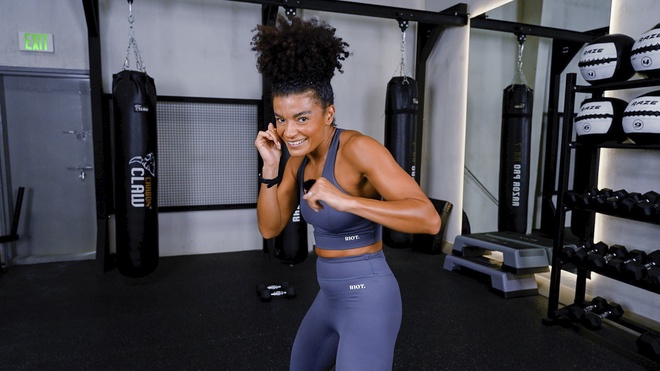
Join women maintaining shoulder health and mobility with 8 certified trainers across 26 workouts
Frequently Asked Questions
Related Exercises
Lateral Raise
The lateral raise strengthens the deltoid that shoulder rolls warm up. Danielle Harrison programs shoulder rolls into boxing warm-ups before pressing and raising movements. Warming the glenohumeral joint with rolls first prevents impingement during loaded abduction.
Shoulder Stretch
Shoulder rolls mobilize the joint through circumduction. Shoulder stretches hold specific end-range positions. They complement each other: rolls for dynamic warm-up, stretches for sustained flexibility. Both target the anterior shoulder and upper trapezius.
Arm Circles
Arm circles extend the shoulder roll into a full-arm movement. The arm acts as a longer lever, creating more demand on the rotator cuff and scapular stabilizers. Linda Chambers and our merged modification cues suggest adding full arm circles after shoulder rolls to increase range.
Neck Stretch
Shoulder rolls incidentally mobilize the cervicothoracic junction and upper trapezius. Neck stretches target the same region with sustained holds. Petra Kapiciakova programs seated shoulder rolls alongside neck releases in her yoga-before-bedtime sequences.
Standing Shoulder Stretch
A standing hold that targets the posterior deltoid and rotator cuff. Pairs well with shoulder rolls for a complete shoulder mobility routine. Both can be performed at a desk without any equipment.
Get shoulder rolls in a guided workout
Access 10 workouts featuring this exercise, plus personalized plans from Dr. Wellls.
Join women maintaining shoulder health and mobility with 8 certified trainers across 26 workouts
Your membership funds independent women's health research