Standing Quad Stretch: How-to, Benefits & Variations
Standing quad stretch: stand on one foot, grab opposite ankle behind you, pull heel toward glute. Hold 15-30 seconds per side. Targets quads and hip flexors.
Standing Quad Stretch: How-to, Benefits & Variations
Try this. Stand on one foot. Reach behind you and grab that ankle. Pull your heel toward your glute. How many seconds before you start wobbling?
Most people treat the standing quad stretch as background noise. The thing you do for ten seconds after a run while scrolling your phone. But there are two things happening simultaneously when you hold this position: your quadriceps are lengthening under load, and your nervous system is fighting to keep you from tipping over. It is a flexibility drill and a balance drill pretending to be simple.
Twenty-four occurrences across twenty workouts in our library. Nine certified trainers. Sophie Jones programs it in strength training cooldowns and glute-focused sessions. Linda Chambers finishes functional full-body workouts with it. Mish Naidoo teaches it in daily stretching. Lianna Brice puts it in barre burn. Danielle Harrison cools down boxing and prenatal sessions with it. Beth Hannam uses it in bodyweight challenges. When trainers from six different disciplines all reach for the same stretch, the exercise is doing more than one job.
7-Day Bodyweight Challenge: Day 1
Beth Hannam
How to Do Standing Quad Stretch
Stand tall with your feet hip-width apart. Find a fixed point at eye level and lock your gaze on it. Mish Naidoo teaches this in daily stretching: focus your gaze on a still point in front of you. This is not a suggestion. It is the single most effective balance trick you will ever learn. Your eyes drive your vestibular system. A fixed gaze keeps you steady.
Shift your weight onto your left foot. Bend your right knee behind you and reach back with your right hand to grab the top of your right foot or ankle. If you cannot reach your foot, loop a towel or yoga strap around your ankle to bridge the gap. Beth Hannam's safety cue: if balance is a challenge, place one hand on a wall or sturdy surface for support. There is no shame in the wall. Use it.
Pull your heel gently toward your glute. The stretch should build across the front of your thigh. Point your bent knee straight down toward the floor rather than letting it flare out to the side. Every trainer in our library cues this: keep your knees in line with each other. When the knee drifts sideways, the stretch migrates from the rectus femoris into the IT band and you lose the quad-specific benefit.
Engage your core and tuck your pelvis slightly forward, driving your hips into a gentle anterior push. Linda Chambers cues this in her functional full-body cooldowns. The pelvic tuck deepens the hip flexor stretch on top of the quad stretch. Without it, your lower back arches to compensate and you feel the stretch in your spine instead of your thigh.
Breathe deeply and hold the stretch for 15 to 30 seconds. Relax your shoulders. Drop them away from your ears. Sophie Jones holds it for the final 30-40 seconds of strength sessions, letting the muscle release completely before switching sides. Gently release the foot back to the floor rather than letting it snap down. Repeat on the other side.
Muscles Worked
Primary
Rectus femoris
The rectus femoris is the only quad muscle that crosses both the hip and the knee. That dual-joint attachment makes it the primary target of the standing quad stretch. When you bend your knee behind you and tuck your pelvis, you lengthen it at both ends simultaneously. This muscle shortens aggressively from sitting. Eight hours at a desk and it tightens into a cable that pulls your pelvis forward, arches your lower back, and compresses the lumbar spine. The standing quad stretch reverses that pattern at the source.
Vastus lateralis, medialis, and intermedius
The three single-joint quad muscles cross only the knee. They get stretched when you bend the knee behind you and pull heel toward glute. The vastus medialis (inner quad) is especially relevant for knee tracking and patellar alignment. When these muscles are tight, the kneecap gets pulled laterally, creating that grinding sensation during stairs or squats.
Secondary
Hip flexors (iliopsoas)
Linda Chambers' pelvic tuck cue activates the hip flexor stretch component. When you drive your hips slightly forward with core engaged, the iliopsoas lengthens along the front of the hip. This muscle is the other chronic victim of desk sitting. Tight hip flexors contribute to anterior pelvic tilt, lower back compression, and altered gait patterns. The standing quad stretch addresses quads and hip flexors in one position.
Core stabilizers (transversus abdominis, obliques)
Standing on one foot demands reflexive core activation. Your deep stabilizers fire continuously to prevent you from falling over. This is not conscious bracing. It is your nervous system recruiting the transversus abdominis and obliques automatically. The balance challenge transforms a passive stretch into an active stability drill.
Ankle stabilizers (peroneals, tibialis posterior)
Your standing ankle makes constant micro-corrections to keep you upright. The peroneal muscles on the outside of the ankle and the tibialis posterior on the inside work in a rapid alternation pattern called postural sway management. This proprioceptive demand is invisible but significant, especially during perimenopause when estrogen decline affects joint position sense.
Why this matters in perimenopause
Estrogen maintains connective tissue elasticity in tendons, ligaments, and muscle fascia. As estrogen declines during perimenopause, the quadriceps and hip flexor complex loses compliance faster than most women expect. A 2023 systematic review confirmed that chronic stretching improves range of motion across all populations, but the effect is dose-dependent: regular practice matters more than intensity. The balance component is equally important. Declining estrogen affects proprioception through changes in joint mechanoreceptors. The standing quad stretch trains both flexibility and single-leg balance in one position, addressing two perimenopause-relevant systems simultaneously.
Coach's Tips
"Point your bent knee straight down toward the floor rather than letting it flare out to the side." I see this mistake in every stretching class. The knee drifts outward because the quad is tight and the body takes the path of least resistance. But when the knee flares, you lose the stretch on the rectus femoris and start torquing the knee joint laterally. Keep both knees parallel, pointing in the same direction. If you cannot get your heel to your glute with the knee pointing down, that is your actual flexibility. Work from there.
Multiple trainers
"Keep your standing leg slightly bent and focus your gaze on a still point in front of you." Mish Naidoo teaches this combination in her daily stretching sessions. The micro-bend in the standing leg activates the glutes and prevents knee hyperextension. The fixed gaze stabilizes the vestibular system. These two cues together eliminate 80% of wobbling. People lock their standing knee and look around the room, then wonder why they cannot hold the stretch for more than five seconds.
Mish Naidoo
"Engage your core and tuck your pelvis slightly to drive your hips forward." Linda Chambers programs this cue in her functional full-body cooldowns. The pelvic tuck is the difference between a decent quad stretch and a comprehensive hip flexor release. Without it, your lower back arches and absorbs the stretch that should be going into the front of your thigh. Think about pulling your belt buckle up toward your ribs. Subtle movement. Significant depth change.
Linda Chambers
"Relax your shoulders and avoid shrugging them toward your ears while holding your foot." When balance feels uncertain, everything tenses. Jaw. Neck. Shoulders. The upper body braces against the instability. Consciously drop your shoulders. Release the grip in your jaw. Let your free arm hang naturally or extend it to the side for balance. The quad stretch happens in the lower body. Your upper body should be quiet.
Multiple trainers
"Breathe deeply and hold the stretch for at least 15 to 30 seconds to allow the muscle to release." A 2024 meta-analysis found that static stretching durations of 15-60 seconds per set optimize flexibility gains. The quad does not release on the first breath. It takes the nervous system roughly 10-15 seconds to reduce the stretch reflex and allow the muscle to lengthen past its resting state. Rushing through in five seconds accomplishes almost nothing. Thirty seconds is the sweet spot where real tissue change begins.
Multiple trainers
"If balance is a challenge, place one hand on a wall or sturdy surface for support." Beth Hannam's cue is clear and non-judgmental. The wall is not a crutch. It is a tool that lets you focus on the actual stretch instead of fighting to stay upright. Use a wall, a chair back, a countertop, a park bench. As your single-leg balance improves over weeks, you will naturally drift away from the support. Let that happen on its own schedule.
Beth Hannam
"Avoid arching your lower back; focus on the stretch staying in the front of the thigh." If you feel the stretch in your lower back instead of your quad, your pelvis is tilting forward and your lumbar spine is compensating. Pull your belly button in. Tuck the pelvis. Re-engage your core. The stretch should live between your hip and your knee, nowhere else. If it migrates into your back, you are going too deep for your current flexibility.
Multiple trainers
"If you cannot reach your foot, loop a towel or yoga strap around your ankle to bridge the gap." This modification exists for anyone with limited knee flexion, larger bodies, or stiff quads that do not allow the heel-to-glute position yet. The strap extends your reach without forcing the knee into painful ranges. You still get the quad stretch. You still get the balance challenge. You just meet the exercise where your body is today rather than where someone else thinks it should be.
Multiple trainers
Why This Matters for You
Two systems decline in parallel during perimenopause, and this one stretch addresses both of them.
The first is connective tissue elasticity. Estrogen receptors exist throughout the musculotendinous junctions of the quadriceps, the patellar tendon, and the hip flexor complex. As estrogen levels fluctuate and decline, these tissues lose compliance. The quads feel tighter earlier in the day. The knees ache on stairs that never bothered you before. A review on endogenous estrogen deficiency and chronic musculoskeletal pain confirms this mechanism: declining estrogen contributes directly to joint stiffness and muscle tightness, particularly in the lower extremity.
The second is proprioception. Estrogen influences the sensitivity of joint mechanoreceptors, the sensors that tell your brain where your body is in space. As these receptors become less responsive, single-leg balance deteriorates. Not dramatically. Not dangerously. But enough that stepping off a curb wrong feels less automatic than it used to. Enough that navigating an uneven hiking trail requires more conscious attention. An online Pilates exercise program showed measurable proprioception improvements in women through balance-challenging movements, which is exactly what the standing quad stretch delivers.
A 2023 systematic review confirmed that chronic stretching improves range of motion, and the effect holds across populations. But the perimenopause angle is this: the combination of flexibility work and balance challenge in one exercise is unusually efficient. The standing quad stretch is not just undoing desk tightness. It is maintaining two functional capacities that hormonal shifts are actively eroding.
The Iyengar yoga RCT with postmenopausal women found improvements in bio-functional age markers. Standing balance poses featured prominently in the protocol.
Variations & Modifications
Standing Quad Stretch (Wall-Supported)
lowOne hand on a wall, chair, or countertop while the other hand holds the foot. Beth Hannam teaches this as the default entry point. Removing the balance challenge lets you focus entirely on the quad stretch depth. Sophie Jones and Linda Chambers program this version in cooldowns where the goal is recovery, not balance training.
Prone Quad Stretch (Lying on Stomach)
lowLie face down, bend one knee, and reach back to hold the foot. Anastasia Zavistovskaya programs this in Barre sessions. Petra Kapiciakova teaches the half-frog version in Yoga for Back Relief. Removes all balance demand. The floor provides feedback for hip alignment. If your hip lifts off the mat, the stretch is going into the wrong place. Best for anyone recovering from ankle injuries or with significant balance limitations.
Reclining Quad Stretch
lowLying on your side, bend the top knee and pull the heel toward your glute. Natalia Gunnlaugs cools down HIIT Blast workouts with this version. Gravity assists rather than fights you. Removes the balance challenge while adding a mild IT band and lateral hip stretch from the side-lying position. A solid option for late-night stretching when standing feels like too much effort.
Standing Quad and Calf Stretch (Combo)
lowLianna Brice programs this in Barre Burn sessions: after stretching the quad, shift into a standing calf stretch on the same leg without putting the foot down. Two stretches, one standing bout. The combo targets the entire posterior and anterior chain of the lower leg in sequence. Efficient cooldown programming for time-limited sessions.
Standing Quad and Glute Stretch (Combo)
lowLianna Brice's Barre Burn variation: standing quad stretch followed by a cross-body ankle-over-knee position for the glute on the same side. Addresses the front and back of the hip in one standing sequence. Requires stronger balance than the standard version because the transitions challenge stability.
Seated Quad Stretch
lowDanielle Harrison cools down boxing sessions with a seated variation. Sit with one leg extended, the other bent behind you in a modified hero's pose. Lower your torso backward to deepen the stretch. Removes the balance requirement entirely. Good for anyone who needs a deeper stretch without the distraction of staying upright.
Benefits
Undoes eight hours of sitting in thirty seconds per side
The rectus femoris shortens every hour you sit. It is the only quad muscle that crosses the hip joint, so seated posture tightens it at both ends. The standing quad stretch reverses this by extending the knee behind you while tucking the pelvis forward. Linda Chambers cues this pelvic tuck to ensure the stretch reaches the hip flexor component, not just the knee extensors. Twenty-four segments in our library and every single one appears in a cooldown or recovery block, because trainers know this stretch fixes what sitting breaks.
Single-leg balance training in disguise
Standing on one foot while holding the other forces reflexive activation of the ankle stabilizers, core muscles, and hip abductors. This is not a strength exercise for those muscles. It is a neural patterning exercise. Your nervous system learns to make rapid micro-corrections to keep you upright. Mish Naidoo's two cues, micro-bend in the standing knee and fixed gaze, teach the balance fundamentals. Over weeks, the wobbling decreases. That is not your muscles getting stronger. It is your proprioceptive system getting faster.
Protects the knee from the front
Tight quads pull the kneecap upward and laterally. This increases patellofemoral compression during stairs, squats, and walking downhill. Maintaining quad flexibility keeps the patellar tracking centered and reduces grinding forces on the joint surface. The standing quad stretch is one of the most commonly prescribed stretches in physiotherapy clinics for anterior knee pain, and every trainer in our database who programs it cites knee health as a primary reason.
Portable recovery that travels with you
No mat. No equipment. No floor required. You can do a standing quad stretch in an airport terminal, at a rest stop, in a hotel hallway, next to your desk, or on a hiking trail. Sophie Jones programs it in five different workout series because it fits anywhere. The wall-supported version needs only a vertical surface. The strap version needs a towel or belt. The unsupported version needs nothing except your body and the ground beneath your foot.
Common Mistakes to Avoid
Arching the lower back instead of tucking the pelvis
This is the most common compensation. When the quad is tight, the body cheats by tilting the pelvis forward and extending the lumbar spine. You feel a stretch, but it is in your back, not your thigh. Linda Chambers corrects this with the pelvic tuck: engage your core and drive your hips slightly forward. Think about pulling your belt buckle toward your ribcage. The stretch should burn in the front of the thigh, from hip to knee. If your lower back is involved, you are leaking range from the wrong joint.
Letting the bent knee flare outward
The knee should point straight down, parallel to the standing leg. When it drifts to the side, the stretch shifts from the quad to the IT band and outer hip. That is a different stretch entirely. Keep your knees in line with each other as you pull your heel closer to your glute. If the knee cannot stay parallel while the heel touches the glute, reduce the pull. The parallel position matters more than the depth.
Locking the standing knee into hyperextension
Mish Naidoo cues a slight bend in the standing leg for a reason. A locked knee compresses the joint, disengages the glutes, and makes balance harder. The micro-bend activates the standing-side glute, protects the knee, and creates a more stable platform. It feels counterintuitive because people associate straight legs with good form. But in a single-leg stance, a soft knee is a smart knee.
Holding for five seconds and calling it done
A 2024 meta-analysis on stretching optimization found that static holds of 15-60 seconds produce the most significant flexibility gains. The quad's stretch reflex takes roughly 10-15 seconds to quiet down. Before that, the muscle is actively resisting the stretch. Five seconds accomplishes almost nothing measurable. Hold for 15-30 seconds per side minimum. Breathe through it. The tissue change happens in the second half of the hold, not the first.
Workouts Featuring This Exercise
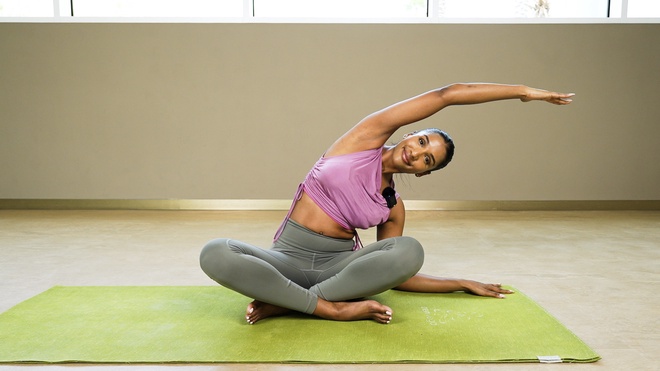
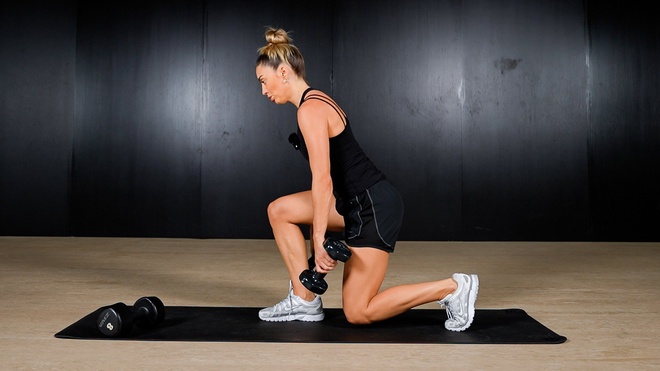
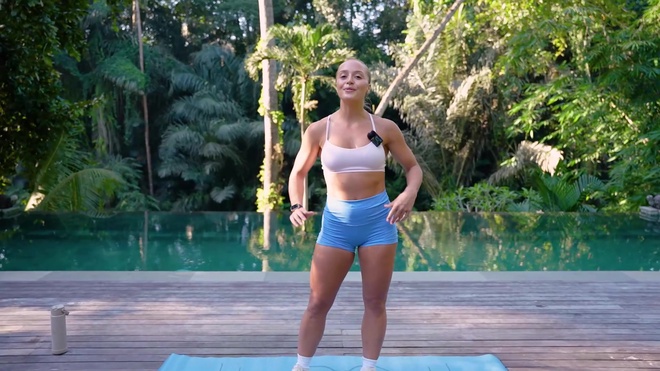
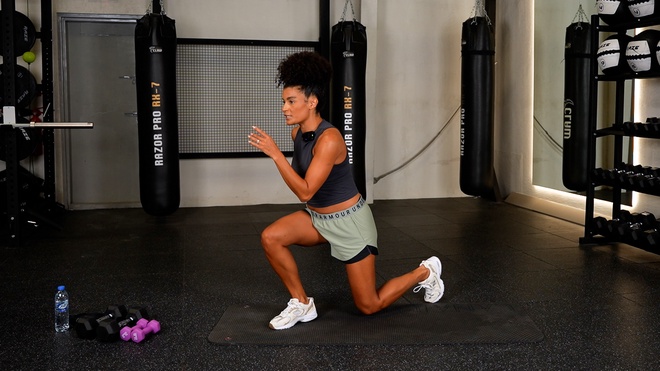

Join women improving quad flexibility and balance with 9 certified trainers across 20 workouts
Frequently Asked Questions
Related Exercises
Hip Flexor Stretch
The standing quad stretch addresses the top of the quad at the hip. The hip flexor stretch goes deeper into the iliopsoas, the muscle that connects the spine to the femur. Together they release the entire anterior chain of the hip that sitting shortens. If your lower back aches after standing up from a desk, both of these stretches are part of the fix.
IT Band Stretch
The IT band runs along the outside of the thigh from hip to knee, right next to the lateral quad. When the quad is tight, the IT band often is too. The directive pairs these because they address different faces of the same thigh, front versus side, and both contribute to knee tracking issues.
Cat Cow Stretch
If sitting has tightened your quads and hip flexors, it has also compressed your spine. Cat cow stretch addresses the spinal mobility that the standing quad stretch does not. A full sitting-recovery routine pairs anterior chain stretching with spinal mobilization.
Neck Stretch
The directive pairs these because they share the same root cause: prolonged sitting. Tight quads pull the pelvis forward, which arches the lower back, which rounds the upper back, which pushes the head forward, which tightens the neck. Stretching the quads and neck together addresses both ends of the sitting posture cascade.
Hamstring Stretch
Quads and hamstrings are antagonist pairs. When one is disproportionately tight, the other compensates. Stretching both maintains the front-to-back muscle balance across the knee and hip. Most cooldown routines pair them back-to-back for exactly this reason.
Get standing quad stretch in a guided workout
Access 10 workouts featuring this exercise, plus personalized plans from Dr. Wellls.
Join women improving quad flexibility and balance with 9 certified trainers across 20 workouts
Your membership funds independent women's health research