Cat Cow Stretch: How-to, Benefits & Variations
The cat cow stretch alternates spinal flexion and extension on all fours. Inhale to arch (cow), exhale to round (cat). Improves spinal mobility, relieves back pain, coordinates breath with core.
Cat Cow Stretch: How-to, Benefits & Variations
Every physiotherapist I've worked with starts their low-back patients with this movement. Not a stretch. Not a strengthening exercise. A spinal reset. The cat cow stretch asks your vertebrae to do the one thing most spines have forgotten: move individually.
There are 33 vertebrae in a healthy spine. After years of sitting, most people move them as a single stiff rod. Cat cow breaks that pattern. You arch, you round, you breathe, and somewhere around the fourth or fifth repetition, segments start unlocking that haven't moved independently in months. Linda Chambers calls these "our two very important spinal movements: flexion and extension." She's not being dramatic. A 2023 systematic review of yoga for chronic low back pain found that spinal mobility exercises reduced pain intensity and improved function across multiple RCTs. The cat cow is often the first exercise prescribed because it carries almost zero injury risk.
I program it in every warm-up. Not because it's trendy. Because it works.
Rise & Shine: Workout 7
Sophie Jones
How to Do Cat Cow Stretch
Start on all fours in a tabletop position. Hands directly under shoulders, knees directly under hips. Spread your fingers wide to distribute weight evenly across both palms. Yasmin Masri cues: hip aligned with the knee, both hands a bit higher than shoulder alignment.
Inhale into Cow: let your belly drop toward the floor. Roll your hips forward (anterior pelvic tilt), lift your head gently, and open your chest. Think of lengthening your spine from tailbone to crown. Sophie Jones cues: let it relax, and let your hips roll forward again.
Exhale into Cat: press through your palms, round your spine toward the ceiling, and tuck your tailbone under. Pull your belly button toward your spine and let your head drop naturally. Linda Chambers cues: come into our flexion and extension. Sophie Jones cues: push through the ceiling of your spine.
Move slowly through each vertebra. Do not rush the transition between cat and cow. Feel each segment of your spine articulate independently. Start from the tailbone and ripple the movement upward through your lower back, mid-back, and finally your neck.
Repeat for 8-10 breath cycles. Match the movement to your breathing, not the other way around. The inhale opens you up, the exhale rounds you in. That rhythm is the exercise.
Muscles Worked
Primary
Erector spinae and multifidus (spinal extensors)
These muscles run the length of your spine and control the 'cow' phase of the movement. When you arch your back and lift your head, the erector spinae contracts concentrically. When you reverse into cat position, they lengthen eccentrically under control. This alternating contraction-stretch cycle is what makes the cat cow stretch so effective for spinal stiffness. A 2023 Pilates systematic review found these muscles activate at moderate levels during flexion-extension sequences, enough to build endurance without overloading.
Rectus abdominis and transverse abdominis (core)
Drive the 'cat' phase. When you exhale and round your spine toward the ceiling, your deep core muscles pull your belly button toward your spine and compress your ribcage. The transverse abdominis acts like a corset around your midsection. A systematic review of diaphragmatic breathing and core stability confirmed that coordinating breath with core engagement activates these muscles more effectively than static holds.
Secondary
Serratus anterior and trapezius (shoulder stabilizers)
Keep your shoulder blades stable as you push through the floor. Yasmin Masri specifically cues the shoulder engagement: squeeze your butt in, you're supposed to feel it only on the shoulders. The push-through-the-floor action in cat position activates the serratus anterior, which helps correct rounded-shoulder posture.
Hip flexors and gluteus maximus
The pelvic tilt drives the entire movement. Yasmin Masri teaches this explicitly: posterior pelvic tilt, anterior pelvic tilt. Your hip flexors initiate the cow arch while your glutes engage during the cat tuck. The pelvis is the engine. The spine follows.
Neck flexors and extensors
Your head moves last in both directions. In cow, the cervical extensors gently lift your gaze. In cat, the neck flexors tuck your chin. Keep your neck long throughout. Never crank your head back or jam your chin into your chest.
Why this matters in perimenopause
Declining estrogen directly impacts the intervertebral discs and spinal ligaments. A 2024 systematic review and meta-analysis on mind-body exercise for perimenopausal and postmenopausal women found that gentle spinal mobility work improved pain, flexibility, and psychological well-being. The cat cow targets the exact structures that stiffen fastest during hormonal transition: the thoracic spine, lumbar multifidus, and the connective tissue between vertebrae. Two minutes of cat cow daily keeps those tissues hydrated and mobile.
Coach's Tips
"Push through the ceiling of your spine." Sophie Jones says this during every cat phase, and it completely changes the exercise. Most people round their back passively. Pushing the floor away with your palms and driving your mid-back toward the ceiling creates active thoracic flexion. You feel muscles engage that you didn't know existed between your shoulder blades.
Sophie Jones
"Posterior pelvic tilt, anterior pelvic tilt." Yasmin Masri strips this movement down to what it actually is: a pelvic tilt with a ripple effect. If your pelvis isn't moving first, your spine is just bobbing up and down. Start the cow from your tailbone rolling forward. Start the cat from your tailbone tucking under. Everything else follows.
Yasmin Masri
"Inhale to lift, big exhale to flex." Linda Chambers teaches the breathing as inseparable from the movement. The inhale expands your ribcage and naturally opens the chest for cow. The exhale compresses the ribcage and naturally rounds the spine for cat. If you're holding your breath, you're doing a different exercise entirely.
Linda Chambers
"Come into our two very important spinal movements: flexion and extension." Linda doesn't call it cat cow in her Abs & Glutes classes. She calls it what it is: the two fundamental spinal motions that every other exercise depends on. If you can't flex and extend your spine with control, loaded movements like deadlifts and rows become dangerous.
Linda Chambers
"Hip aligned with the knee, both hands on the wall, a bit higher than shoulder alignment." Yasmin Masri teaches the wall-assisted version for anyone with wrist pressure or knee pain. Same spinal movement, zero weight on your joints. I send every client with wrist issues to this variation first.
Yasmin Masri
"Take this hand, one hand underneath, and take a tiny twist." Linda Chambers threads the needle between cat and cow repetitions in her warm-up sequence. Adding a gentle rotation targets the thoracic spine, which is the segment most people can't access. If your upper back feels welded shut, this modification is the way in.
Linda Chambers
Why This Matters for You
I keep coming back to cat cow for clients going through perimenopause because it addresses three things that change simultaneously: spinal stiffness, stress response, and body awareness.
The stiffness piece is biochemical. Estrogen maintains the water content of intervertebral discs and the elasticity of spinal ligaments. As levels fluctuate and decline, the spine literally dries out. A 2024 meta-analysis of mind-body exercise for perimenopausal and postmenopausal women found that gentle rhythmic movement improved musculoskeletal symptoms and flexibility. Cat cow's pumping action drives fluid into the discs through imbibition. It is the simplest way to counteract what hormones are doing to your spine.
The stress piece matters just as much. A systematic review of mind-body exercise for perimenopause anxiety and depression found significant improvements in psychological well-being. The breath-movement coordination in cat cow activates the parasympathetic nervous system. Inhale to open, exhale to round. That rhythm tells your body it's safe. For women dealing with the cortisol spikes and sleep disruption of perimenopause, this two-minute exercise does more for their nervous system than most people realize.
And the body awareness piece. Perimenopause changes how your body feels from the inside. Things that used to be automatic become unpredictable. Cat cow forces you to feel your spine. Every segment. Every breath. That reconnection isn't just physical. It's a small act of reclaiming a body that feels like it's betraying you.
Variations & Modifications
Wall-Assisted Cat Cow
lowHands on a wall at shoulder height instead of the floor. Yasmin Masri teaches this in her Mobility classes for anyone with wrist pain or knee sensitivity. You get the same spinal flexion and extension without bearing weight through your arms. I've used this with clients recovering from wrist surgery who couldn't load their hands for months. Same movement, zero joint stress.
Cat Cow to Downward Dog
low-mediumFrom the cow position, tuck your toes and push your hips up and back into a downward-facing dog. Linda Chambers programs this flow in Functional Full Body 2 as a warm-up. The downward dog adds a hamstring and calf stretch to the spinal mobility, turning a 30-second movement into a full posterior chain warm-up. Her cue: lift the head and flex and extend the spine a few times, then push back.
Cat Cow with Thread the Needle
low-mediumBetween cat and cow transitions, slide one arm underneath your body and rotate your thoracic spine. Linda Chambers uses this in her Abs & Glutes warm-up: take this hand, one hand underneath, and take a tiny twist. The rotation adds a dimension that standard cat cow misses. If your mid-back feels locked up from sitting, this is the variation that unlocks it. Three reps each side between every couple of cat-cows.
Benefits
Restores segmental spinal mobility
Your spine has 33 vertebrae, and each one should move independently. After years at a desk, most people's mid-backs move as a single block. The cat cow stretch forces vertebra-by-vertebra articulation through the full range of flexion and extension. A systematic review on thoracic spine mobility exercises found that targeted extension and flexion movements improved posture and shoulder function. Two minutes of cat cow does what an hour of sitting undoes.
Reduces lower back pain with minimal risk
A 2023 systematic review of yoga for chronic low back pain found consistent pain reduction across multiple RCTs. The cat cow is the lowest-risk entry point into spinal movement. There is no load, no impact, no balance challenge. Just your spine moving through its designed range. Linda Chambers programs it in every back health class. It is the first thing she teaches and the last thing she programs.
Coordinates breath with movement
A systematic review on diaphragmatic breathing and core stability found that breath-synchronized movement improves deep core activation more effectively than static exercises. The cat cow stretch is a breathing exercise disguised as a stretch. Inhale to extend, exhale to flex. That rhythm downregulates the nervous system while simultaneously mobilizing the spine. Two mechanisms. One movement.
Supports spinal health during hormonal changes
A 2024 meta-analysis of mind-body exercise for perimenopausal women found improvements in musculoskeletal pain, flexibility, and psychological well-being. Estrogen decline thins the intervertebral discs and stiffens spinal ligaments. Regular flexion-extension cycling keeps those structures hydrated through a process called imbibition: the pumping action draws nutrients into the discs. Cat cow is the simplest way to keep that pump running.
Universal warm-up for every training style
Yoga, pilates, strength training, physiotherapy. The cat cow appears in all of them. In our library alone, it shows up in six guided workouts across weight loss, muscle tone, flexibility, and functional training. Sophie Jones uses it to open morning workouts. Linda Chambers uses it before heavy core work. Yasmin Masri uses it in dedicated mobility sessions. If three trainers with different specialties all start with the same exercise, pay attention.
Common Mistakes to Avoid
Rushing through the movement
This is not a rep-counting exercise. Each transition should take a full breath cycle: 3-4 seconds to arch, 3-4 seconds to round. If you're flying through ten repetitions in thirty seconds, you're bobbing, not mobilizing. Linda Chambers cues the pace by linking every position change to breath. Match the movement to your inhale and exhale. Not faster.
Cranking the neck instead of letting it follow
Your head should be the last thing that moves in both directions. In cow, the lift starts at your tailbone and ripples up. Your head rises gently at the end. In cat, the tuck starts at your pelvis and your chin drops naturally as the wave reaches your neck. If you're whipping your head up or jamming your chin down, you're compressing your cervical spine. Let it float.
Collapsing into the shoulders
Sophie Jones cues: push through the ceiling of your spine. That push comes from your palms pressing into the floor and your serratus anterior engaging to stabilize your shoulder blades. If your shoulders are shrugging up toward your ears or your chest is sinking between your arms, you've lost the active component. Press the floor away.
Moving the spine as one block
The whole point is segmental motion. If your entire back arches and rounds in one piece, you're missing the benefit. Start the movement from your pelvis. Yasmin Masri teaches this explicitly: posterior pelvic tilt, anterior pelvic tilt. Think of your spine as a chain. Each link moves a fraction of a second after the one below it. That ripple is everything.
Workouts Featuring This Exercise
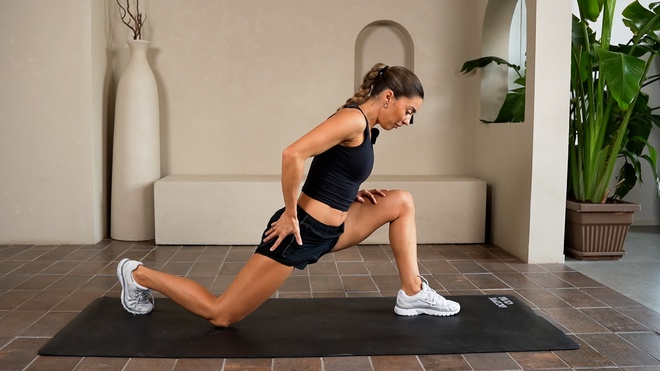
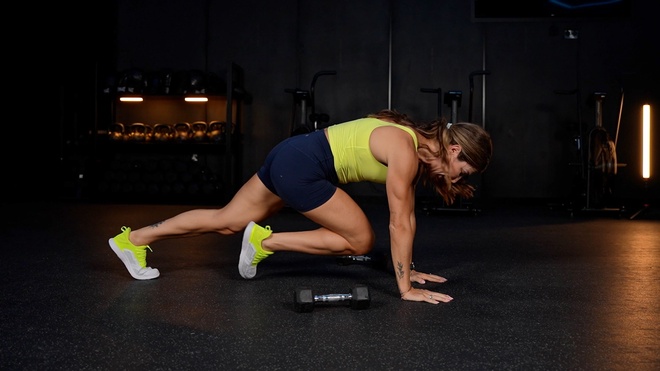
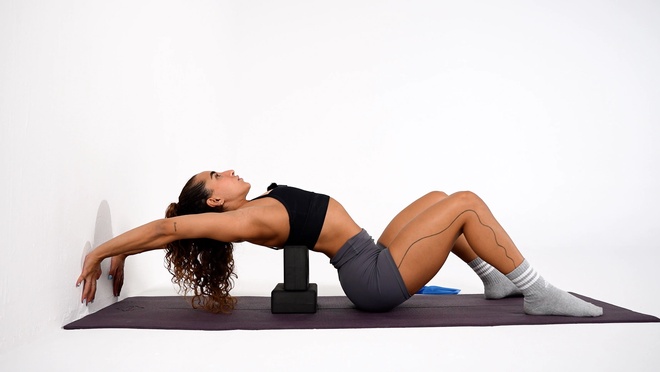
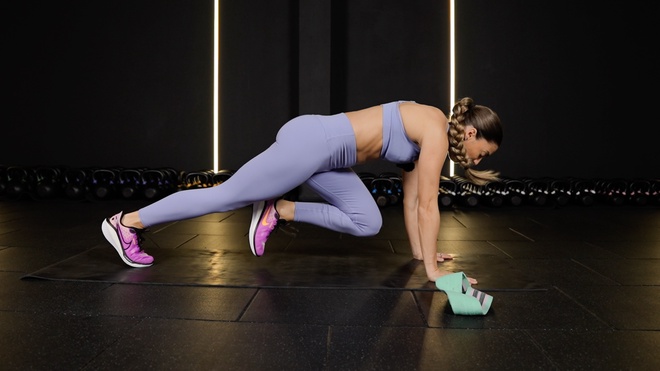
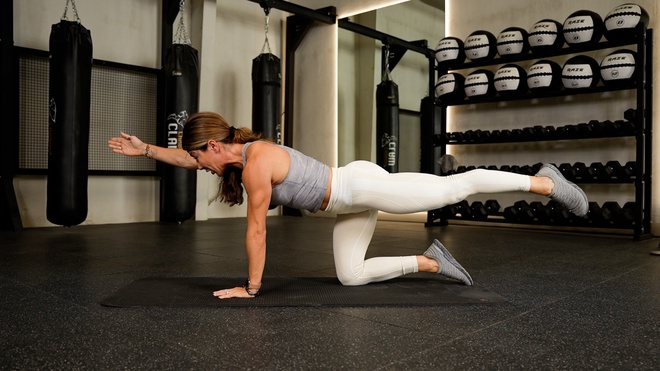
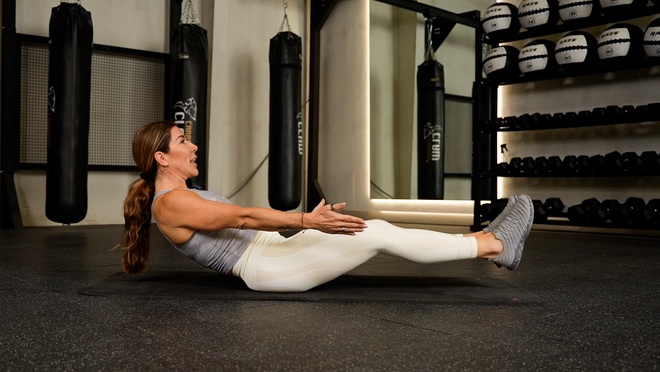
Join women building spinal mobility and back health with certified trainers
Frequently Asked Questions
Related Exercises
Child's Pose
Natural rest position between cat cow repetitions. Deepens the lumbar flexion from the cat phase.
Pigeon Pose
Opens the hips while cat cow opens the spine. Common pairing in yoga sequences.
Downward Dog
Natural flow from cat cow. Adds hamstring and calf stretch to the spinal mobility work.
Bird Dog
Same tabletop starting position. Cat cow mobilizes the spine, bird dog stabilizes it. Perfect sequence.
Thread the Needle Stretch
Adds thoracic rotation to the flexion-extension pattern of cat cow. Linda Chambers combines them.
Get cat cow stretch in a guided workout
Access 6 workouts featuring this exercise, plus personalized plans from Dr. Wellls.
Join women building spinal mobility and back health with certified trainers
Your membership funds independent women's health research