Thread The Needle Stretch: How-to, Benefits & Variations
Thread the needle stretch: from all fours, slide one arm under your body until shoulder and ear rest on the mat. Targets thoracic spine rotation, shoulders, upper back. Hold 3-5 breaths per side.
Thread The Needle Stretch: How-to, Benefits & Variations
That spiral through the upper back. The moment your shoulder drops toward the mat and your ribs crack open like a book that has been closed too long. The thread the needle stretch hits a place most stretches cannot reach: the thoracic spine, the segment of your back between your shoulder blades that locks up from sitting, from driving, from holding a laptop on your lap while pretending the couch is an office.
Eighty-eight occurrences across 64 workouts. Eleven trainers. That is not a niche stretch tucked into one yoga class. Sophie Jones uses it in strength training cooldowns. Danielle Harrison puts it into boxing recovery. Jessica Casalegno teaches it in Pilates and prenatal sessions. Mish Naidoo threads it through morning yoga flows and daily stretching routines. Linda Chambers programs it as a spine release after back strengthening work.
The thread the needle stretch shows up everywhere because modern posture destroys thoracic rotation. Every hour you spend hunched forward, your upper back pays for it. This is the counter-move. One arm slides underneath your body, your shoulder and ear settle onto the floor, and your thoracic spine remembers what rotation feels like.
7-Day Bodyweight Challenge: Day 7
Beth Hannam
How to Do Thread The Needle Stretch
Start on all fours with your wrists under your shoulders and your knees under your hips. Linda Chambers sets the foundation: take one arm, thread it through the gap. That gap is between your supporting arm and your opposite knee. Before you move anything, check your hands. Spread your fingers wide. Press evenly through all ten fingertips. This is your base.
Inhale and reach one arm straight up toward the ceiling, opening your chest to the side. Petra Kapiciakova cues this precisely: inhale, lift your right arm up. The inhale matters. It creates space between your ribs. Feel your chest open like a door swinging wide. Stack your shoulders vertically if you can. If not, open as far as your body allows today.
Exhale and slide that arm underneath your chest, threading it through the space between your grounded arm and your knee. Let your shoulder and ear lower all the way down to the mat. Mish Naidoo: thread your right arm underneath, come down onto the shoulder, move your ears away from the shoulder. The exhale drives the rotation. Let gravity do the rest.
Keep your hips stacked directly over your knees. This is the most important alignment cue. If your hips shift backward, the twist happens in your lower back instead of your thoracic spine. Beth Hannam and every trainer in our database repeats this one: keep hips stacked directly over knees. That is non-negotiable.
Once settled, breathe into the twist. Each exhale, let your upper back soften a fraction deeper. Petra Kapiciakova: keep sinking deeper, releasing tension, maybe from your shoulders, your upper back. Hold for 3-5 breaths per side. There is no rushing this. The thoracic spine opens on its own schedule.
To come out, press through your grounded hand, sweep the threaded arm back up toward the ceiling on an inhale, and return to all fours. Switch sides. Jessica Casalegno: right arm all the way up, stack the shoulders, exhale to thread the needle. Both sides need equal attention.
Muscles Worked
Primary
Thoracic spine (erector spinae, multifidus, rotatores)
The thread the needle stretch targets thoracic rotation specifically. The small rotator muscles along each vertebra, the rotatores and multifidus, get loaded through passive range of motion as your upper back twists. These muscles stiffen from prolonged flexion posture (desk sitting, phone scrolling). The stretch restores segmental mobility between T1 and T12. Jessica Casalegno cues it clearly: twisting through your thoracic spine. That is where the action is.
Posterior deltoid and infraspinatus (shoulder)
When your shoulder drops to the mat, the entire posterior shoulder complex gets stretched under body weight. Mish Naidoo: drop your shoulder and ear all the way down to the mat, letting your weight settle into the floor. Using the weight of your body to deepen the stretch in your shoulders, Petra Kapiciakova adds. This passive loading is harder to replicate with any other stretch because gravity does the work your tight muscles will not voluntarily release.
Rhomboids and middle trapezius
The inter-scapular muscles, the ones between your shoulder blades, lengthen as the threaded arm crosses underneath your body. If you carry tension in a knot between your spine and your shoulder blade (most desk workers do), this is the stretch that gets directly into that tissue. Linda Chambers uses it after back strengthening work: stretching through the upper back, especially after all of those flies.
Secondary
Latissimus dorsi
Mish Naidoo adds an extra dimension: reach your top arm forward toward the front of the mat to increase the stretch along your side and lats. This variation pulls the lat into the stretch, running from the armpit down to the lower back. Two stretches in one position if you know where to reach.
Neck (upper trapezius, levator scapulae)
The safety cue from every trainer: move your ears away from your shoulders to keep your neck long. When your ear rests on the mat, the upper trapezius on the non-threaded side gets a gentle stretch. This is where people carry the most tension, and they do not even realize it is releasing until they stand back up.
Chest (pectoralis major)
On the inhale phase, when you open your arm to the ceiling, the chest wall stretches across the front. The thread the needle yoga pose is essentially a chest opener followed by a back opener in one flowing movement. Nuni Soriano: right arm cross it underneath your left armpit, lower the shoulder. The chest gets the counter-stretch on the rotation.
Why this matters in perimenopause
Thoracic stiffness accelerates during perimenopause. Declining estrogen affects connective tissue elasticity throughout the spine. The intervertebral discs lose hydration. The facet joints stiffen. A 2022 systematic review found yoga improved flexibility and reduced menopausal symptoms in postmenopausal women. The thread the needle stretch addresses thoracic mobility directly, which influences breathing mechanics, shoulder function, and posture. When the thoracic spine cannot rotate, the lumbar spine compensates, and that is when lower back pain starts.
Coach's Tips
"Keep your hips stacked directly over your knees." I have lost count of how many times Beth Hannam says this across her segments. Every trainer repeats it. When your hips drift backward toward your heels, the twist migrates from your thoracic spine down to your lumbar spine. Your lower back is not designed for large rotation. Your upper back is. The hips-over-knees alignment ensures the stretch goes where it belongs.
Beth Hannam
"Move your ears away from your shoulders to keep your neck long and tension-free." Mish Naidoo coaches this as both a form cue and a safety cue. When you thread your arm underneath and your ear touches the mat, there is a natural tendency to scrunch the neck, hiking the opposite shoulder up toward the ear. Fight that. Create length. Imagine someone gently pulling the top of your head away from your shoulders. The neck stretch is a bonus, not a battle.
Mish Naidoo
"Drop your shoulder and ear all the way down to the mat, letting your weight settle into the floor." This cue from Mish Naidoo separates a real thread the needle stretch from a half-hearted attempt. People resist letting go. They hold themselves slightly off the floor, arm tense, shoulder hovering. Let gravity win. Your body weight pressing the shoulder down is what creates the thoracic rotation. Resist the urge to resist.
Mish Naidoo
"Gaze up toward the ceiling or underneath your supporting arm to deepen the spinal rotation." Eye gaze drives spinal rotation. Where your eyes go, your spine follows. Looking up adds 5-10 degrees of additional rotation without any muscular effort. Mish Naidoo and Jessica Casalegno both use this cue. Small detail. Noticeable difference.
Multiple trainers
"Inhale as you reach your arm toward the ceiling, and exhale as you thread it through the gap." Petra Kapiciakova is precise about the breath timing. The inhale creates space between your ribs while you open. The exhale lets your diaphragm relax so your thoracic spine can rotate deeper. Focus on releasing tension with every exhale, allowing your upper back to soften. Breath is the tool that turns a static position into a deepening stretch.
Petra Kapiciakova
"Avoid putting excessive weight on your neck; keep the pressure primarily in your shoulder." When your ear reaches the mat, it is tempting to let your head bear the load. Your cervical spine is not built for lateral compression under weight. Roll slightly forward onto the shoulder itself. Linda Chambers reinforces: making sure there's no tension in the neck whatsoever. If you feel pressure in your neck, adjust your position or use a block under your ear.
Linda Chambers
"If your head doesn't reach the floor comfortably, place a pillow or block under your ear for support." Petra Kapiciakova offers this modification for anyone with limited shoulder mobility or neck sensitivity. For those who cannot bring their head all the way down, you can use your pillow. There is zero benefit to forcing range you do not have. The block lets you relax into the stretch at your available depth instead of fighting against gravity.
Petra Kapiciakova
"Take your right hand, bring it behind your lower back, and you might catch your big right toe." This is the advanced bind variation from Nuni Soriano and Jessica Casalegno. Bring the right arm around the lumbar spine. Imagine you want to grab your inner right thigh. The bind locks the rotation and deepens the stretch through the entire shoulder complex. Only attempt this after the standard version feels comfortable and your shoulder has warmed up.
Nuni Soriano
Why This Matters for You
Thoracic spine stiffness is not just a posture problem. It is a hormone problem.
Estrogen maintains connective tissue elasticity throughout the body, including the ligaments and intervertebral discs of the spine. As estrogen declines during perimenopause, these tissues lose hydration and become stiffer. The thoracic spine, already prone to stiffness from modern sitting posture, gets hit twice: lifestyle and biology working against it simultaneously.
A 2022 systematic review found yoga improved flexibility and reduced menopausal symptoms in postmenopausal women. The thread the needle stretch is one of the most targeted thoracic mobility tools in any yoga or Pilates practice. It does not ask your lower back to compensate. It does not require equipment. It puts the rotation exactly where the stiffness lives.
There is a breathing angle too. Thoracic stiffness restricts rib expansion. Restricted breathing elevates cortisol. Elevated cortisol worsens hot flashes, disrupts sleep, and increases abdominal fat storage. Jessica Casalegno programs the thread the needle into prenatal and postpartum Pilates for the same reason: the rib cage needs to move freely.
And the shoulder tension piece matters during perimenopause. Stress-related muscle tension concentrates in the upper trapezius and inter-scapular region. A 2023 meta-analysis found mindfulness yoga exercises significantly reduced depression scores. The thread the needle stretch is not meditation, but the slow breathing and passive release create a similar parasympathetic response. Petra Kapiciakova says it simply: keep sinking deeper, releasing tension, maybe from your shoulders, your upper back.
One stretch. Three perimenopause-relevant systems: spinal mobility, breathing mechanics, stress release.
Variations & Modifications
Thread the Needle (Standard, Right/Left)
lowThe base version: from all fours, thread one arm underneath the body, lower shoulder and ear to the mat, hold 3-5 breaths, switch sides. Sophie Jones programs it in 16 segments. The fundamental version that every other variation builds from.
Thread the Needle with Bind
low-mediumOnce your shoulder is on the mat, wrap your top hand behind your lower back and reach for your inner thigh. Nuni Soriano: bring the right arm around the lumbar spine, imagine you want to grab your inner right thigh. Jessica Casalegno offers it as option two in her Pilates flows. The bind locks the rotation and deepens the stretch through the entire shoulder girdle. Only attempt once the standard version is comfortable.
Dynamic Thread the Needle
lowFlowing between the open position (arm to ceiling) and the threaded position (arm under body) without holding either. Danielle Harrison uses this in boxing warm-ups: reaching round, reach towards the camera, and then reaching the other side. The dynamic version warms up the thoracic spine before heavier movement. Three to five repetitions per side.
Thread the Needle with Balance Variation
mediumFrom the threaded position, extend one leg straight behind you. Nuni Soriano: maybe you want to challenge yourself a little bit more and start bringing that right foot up in the air. Adding the leg extension challenges hip stability while the upper body stays in rotation. A proprioceptive challenge on top of a mobility drill.
Thread the Needle in Pigeon
low-mediumPerformed from pigeon pose instead of all fours. One hip is externally rotated in the front pigeon position while the upper body threads. This combines the deep hip opening of pigeon with the thoracic rotation of thread the needle. Two notoriously tight areas addressed simultaneously.
Child's Pose with Thread the Needle
lowFrom child's pose, slide one arm underneath the opposite side while keeping hips back toward heels. A gentler entry point than the standard version because the hips are already grounded. Good for anyone who finds the all-fours position uncomfortable for their wrists or who needs more support during the twist.
Thread the Needle with Gate Balance
mediumFrom the threaded position, extend one leg out to the side in a gate-style opening. This adds an inner thigh and adductor stretch to the thoracic rotation. Two segments in our library feature this combination. A creative way to address multiple mobility limitations in one position.
Benefits
Thoracic spine rotation recovery
The thread the needle stretch targets thoracic rotation more directly than almost any other stretch in a standard fitness library. The thoracic spine should be able to rotate roughly 35 degrees per side. Most desk workers have lost half of that. Jessica Casalegno cues it: twisting through your thoracic spine. Each rep nudges segmental mobility back toward normal range. Eighty-eight occurrences in our library is not accidental. Trainers know this is the one stretch that undoes hours of sitting.
Shoulder decompression under body weight
Your posterior shoulder gets loaded passively as your body weight presses the shoulder into the mat. Petra Kapiciakova: using the weight of your body to deepen the stretch in your shoulders. This passive loading reaches deeper tissue layers than active stretching. The infraspinatus, teres minor, and posterior deltoid all lengthen under gravity. For women who carry stress in their shoulders (which is most women), this is the release that active stretching cannot replicate.
Upper back tension relief
The inter-scapular region, that knot between your spine and shoulder blade, is where chronic tension lives. The thread the needle exercise stretches the rhomboids and middle trapezius while the thoracic spine rotates. Linda Chambers programs it specifically after back strengthening work: stretching through the upper back, especially after all of those flies. It is both a recovery tool and a standalone tension release.
Breathing mechanics improvement
Thoracic stiffness restricts rib expansion. When the vertebrae between your shoulder blades cannot move, your ribs cannot fully expand laterally. This limits lung capacity. The thread the needle stretch opens the rib cage through rotation, creating space for deeper breathing. Every trainer cues the breath during this stretch for a reason. The exhale is not just a rhythm tool. It is the mechanism that allows the stretch to deepen.
Posture correction for desk-bound lifestyles
A stiff thoracic spine forces the cervical spine and shoulders to compensate. The head drifts forward. The shoulders round. The neck tightens. Restoring thoracic rotation addresses the root of the problem rather than chasing symptoms. Mish Naidoo programs the thread the needle stretch into daily stretching and morning yoga flows because the benefit is cumulative. One session feels good. Regular practice changes posture.
Common Mistakes to Avoid
Hips shifting backward toward the heels
This is the mistake every trainer in our database corrects most aggressively. When your hips drift back, the rotation shifts from the thoracic spine to the lumbar spine. Your lower back is designed for roughly 5 degrees of rotation. Your thoracic spine handles 35. Keep your hips stacked directly over your knees. Beth Hannam's cue is definitive. If your thighs are not vertical, you are in child's pose with a twist, which is a different exercise entirely.
Holding tension in the neck
Mish Naidoo: move your ears away from your shoulders. Linda Chambers: making sure there's no tension in the neck whatsoever. When the ear touches the mat, people unconsciously brace the neck. Scrunch the opposite shoulder up. Clench the jaw. The fix: once your shoulder is down, consciously relax everything above it. Let the neck be long. Let the jaw be soft. If you are gritting your teeth, you are fighting the stretch.
Not letting the shoulder fully drop to the floor
People hover. They thread the arm halfway and hold themselves in space with their supporting arm. Mish Naidoo: drop your shoulder and ear all the way down to the mat, letting your weight settle into the floor. The stretch happens when gravity wins. If your shoulder cannot reach the floor, that is fine. Put a block or pillow under your ear, accept where you are today, and let your body weight do the work.
Rushing through without breathing into the stretch
Petra Kapiciakova: focus on releasing tension with every exhale, allowing your upper back to soften. The thoracic spine does not open on demand. It opens incrementally, one exhale at a time. Holding for one breath and moving on wastes the position. Three to five deep breaths per side is the minimum. Five to eight is better. The biggest range gains happen in breaths four and five, not breath one.
Workouts Featuring This Exercise

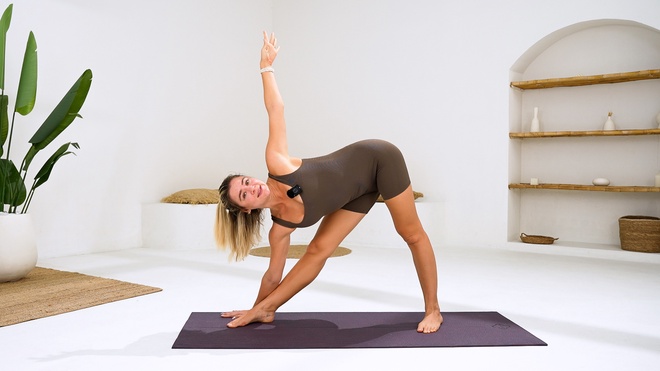
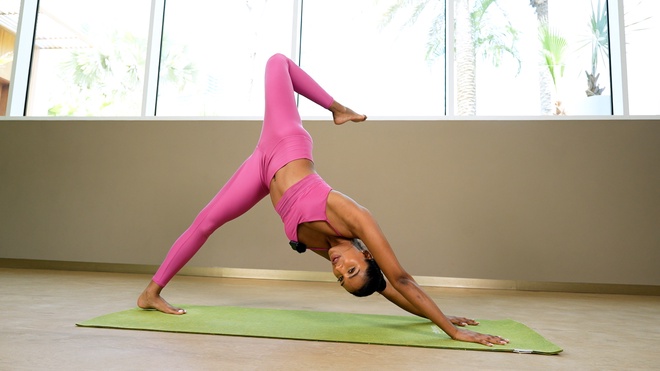
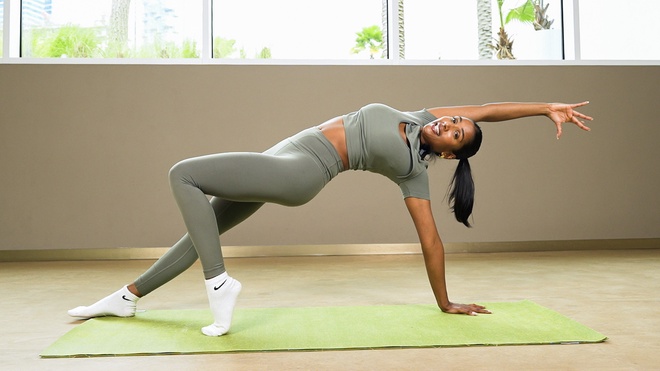
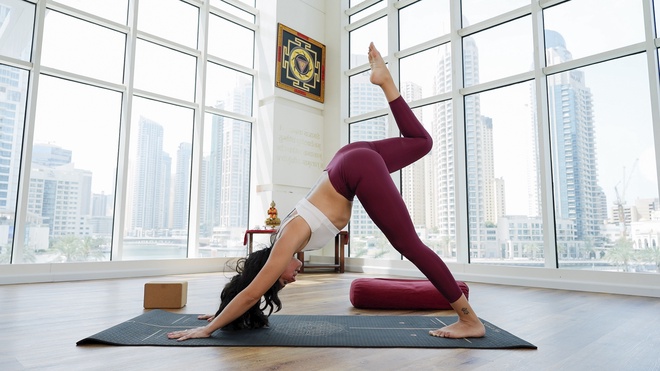
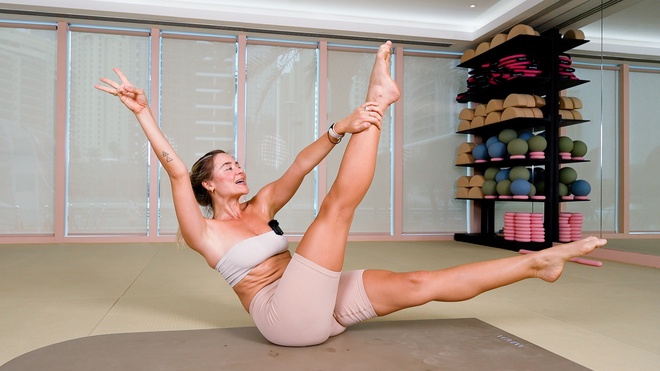
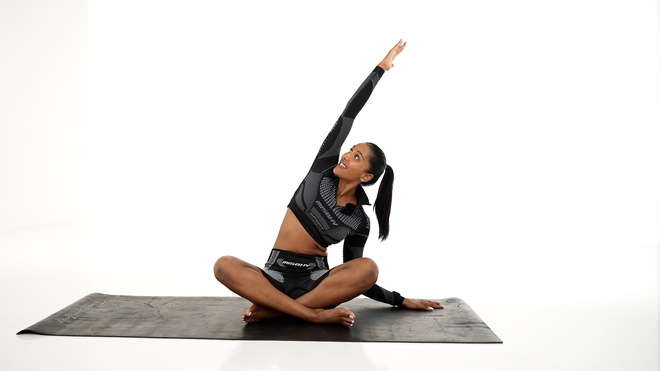

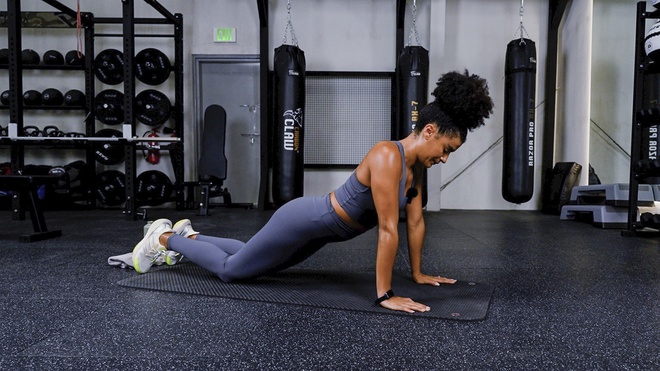
Join women restoring thoracic mobility and shoulder health with 11 certified trainers across 64 workouts
Frequently Asked Questions
Related Exercises
Cat Cow
Targets spinal mobility in a different plane. Cat cow moves the spine through flexion and extension while thread the needle works rotation. Mish Naidoo programs both back-to-back in morning yoga flows. Together they address all three planes of spinal movement.
Child's Pose
The resting position that shares a starting posture with thread the needle. One of our named variants is Child's Pose with Thread the Needle. The hips-back position adds a lat stretch and lower back decompression that the standard version does not include.
Pigeon Pose
Thread the needle in pigeon is one of our named variants. Pigeon opens the hips while thread the needle opens the thoracic spine. Combining them addresses the two most common mobility restrictions from desk sitting in one position.
IT Band Stretch
The directive pairs these because they both address areas that stiffen from prolonged sitting. IT band for the lateral hip and thigh, thread the needle for the upper back. Different body regions, same root cause.
Neck Stretch
Thread the needle incidentally stretches the upper trapezius and neck. For anyone who finds this stretch releases neck tension, dedicated neck stretches are the natural companion exercise. Linda Chambers programs both in her Back Health series.
Get thread the needle stretch in a guided workout
Access 10 workouts featuring this exercise, plus personalized plans from Dr. Wellls.
Join women restoring thoracic mobility and shoulder health with 11 certified trainers across 64 workouts
Your membership funds independent women's health research