Standing Side Bend: How-to, Benefits & Variations
Standing side bend: reach one arm overhead, lean to the opposite side. Stretches intercostals, obliques, and QL. Hold 3-5 breaths per side for rib mobility and breathing depth.
Standing Side Bend: How-to, Benefits & Variations
Your ribs have not moved independently of your torso in weeks. Maybe months. You breathe shallow, you sit square, you twist from the lumbar spine when you reach for something behind you. The lateral plane of your body, the muscles between your ribs, the tissue running from your hip crest to your armpit, has been quietly shortening while you live your life in forward-and-back.
The standing side bend breaks that pattern. One arm reaches overhead, the torso leans, and the entire lateral chain from hip to fingertip opens. Mish Naidoo cues it precisely: left palm down, reach your right arm over, feel the length through the side of the body. That length is what your intercostals, obliques, quadratus lumborum, and lats have been missing.
Sixteen appearances across 14 workouts. Eight trainers. Yoga, Pilates, barre, boxing cooldowns, mobility sessions, HIIT recovery. Petra Kapiciakova teaches it as Indudalasana in bedtime yoga. Anastasia Zavistovskaya uses a chair for support in barre. Danielle Harrison slots it into boxing cooldowns. The standing side stretch shows up everywhere because lateral flexion is the plane of movement modern life forgets entirely.
New to Stretching: Session 2
Mish Naidoo
How to Do Standing Side Bend
Stand with your feet hip-width apart, weight balanced evenly between both feet. Root down through your heels and the balls of your feet. If you feel unsteady, step your feet slightly wider. Anastasia Zavistovskaya coaches: if you feel unstable, step your feet slightly apart to create a wider base for balance. Arms at your sides, shoulders relaxed, spine tall.
Inhale and reach one arm straight up toward the ceiling. Petra Kapiciakova: inhale, lift your left arm up. The inhale is not optional here. As your lungs expand, your rib cage lifts. That lift creates the vertical space you need before you lean. Think about getting taller before you go sideways. Mish Naidoo adds a grip variation: interlace your fingers and flip your palms toward the ceiling for a deeper overhead reach.
Exhale and lean your torso to the opposite side, reaching the raised arm up and over. Petra Kapiciakova: exhale, reach to the side. Keep your chest open. Keep your hips square, both feet grounded. The lean happens from the waist, not from collapsing the bottom hip. Anastasia Zavistovskaya: lift up and out of the waist before leaning to ensure you are not collapsing into the hip. That cue changes everything about where you feel this stretch.
Hold the stretch for 3-5 deep breaths. Expand your ribcage and fill your lungs with oxygen, as Anastasia Zavistovskaya cues for the chair-supported version. Each exhale, let the stretch deepen a fraction. Mish Naidoo: keeping your chin away from your chest, breathing through the side of the body. You should feel the stretch running from your hip up through your obliques, between your ribs, and into the underside of your reaching arm.
Inhale to return to center, standing tall. Exhale, lower the arm. Repeat on the other side. Both sides need equal time. If one side feels dramatically tighter, give it an extra 2-3 breaths. Jessica Casalegno: reach up nice and tall, squeeze through the back of your legs. That squeeze through the legs anchors your lower body so the stretch stays in the lateral chain where it belongs.
Muscles Worked
Primary
Intercostal muscles
The muscles between your ribs. They expand and contract with every breath, but in most people they are locked short from shallow breathing and sedentary posture. The standing side bend stretches the intercostals on the lengthened side while activating the ones on the shortened side. Anastasia Zavistovskaya cues: extending the distance between your ribs. That is the intercostals releasing. When these muscles have room, breathing deepens without conscious effort.
External and internal obliques
The obliques run diagonally across the sides of your trunk. The standing side stretch targets them through lateral flexion, a movement pattern most exercise programs ignore entirely. Lianna Brice: move your hips side to side, add a little pull down with your elbow. The obliques on the reaching side lengthen. The obliques on the bending side contract to control the movement. Isometric on one side, eccentric on the other.
Quadratus lumborum (QL)
The deep muscle connecting your lowest rib to your pelvis. It is a primary lateral flexor and stabiliser of the lumbar spine. When it gets tight, which happens from sitting, it pulls the rib cage down toward the hip on one side. That creates the uneven shoulder and hip alignment people mistake for scoliosis. The standing side bend lengthens the QL on the stretched side. This is one of the few stretches that reaches it effectively.
Secondary
Latissimus dorsi
Sophie Jones: take our arms up, pull over, and then release. The lat runs from the lower back and pelvis up to the upper arm. When the arm reaches overhead and you lean away, the lat gets a full-length stretch. The standing side lat stretch variant in our library emphasises this specifically, focusing on the upper back and shoulder connection.
Shoulder and upper back complex
Mish Naidoo: gently move your neck over so we feel a good stretch from your ears all the way to the shoulders. When you add a gentle neck tilt toward the bending side, the upper trapezius and levator scapulae stretch alongside the lateral trunk. The Standing Side & Neck Stretch variant in our library targets this combined pattern.
Why this matters in perimenopause
Declining estrogen directly affects connective tissue elasticity throughout the trunk. The intercostal membranes, the fascial connections between obliques and lats, and the QL attachments all become stiffer. A 2023 systematic review with meta-analysis found stretching improves range of motion with chronic practice, and these effects are modulated by tissue elasticity. As hormones shift, the lateral trunk stiffens faster than anterior or posterior muscles because it gets the least daily movement. The standing side bend addresses the exact tissues most affected by hormonal changes in connective tissue.
Coach's Tips
"Lift up and out of the waist before leaning to ensure you are not collapsing into the hip." Anastasia Zavistovskaya's cue is the difference between a productive stretch and a compression. Most people dump into the bottom hip when they lean. That closes the space you are trying to open. Think about getting taller first, then leaning. The stretch should feel like you are creating space between each rib, not crunching down into one side.
Anastasia Zavistovskaya
"Left palm down, reach your right arm over. Feel the length through the side of the body." Mish Naidoo teaches this as a proprioceptive cue. Feel the length. Do not just lean. The stretch runs from your hip crest, through your obliques, across your intercostals, and into the underside of your reaching arm. If you cannot trace that line of tension, you are probably rotating forward or backward instead of bending purely to the side.
Mish Naidoo
"Keeping your chin away from your chest, breathing through the side of the body." Petra Kapiciakova's cue solves two problems at once. Dropping the chin tucks the thoracic spine into flexion, which blocks the lateral opening. And breathing through the side of the body is not metaphor. When your intercostals are open, your lungs expand laterally. You can feel the breath moving into the stretched side of your rib cage.
Petra Kapiciakova
"Squeeze your thighs together and keep your weight centred as you lean." This cue appears in the cross-legged variation but applies to every standing side bend. When the torso leans, the hips want to shift in the opposite direction as a counterbalance. Squeezing the thighs and keeping your weight centred means the lateral stretch comes from trunk movement, not weight shifting. The obliques and QL work harder. The stretch goes deeper.
Multiple trainers
"Expanding your ribcage, filling your lungs with the oxygen." Anastasia Zavistovskaya uses this cue during the chair-supported version, but the breathing mechanics are universal across every standing side bend variation. The inhale before the lean creates vertical space. The exhale during the lean lets you sink deeper. And the breaths you take while holding the stretch are the actual therapeutic component. Shallow holds with shallow breathing accomplish almost nothing.
Anastasia Zavistovskaya
"Do not pull too hard on your arm; focus on a gentle stretch through the lats and ribcage." This is not a strength exercise. Yanking yourself deeper with the opposite hand compresses the spinal facet joints on the bending side. The stretch should feel like opening, not crushing. If you feel pinching on the shortened side, you have gone too far. Back off until the sensation is purely a stretch along the lengthened side.
Multiple trainers
"If you feel unstable, step your feet slightly apart to create a wider base for balance." The standard hip-width stance works for most people. But if you are on an uneven surface, wearing socks on a hard floor, or simply feel off-balance today, a wider stance solves the problem without changing the stretch. Anastasia Zavistovskaya also offers a chair-supported version in her barre workouts, which eliminates the balance component entirely so you can focus purely on the lateral stretch.
Anastasia Zavistovskaya
"Bend your knees, draw a semicircle around, and then we lift up, and we open across the other side." Mish Naidoo's dynamic flow version turns the static stretch into a moving warm-up. The bent knees absorb instability. The semicircle creates a continuous lateral stretch that transitions through centre without stopping. Good for cold bodies, early morning sessions, or anyone who finds static stretches uncomfortable.
Mish Naidoo
Why This Matters for You
The lateral trunk is where hormonal changes show up first in movement quality, and almost nobody talks about it.
Estrogen maintains collagen density and hydration in connective tissue throughout the body. As estrogen declines, fascial tissues lose elasticity. The intercostal membranes between your ribs stiffen. The QL attachments tighten. The lateral raphe, the connective tissue junction between your obliques and lats, becomes less pliable. A 2023 systematic review found chronic stretching improved range of motion, with tissue elasticity as a key moderating variable.
Breathing capacity shrinks. Not because the lungs change, but because the rib cage loses its ability to expand laterally. Restricted rib mobility forces shallower breathing. Shallower breathing elevates cortisol. Elevated cortisol worsens hot flashes, disrupts sleep, fragments concentration. A systematic review on diaphragmatic breathing and core stability confirmed the link between rib cage mobility and respiratory function.
The standing side bend directly addresses this chain. Open the intercostals, restore rib mobility, deepen breathing, lower the cortisol baseline. It is not a cure. But it is a daily reset that takes 60 seconds and requires nothing except a willingness to lean.
Jessica Casalegno teaches the standing side stretch in Flexibility sessions. Petra Kapiciakova uses it in bedtime yoga to calm the nervous system before sleep. Danielle Harrison puts it in boxing cooldowns to decompress the trunk after impact work. Different contexts, same underlying benefit: the lateral body needs movement that modern life does not provide.
Variations & Modifications
Standing Side Stretch (Indudalasana)
lowThe yoga version taught by Petra Kapiciakova in bedtime yoga. Same mechanics as the standard standing side bend but held longer (5-8 breaths) with emphasis on meditative breathing. The Sanskrit name Indudalasana translates to crescent moon pose. Breath timing is deliberate: inhale to lift, exhale to lean, breathe laterally while holding.
Standing Side Stretch Flow
lowMish Naidoo's flowing version. Bend your knees, draw a semicircle around, lift up, and open across the other side. Continuous movement between left and right without stopping at centre. Turns the static stretch into a dynamic warm-up. Good for cold mornings or as transition between floor work and standing exercises.
Standing Side Bends with Chair
lowAnastasia Zavistovskaya's barre variation. One hand on a chair, the other arm reaches overhead. The chair eliminates the balance component entirely, letting you focus purely on the lateral stretch. She cues: sliding your leg behind, and then again, side bend to the other side. The chair support also allows for greater lean depth because the stabilising hand takes the fall risk off the table.
Standing Side Bend Stretch Holds
lowYasmin Masri's mobility version. Extended holds of 15-30 seconds per side rather than the standard 3-5 breaths. Used in dedicated mobility sessions where the goal is tissue adaptation, not just a quick release. The longer hold duration allows the QL and intercostals to move past the initial stretch reflex into genuine tissue lengthening.
Standing Side & Neck Stretch
lowMish Naidoo's compound variation. After leaning to the side, gently tilt the neck toward the bending direction. Mish: gently move your neck over so we feel a good stretch from your ears all the way to the shoulders. Adds upper trapezius and levator scapulae to the lateral chain stretch. The neck tilt should be small and controlled, not forced.
Standing Side Bends & Backbend
low-mediumJessica Casalegno's extended version. After the side stretch, return to centre and add a gentle backbend. She cues: flip the palms, backbend, lean back. Then transition into the other side. Combines lateral flexion with spinal extension. Opens the chest and hip flexors alongside the obliques and intercostals.
Standing Side Bends / Hip Sways
lowLianna Brice's Pilates variation. Move your hips side to side, add a little pull down with your elbow. The hip sway adds a lateral pelvic shift that deepens the QL stretch. The elbow pull engages the lat more actively than the standard overhead reach. An intermediate variation that turns the passive stretch into controlled lateral mobilisation.
Standing Cross-Legged Side Stretch & Fold
mediumA deep stretch yoga variation from the library. Cross one leg behind the other, perform the side stretch, then fold forward to target the outer hip and IT band alongside the lateral trunk. This is the most advanced variation. It requires hip mobility, hamstring flexibility, and balance simultaneously. Use a block under the hands during the fold if needed.
Benefits
Rib cage expansion for deeper breathing
The intercostal muscles between your ribs shorten from shallow breathing and desk posture. The standing side bend stretches them on one side while the opposite side contracts. Anastasia Zavistovskaya: expanding your ribcage, filling your lungs with the oxygen. A systematic review on diaphragmatic breathing and core stability found rib cage mobility directly influences respiratory function. When your intercostals can move, each breath reaches deeper without conscious effort.
Lateral chain mobility most people never train
Forward bends, back bends, twists. That is where most stretching programs live. The lateral plane gets forgotten. The standing side stretch targets the obliques, intercostals, QL, and lats in a pattern no sagittal-plane exercise can replicate. Sixteen occurrences across yoga, Pilates, barre, boxing, and HIIT in our library because every discipline recognises this gap.
Lower back tension relief through the QL
The quadratus lumborum is one of the most common sources of lower back discomfort. It connects the lowest rib to the pelvis and tightens from prolonged sitting. Stretching it requires lateral flexion, not forward bending. Most people with lower back tension stretch their hamstrings and hip flexors but never address the QL. The standing side bend is one of the few stretches that reaches it directly.
Posture correction from the ribcage up
When the lateral trunk shortens on one side, the shoulders and hips tilt asymmetrically. One shoulder rides higher than the other. The rib cage rotates slightly. This creates compensation patterns through the neck, upper back, and pelvis. The standing side stretch evens out bilateral tension. Anastasia Zavistovskaya: trying to bend yourself a little more every time. Consistent practice on both sides restores symmetry that sitting and carrying bags on one shoulder gradually destroys.
Common Mistakes to Avoid
Collapsing into the bottom hip instead of lifting up first
Anastasia Zavistovskaya's cue is definitive: lift up and out of the waist before leaning to ensure you are not collapsing into the hip. The mistake compresses the lumbar spine on the bending side instead of opening the ribs on the stretching side. Think about the stretch happening between your ribs, not at your waist. If you feel pinching on the shortened side, you are collapsing.
Rotating the chest forward or backward instead of bending purely to the side
Lateral flexion means the torso bends sideways in the coronal plane. Your chest should face forward throughout the entire stretch. If your chest turns toward the floor, you have added rotation. If it turns toward the ceiling, same problem. Mish Naidoo: feel the length through the side of the body. That line of length should run straight from hip to fingertip, not spiral.
Holding the breath instead of breathing into the stretch
The breathing is not background noise. It is the mechanism that opens the intercostals. Petra Kapiciakova: keeping your chin away from your chest, breathing through the side of the body. If you are holding your breath, your rib cage is locked. The stretch cannot deepen because the very muscles you are trying to lengthen are bracing. Exhale to release. Inhale to expand. Repeat.
Leaning the head and neck instead of the torso
Some people tilt their head to the side and call it a stretch. The head weighs roughly 5 kilograms. Moving it sideways does nothing for the intercostals or obliques. The lean must come from the thoracic and lumbar spine. Imagine your spine bending like a bow, not your neck drooping like a wilting flower. The head follows the spine. It does not lead.
Workouts Featuring This Exercise
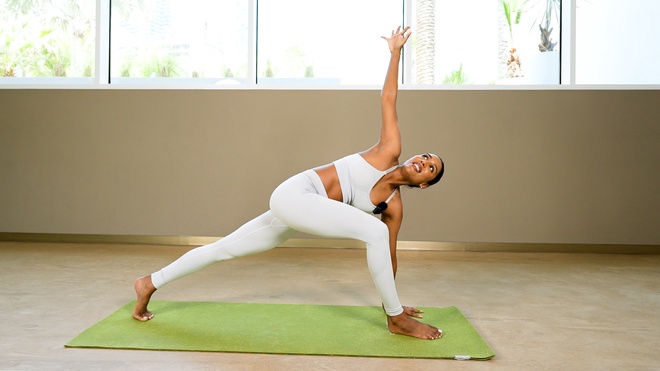
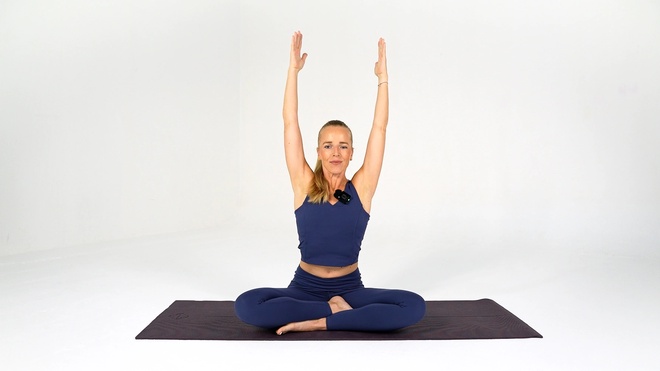
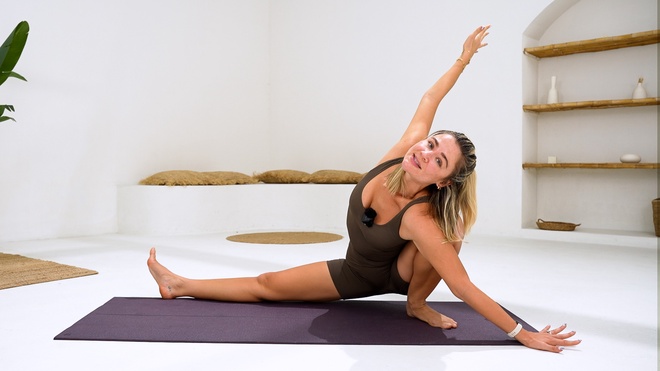
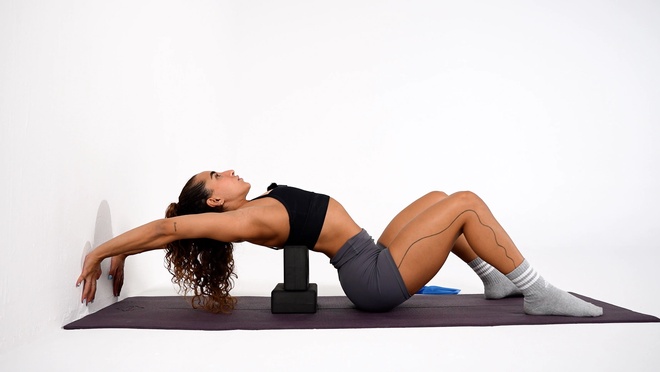
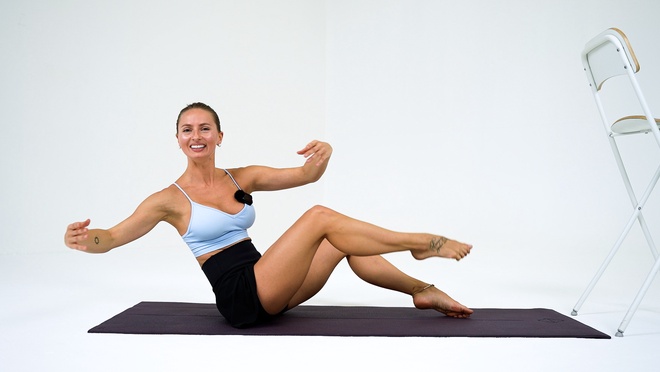
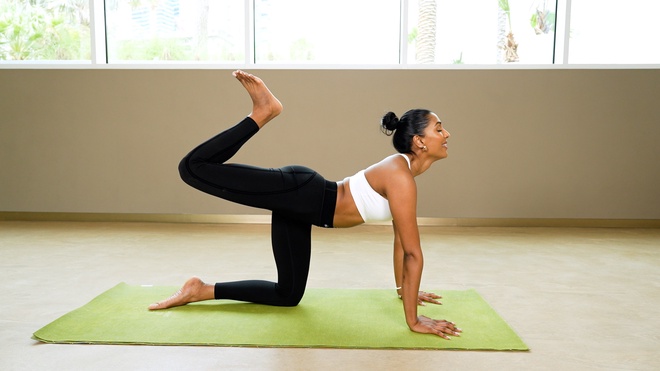
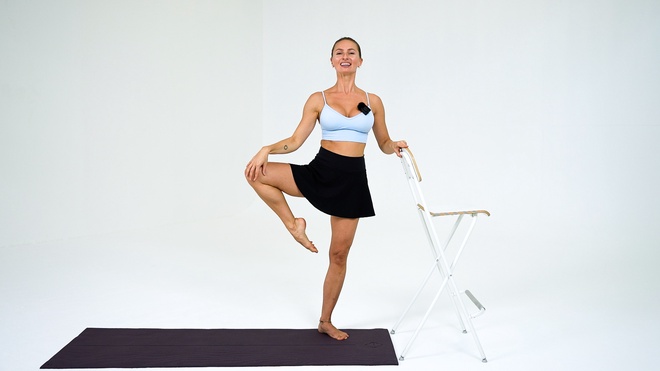
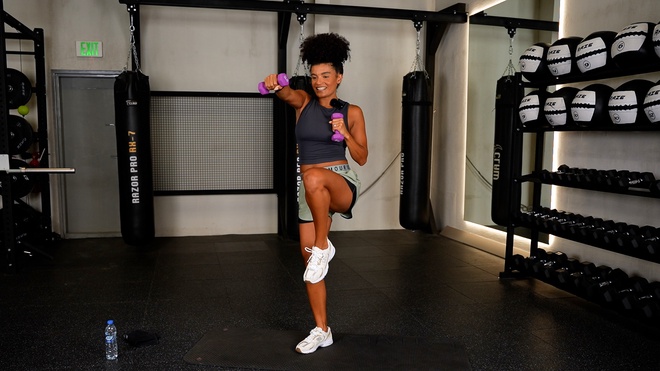
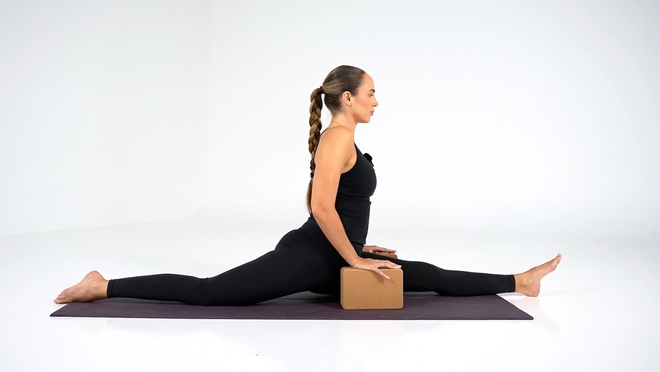
Join women improving rib mobility and breathing depth with 8 certified trainers across 14 workouts
Frequently Asked Questions
Related Exercises
Hip Flexor Stretch
The hip flexors and QL share attachments around the pelvis. When one is tight, the other compensates. The hip flexor stretch addresses the anterior chain while the standing side bend addresses the lateral chain. Together they release the two directions of tightness that sitting creates.
Shoulder Stretch
The standing side bend opens the lat and shoulder on the reaching side. A dedicated shoulder stretch completes the shoulder decompression. Mish Naidoo programs both in daily stretching and morning yoga flows.
Thread The Needle Stretch
Thread the needle works thoracic rotation while the standing side bend works thoracic lateral flexion. Together they address two of the three planes of spinal movement. Cat cow covers the third (flexion-extension). All three belong in any mobility routine.
Chest Opener Stretch
The chest opener stretches the anterior trunk while the standing side bend stretches the lateral trunk. Between them, the entire rib cage gets mobilised. Jessica Casalegno combines both in her Flexibility programming.
Seated Side Stretch
The seated version of the same lateral flexion pattern. Eliminates the balance component. Better for anyone who finds standing uncomfortable or who wants to stretch at a desk. The muscles targeted are identical.
Get standing side bend in a guided workout
Access 10 workouts featuring this exercise, plus personalized plans from Dr. Wellls.
Join women improving rib mobility and breathing depth with 8 certified trainers across 14 workouts
Your membership funds independent women's health research