Donkey Kicks: How-to, Benefits & Variations
Donkey kicks: from all fours, flex foot, drive heel to ceiling with knee bent 90 degrees. Works glutes, hamstrings, core. Keep hips level, spine neutral. 12-15 reps per side.
Donkey Kicks: How-to, Benefits & Variations
You have been doing donkey kicks wrong since the day you first dropped to all fours in a fitness class. I know because I have watched the footage. Forty-two donkey kick segments across our workout library, six certified trainers, and the same mistake shows up in nearly every beginner clip: the lower back arches, the hips twist open, and the glute does maybe 40% of the work it should be doing.
Donkey kicks are deceptively simple. Kneel on all fours. Kick one leg toward the ceiling. Lower it. Repeat. That is the movement most people picture. What most people miss is the precision underneath. Linda Chambers, who leads our Back Health series, says it plainly: "Common fault here is when we lift, we do this, and we lose that tilt of the pelvis." That one sentence contains the entire difference between a donkey kick that builds a strong, functional posterior and one that just loads your lumbar spine.
I pulled the data on this exercise. Jessica Casalegno programs donkey kicks in 18 of her Pilates and yogalates sessions. Natalia Gunnlaugs includes them in strong pilates and HIIT. Amelia Jane uses them across a 7-day sculpting challenge. Linda Chambers prescribes them for back pain rehab. This is not a vanity exercise. When done right, it is a targeted glute activation drill that protects your lower back, stabilizes your pelvis, and addresses the gluteal amnesia that comes from sitting all day.
Full Workout
Linda Chambers
How to Do Donkey Kicks
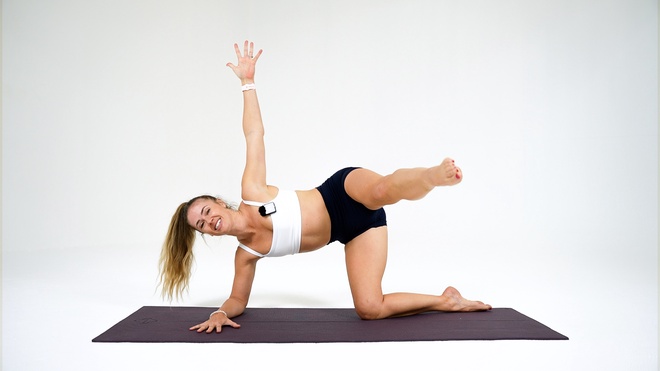
Start on all fours in a tabletop position. Hands directly under shoulders, knees directly under hips. Spread your fingers wide and press evenly through both palms. Jessica Casalegno cues: drawing the navel in, tucking the bum a little bit under. That pelvic tilt is your foundation. Without it, nothing else matters.
Keeping your right knee bent at 90 degrees, flex your right foot. Linda Chambers: sole of the foot facing the ceiling, so you're gonna flex your ankle. A pointed toe shifts activation toward your hamstring. A flexed foot keeps the work squarely in your glute. Every trainer in our library cues the flex.
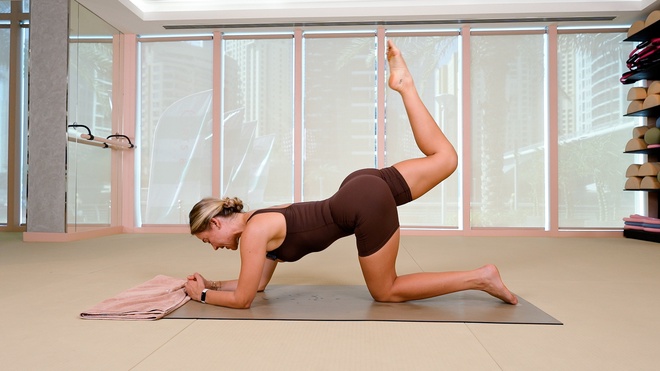
Exhale and drive your right heel toward the ceiling. Imagine putting a footprint on the ceiling above you. Linda: flex at the ankle, and let's put a print on the ceiling. Lift until your thigh is roughly parallel with the floor or slightly above. Your knee stays bent at 90 degrees the entire time. The moment your back starts arching, you have gone too high.
Pause at the top. Squeeze your glute and hamstring hard for one full second. Jessica: squeeze the hamstring and the glute, spine still. This isometric squeeze at peak contraction is where the real activation happens. Rushing through it halves the benefit.
Inhale and lower your knee back down with control, stopping just before it touches the mat. Jessica: inhale to lower the knee down towards the mat. Not crashing it down. Hovering just above the floor maintains tension on the glute and eliminates the momentum cheat that lets people blast through 30 reps without feeling anything.
Complete all reps on one side before switching. Donkey kicks are unilateral by design. Each glute works independently. This exposes strength imbalances between left and right sides that bilateral exercises like squats can mask.
Muscles Worked
Primary
Gluteus maximus
The gluteus maximus is the primary mover in donkey kicks. It produces the hip extension that drives your heel toward the ceiling. A meta-analysis of therapeutic gluteal exercises found that quadruped hip extension (donkey kick) generates high activation of the gluteus maximus, particularly at the top of the movement when the hip reaches full extension. This matters because the gluteus maximus is the largest muscle in your body and the primary engine for standing up, climbing stairs, and stabilizing your pelvis during walking. When it stops firing properly, your lower back and hamstrings pick up the slack.
Gluteus medius and minimus
Your hip stabilizers work isometrically throughout the entire movement to keep your pelvis level. Without them, your hips would rotate open toward the working side. Linda Chambers hammers this cue: avoid leaning over to the side, think about going straight up. EMG analysis confirms the gluteus medius fires substantially during single-leg hip extension to prevent pelvic drop on the non-working side. Lianna Brice cues it directly: trying to keep your hips really still, really even.
Hamstrings
The hamstrings assist the gluteus maximus during hip extension and are heavily engaged when you hold the leg at the top position. The muscles worked during donkey kicks include both heads of the biceps femoris, which help control the lift phase and decelerate the lowering phase. Jessica Casalegno cues: really pushing through that right heel, squeezing through your right hamstring. The hamstring engagement is especially strong in the pulse variation, where repeated small lifts at peak contraction keep the muscle under sustained tension.
Secondary
Core (transversus abdominis, rectus abdominis, obliques)
Your core fires throughout every rep to maintain the tabletop position and prevent your lower back from collapsing. The merged cues from our trainers consistently target this: keep your core engaged, keep your ribcage lifted and navel drawn in. The anti-extension demand on the core is the reason donkey kicks show up in Linda Chambers' back health programming. Strong core activation during the movement protects the lumbar spine.
Erector spinae (lower back)
The erector spinae muscles work isometrically to maintain a neutral spine. They resist the extension force created by the lifting leg. This is why arching your lower back is the number one form error. When the erectors take over concentrically (actively extending the spine), the glute has lost its job.
Shoulders (deltoids and rotator cuff)
Your shoulders and wrists bear a significant portion of your body weight in the tabletop position. The longer your set, the more shoulder stabilization is required. This is why Jessica Casalegno offers the forearm variation: come down to our forearms. Forearm donkey kicks eliminate the wrist load entirely.
Why this matters in perimenopause
Donkey kicks target three systems that weaken during perimenopause. First, glute strength. Declining estrogen accelerates muscle loss, and the gluteus maximus is often the first muscle to atrophy because modern life requires so little hip extension. Research on resistance training for postmenopausal women consistently shows targeted muscle loading reverses this trajectory. Second, pelvic stability. The gluteus medius is critical for pelvic floor support, and its weakness contributes to hip and lower back pain. Third, bone density. Weight-bearing exercise in the quadruped position loads the wrists, knees, and hips, all sites vulnerable to osteoporotic fracture.
Coach's Tips
"Flex at the ankle, and let's put a print on the ceiling." Linda Chambers' signature cue for donkey kicks, and the single most important thing to get right. A flexed foot changes the activation pattern entirely. Point your toes and you will feel the movement in your hamstring. Flex your foot, drive through the heel, and the glute takes over. Every one of our 6 trainers cues this.
Linda Chambers
"Common fault here is when we lift, we do this, and we lose that tilt of the pelvis." Linda again, addressing the arch. When your lower back dips into extension during the lift, you have just transferred the load from your glute to your lumbar spine. The fix is not lifting lower. The fix is maintaining a slight posterior pelvic tilt before you even begin the kick. Draw your navel in. Tuck slightly. Then kick. If you cannot kick without arching, the range of motion is too high for your current core strength.
Linda Chambers
"Exhale, donkey kick up towards the ceiling; inhale to lower the knee back down." Jessica Casalegno repeats this breathing pattern in every single one of her 18 donkey kick segments. It is not arbitrary. Exhaling on the concentric phase (the kick) automatically engages your deep core muscles. Inhaling on the lowering phase allows controlled deceleration. Reverse the breathing and watch your core stability collapse.
Jessica Casalegno
"Trying to keep your hips really still, really even, and your ribcage lifted." Lianna Brice teaches the anti-rotation principle. Your pelvis wants to rotate toward the working side because it is the path of least resistance. Fighting that rotation is what activates the gluteus medius. If someone were standing behind you, they should see your hips staying perfectly square to the floor. The moment one hip opens up, the movement has leaked.
Lianna Brice
"Sending the heel up towards the ceiling, and just give me 12 pulses here." Linda Chambers transitions into the pulse variation mid-set. Pulses at the top of the movement keep the glute under constant tension. No rest at the bottom. No momentum. Just the top 2-3 inches of range, over and over. This is where the burn happens because the glute never gets to relax.
Linda Chambers
"Come down onto the forearms." Jessica Casalegno and Lianna Brice both offer this for wrist discomfort. Dropping to forearms also slightly shifts your center of gravity forward, which can make it easier to maintain a neutral spine. If your wrists ache after the first set, switch to forearms immediately. The glute activation is identical.
Jessica Casalegno
"Hold it up, give me tiny little push-ups, so little pulses up." Mish Naidoo uses micro-pulses: the leg stays elevated while you perform tiny upward lifts that barely cover an inch of range. This creates time under tension that traditional full-range reps cannot match. She programs 12-15 pulses per side, and by pulse 8 the glute is burning in a way that 30 full-range reps never achieve.
Mish Naidoo
"Keep your ribcage lifted and navel drawn in to protect your spine." This safety cue from our merged coaching data applies to every single rep. The quadruped position naturally tempts your belly to sag toward the floor, especially as fatigue sets in. When the belly drops, the lower back hyperextends, and the glute check out. Think about pulling your ribcage away from the floor while keeping your belly button magnetized to your spine.
Jessica Casalegno
Why This Matters for You
Donkey kick benefits extend directly into perimenopause health in ways that matter. Declining estrogen accelerates sarcopenia, the age-related loss of muscle mass, and the gluteus maximus is often among the first muscles to weaken because our daily lives demand so little hip extension. A systematic review of resistance training in postmenopausal women found targeted loading reversed muscle loss and improved functional capacity. Donkey kicks deliver that targeted loading to the exact muscle group responsible for pelvic stability, lower back protection, and the basic mechanics of standing up from a chair. The pelvic floor connection is real. The gluteus medius directly supports pelvic floor function. When it weakens, the pelvic floor compensates, and that compensation contributes to incontinence and prolapse. Strengthening the glutes from underneath, in the quadruped position, reduces that burden. The bone density angle matters too. Weight-bearing exercise in the tabletop position loads the wrists and knees, both common fracture sites in women with declining bone density.
Variations & Modifications
Donkey Kick Pulses
mediumHold the leg at the top of the movement and perform small, controlled lifts of 2-3 inches. Linda Chambers programs 12 pulses per side. Mish Naidoo uses 15. The reduced range of motion keeps the glute under constant tension with zero momentum. This is the variation that makes people discover muscles they did not know they had.
Forearm Donkey Kicks
low-mediumDrop from hands to forearms. This eliminates wrist strain and slightly shifts the center of gravity forward, which some people find makes it easier to maintain a neutral spine. Jessica Casalegno and Lianna Brice both offer this modification. Same glute activation, zero wrist load.
Weighted Donkey Kicks
medium-highTuck a light dumbbell or small ball behind the working knee. The added resistance forces the hamstring to grip the weight while the glute drives the extension. Jessica Casalegno programs this with a pilates ball: that ball comes into that right knee. Start light. A 2-3kg dumbbell is enough to transform the exercise.
Donkey Kick with Extension
mediumAt the top of the donkey kick, straighten your leg fully, then bend back to 90 degrees and lower. Linda Chambers: extend the leg, pull the heel in towards the tail, and then lower the knee back down. Adding the extension increases hamstring engagement and lengthens the time under tension per rep.
Banded Donkey Kicks
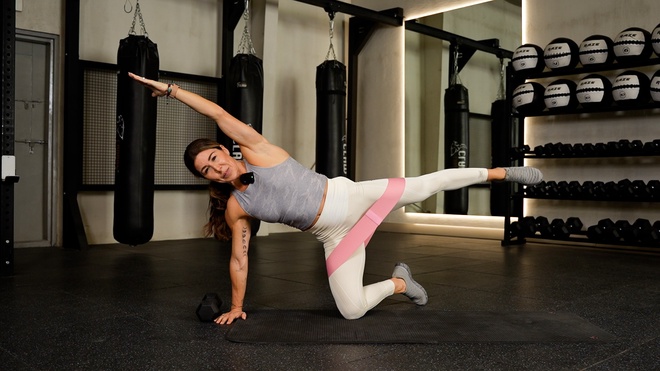
mediumLoop a mini-band above both knees or around the arches of your feet. The band provides progressive resistance that increases as the knee rises, peaking exactly where the glute is strongest. EMG analysis of mini-band exercises confirms banded variations significantly increase gluteal activation compared to bodyweight alone.
Alternating Donkey Kicks
mediumSwitch legs every rep instead of completing one side before the other. Linda Chambers programs this in her back health sessions. Alternating adds a core stability challenge because your pelvis must re-stabilize with every single leg change. Also doubles the weight transfer demand on your shoulders.
Benefits
Common Mistakes to Avoid
Workouts Featuring This Exercise


Join women building glute strength and back health with 6 certified trainers across 17 workouts
Frequently Asked Questions
Related Exercises
Glute Bridge
The other foundational glute activation exercise. Glute bridges load the gluteus maximus through hip extension in a supine position, complementing the quadruped loading of donkey kicks. Together they hit the glute from two different angles.
Hip Thrust
A loaded progression from the glute bridge. Once bodyweight donkey kicks and glute bridges feel easy, hip thrusts add significant external load for continued glute development. Research comparing glute bridge vs hip thrust EMG shows the hip thrust generates higher peak activation.
Fire Hydrant
Same starting position as donkey kicks but targets the gluteus medius through hip abduction instead of extension. Pairing donkey kicks with fire hydrants covers both the maximus and the medius in one superset.
Clamshell
Another gluteus medius isolation exercise performed lying on your side. EMG analysis confirms high medius activation during clamshells. Pairs well with donkey kicks for comprehensive glute programming.
Glute Kickback
Standing or cable variation of the same hip extension pattern. Glute kickbacks allow external loading through cables or machines. A natural progression from bodyweight donkey kicks.
This exercise helps with
Get donkey kicks in a guided workout
Access 10 workouts featuring this exercise, plus personalized plans from Dr. Wellls.
Join women building glute strength and back health with 6 certified trainers across 17 workouts
Your membership funds independent women's health research