Jump Squats: Proper Form, Benefits & Variations
Jump squats: lower into a squat, explode upward, land softly on flat feet. Targets quads, glutes, calves. Builds bone density through 3-5x bodyweight impact loading. No equipment needed.
Jump Squats: Proper Form, Benefits & Variations
Here is something most trainers will not tell you: the jump squat is not about how high you jump. It is about how you land.
The landing produces 3-5 times bodyweight in ground reaction force through your legs and spine. That force is the entire point. A 2023 network meta-analysis on impact exercise versus resistance exercise found that high-impact jumping protocols produced the strongest osteogenic (bone-building) stimulus in women. Your bones do not care how impressive the jump looks. They respond to mechanical loading on impact.
Our trainers program jump squats into 14 workouts across HIIT, muscle tone, yoga-hybrid, and stretching categories. Twenty-nine total occurrences. Six certified trainers. Sophie Jones alone teaches them across 7 workouts. She never once cues for maximum height. Her cue: I'm not pushing too high here, okay? So I'm just finding that nice little balance that works for me.
That is the entire philosophy of the jump squat exercise in one sentence. Control the descent. Explode up with intention. Absorb the landing. Repeat.
Peach Project: Workout 9
Sophie Jones
How to Do Jump Squats
Stand with your feet hip-width apart, arms relaxed at your sides or bent at chest level. Weight distributed evenly across the whole foot. Sophie Jones starts every set clean: feet underneath the hips, we're just gonna squat and jump.
Lower into a squat by bending your knees and pushing your hips back, as if sitting into a chair. Go until your thighs are roughly parallel to the floor. Sophie cues the depth: reaching down, just tapping the floor, bend those knees, get nice and low. If you cannot reach parallel without your heels lifting, work on ankle mobility before adding the jump.
Explode upward by driving through both feet simultaneously, extending your hips, knees, and ankles in one powerful chain. Squeeze your glutes at the top as you leave the ground. Sophie: think about, as you're jumping, squeezing through those glutes. Your arms can swing forward and up to help generate momentum.
Land softly with your feet flat, absorbing the impact through a slight knee bend. This is the most important step. Sophie: make sure we're landing with the feet flat and then drive onto the toes. Flat foot landing distributes force across the entire foot instead of channeling it through one joint. You should barely hear yourself land.
Immediately sit back into the next squat rep without pausing at the top. The rhythm should feel continuous: lower, explode, land, lower. Control your breathing by exhaling on the effort of the jump, inhaling on the descent. Keep your chest lifted and core braced throughout.
Muscles Worked
Primary
Quadriceps (rectus femoris, vastus lateralis, medialis, intermedius)
Your quads do the heaviest lifting in jump squats. They decelerate your body during the squat descent, then fire explosively to extend the knee and launch you off the ground. They also absorb the landing impact through eccentric contraction. Sophie Jones programs jump squats specifically in her Peach Project and Glow Up Challenge workouts to target quad development. The quad demand in jump squats exceeds a standard squat because of the explosive concentric phase and the landing deceleration.
Gluteus maximus
The glutes drive hip extension during the jump phase. Sophie cues it directly: think about, as you're jumping, squeezing through those glutes. Without glute engagement, the jump becomes quad-dominant and you lose power. The glutes also stabilize the pelvis on landing, preventing your knees from caving inward. Every single body_parts tag in our database lists glutes for jump squats.
Gastrocnemius and soleus (calves)
Your calves provide the final push-off force (ankle plantarflexion) and act as the primary shock absorbers on landing. Sophie cues: landing with the feet flat and then drive onto the toes. That drive onto the toes is pure calf contraction. During landing, the calves eccentrically decelerate ankle dorsiflexion. Weak calves mean harder landings and more stress on the knee.
Secondary
Hamstrings
The hamstrings assist hip extension during the upward phase and help control the rate of knee extension on landing. They work as a synergist with the glutes. Our Squat Jumps variation on mat specifically tags hamstrings as a targeted muscle group.
Core (transversus abdominis, rectus abdominis, obliques)
Core bracing keeps your torso upright during the squat and prevents forward lean during the explosive jump. Without core tension, you tip forward. Sophie: keep your chest lifted and your core engaged throughout the entire movement. Core engagement also protects the lumbar spine from compressive forces during landing.
Why this matters in perimenopause
Estrogen is osteoproctective. As it declines during perimenopause, bone mineral density drops at an accelerated rate of 2-3% per year around the lumbar spine. A 2023 network meta-analysis specifically found that high-impact jumping protocols produced the strongest improvements in bone mineral density in women. Plyometric exercises like jump squats generate ground reaction forces of 3-5 times bodyweight. That level of mechanical loading triggers osteoblast activity (bone-building cells) in a way that low-impact exercises simply cannot match. A separate 2022 review on plyometric training for women confirmed that jump-based training maintained fast-twitch muscle fibers. Those fibers decline faster during hormonal shifts, and losing them impairs explosive power, balance recovery, and metabolic rate.
Coach's Tips
"Make sure we're landing with the feet flat... and then drive onto the toes." Sophie Jones gives the definitive landing cue. Most people either slam their heels or bounce off their toes. Neither is right. You land with your full foot contacting the ground to distribute force across the entire surface area. Then you transfer to your toes for the next jump. That sequence protects your knees, loads your calves properly, and sets up the next rep.
Sophie Jones
"Reaching down, just tapping the floor. Bend those knees, get nice and low." Natalia Gunnlaugs programs the floor-tap variation where you reach down with alternating hands at the bottom of each squat. It forces genuine depth. You cannot fake the range of motion when your fingertips need to touch the ground. If you are not getting low enough in your jump squats, this cue fixes it immediately.
Natalia Gunnlaugs
"Think about, as you're jumping, squeezing through those glutes." Sophie isolates the glute squeeze at the top of the movement. Without this cue, most people jump with their quads only and let the glutes coast. The glute squeeze happens at full hip extension, right as your feet leave the floor. That is where you generate maximum power and where your pelvis is most stable.
Sophie Jones
"We don't wanna be tipping forward... Sit in, lift up." Linda Chambers corrects the most common jump squat form error. When fatigue hits, the torso pitches forward, and the squat turns into a good morning with a hop. Sitting in means pushing your hips back, not letting your chest drop. Lifting up means driving vertically through the crown of your head, not launching at an angle.
Linda Chambers
"Keep those knees strong. I don't wanna see any chicken knees." Sophie's way of saying: do not let your knees cave inward on landing. Knee valgus during plyometric landing is the primary mechanism for ACL injuries. A 2023 meta-analysis on ACL injury prevention in female athletes found neuromuscular training that emphasizes proper knee alignment reduced injury rates significantly. Push your knees out over your toes on every single landing.
Sophie Jones
"If it gets too much, you take out the jump, and you just give me fast air squats instead." Sophie offers this in nearly every jump squat segment. Fast air squats preserve the metabolic stimulus and quad work without any impact. You still get the heart rate spike. You just remove the ground reaction forces that stress joints and pelvic floor. This is the go-to for anyone with knee sensitivity, ankle issues, or pelvic floor concerns.
Sophie Jones
"Anyone that feels like they have any knee, ankle, hip issues, you guys can just pulse it." Linda Chambers offers the pulse squat as a second modification tier. Pulse at the bottom of the squat rather than jumping. You still feel the quad burn. The range of motion stays deep. The only thing you remove is the explosive and impact component. It is harder than it sounds. Thirty seconds of squat pulses will light up your quads without a single jump.
Linda Chambers
"Focus on a consistent pace you can hold rather than maximum height." This cue is embedded in the canonical data and it captures Sophie's entire approach. Jump squats are not a vertical jump test. They are a sustained plyometric exercise. A pace you can maintain for 30-60 seconds with clean form beats three explosive reps followed by sloppy ones. Height is irrelevant. Rhythm and landing quality are everything.
Sophie Jones
Why This Matters for You
Jump squats address the two fastest-declining physical capacities during perimenopause: bone density and explosive power.
Estrogen protects bone. When it drops, bone mineral density declines at 2-3% per year around the lumbar spine and hip. A 2023 network meta-analysis comparing impact exercise to resistance exercise found that high-impact jumping protocols produced the strongest bone mineral density improvements in women. Jump squats generate 3-5 times bodyweight in ground reaction force on every single landing. That level of mechanical loading triggers osteoblast activity in a way that walking, swimming, or cycling cannot.
But there is a second mechanism that gets less attention. Fast-twitch muscle fibers. A 2022 review on plyometric training for women found that jump-based exercise specifically preserved fast-twitch fibers. These are the fibers you need for explosive movements, for catching yourself when you stumble, for getting off the floor quickly. They decline faster during hormonal transitions than slow-twitch endurance fibers do.
Then the cardiovascular piece. As estrogen loses its cardioprotective effect, cardiovascular conditioning becomes non-optional. Jump squats deliver high-intensity cardiovascular demand in 30-second intervals. HIIT protocols built around plyometric exercises improved insulin sensitivity and body composition in menopausal women.
One caveat that matters: pelvic floor. High-impact exercises increase intra-abdominal pressure. If you experience any urinary leaking during jump squats, this is a pelvic floor signal, not a fitness failure. A 2022 meta-analysis found 32% prevalence of urinary incontinence in women performing high-impact exercise. The answer is not to stop jumping forever. It is to strengthen the pelvic floor first, then reintroduce impact gradually. Start with pulse squats (zero impact), progress to small hops, then to full jump squats.
Variations & Modifications
Jump Squats with Floor Tap
medium-highReach down and tap the floor with alternating hands at the bottom of each squat before jumping. Natalia Gunnlaugs programs this in her HIIT Blast workouts. The floor tap forces genuine squat depth because your hand has to actually reach the ground. It adds an anti-rotation core challenge since you are reaching with one hand while stabilizing with the other. Mish Naidoo cues it similarly: tap down, jump squats, just switching those arms down to the floor. We program this across 2 workouts.
3-Way Jump Squats
highJump from center to the right, back to center, then to the left. Aylar Fetrati programs this multi-directional variation in her Full Body HIIT workouts. She cues: you're going to go from a regular squat, jump to the right, back to the middle, to the left. The lateral component recruits the hip abductors and adductors that standard jump squats miss entirely. It also trains deceleration in multiple planes, which is closer to how your body actually moves in real life.
Squat Combo (Punches + Jump Squats)
highFour straight punches followed by two explosive jump squats. Danielle Harrison programs this in her Boxing Full Body Burn workouts. The punches spike the heart rate and engage the shoulders and core. The jump squats hit the lower body. The transition between upper and lower body dominant movements creates a full-body metabolic demand that neither exercise achieves alone. It is a conditioning finisher, not a strength exercise.
Pulse Squat (No Jump)
mediumPulse at the bottom of the squat position with small up-and-down movements, never fully extending the knees. Sophie and Linda both offer this as the primary low-impact modification. Sophie: if you wanna slow it down, you're gonna be here, you're gonna pulse. Zero ground reaction force. Zero pelvic floor impact. Sustained time under tension that burns the quads differently than the explosive version. Start here if you have any joint sensitivity, pelvic floor concerns, or are returning to exercise.
Benefits
Bone density through high-impact loading
This is the jump squat benefit that matters most during perimenopause. Every landing generates 3-5 times bodyweight in ground reaction force through your legs, hips, and lumbar spine. A 2023 network meta-analysis found that high-impact jumping produced the strongest bone mineral density improvements in women. A separate 2022 review on plyometric training for women confirmed it maintained fast-twitch muscle fibers and prevented osteopenia. Your bones remodel in response to mechanical stress. No stress, no remodeling. Jump squats deliver the most concentrated bone-loading stimulus of any bodyweight exercise.
Fast-twitch muscle fiber preservation
Fast-twitch muscle fibers decline faster than slow-twitch during perimenopause. They are the fibers responsible for explosive power, balance recovery, and catching yourself if you trip. A 2022 review on plyometric training for women found jump-based exercises specifically maintained these fibers. Jump squats are plyometric by definition. Every rep demands an explosive concentric contraction. Once you lose fast-twitch capacity, it is significantly harder to rebuild than slow-twitch endurance. Preserving it now is easier than recovering it later.
Cardiovascular conditioning without a treadmill
Thirty seconds of continuous jump squats will push your heart rate to training zone 4. That is faster than running, cycling, or rowing at moderate intensity. The simultaneous demand on the largest muscle groups in your body (quads, glutes) combined with the explosive component creates a metabolic cost that steady-state exercise cannot match rep for rep. HIIT protocols using jump squats improved body composition, blood glucose control, and insulin sensitivity in menopausal women.
Functional power for daily life
Getting up from a low chair. Catching yourself on ice. Sprinting across a parking lot in the rain. All of these demand the exact pattern jump squats train: rapid force production from a flexed position. Sophie programs them across beginner, intermediate, and advanced workouts because the movement pattern is the same at every level. Only the intensity changes.
Metabolic afterburn effect
High-intensity plyometric exercises elevate excess post-exercise oxygen consumption (EPOC). In practical terms: you continue burning calories at an elevated rate for hours after you finish. This matters specifically during perimenopause because metabolic rate tends to decline as hormones shift. Jump squats packed into a 20-minute HIIT session can produce a metabolic effect that a 45-minute moderate jog cannot.
Common Mistakes to Avoid
Landing on the heels instead of flat foot
Sophie: make sure we're landing with the feet flat. A heel-first landing sends impact force directly through the knee joint and up into the lumbar spine, bypassing the calves entirely. The calves are natural shock absorbers. Use them. Land with your full foot contacting the ground, then transfer weight forward to the toes for the next jump. If your heels are slamming, you are landing too hard.
Knees caving inward on landing (valgus collapse)
Sophie: keep those knees strong, I don't wanna see any chicken knees. Medial knee collapse during plyometric landing is the primary mechanism for ACL injuries. It happens when the hip abductors (gluteus medius) are weak or when fatigue sets in. Consciously push your knees out over your toes on every landing. If you cannot maintain knee alignment after 20 seconds, take a rest or switch to pulse squats.
Torso pitching forward during the squat phase
Linda Chambers: we don't wanna be tipping forward. Sit in, lift up. Forward lean shifts the load from your glutes and quads to your lower back. It also compromises your landing position because you cannot land upright from a forward-leaning jump. Keep your chest proud, core braced, and sit your hips back rather than letting your chest fall forward.
Prioritizing jump height over landing quality
Sophie: I'm not pushing too high here, okay? So I'm just finding that nice little balance that works for me. The jump squat is not a vertical jump test. A controlled 10-centimeter hop with a perfect silent landing is better training than a maximum-height jump that ends with a heel slam. Focus on the landing. The landing is the exercise.
Workouts Featuring This Exercise
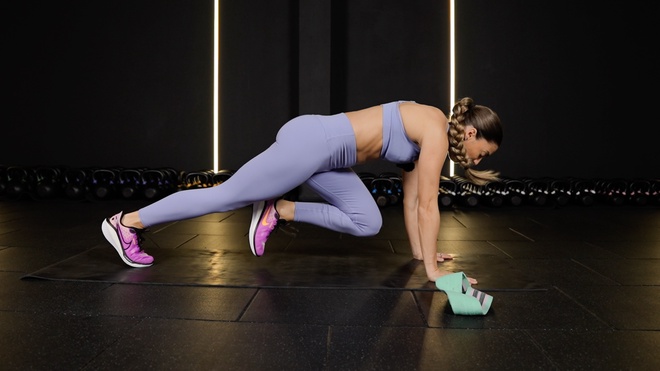
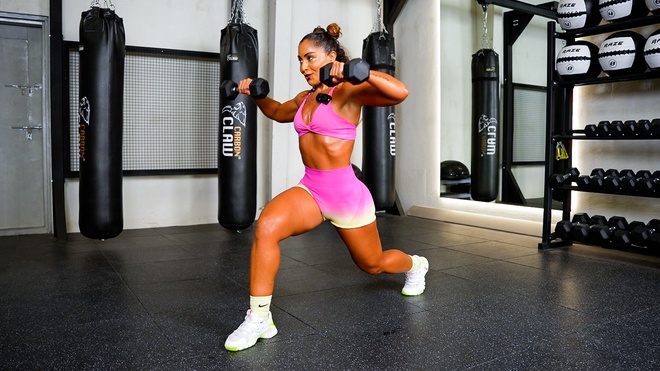
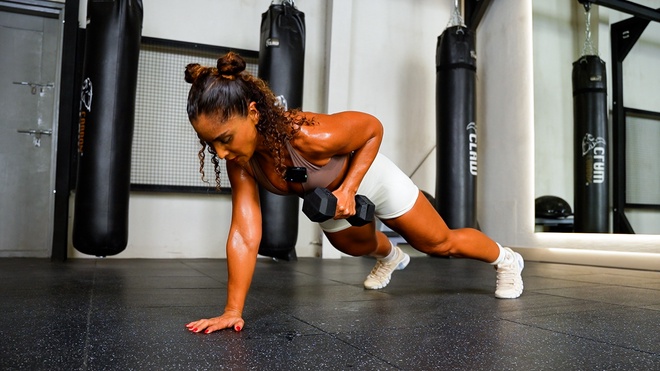
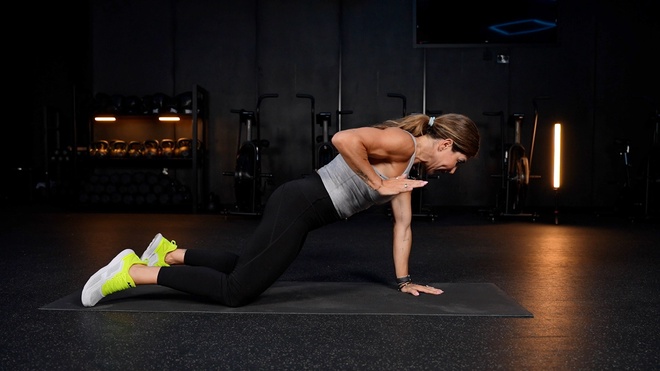
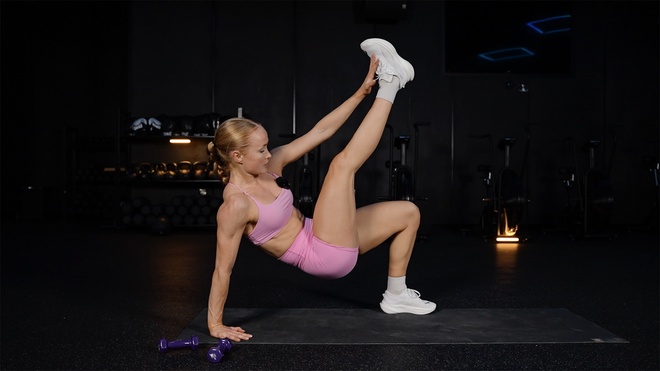
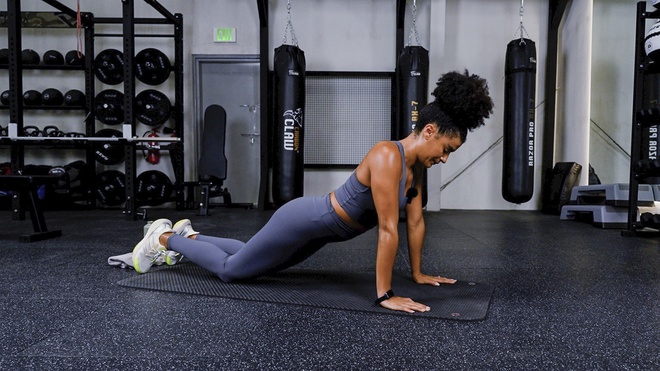
Join women building bone density and explosive power with 6 certified trainers across 14 workouts
Frequently Asked Questions
Related Exercises
Squats
The foundation movement. Master the bodyweight squat first, then add the jump. If your squat form breaks down without the jump, the jump will make it worse.
Jumping Jacks
Similar impact-loading bone density benefit with less lower-body intensity and more shoulder work. Pairs well in circuit format with jump squats.
Burpees
Full-body plyometric progression that includes a squat-to-jump at the top. Higher total-body demand than jump squats alone.
Mountain Climbers
Lower-impact cardio alternative when jump squats fatigue your legs. Maintains heart rate with more core emphasis.
Split Squat Jumps
Unilateral plyometric progression from bilateral jump squats. Identifies and corrects side-to-side strength imbalances.
This exercise helps with
Get jump squats in a guided workout
Access 10 workouts featuring this exercise, plus personalized plans from Dr. Wellls.
Join women building bone density and explosive power with 6 certified trainers across 14 workouts
Your membership funds independent women's health research