Mountain Climbers: How-to, Benefits & Variations
Mountain climbers: start in a high plank, drive alternating knees toward your chest. Trains core, cardio, and hip flexors simultaneously. No equipment needed.
Mountain Climbers: How-to, Benefits & Variations
Sprinting to catch a bus. Scrambling up a muddy hiking trail with your hands bracing the ground. That frantic morning when you dropped to all fours to fish your phone from under the couch before the alarm stopped.
You have done mountain climbers in real life without knowing it. The exercise just names the pattern: running while your hands hold you up.
The mountain climbers exercise is the only movement in our library that trains core bracing, cardiovascular conditioning, and hip mobility in one shot. We program it in 109 segments across 44 workouts, from boxing HIIT to Pilates to beginner weight loss circuits. Nine different trainers teach it, and they have collectively given us 180 coaching cues. That is more coaching data than any other exercise in our system. Some of those cues changed how I think about the movement entirely.
Rise & Shine: Workout 5
Sophie Jones
How to Do Mountain Climbers
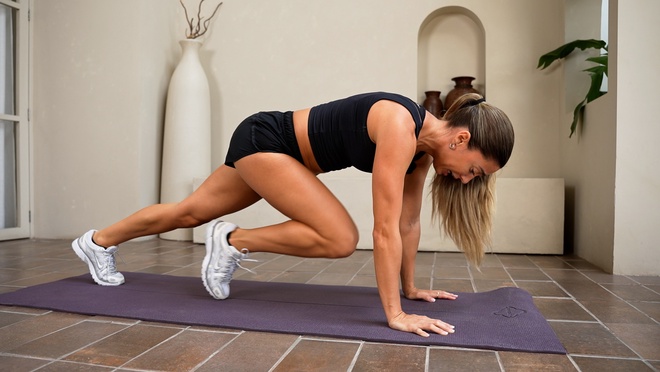
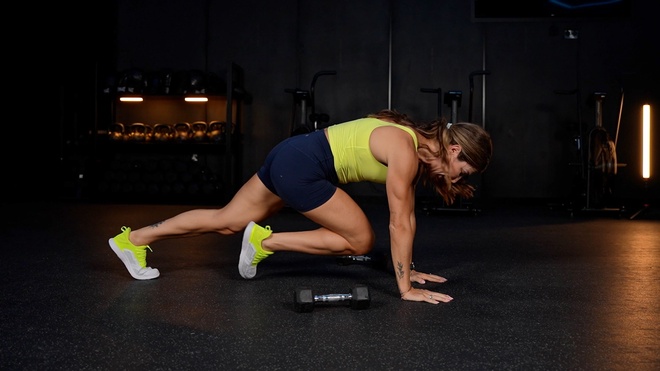
Start in a high plank with your hands stacked directly underneath your shoulders. Fingers spread wide, arms locked. Sophie Jones cues: push away from the floor to keep the upper body stable. Your body should make a straight line from head to heels. Not a tent. Not a hammock.
Drive your right knee toward your chest, aiming for your wrists, not your belly. Sophie cues this repeatedly: knees right under the chest, not cutting the movement short. The deeper the knee drive, the more your hip flexors and core actually work.
As your right foot returns to the starting position, drive your left knee forward. Think running in place, but horizontal. One foot moves forward as the other goes back.
Keep your hips level throughout. This is the part everyone messes up. Sophie says it bluntly: I don't wanna see bums in the air. Natalia Gunnlaugs echoes it: shoulders and hips nice and level. If your butt starts creeping toward the ceiling, you are offloading your core.
Breathe with each knee drive. Exhale sharply when the knee pulls in. Sophie cues: pumping those knees in towards the wrists with a little exhale every time. Holding your breath during mountain climbers tanks your endurance within seconds.
Start slow. Find the form first, then build speed. Sophie gives the best cue here: find a nice rhythm and just stick with it. Beginners should aim for 20-30 seconds of controlled knee drives before adding any speed.
Muscles Worked
Primary
Rectus abdominis and transversus abdominis
Your abs hold your pelvis and ribcage stable while your legs sprint underneath you. The rectus abdominis resists spinal extension (back arching) and the transversus abdominis creates the intra-abdominal pressure that keeps your trunk rigid. Sophie cues it: core nice and tight. Every single trainer in our database cues core engagement during mountain climbers. Not one skips it.
Hip flexors (iliopsoas)
These drive your knees toward your chest. Mountain climbers are one of the few exercises that load the hip flexors through a full range while they are working against gravity. Women who sit at desks all day tend to have shortened, weak hip flexors. This exercise reverses both problems at the same time.
Deltoids and serratus anterior
Your shoulders are bearing your bodyweight the entire time. The anterior deltoids and serratus anterior stabilize the shoulder girdle in a closed-chain position. Sophie cues: strong through the arms, nice and strong. If your arms give out before your legs, your shoulder endurance needs attention.
Secondary
Obliques
Prevent trunk rotation as your legs move asymmetrically. Cross-body mountain climbers (knee to opposite elbow) amplify oblique demand significantly. Multiple trainers cue this variation: right knee towards the left elbow, left knee towards the right elbow.
Quadriceps
Extend the knee of the trailing leg. They work eccentrically to control the returning leg. Subtle but consistent demand across every rep.
Glutes
Stabilize the pelvis and extend the hip of the returning leg. Mountain climbers with glute squeeze variants (which we program in 6 segments) add a deliberate hip extension pause that increases glute activation.
Why this matters in perimenopause
Estrogen decline affects muscle protein synthesis, and the deep stabilizers weaken before the big movers do. Mountain climbers are metabolically demanding enough to stimulate cardiovascular adaptation while simultaneously training core stability and hip mobility. A 2023 systematic review found HIIT-style exercises (which mountain climbers frequently appear in) improved body composition and cardiovascular health in menopausal women. The exercise also loads the wrists and shoulders in a weight-bearing position, which matters for bone density in the upper body.
Coach's Tips
"Don't cut it short on these climbers. Get right underneath the chest." That is Sophie Jones, and she repeats this cue more than any other during mountain climbers. The most common form breakdown I see is a half-hearted knee drive that barely reaches the belly. Drive all the way to the wrists. If you cannot get there, slow down and use the full range rather than sprinting with short strokes.
Sophie Jones
"I don't wanna see bums in the air." Sophie says this in nearly every workout that includes mountain climbers. The hip pike is the universal cheat. When your core gets tired, your butt rises because it is easier to hold that position. Push your hips down until they are level with your shoulders. Danielle Harrison cues the same thing from a different angle: no triangles to the sky.
Sophie Jones
"Pumping those knees in towards the wrists with a little exhale every time." Sophie links breathing to rhythm. This is not just about getting oxygen. The sharp exhale on each knee drive engages the diaphragm, which co-contracts with the pelvic floor and transversus abdominis. One cue. Three muscle groups firing. That is efficient coaching.
Sophie Jones
"Nothing moving in the shoulders, all the movement happening from your pelvis." This cue reframes the entire exercise. Mountain climbers are not an arm exercise. Your upper body should be locked in place like a table. All the action comes from the hips. If your shoulders are rocking forward and back, you are leaking energy and losing core activation.
Multiple trainers
"If you feel any pressure through the knees, just take it a little bit slower." Knee discomfort during mountain climbers usually means you are slamming your feet into the floor on each landing. Slow it down to a controlled step-in, step-out. Linda Chambers echoes this: the exercise should be smooth, not jarring.
Linda Chambers
"If you're struggling, just keep it moving through the knees. Nice, steady pace." Speed is not the goal for beginners. A slow mountain climber (390 monthly searches, by the way) is a legitimate variation that our trainers program intentionally. Step one foot forward, hold, step it back, repeat on the other side. You get the full hip flexor and core training without the cardiovascular overload.
Sophie Jones
"Those of you that wanna take it up, you're gonna add that little jump." Sophie gives permission to scale up too. Power climbers add an explosive hip switch at the top, like a plyometric lunge in a plank position. It is genuinely hard. Do not attempt it until your standard mountain climbers form is automatic for 30 seconds straight.
Sophie Jones
Why This Matters for You
Mountain climbers address three perimenopause priorities that most exercises only hit one at a time.
Cardiovascular health first. Estrogen is cardioprotective. As it declines, cardiovascular disease risk climbs. A 2023 systematic review of exercise modalities in women found that cardiovascular exercise was the strongest intervention for managing that transition. Mountain climbers deliver cardiovascular intensity without impact. No running. No jumping. Your feet barely leave the ground.
Metabolic health second. A 2023 review of HIIT in menopausal women found improvements in body composition, cardiovascular health, and vasomotor symptoms. Mountain climbers are programmed into HIIT circuits across 44 of our workouts. The metabolic demand is real. You burn calories during the exercise, and your metabolism stays elevated afterward.
Core and pelvic floor third. Every mountain climber rep is a dynamic plank. The core bracing and breathing pattern (exhale on knee drive) activates the same diaphragm-pelvic floor connection that a 2023 systematic review confirmed supports pelvic floor health. A 2023 review of core strengthening specifically linked this type of exercise to pelvic organ prolapse prevention.
Three systems, one exercise, no equipment. That is why nine of our certified trainers program mountain climbers regularly.
Variations & Modifications
Slow Mountain Climbers
low-mediumStep one foot forward toward your hands, pause, step it back. Repeat on the other side. Sophie cues: we go slow mountain climbers, right, left, right, and left. This removes the cardio demand and isolates the core stabilization and hip flexor strengthening. Perfect starting point for beginners. We program slow mountain climbers in 6 segments across our library, including specific left-lead and right-lead versions for single-side focus.
Cross-Body Mountain Climbers
medium-highDrive your right knee toward your left elbow, then your left knee toward your right elbow. Multiple trainers cue this identically: knee kicking in towards the opposite elbow, twisting into the obliques. The trunk rotation adds anti-rotation demand from the obliques and creates a deeper hip flexor stretch. Sophie programs both slow and fast versions. The slow version is a controlled crunch. The fast version is a cardio oblique destroyer.
Mountain Climber with Glute Squeeze
mediumDrive your knee in slowly, then extend the leg back with a deliberate glute squeeze at the top. We program this as a single-side exercise, left and right separately, across 6 segments. It flips the emphasis: standard mountain climbers focus on the forward drive, this variation focuses on the extension. Your posterior chain gets involved. Think of it as a mountain climber meets a glute kickback.
Mountain Climber Hold (3-Count)
mediumPerform three knee drives, then hold the third knee in toward your chest for a three-count pause. This eliminates momentum and forces pure core stabilization under fatigue. It is harder than it sounds. The hold exposes any form breakdown immediately. If your hips rise or your back arches during that pause, you know exactly where your weak link is.
Two-Point Mountain Climber
highA progression where you alternate removing a point of contact, creating three-point instability at every phase. We program this across 3 rounds. It demands significantly more from the obliques and serratus anterior because you are constantly fighting rotation with fewer support points. Advanced only.
Mountain Climber Burpee Combo
highFour mountain climbers followed by a full chest-to-floor burpee. Sophie and Danielle Harrison both program this in their boxing and HIIT circuits. It is one of the highest calorie-burn sequences in our library. The mountain climber portion pre-fatigues the core so the burpee hits harder. Not for beginners. Not for the faint of heart, honestly.
Benefits
Full-body cardio without leaving the floor
Mountain climbers drive your heart rate up as fast as sprinting does, but you need zero space and zero equipment. A 2023 meta-analysis found low-volume HIIT produced equivalent fitness improvements to moderate-intensity continuous training. Mountain climbers are the workhorse exercise in most HIIT protocols for exactly this reason. Twenty seconds of fast mountain climbers, ten seconds rest. Repeat. Your heart rate hits training zone 4 within the first round.
Core stability under dynamic load
Static planks teach your core to hold still. Mountain climbers teach your core to hold still while your legs are sprinting. That is a fundamentally different and more functional demand. Every time a knee drives forward, your trunk wants to rotate and flex. Your core must resist both forces simultaneously. A 2025 meta-analysis of 57 RCTs found core training reduced chronic low back pain with an effect size of 0.70. Dynamic core exercises like mountain climbers appeared in study protocols because they train stabilization under real-world conditions.
Hip flexor mobility with strengthening
Sitting at a desk all day shortens your hip flexors and weakens them. Mountain climbers reverse both problems at once by taking the hip flexors through a full range of motion under load. The forward knee drive stretches the trailing hip flexor while strengthening the working one. Two benefits per rep, without a separate stretching routine.
Metabolic demand for weight management
Mountain climbers in a HIIT format create excess post-exercise oxygen consumption. In plain terms: your metabolism stays elevated for hours after you stop. A 2023 meta-analysis of HIIT vs steady-state cardio found HIIT was superior for fat loss and cardiorespiratory fitness in young and middle-aged adults. Mountain climbers are a staple of every HIIT protocol in our library because they demand large muscle groups and high effort simultaneously.
Scalable from rehab to elite conditioning
Slow step-in mountain climbers for someone recovering from knee surgery. Standard pace for intermediate fitness. Power climbers with explosive hip switches for athletes. Cross-body versions for oblique emphasis. Burpee combos for maximum calorie burn. We program 27 different mountain climbers variations across 109 workout segments. No other exercise in our library has this range.
Common Mistakes to Avoid
Hips rising into a pike position
Sophie Jones calls this out constantly: no bums in the air, bums down, knees in. When your core fatigues, your butt rises because it reduces the stabilization demand on your abs. The fix is to consciously push your hips down until they are level with your shoulders. If you cannot maintain that position, slow down. Speed without form is just cardio with extra injury risk.
Shallow knee drives that stop at the belly
Sophie cues: drive the knees in towards the wrists, don't cut it short. Half-range mountain climbers look fast but they barely engage your hip flexors or deep core. Full range at half speed beats half range at full speed.
Shoulders drifting forward of the wrists
Shoulders stay stacked over your wrists. When your base shifts forward, your shoulders absorb the load that your core should be handling. Check your hand position before you start. If your wrists are behind your shoulders, scoot your hands back.
Holding your breath
The exhale on each knee drive is functional, not decorative. It triggers the diaphragm-pelvic floor co-contraction that deepens core activation. Sophie cues: exhale sharply every time you pull a knee in. Breathe out on the work. Breathe in on the return. Repeat until it becomes automatic.
Workouts Featuring This Exercise


Join women building cardio fitness and core strength with 9 certified trainers
Frequently Asked Questions
Related Exercises
Plank
Mountain climbers are a dynamic plank. Master the static hold first, then add leg movement.
Bird Dog
Another dynamic core stability exercise with alternating limb movement. Lower intensity entry point.
Dead Bug
Supine version of the same motor pattern. Trains core anti-extension with alternating leg drives.
Burpees
The natural progression. Mountain climber burpee combos are programmed in our boxing workouts.
Child's Pose
Recovery stretch after mountain climber sets. Opens the hip flexors and decompresses the spine.
This exercise helps with
Get mountain climbers in a guided workout
Access 7 workouts featuring this exercise, plus personalized plans from Dr. Wellls.
Join women building cardio fitness and core strength with 9 certified trainers
Your membership funds independent women's health research