Reverse Lunges: How-to, Benefits & Variations
Reverse lunges target glutes, quads, and hamstrings. Step one foot back, lower until both knees reach 90 degrees, drive through the front heel to stand. Safer on knees than forward lunges.
Reverse Lunges: How-to, Benefits & Variations
Every step you take down a staircase is a single-leg deceleration pattern. Every time you bend to pick up something from the floor, one leg loads while the other stabilizes. The reverse lunge is not a gym exercise. It is the way your body was designed to move under its own weight, one leg at a time.
Here is what most people miss. Stepping backward is fundamentally safer than stepping forward. When you lunge forward, your momentum carries your knee past your ankle, generating shear force through the patellofemoral joint. When you step back, your front knee stays stacked over the ankle. The load goes through the heel. The glutes catch the deceleration. Physiotherapists have known this for decades, which is why reverse lunges show up in ACL rehab protocols and knee-pain management programs long before forward lunges do.
Our workout library has 149 reverse lunge occurrences across 57 workouts, taught by 10 different certified trainers. Sophie Jones alone programs reverse lunges in 23 separate sessions. That is not an accident. It is the single-leg exercise she trusts most for building real-world leg strength without chewing up your knees.
Strength Fundamentals: Workout 4
Sophie Jones
How to Do Reverse Lunges
Stand tall with feet hip-width apart, not on a tightrope. Sophie Jones cues this as train tracks: two parallel lines, each foot on its own rail. Weight distributed evenly. Arms at your sides, on your hips, or holding dumbbells.
Step one foot straight back, roughly 2-3 feet behind you. Sophie Jones says: step straight back from the hip. Not across your body. Not at an angle. Straight back. Crossing over is the fastest way to lose your balance.
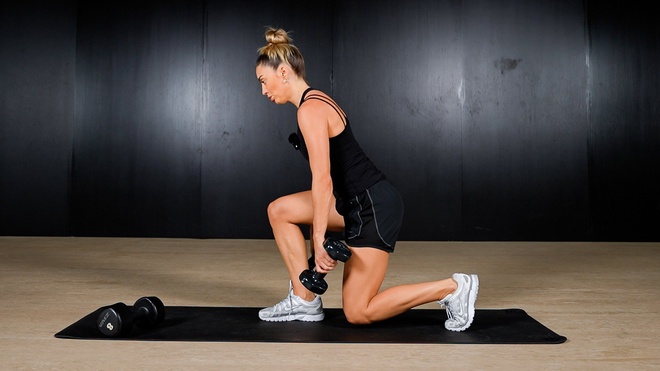
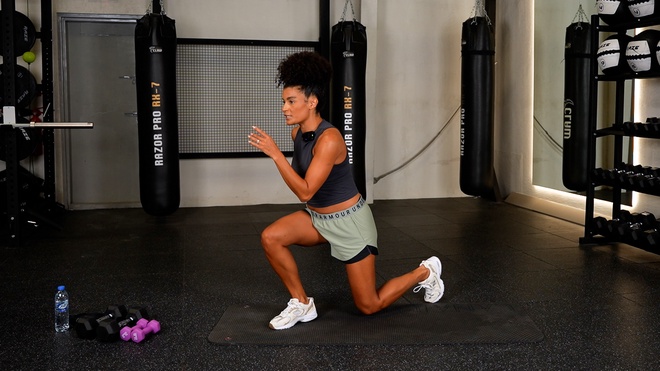
Lower your hips until both knees bend to approximately 90 degrees. Your front knee stays directly above your ankle. Your back knee hovers just above the floor. Sophie Jones in a different workout: you see my knee hovers just above the floor. That hover, not a slam, protects the kneecap.
Drive through the front heel to stand back up. Sophie Jones again: driving through that left heel, squeezing that left glute as you stand up. The heel cue shifts the load from your quad into your glute and hamstring. If your heel lifts, you are quad-dominant and missing the point.
Return the back foot to the starting position. Alternate legs, or perform all reps on one side before switching. Linda Chambers cues: make sure you bend and stretch before you step it up. Do not try and do it all at the same time. Separate the lowering from the stepping.
Muscles Worked
Primary
Gluteus maximus
The main hip extensor. During the reverse lunge, your front-leg glute max drives the upward phase. Because the reverse lunge keeps your torso slightly more upright and your shin more vertical than a forward lunge, the glute max takes on a larger share of the work compared to the quads. A 2023 review of lunge biomechanics confirmed that posterior step lunges shift peak muscle activation toward the hip extensors. This is why physiotherapists prefer reverse lunges for glute-focused rehab.
Quadriceps
The four muscles on the front of your thigh control the lowering phase eccentrically and assist with knee extension on the way up. The front-leg quad does most of the work. The reverse lunge exercise loads the quad with less patellofemoral shear stress than a forward lunge, making it a better option for anyone with anterior knee sensitivity.
Hamstrings
Your hamstrings cross both the hip and knee joints. During the reverse lunge, they assist hip extension on the front leg and stabilize the knee. Sophie Jones cues a slight forward lean from the hips to better target the hamstrings and glutes. That lean shifts the moment arm toward the hip extensors.
Secondary
Core (transversus abdominis, obliques)
A single-leg stance is inherently unstable. Your deep core fires constantly to prevent your trunk from rotating or side-bending during each rep. A 2023 review of single-leg versus bilateral exercises found unilateral movements produce greater core activation due to the asymmetric loading pattern.
Hip flexors (rear leg)
The iliopsoas on your rear leg stretches under load during the bottom position. This makes the reverse lunge both a strengthener and a hip flexor mobilizer. If you sit at a desk all day, the bottom of each rep is giving your hip flexors a stretch they desperately need.
Calves and ankle stabilizers
Your front-leg calf and the intrinsic muscles of the foot stabilize the ankle against lateral wobble. Balance training built into a strength exercise, not as a separate drill.
Why this matters in perimenopause
Reverse lunges target the entire lower body chain that weakens as estrogen fluctuates. The gluteus maximus and quadriceps are the two largest muscle groups in the body by mass. Maintaining them protects bone density at the hip and femoral neck, the two sites most vulnerable to osteoporotic fracture. A 2023 systematic review of resistance training for postmenopausal women found significant improvements in bone mineral density with exercises that load the lower extremity through functional patterns. A 2023 network meta-analysis confirmed that combined resistance and balance training produces the best outcomes for bone density. The reverse lunge is both: a resistance exercise and a balance challenge, simultaneously.
Coach's Tips
"Step straight back from the hip. Don't try and cross your back leg over, 'cause you're gonna fall off balance." Sophie Jones delivers this with zero sugarcoating. I see the crossover pattern constantly. The back foot drifts behind the front foot like a curtsy. That is a different exercise entirely. Straight back. Hip-width rails. Every rep.
Sophie Jones
"I'm not driving through the toe, my heel is not coming off the floor." Another Sophie Jones cue from her Strength Fundamentals series. When the front heel lifts, the quad takes over and the glute goes quiet. Press the heel into the ground like you are trying to leave a footprint. That single cue changes the entire exercise.
Sophie Jones
"Keeping my eye gaze forward so I can stay nice and balanced." This cue appears in Sophie Jones' banded lunge series. Look at the floor and your balance crumbles. Look at the ceiling and your back hyperextends. Eyes forward, chin level. It is that simple and people forget it every single time.
Sophie Jones
"Try not to let the knee bang off the floor. Always leave a little bit of space." Multiple trainers repeat this: hover, do not slam. Natalia Gunnlaugs says: I don't like it when people go down and smack their knees off the floor. A folded towel or mat under the back knee helps while you learn the pattern. The goal is control, not impact.
Natalia Gunnlaugs
"Make sure when we're doing the knee drive, we're not overarching." This comes from the advanced variations where you add a knee drive at the top. The lower back wants to extend as the hip flexes. Brace the core before the drive. Think about pulling your ribs down toward your pelvis. If the belly pushes forward, you have lost it.
Sophie Jones
"If you feel like you're struggling for balance, you can pop the arms out to the side." Arms wide is an instant balance upgrade. Danielle Harrison also offers: if you need a low impact, just give me a normal squat. Lose the jump. Not every session needs to be a progression. Some days your body needs the simpler version.
Danielle Harrison
"Take it as far back as you can. Doesn't necessarily have to be knee to floor." This is a permission slip from our trainers. A half-range reverse lunge still loads the glutes and quads. Reducing the range of motion decreases knee flexion angle and reduces compressive force. For anyone with knee sensitivity during perimenopause, mid-range is perfectly fine. Build depth over weeks.
Sophie Jones
"Inhale, tap the knee all the way to the mat. Exhale, lift all the way up." The breathing pattern from our Pilates-style lunge sessions. Inhale on the way down. Exhale through the effort of standing. That exhale braces the core and activates the pelvic floor as a co-contractor. Natalia Gunnlaugs programs this rhythm across her Strong Pilates series.
Natalia Gunnlaugs
Why This Matters for You
The reverse lunge addresses three perimenopause vulnerabilities in one movement.
Bone density. The femoral neck and total hip are the two fracture sites that concern clinicians most during and after menopause. A 2023 systematic review and meta-analysis of resistance training in postmenopausal women found that exercises loading the lower extremity through functional movement patterns produce the greatest improvements in femoral neck bone mineral density. The reverse lunge loads the hip joint through body weight plus any external resistance, under gravity, on one leg. That checks every box on the bone-loading protocol.
Balance. Balance and proprioception shift as hormones fluctuate. A 2023 meta-analysis confirmed that balance training significantly improves stability outcomes. The reverse lunge is a balance exercise disguised as a strength exercise. Every rep requires single-leg stability, ankle control, and core anti-rotation. A 2023 network meta-analysis found that combined resistance and balance training outperforms either modality alone.
Muscle mass. The glutes and quads are the two largest muscle groups in the body. Preserving their mass protects metabolic rate, supports joint health, and maintains functional independence. The reverse lunge exercise trains both through a full range of motion with a pattern that transfers directly to real life: stepping, climbing, standing from a chair.
Variations & Modifications
Bodyweight Reverse Lunge
lowNo weights. Hands on hips or arms extended for balance. This is where everyone should start. Danielle Harrison programs bodyweight reverse lunges across her entire Low Impact HIIT series for exactly this reason. Master the pattern before you add load. If balance is a struggle, hold a wall or chair for the first few sessions. 12+ occurrences in our library.
Alternating Reverse Lunges
low-mediumSwitch legs every rep. This is the classic alternating lunges pattern that appears in 8+ workouts. The left-right-left rhythm adds a coordination challenge and elevates heart rate compared to single-side work. Beth Hannam programs these in her 7-Day Bodyweight Challenge as a conditioning tool. Good for warm-ups and circuit training.
Reverse Lunge with Pulse
mediumHold the bottom position and pulse 2-3 times before standing. Sophie Jones cues: back into your lunge, ten pulses. The pulses extend time under tension at the hardest point of the movement. Your quads and glutes work without the rest that standing between reps gives you. Burns more than it looks.
Reverse Lunge with Knee Drive
medium-highStep back into the lunge, then drive the back knee forward and up as you stand. Natalia Gunnlaugs cues: stepping back with the right, and then we're gonna kick the right knee up. We're gonna add a jump now. The knee drive adds explosive hip flexion and tests single-leg balance at the top. 6+ occurrences across HIIT and Pilates programs.
Reverse Lunge with Twist
mediumAt the bottom of the lunge, rotate your torso toward the front knee. Natalia Gunnlaugs cues: take a step back, and then just twist to the opposite direction, or to the same direction as the knee that's forward. Linda Chambers adds: spend a little time in that overhead reach, so we feel nice lengthening through the side of the body. Adds thoracic rotation and oblique engagement to the lunge pattern. 5 occurrences in our library.
Banded Reverse Lunge
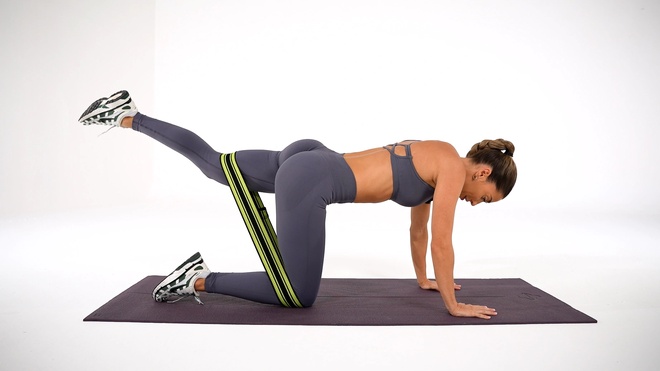
mediumBand above the knees. Sophie Jones: I pull my band, reverse lunge down, keeping it low, keeping my core engaged. The band forces your glute medius to fight against knee valgus (inward collapse) throughout the entire rep. This is the variation physiotherapists love for hip stability. Sophie Jones programs it across her Body by Band series. 4+ occurrences.
Reverse Lunge with Overhead Press
medium-highHold dumbbells at shoulder height. Press overhead as you stand from the lunge. This is the reverse lunge and press combination that turns a lower-body exercise into a full-body movement. The overhead press loads the deltoids while the lunge loads the legs. Core works overtime to stabilize between the two. 6+ occurrences across Strength Fundamentals and Total Body Conditioning.
Reverse Lunge with Bicep Curl
mediumCurl dumbbells during the lowering phase or at the bottom. Sophie Jones programs reverse lunges to bicep curls across multiple rounds in her Peach Project series. The curl adds arm work without changing the lower body mechanics. A time-efficient combination for full-body circuits. 3+ occurrences.
Benefits
Safer on the knees than forward lunges
The backward step keeps your front shin more vertical. Less anterior knee translation means less patellofemoral shear stress. A 2023 review of lunge biomechanics confirmed that posterior-step lunges reduce peak knee joint force compared to anterior-step variations. This is why physical therapists reach for reverse lunges first when rebuilding knee confidence after injury or during joint sensitivity that comes with hormonal shifts.
Trains single-leg balance and coordination
Every rep of a reverse lunge is a single-leg balance challenge. Your standing leg must stabilize your entire body mass while the other leg travels backward. A 2023 review of single-leg exercises found that unilateral lower body movements produce greater core and stabilizer muscle activation than bilateral exercises. The reverse lunge builds functional balance without needing a wobble board or special equipment.
Exposes and corrects left-right imbalances
Bilateral exercises like squats let your stronger leg compensate for your weaker one. You cannot hide in a reverse lunge. If your left glute is weaker, you will feel it. If your right ankle is stiffer, you will wobble. The reverse lunge is diagnostic and corrective at the same time. Ten trainers program it in our library because it builds honest, symmetrical strength.
Doubles as a hip flexor stretch
At the bottom of each rep, the rear leg's hip flexors are in a stretched position under load. If you sit for 8+ hours a day, your psoas and rectus femoris are chronically shortened. The reverse lunge exercise gently lengthens them while also strengthening the glutes on the opposite side. Strength and mobility in one movement pattern.
Bone density loading at the hip and femoral neck
A 2023 systematic review confirmed that lower-extremity resistance exercises improve bone mineral density at the femoral neck and total hip in postmenopausal women. The reverse lunge loads exactly these sites through the weight-bearing leg. Combined with the balance challenge, it addresses both the strength and the coordination components of fracture prevention.
Common Mistakes to Avoid
Stepping back at an angle or crossing behind the front foot
Sophie Jones is blunt about this: don't try and cross your back leg over, 'cause you're gonna fall off balance. Think train tracks. Each foot gets its own rail, hip-width apart. The back foot drops straight behind, not behind the opposite hip. If you keep drifting, place two strips of tape on the floor as guides.
Slamming the back knee into the floor
Multiple trainers flag this independently. Natalia Gunnlaugs: I don't like it when people go down and smack their knees off the floor. Aim for a hover. Two centimeters of air between your kneecap and the ground. If you cannot control the descent, reduce the range of motion. Go halfway down until you build the eccentric strength to control the full range.
Front heel lifting off the ground
Sophie Jones: I'm not driving through the toe, my heel is not coming off the floor. When the heel lifts, you are in your quads and your glutes are asleep. Press the heel down hard. If it keeps lifting, your step length is probably too short. Take a slightly longer step back so the front shin stays vertical.
Torso collapsing forward
Sophie Jones cues: you literally don't move your torso. Your torso stays where it is. A slight forward lean is fine and actually targets the glutes better. But a collapse at the waist means your core has checked out. Brace before you step. Keep the chest up. If you are holding dumbbells and they pull you forward, go lighter.
Workouts Featuring This Exercise

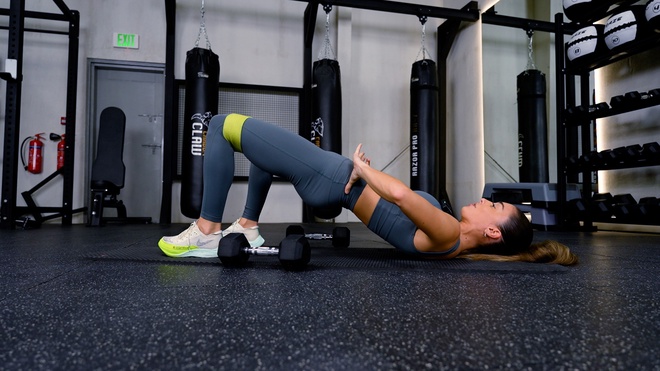
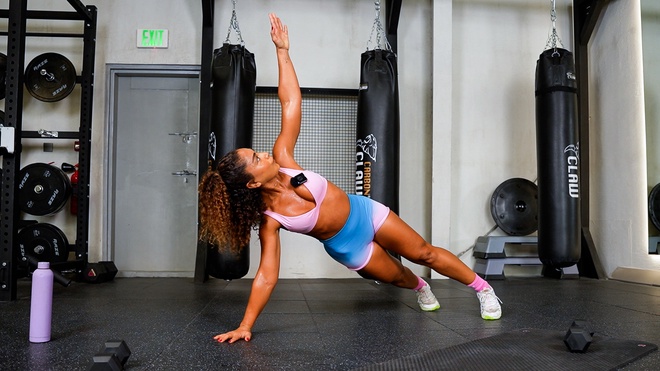
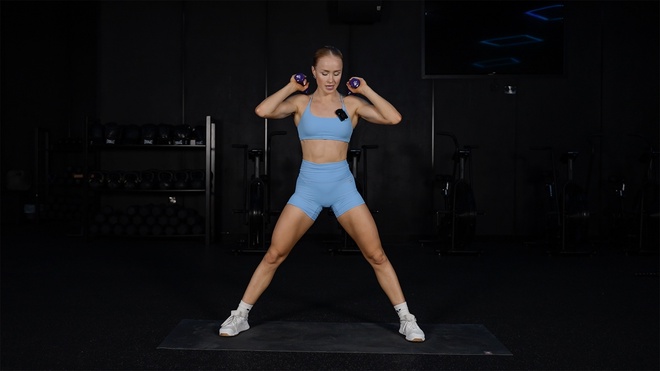
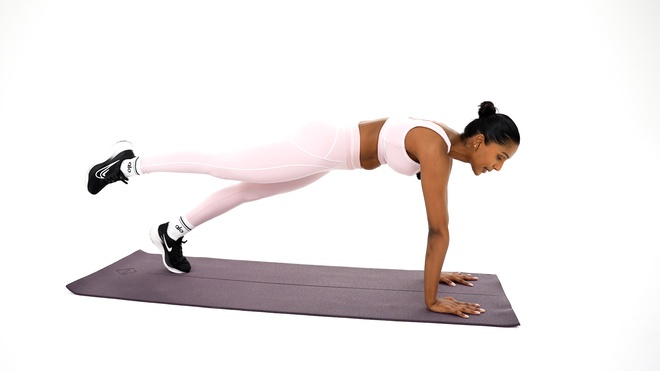
Join women building lower body strength with 10 certified trainers across 57 guided workouts
Frequently Asked Questions
Related Exercises
Squats
The bilateral counterpart. Squats load both legs equally. Reverse lunges expose which leg is doing more work. Train both for complete lower body development.
Goblet Squat
Front-loaded squat pattern that teaches upright torso position. Good complement to the reverse lunge for building quad and glute strength bilaterally.
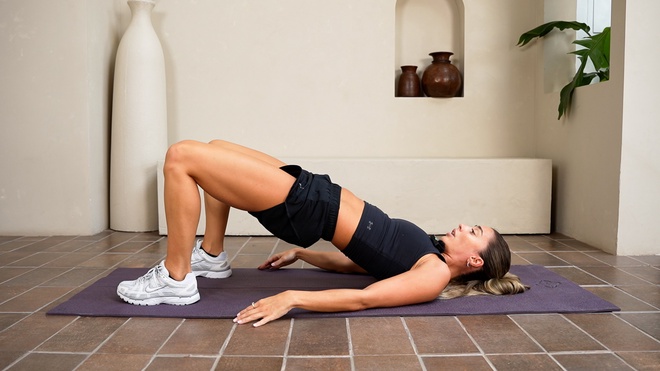
Glute Bridge
Isolates the glutes in a non-weight-bearing position. Useful warm-up to activate glutes before reverse lunges, or as a lower-intensity glute option on recovery days.
Bulgarian Split Squat
The advanced single-leg progression. Once reverse lunges feel easy at bodyweight, the Bulgarian split squat adds rear-foot elevation for greater range and challenge.
Jumping Lunges
The plyometric progression. Natalia Gunnlaugs cues the transition from reverse lunge to jumping lunge in her HIIT Blast series. Add the jump only when you can do 12+ controlled reverse lunges per side.
This exercise helps with
Get reverse lunges in a guided workout
Access 10 workouts featuring this exercise, plus personalized plans from Dr. Wellls.
Join women building lower body strength with 10 certified trainers across 57 guided workouts
Your membership funds independent women's health research