Squat Press: Complete Form Guide & Benefits
The squat press (dumbbell thruster) combines a squat with an overhead press. Targets quads, glutes, shoulders, core. Hold dumbbells at shoulders, squat, drive up and press overhead.
Squat Press: Complete Form Guide & Benefits
The squat press is not two exercises glued together. That is the mistake most people make. They squat. They pause. They press. Three separate events that kill the whole point of the movement.
A real squat press is one fluid chain of force. You drop into a squat, and as you drive up through your heels, that momentum transfers straight into the overhead press. It is the same movement CrossFit calls a dumbbell thruster and the same thing our trainer Sophie Jones labels "Squat Thrusters" in her Glow-Up Challenge. Different names, identical biomechanics: lower body generates power, upper body redirects it overhead.
The thruster exercise shows up 11 times across our workout library, programmed by three certified trainers in workouts ranging from beginner Pilates to intermediate HIIT and full-body conditioning. That range tells you something important: the squat to overhead press is not just a CrossFit staple. It is a compound movement that belongs in any training program built for real-world strength.
Here is what makes the squat press exercise different from doing a squat and a shoulder press separately: metabolic cost. Two muscle groups working in sequence without rest spikes your heart rate faster than any isolation exercise. A 2022 systematic review of compound versus isolation exercises found that multi-joint movements produced significantly greater energy expenditure and hormonal response. For women during perimenopause, that hormonal response matters. Growth hormone and testosterone both support muscle maintenance and bone density, and compound lifts are the most efficient way to trigger their release.
Total Body Conditioning: Full Body Functional
Sophie Jones
How to Do Squat Press
Stand with feet hip-to-shoulder-width apart, holding dumbbells at shoulder height with palms facing each other. Elbows slightly in front of your body, not splayed to the sides. Sophie Jones starts the setup clean: grab your weights, rack them at the shoulders, squeeze the core. If you do not have dumbbells, Natalia Gunnlaugs says to use bodyweight and focus on full range of motion.
Inhale and lower into a squat by pushing your hips back and bending your knees. Sophie cues it with zero ambiguity: sit right in on that squat, squeeze the butt, squeeze the core. Keep your chest upright. Your elbows should stay in front of you. Sophie again: don't tip forward, and keep them elbows in front of you. Go as deep as your mobility allows while keeping your heels on the floor.
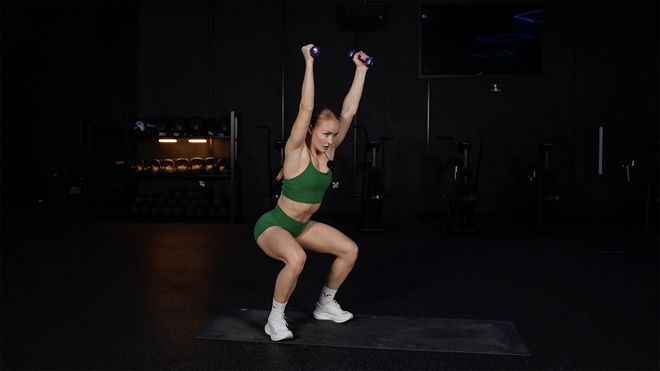
Drive through your heels to stand up. This is where the squat to press becomes one movement instead of two. As your legs straighten, immediately begin pressing the dumbbells overhead. Sophie: squat, and then drive into a press. The power comes from your legs, not your arms. Exhale forcefully as you push through.
Finish with arms fully extended overhead, directly above your shoulders. Sophie is strict on this: squeezing the glutes at the bottom, driving those arms directly above the shoulders. Not in front of your face. Not behind your head. Natalia reinforces: I want you to focus on reaching the arms overhead, not forward, not back. Your body should form one straight line from hands to heels.
Lower the dumbbells back to shoulder height as you simultaneously begin the next squat. The movement is continuous. Jessica Casalegno cues the rhythm: inhale, come down low, exhale, stand up, press. No pause at the top. No pause at the bottom. One breath cycle per rep.
Muscles Worked
Primary
Quadriceps
Your quads handle the heaviest work in the squat press. They decelerate your descent, reverse direction at the bottom, and generate the upward force that powers the entire movement. Every single instance of this exercise in our database lists quads as the primary target. The deeper your squat, the harder they work. Sophie Jones cues nice and deep on those squats, no cheating for a reason.
Gluteus maximus
The glutes drive hip extension as you stand from the squat. They also transfer force from the lower body into the overhead press. Sophie cues glute engagement repeatedly: squeezing the glutes at the bottom. Without active glutes, the squat to press becomes quad-dominant and you lose the power transfer that makes this a compound lift.
Deltoids (anterior and medial heads)
Your shoulders take over the moment your legs finish their job. The anterior deltoid flexes the shoulder to push the weight overhead. The medial deltoid stabilizes the joint under load. Sophie's cue targets this exactly: driving those arms directly above the shoulders. If your arms drift forward, you overload the front delt and shortchange the press.
Core (transversus abdominis, rectus abdominis, obliques)
The core is the transmission between your lower body and upper body. Without it, force leaks. Sophie cues it before every set: squeeze the core. Your core braces isometrically through the entire squat, then resists spinal extension as you press overhead. A weak core means a wobbly press and a vulnerable lower back.
Secondary
Triceps brachii
Extends your elbows to lock out the overhead press. Works hardest in the top third of the pressing motion. Sophie cues: butt tight, abs tight, nice and strong at the top. That lockout at the top is pure triceps.
Hamstrings
Assist the glutes during hip extension in the squat phase. Act as stabilizers for the knee joint throughout the movement.
Upper back (trapezius, rhomboids)
Stabilize the shoulder blades during the overhead press. Without upper back engagement, the shoulders round forward under load. Natalia cues: squeeze your shoulder blades together and keep your neck relaxed as you reach upward.
Why this matters in perimenopause
Compound exercises like the squat press trigger a significantly greater hormonal response than isolation movements. A 2022 systematic review found that multi-joint exercises produced elevated growth hormone and testosterone levels. Both hormones directly support muscle protein synthesis and bone mineral density. During perimenopause, estrogen decline accelerates sarcopenia (muscle loss) and osteopenia (bone loss). The squat press loads your femur, tibia, and lumbar spine through the squat, then loads your shoulder girdle and thoracic spine through the press. One movement, six major bone sites. A 2023 international expert position statement recommended compound resistance exercises for menopausal women specifically because they deliver the highest osteogenic stimulus per minute of training.
Coach's Tips
"Squeezing the glutes at the bottom, driving those arms directly above the shoulders." Sophie Jones captures the entire dumbbell thruster in one cue. The glute squeeze at the bottom prevents your pelvis from tucking under (which loads the lumbar spine). The arm path directly above the shoulders means no wasted energy pressing forward or backward. This is the one sentence to internalize.
Sophie Jones
"I want you to focus on reaching the arms overhead, not forward, not back." Natalia Gunnlaugs repeats this cue in every squat to overhead press set she teaches. Forward press means your chest is collapsing. Backward press means you are arching your lower back. Overhead means neutral spine and maximum shoulder stability.
Natalia Gunnlaugs
"Make sure you're not pressing out here. You wanna press up towards the ceiling." Sophie Jones catches the single most common squat press mistake. Pressing forward turns this into a front raise hybrid that overloads your anterior deltoid and takes your legs out of the equation. Up. Not out. The ceiling is your target.
Sophie Jones
"Think about keeping your body like one long, lean line." Jessica Casalegno wants you to feel the thruster exercise as a full-body connection, not a two-part movement. At the top of the press, you should be one line from fingertips to heels. Core braced, glutes engaged, arms locked overhead. That line is the checkpoint.
Jessica Casalegno
"Inhale to come all the way down low... Exhale to press to the ceiling." Jessica Casalegno matches breath to movement. The inhale on the descent loads your core with intra-abdominal pressure. The exhale on the press creates the force transfer from squat to overhead. If you hold your breath, you lose both the stability and the power transfer.
Jessica Casalegno
"Don't tip forward, and keep them elbows in front of you." Sophie Jones names the two form breakdowns that cause injuries. Forward tip shifts load from your legs to your lower back. Elbows flaring behind you impinges the shoulder joint under load. Elbows slightly forward, chest upright. Every rep.
Sophie Jones
"You don't need to go too fast for this one. I want you to focus on bringing the arms fully overhead." Natalia Gunnlaugs slows people down for a reason. Speed hides bad form. When you rush the dumbbell squat press, you cut the press short and never reach full extension. Slow enough to get your arms all the way up. Then speed up as form allows.
Natalia Gunnlaugs
"If you have dumbbells, amazing. Otherwise, you can always do the movements bodyweight." Natalia Gunnlaugs normalizes starting without weight. Bodyweight squat to press lets you nail the timing, the arm path, and the breathing before you add load. This is not a regression. It is how you build the pattern correctly.
Natalia Gunnlaugs
Why This Matters for You
The squat press addresses three things that shift simultaneously during perimenopause: muscle mass, bone density, and metabolic rate.
Compound exercises produce a stronger hormonal response than isolation movements. A 2022 systematic review confirmed that multi-joint movements elevated growth hormone and testosterone. Both hormones directly support muscle protein synthesis, and both decline as estrogen drops. The squat to press loads six major bone sites in a single movement: femur, tibia, and lumbar spine during the squat phase, then shoulder girdle, thoracic spine, and wrist during the press.
But the metabolic piece is where this exercise genuinely outperforms most alternatives. The dumbbell thruster uses every major muscle group in sequence without rest. That continuous demand spikes heart rate and oxygen consumption far beyond what a squat or a press would produce alone. Research on combined resistance-aerobic exercise found improved insulin sensitivity, reduced visceral fat, and better cardiovascular markers compared to either modality in isolation.
There is a practical angle too. Lifting a heavy box onto a high shelf. Hoisting a carry-on into an overhead bin. Picking up a child and swinging them onto your hip. The squat to overhead press is the gym version of every lift-and-place movement you do in real life. Training it means those movements feel easier, not harder, as your body changes.
Variations & Modifications
Bodyweight Squat to Press
low-mediumNatalia Gunnlaugs teaches this version in her HIIT Blast workouts. Same movement pattern, no external load. Squat down and reach your arms overhead as you stand. Focuses on range of motion, timing, and the breath-to-movement connection. Start here if you are new to the squat to press or returning after a break.
Explosive Thruster (faster tempo)
highThe CrossFit-style dumbbell thruster. Same mechanics but with a faster, more explosive tempo where the squat and press blend into one continuous power movement. Sophie Jones programs this in her Total Body Conditioning workouts. Higher metabolic demand, higher heart rate. Only progress here after your form is solid at a controlled pace.
Single Dumbbell Goblet Squat to Press
mediumHold a single dumbbell at chest height in a goblet position. Squat, then press the weight overhead with both hands. Reduces shoulder strain while increasing core anti-rotation demand. Good bridge between bodyweight and full dumbbell squat press.
Squat to Shoulder Press (alternating arms)
medium-highSquat with both dumbbells at shoulder height, but press only one arm per rep, alternating sides. Adds an anti-rotation challenge for the core and increases time under tension for each shoulder. The squat to shoulder press variation also exposes side-to-side imbalances.
Benefits
Common Mistakes to Avoid
Pressing the weights forward instead of overhead
Sophie Jones is direct: make sure you're not pressing out here. You wanna press up towards the ceiling. Forward pressing turns the squat press into a bastardized front raise that underloads the shoulders and overloads the anterior deltoid. Point your knuckles at the ceiling, not the wall in front of you. At lockout, your biceps should be roughly beside your ears.
Splitting the movement into two separate exercises
Squat. Pause. Press. That three-beat rhythm kills the entire purpose of the dumbbell thruster. The power comes from momentum transfer. As you stand from the squat, the upward drive should seamlessly become the press. Sophie cues it as one action: squat, and then drive into a press. No hitch at the top. The legs finish and the arms start in the same breath.
Tipping the chest forward during the squat
Sophie: don't tip forward, and keep them elbows in front of you. When your chest drops, the dumbbells pull your center of gravity forward and your lower back picks up the slack. Keep the chest upright by actively squeezing your core and pushing your elbows slightly forward of your ribcage. If you cannot squat deep without tipping, reduce your squat depth until your mobility improves.
Cutting the squat depth to move faster
Sophie: nice and deep on those squats, no cheating. Shallow squats mean less quad and glute engagement, less ground reaction force, and less hormonal stimulus. Every centimeter of depth you skip is potential strength you leave on the table. Natalia Gunnlaugs agrees: you don't need to go too fast for this one. Depth first. Speed second.
Workouts Featuring This Exercise
Join women building full-body strength with 3 certified trainers across 7 workouts
Frequently Asked Questions
Related Exercises
Overhead Press
Isolates the pressing portion of the squat press. If your shoulder press form needs work, train it separately before combining with the squat.
Squats
The foundation of the squat to press. Master the squat depth, knee tracking, and breathing pattern before adding the overhead component.
Push Press
Uses leg drive to press weight overhead, similar to the dumbbell thruster but starting from standing. Bridges the gap between strict press and full squat press.
Goblet Squat
Front-loaded squat that teaches the upright torso position critical for a safe squat to overhead press. Excellent regression for building squat depth.
Reverse Lunges
Another compound lower-body movement that pairs well with the squat press in full-body circuits. Targets similar muscles with a unilateral emphasis.
This exercise helps with
Get squat press in a guided workout
Access 7 workouts featuring this exercise, plus personalized plans from Dr. Wellls.
Join women building full-body strength with 3 certified trainers across 7 workouts
Your membership funds independent women's health research