Standing Lat Stretch: How-to, Benefits & Variations
Standing lat stretch targets the latissimus dorsi from hip to armpit. Reach one arm overhead, lean sideways, hold 20 seconds. Improves breathing, reduces side-body stiffness.
Standing Lat Stretch: How-to, Benefits & Variations
That tightness along your side rib cage that makes it hard to take a deep breath. The stiffness in your upper back that no amount of shoulder rolling seems to fix. The nagging pull under your armpit when you reach overhead.
All three trace back to the same muscle: your latissimus dorsi. It is the widest muscle in your body, spanning from your lower back to your upper arm, and it gets short and stiff from hours of sitting with your arms in front of you.
The standing lat stretch targets this entire sheet of muscle in one movement. You reach one arm overhead, grab your wrist with the other hand, and lean sideways. The stretch runs from your hip to your armpit. Hold it for twenty seconds and you can feel the difference in your next breath. That is not placebo. Your lats attach to your ribs, and when they release, your rib cage expands more freely.
Strength Fundamentals 7
Sophie Jones
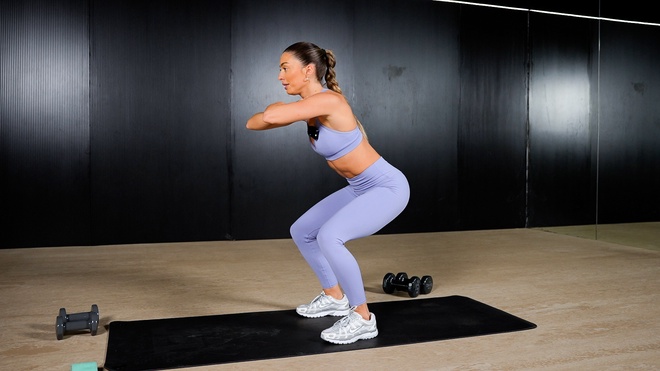
How to Do Standing Lat Stretch
Start in the initial position for standing lat stretch. Breathe steadily and find your alignment before moving deeper.
Move into the stretch slowly, following your breath. Never force past discomfort.
Hold the position for 20-30 seconds, breathing deeply into the stretch.
Release slowly and repeat on the other side if applicable.
Muscles Worked
Primary
Secondary
Why this matters in perimenopause
declining estrogen reduces connective tissue elasticity, making stretching essential. The standing lat stretch directly supports this by targeting key muscle groups.
Coach's Tips
"We're gonna start off with some gorilla rows there, up to the other side, pull." - Sophie Jones
Sophie Jones
Focus on controlled movement throughout the full range of the standing lat stretch. Speed is not the goal.
If you feel pain (not discomfort) during the standing lat stretch, stop and reassess your form. Joint pain means something is wrong.
Why This Matters for You
declining estrogen reduces connective tissue elasticity, making stretching essential. The standing lat stretch maintains mobility and reduces stiffness during a time when the body needs it most. Research supports regular stretching for women during the menopausal transition.
Variations & Modifications
Benefits
Improves flexibility
Regular standing lat stretch practice restores range of motion that desk work and daily habits gradually steal.
Supports your body through hormonal changes
declining estrogen reduces connective tissue elasticity, making stretching essential. The standing lat stretch directly addresses this.
Requires minimal equipment
No equipment needed. You can do the standing lat stretch at home, in a hotel room, or between meetings.
Common Mistakes to Avoid
Forcing the stretch past pain
Discomfort is acceptable. Sharp or stabbing pain is not. Back off until you feel a pull, not a stab.
Holding your breath during the hold
Breathe steadily and deeply. The stretch actually deepens when you exhale and relax into it.
Workouts Featuring This Exercise
Join women building strength and confidence with certified trainers
Frequently Asked Questions
Related Exercises
Get standing lat stretch in a guided workout
Access 1 workouts featuring this exercise, plus personalized plans from Dr. Wellls.
Join women building strength and confidence with certified trainers
Your membership funds independent women's health research