Walking Lunges: How-to, Benefits & Variations
Walking lunges target glutes, quads, and hamstrings. Step forward, lower until both knees bend to 90 degrees, push through the heel, then step the next foot forward. Builds strength and balance.
Walking Lunges: How-to, Benefits & Variations
Watch someone walk across a room. Every step is a single-leg load, a weight shift, a deceleration, a push-off. Walking is lunging. Walking lunges just add intention to a pattern your body already knows.
Here is what makes walking lunges different from stationary lunges: you never reset. Each rep flows into the next. Your body must stabilize, push off, decelerate, and catch itself on every single step. There is no pause at the top to collect your balance. No bilateral stance to hide behind. Just one leg after the other, traveling forward, under load if you choose.
Sophie Jones programs walking lunges across three different workout series in our library. She cues them with dumbbells in her Strength Fundamentals program, bodyweight in her Peach Project warm-ups, and loaded in her intermediate Muscle Tone sessions. Seven total occurrences, all her. That consistency tells you something: when a trainer reaches for the same exercise across beginner and intermediate programs, it is because she trusts it.
Strength Fundamentals: Workout 2
Sophie Jones
How to Do Walking Lunges
Stand tall with feet hip-width apart, core braced. If using dumbbells, hold them at your sides with a neutral grip. Sophie Jones cues: abs engaged, nice and steady. Make sure you have enough room to take at least four steps forward.
Step one foot forward into a long stride. Sophie Jones says: making sure that front foot is nice and flat. The entire sole of your front foot presses into the ground. Not the toes. Not the ball. The whole foot.
Lower your hips by bending both knees. Your front thigh approaches parallel to the floor. Your back knee drives straight down toward the ground. Sophie Jones: we're driving the knee down towards the floor. Hover the back knee an inch above the surface. Do not slam it.
Push through the front heel to stand. Sophie Jones again: pushing to come back up. The heel drive shifts the work into your glutes and hamstrings instead of your quads. If your heel lifts, your step was probably too short.
Without pausing at the top, immediately step the opposite foot forward into the next lunge. Alternate legs with each step. Sophie Jones cues: make sure you're using the opposite leg each time. She programs four steps forward, then turns around and does four back.
Keep your arms relaxed throughout. Sophie Jones: my arms are staying nice and relaxed, not lifting my shoulders up. Tension in the shoulders means tension in the neck. Let the dumbbells hang. Let gravity do that part.
Muscles Worked
Primary
Gluteus maximus
Your glutes power the upward phase of every rep. Because walking lunges demand a longer stride than stationary lunges, your hip flexion angle increases at the bottom, which means your glutes stretch further and contract through a bigger range. A 2023 comprehensive review of lunge biomechanics confirmed that longer-stride lunge variations increase gluteus maximus activation compared to short-stride versions. The walking component adds a propulsive demand: your glute has to push you forward, not just upward.
Quadriceps
The four muscles on the front of your thigh control the descent eccentrically and drive knee extension on the way up. Walking lunges with dumbbells increase the external load on the quads compared to bodyweight versions. The front-leg quad does the bulk of the work. The back-leg quad stretches under load at the bottom, which is both a strengthening and a lengthening stimulus.
Hamstrings
Your hamstrings assist hip extension on the front leg and stabilize the knee joint throughout the movement. They work harder during walking lunges than during stationary lunges because the forward travel requires your hamstrings to decelerate your body mass on each landing. Sophie Jones cues a controlled descent for exactly this reason: the slower you lower, the more your hamstrings contribute.
Secondary
Core (transversus abdominis, obliques)
Walking creates rotational forces that stationary exercises do not. Your trunk wants to twist toward the stepping leg. Your deep core fights that rotation on every single rep. Sophie Jones cues: abs engaged. A 2023 review of single-leg exercises found that unilateral movements produce significantly greater core activation than bilateral alternatives.
Hip flexors (rear leg)
The psoas and rectus femoris on your trailing leg stretch under load at the bottom of each rep. If you spend hours sitting, this stretch is doing double duty: strengthening the front leg while mobilizing the rear hip. Walking lunges are one of the few exercises that combine hip flexor lengthening with lower-body loading in a single movement.
Calves and ankle stabilizers
The forward travel demands ankle stability that stationary lunges do not. Your front ankle must decelerate your body, stabilize laterally, and then push off. The intrinsic foot muscles and peroneals work constantly. This is why walking lunges wobble more than standing ones: you are training balance through the ankle, not just the hip.
Why this matters in perimenopause
Walking lunges load the three largest muscle groups in the lower body simultaneously. As estrogen fluctuates during perimenopause, muscle protein synthesis becomes less efficient, and bone mineral density begins to decline. A 2025 systematic review of resistance training for postmenopausal women found that weight-bearing lower-extremity exercises significantly improve bone mineral density at the femoral neck and total hip. Walking lunges load both sites through single-leg stance under gravity. A 2023 network meta-analysis confirmed that combined resistance and balance training outperforms either alone for bone outcomes. Walking lunges deliver both: resistance through the load, balance through the continuous forward travel.
Coach's Tips
"Making sure that front foot is nice and flat. We're driving the knee down towards the floor." Sophie Jones is consistent about this across every walking lunge segment. Flat foot means whole-foot contact. If only your toes hit the ground, your step is too short and the quad is doing all the work. Press the heel. Feel the glute.
Sophie Jones
"My arms are staying nice and relaxed... not lifting my shoulders up." I see this constantly with dumbbells. People hold them like they might drop, shoulders hiked up to the ears, neck locked tight. Let the weights hang. Relax the grip. Your legs are doing the work, not your traps.
Sophie Jones
"Down to the floor, find the balance." Short cue, massive impact. The word balance is not accidental. Sophie uses it because walking lunges are an unstable exercise by design. Each step is a controlled wobble. If you are not wobbling slightly, you are probably stepping too narrow. Hip-width stance, each foot on its own rail.
Sophie Jones
"Find that control." Two words that show up in Sophie's intermediate Peach Project walking lunges. Speed is the enemy here. A fast walking lunge is a momentum exercise. A slow walking lunge is a strength exercise. Aim for a two-count on the way down and a strong push on the way up. If you cannot slow the descent, drop the weight.
Sophie Jones
"Abs engaged. Nice, stretch down, just nice and steady." This cue comes from Sophie's bodyweight walking lunge warm-up in Peach Project 12. The word stretch is intentional. At the bottom of each rep, your rear hip flexor lengthens under your body weight. That stretch through the psoas is one of the hidden benefits of walking lunges for anyone who sits most of the day.
Sophie Jones
"Making sure that front foot is nice and flat. We're not driving through the knees." Sophie distinguishes between driving the knee down and driving through the knee. Down means the back knee lowers toward the floor. Through means the front knee shoots past the toes. The first loads your glutes. The second loads your patella. Huge difference in one word.
Sophie Jones
"If you do not have the space to do walking lunges, you're just gonna do a forward lunge." Space is the honest limitation. Walking lunges need a hallway, a garage, a long room. Not everyone has that. Sophie offers stationary forward lunges as the swap: same muscles, same depth, no travel. You lose the continuous balance challenge but keep the strength stimulus.
Sophie Jones
"If you don't feel comfortable with weights... drop the weights." Sophie says this mid-set in her Strength Fundamentals program. She does not whisper it. She does not apologize for it. Walking lunges with dumbbells is the loaded version, but the pattern has to be solid first. If your balance is off or your knees complain, bodyweight is the exercise. Dumbbells are the progression, not the default.
Sophie Jones
Why This Matters for You
Walking lunges address three things that shift as hormones change during perimenopause.
Muscle mass. The quads and glutes are the two largest muscle groups in the body. Estrogen supports muscle protein synthesis, and when it fluctuates, maintaining these muscles requires intentional resistance training. Walking lunges load both through a full range of motion with a pattern that transfers directly to daily life.
Bone density. A 2025 meta-analysis found that weight-bearing resistance exercises improve bone mineral density at the femoral neck and total hip in postmenopausal women. Walking lunges load the hip joint through body weight plus any external resistance, on one leg, under gravity. Every step is a bone-loading event. A 2023 network meta-analysis confirmed that combined resistance and balance training produces the best outcomes for bone density. Walking lunges are both.
Coordination. Balance and proprioception shift as hormones change. Walking lunges train dynamic balance in a way that standing exercises cannot. The continuous forward travel forces your vestibular system, ankle stabilizers, and core to coordinate in real time. A 2023 meta-analysis of balance training in perimenopausal women found significant stability improvements with regular practice.
Variations & Modifications
Bodyweight Walking Lunge
mediumNo weights. Hands on hips or arms swinging naturally. Sophie Jones programs this as a warm-up in her Peach Project 12 session: bodyweight walking lunges to warm up the glutes and quads. Start here. Master the balance, the foot placement, the knee tracking. If bodyweight walking lunges feel unstable, you are not ready for dumbbells. Period.
Walking Lunges with Dumbbells
highHold dumbbells at your sides. Sophie Jones programs this in Strength Fundamentals and Peach Project 9. She cues: if you wanna go heavier, do so please. Start with 3-5 kg per hand. The dumbbells add load but also act as a pendulum: they swing slightly with each step, which forces your core to stabilize harder. Walking lunges with dumbbells is the progression once bodyweight is easy for 12+ steps.
Short-Space Walking Lunge (Four and Back)
medium-highSophie Jones cues: feet nice and flat. I'm gonna do four forward and then four back. This is her answer to limited floor space. Take four steps forward, turn around, take four back. The turnaround adds a rotational stability challenge and a moment to reset your breath. Good for home gyms, hotel rooms, or anywhere you do not have a 20-foot runway.
Benefits
Trains the gait pattern under load
Walking lunges are the only lunge variation that mimics actual human locomotion. Each rep is a exaggerated step: load the front leg, push off, swing the back leg through. A 2023 review of functional training found that exercises replicating real movement patterns transfer better to daily function than isolated machine work. Walking lunges train your legs the way your legs actually work: one at a time, moving forward.
Exposes left-right imbalances you cannot hide
Bilateral exercises like squats let your dominant leg compensate. Walking lunges do not allow that. If your left glute is weaker, you will wobble on the left step. If your right hip flexor is tighter, the right step will feel shorter. Seven occurrences in our library, all taught by Sophie Jones, and she watches for this: the leg that wobbles more is the leg that needs more work.
Cardiovascular demand without running
Walking lunges elevate heart rate more than stationary lunges because the continuous movement eliminates rest between reps. Your legs never fully straighten, your core never switches off, and your cardiovascular system has to supply blood to working muscles nonstop. For women who want conditioning without impact, walking lunges deliver the metabolic challenge of running with the joint safety of controlled resistance training.
Hip flexor stretch built into every rep
At the bottom of each walking lunge, the rear leg's hip flexors stretch under your body weight. The psoas and rectus femoris lengthen while the front-leg glutes contract. If you sit for 8+ hours a day, your hip flexors are chronically shortened. Sophie Jones cues: stretch down. Walking lunges benefits include this dual-purpose loading: strength on the front leg, mobility on the back leg, in every single step.
Bone density loading at the hip
A 2025 systematic review confirmed that lower-extremity resistance exercises improve bone mineral density at the femoral neck and total hip. Walking lunges load these exact sites through single-leg stance under gravity plus external resistance. The continuous weight-bearing nature of the exercise means your bones receive impact forces on every foot strike, combined with muscular tension on every push-off.
Common Mistakes to Avoid
Taking steps that are too short
A short step cramps the front knee forward past the toes and turns the exercise into a quad-dominant movement. Take a long enough stride that your front shin stays vertical at the bottom. Sophie Jones cues: making sure that front foot is nice and flat. If the heel lifts, lengthen your step. You will feel the difference immediately: longer steps shift the work into the glutes.
Rushing through reps for speed
Walking lunges are not a race. Sophie Jones cues: find that control and nice and steady across multiple sessions. A fast walking lunge uses momentum instead of muscle. Aim for a two-count descent on every rep. If you cannot slow it down, the weight is too heavy or your legs are too fatigued. Either go lighter or rest.
Leaning the torso excessively forward
A slight forward lean targets the glutes. A collapse at the waist means your core checked out. Sophie Jones: abs engaged. Think about keeping your chest proud and your ribcage stacked over your pelvis. If dumbbells are pulling you forward, go lighter until your legs are strong enough to keep the torso upright.
Stepping on a tightrope instead of train tracks
Feet should land hip-width apart, like walking on two parallel lines. If your feet cross behind each other, you lose your lateral base and wobble on every step. Sophie Jones cues: find the balance. Widen your stance and each step stabilizes.
Workouts Featuring This Exercise
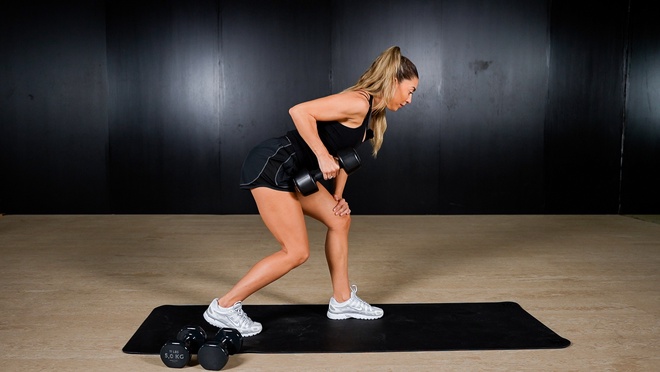
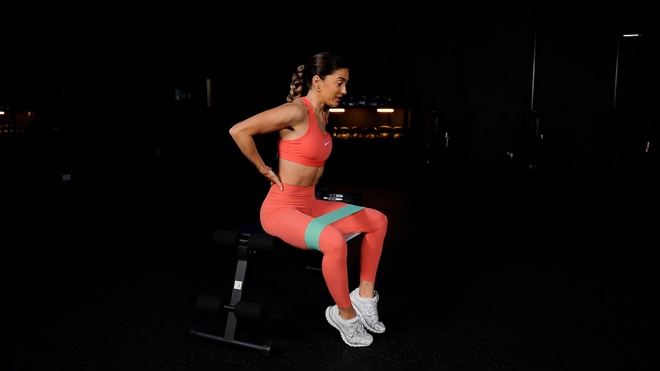
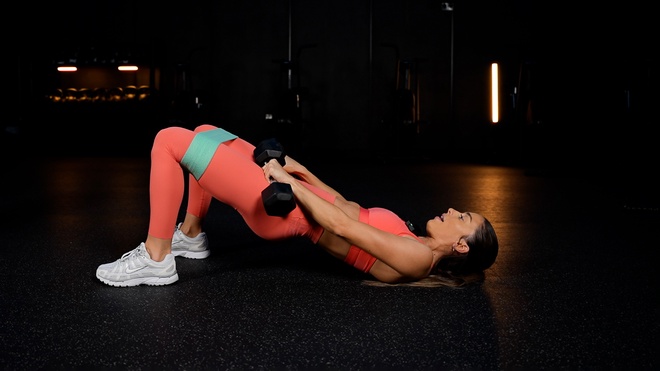
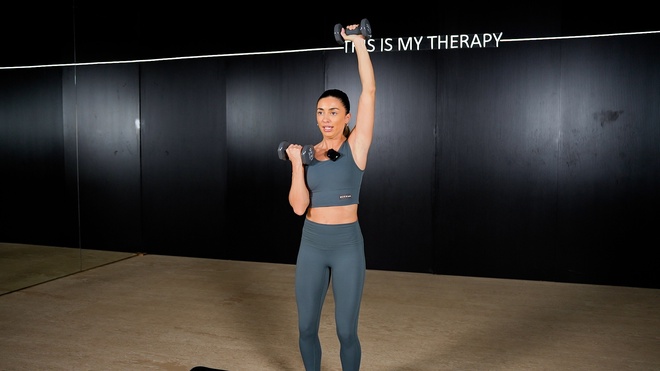
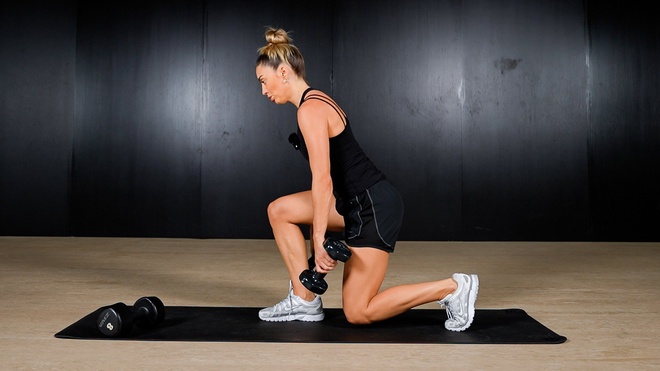
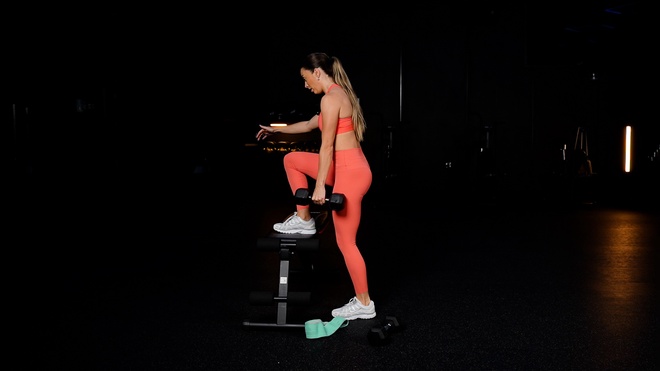
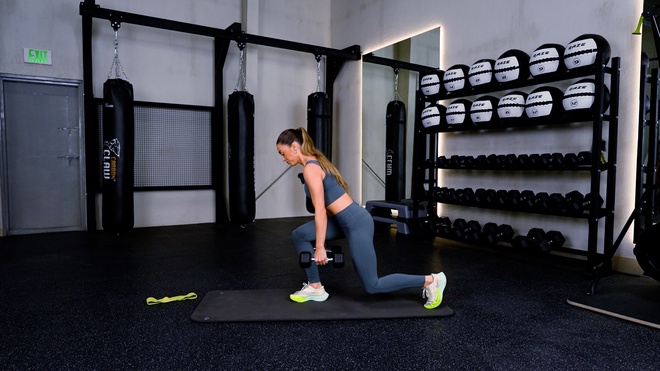
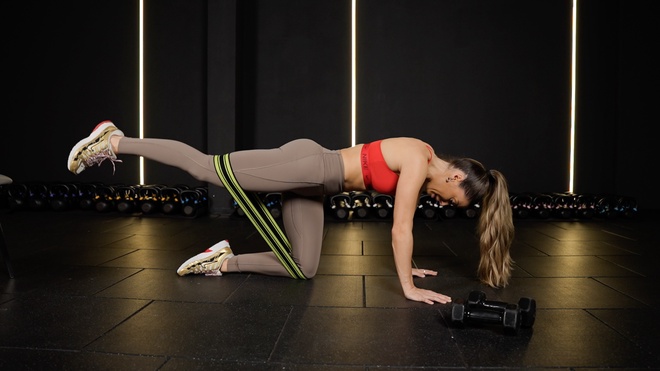
Join women building lower body strength with certified trainer Sophie Jones across 3 guided walking lunge workouts
Frequently Asked Questions
Related Exercises
Reverse Lunges
The backward-stepping counterpart. Reverse lunges are safer on the knees because the front shin stays more vertical. If walking lunges bother your knees, reverse lunges are the swap. Same muscles, different direction, less patellofemoral stress.
Bulgarian Split Squat
The advanced single-leg progression. Rear foot elevated on a bench increases hip flexion range and removes the walking component. Harder on balance, deeper on the glutes. Graduate to these once walking lunges feel comfortable for 12+ steps per side.
Goblet Squat
A bilateral squat that teaches upright torso position. Good pairing with walking lunges: the squat builds overall lower body strength, the lunge trains single-leg function and balance. Different tools, complementary adaptations.
Step Up
Another single-leg exercise that mimics a real movement pattern. Step-ups train the same push-off mechanics as walking lunges but with a vertical challenge instead of horizontal travel. Good alternative if space is limited.
Hip Thrust
Isolates the glutes in a hip-extension-dominant pattern. Pair hip thrusts with walking lunges to hit the glutes from two different angles: loaded hip extension from the thrust, functional single-leg loading from the lunge.
This exercise helps with
Get walking lunges in a guided workout
Access 10 workouts featuring this exercise, plus personalized plans from Dr. Wellls.
Join women building lower body strength with certified trainer Sophie Jones across 3 guided walking lunge workouts
Your membership funds independent women's health research