Step Up: How-to, Benefits & Variations
The step ups exercise targets quads, glutes, and hamstrings one leg at a time. Step onto a platform, drive through the heel, stand tall. Builds single-leg strength.
Step Up: How-to, Benefits & Variations
Climbing subway stairs with two bags of groceries. Walking up a trail that gets steeper than the map promised. Stepping onto a high curb while carrying a child on your hip. These are not gym exercises. These are Tuesday.
Step-ups train exactly this pattern. You place one foot on a raised surface, drive through that heel, and stand up on top of it. Then you lower yourself back down with control. One leg does all the work while the other assists minimally.
What separates step-ups from squats or lunges is the unilateral loading. Your dominant leg cannot compensate for the weaker one. If your left glute is not firing properly, you will feel it on the very first rep. Physical therapists use step-ups as both an assessment and a rehabilitation tool because the movement reveals weakness and corrects it simultaneously.
Peach Project 7
Sophie Jones
How to Do Step Ups Exercise
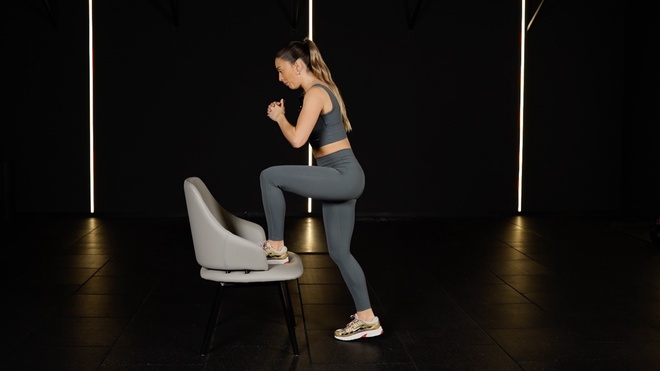
Set up in the starting position for step up. Feet hip-width apart (or as the exercise requires). Engage your core before initiating any movement.
Begin the movement with control. Sophie Jones cues: "Think about leaning just onto the top of the chair so you're nice and strong through the glutes."
Complete the full range of motion. "Holding them down the sides of my arms... My upper body is just nice and relaxed."
Return to the starting position with control. Make sure your foot is far enough on the chair so you're not in an unstable position.
Sophie Jones adds: "Make sure my foot is nice and flat... I'm not on my toe, I'm not on my heel."
Muscles Worked
Primary
Secondary
Why this matters in perimenopause
resistance training preserves muscle mass and bone density during perimenopause. The step up directly supports this by targeting key muscle groups.
Coach's Tips
"Think about leaning just onto the top of the chair so you're nice and strong through the glutes." - Sophie Jones
Sophie Jones
"Holding them down the sides of my arms... My upper body is just nice and relaxed." - Sophie Jones
Sophie Jones
"Make sure my foot is nice and flat... I'm not on my toe, I'm not on my heel." - Sophie Jones
Sophie Jones
"Make sure your foot is far enough on the chair so you're not in an unstable position." - Sophie Jones
Sophie Jones
"Now I'm gonna add my weights with me." - Sophie Jones
Sophie Jones
Why This Matters for You
resistance training preserves muscle mass and bone density during perimenopause. The step up loads bones and builds lean muscle during a time when the body needs it most. Research supports resistance training for women during the menopausal transition.
Variations & Modifications
Step Ups (Right Leg) - Round 1
mediumBenefits
Builds strength
The step up targets a key muscle group, making it efficient for building functional strength that transfers to daily activities.
Supports your body through hormonal changes
resistance training preserves muscle mass and bone density during perimenopause. The step up directly addresses this.
Requires minimal equipment
No equipment needed. You can do the step up at home, in a hotel room, or between meetings.
Common Mistakes to Avoid
Using momentum instead of muscle
Slow down. If you can't complete the step up with a two-second pause at the hardest point, the weight is too heavy or you're moving too fast.
Holding your breath
Exhale during the effort phase, inhale during the return. Holding your breath spikes blood pressure and reduces core stability.
Common form breakdown
Sophie Jones warns: "Make sure your foot is far enough on the chair so you're not in an unstable position."
Workouts Featuring This Exercise
Join women building strength and confidence with certified trainers
Frequently Asked Questions
This exercise helps with
Get step ups exercise in a guided workout
Access 3 workouts featuring this exercise, plus personalized plans from Dr. Wellls.
Join women building strength and confidence with certified trainers
Your membership funds independent women's health research