Boxing Full Body Burn — Workout 1 – Six Rounds Bodyweight
Exercise Breakdown
15 exercises in Workout 1 – Six Rounds Bodyweight
Warm-up8 exercises3m 10s
“Let's give that head roll, round to the right.”
“You're going to turn and rotate side to side.”
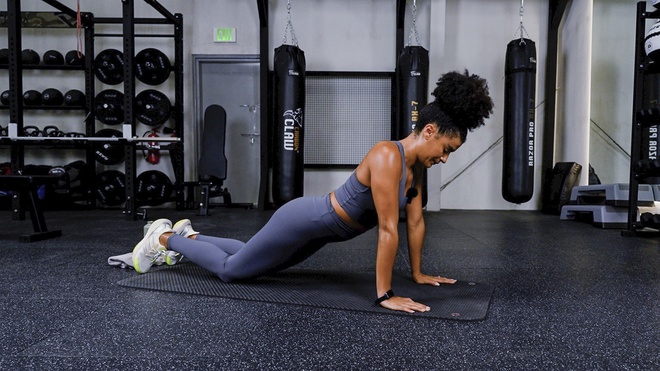
“Roll down the spine, walk out to plank position, lower down the hips.”
“Push your heels into the floor, have a little walk through.”
“Start to get the knees up a little bit.”
Strength1 exercise3m
“Knee in, knee in.”
Cardio5 exercises15m
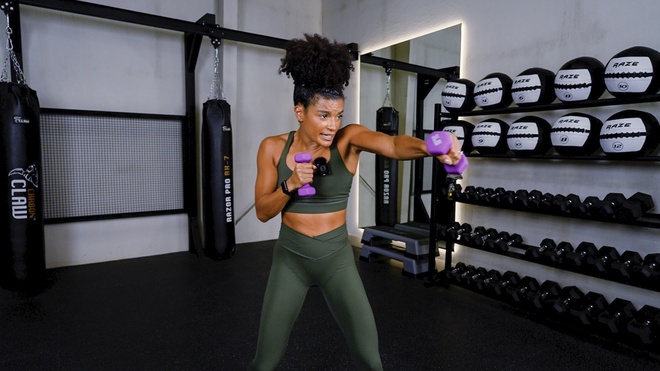
“Uppercuts. Get back into that boxing stance.”
“10 jumps on the spot, 10 high knees.”
“Shuffling side to side, tapping the floor.”
“Duck needs to be quick.”
“One-twos, traveling. Shuffle it back.”
Cool-down1 exercise1m 40s
“Try not to lift that opposite shoulder too much.”
Muscles Targeted
Primary
Secondary
Equipment & Modifications
Equipment Needed
- mat
Don't Have Equipment?
You can substitute with:
Available Modifications
- Drop the knees if you need to
- Drop knees for push-ups
- Step the sprawl instead of jumping
- Low-impact jumping jacks (no jumping)
- Wider feet in plank for stability
Coaching Highlights from Danielle Harrison
“Roll down the spine, walk out to plank position, lower down the hips — I tell every new client the same thing: if you can't feel the muscle working, slow down until you can. Speed is not the goal.”
Form
“The wider we go with our feet, slightly easier it is. Nobody gets a medal for collapsing halfway through. Pick the version where your form stays clean for the full set.”
Modification
“A focused, experienced coach who balances challenge with accessibility, always offering modifications and form cues.”
Form
Health Benefits
Busy women who can't train five days a week but still want meaningful results. This 30-minute session with Danielle Harrison hits shoulders, full body, arms and everything in between. If you're a mom, a professional, or both, and you've got 2-3 available slots per week — full-body training is the most efficient use of that time. Also for anyone dealing with early-stage metabolic changes: the compound movements in this workout improve insulin sensitivity, preserve muscle mass, and support bone density simultaneously. One workout. Multiple problems addressed.
divorce consideration
90% relevantstress reduction through parasympathetic activation; endorphin release for mood elevation; establishing routine and structure during a period of upheaval; improving self-efficacy and body awareness; gentle energy boost without overstimulation
financial stress
90% relevantEndorphin release for mood elevation and stress reduction; Establishment of routine and structure to combat feelings of chaos; Mindfulness and breathwork to activate the parasympathetic nervous system and reduce anxiety; Improved sleep quality through regular physical activity; Enhanced self-efficacy and sense of control through consistent achievement
perimenopause-fatigue
90% relevantcortisol regulation; parasympathetic nervous system activation; improved energy production (cellular level); enhanced circulation; mind-body connection; gradual strength building without overexertion
loneliness
90% relevantEndorphin release for mood elevation and stress reduction; Establishment of routine and structure, providing a sense of control and predictability; Mindfulness and present-moment awareness to combat rumination and negative thought patterns; Social connection and community building through group classes (if applicable); Improved self-efficacy and body awareness, fostering a positive self-image
brain fog
90% relevantImproved cerebral blood flow and oxygenation; Enhanced neuroplasticity and cognitive function; Reduction of stress hormones (cortisol) and inflammation; Regulation of neurotransmitters (dopamine, serotonin); Improved sleep quality and circadian rhythm regulation; Increased energy levels and reduced fatigue; Enhanced body awareness and interoception
Relevant For
Frequently Asked Questions
What muscles does this full-body workout target?
Everything. That's the point of a full body exercise routine — shoulders, full body, arms are the primary movers, with core, hips, quads getting secondary work. Danielle Harrison sequences 15 exercises to cycle through upper body, lower body, and core without wasting time. A 2020 study by Isenmann et al — found full-body resistance training 2-3x/week significantly altered body composition in middle-aged women regardless of menopausal status. The research is clear: for women over 35, training everything in one session beats body-part splits.
What equipment do I need for this workout?
You'll need: mat. Don't have these? thick towel, carpet work as substitutes — I've coached women through this with filled water bottles and it works. The resistance is what matters, not the brand. Danielle Harrison shows form with standard equipment, but anything that adds load will do. Just make sure it's comfortable to grip — slippery objects and high-intensity moves don't mix. This pairs well with a shoulders and arms workout approach. This pairs well with a full body workout at home approach.
Is this workout suitable for beginners?
This is rated intermediate, so it assumes some baseline fitness. But Danielle Harrison offers modifications: Drop the knees if you need to; Drop knees for push-ups. If you've been training consistently for 2-3 months, you're ready. If you're brand new, start with a beginner-level workout in this series and work up. Nobody benefits from ego-lifting into an intermediate session on day one. This pairs well with a full body strength workout approach.
How long is this workout?
Approximately 30 minutes, including warm-up and cool-down. Danielle Harrison wastes zero time — 15 exercises, no standing around, no 3-minute rest periods. The ACSM recommends 150 minutes of moderate or 75 minutes of vigorous exercise per week. Two or three of these sessions gets you there. That's 40-60 minutes per week of actual exercise. The rest of your week is yours.
Are there modifications available?
For every exercise. Danielle Harrison cues modifications as they come up: Drop the knees if you need to; Drop knees for push-ups; Step the sprawl instead of jumping — I'll say this once: using a modification is not failing. It's choosing the version that lets you maintain form for the entire set. A half-range pushup with a flat back beats a full-range pushup with a sagging spine every time. Pick the version where your technique stays clean.
How is a full-body workout different from split training?
Split training (chest day, leg day) works for people who train 5-6 days a week. Most women I know don't have that kind of schedule. A full body exercise routine hits every major muscle group in one session, so you get the training stimulus you need in 2-3 workouts per week. The Copenhagen Sarcopenia Study found women lose muscle across ALL body regions after 40 — not just legs, not just arms. Full-body training matches the problem: systemic muscle loss requires systemic training.
Can I do full-body workouts every day?
No. Your muscles need 48 hours to recover between sessions that load the same muscle groups. Two to three times per week with rest days between is optimal. International exercise guidelines (Izquierdo et al., 2021) recommend multicomponent exercise 2-3 days/week for adults. If you want to move daily, alternate full-body strength days with walking, yoga, or light stretching. Daily is great. Daily high-intensity full-body is overtraining.
Is this workout good for weight loss?
It's good for body composition change, which is more meaningful than the number on a scale. Tan et al.'s systematic review showed combined exercise programs reduce metabolic syndrome risk factors in postmenopausal women — that's waist circumference, blood pressure, triglycerides, and blood sugar. The scale might not move much because muscle is denser than fat. But your clothes will fit differently, your energy will change, and your bloodwork will improve. Those matter more.
Related Workouts & Topics
More from Boxing Full Body Burn
More with Danielle Harrison
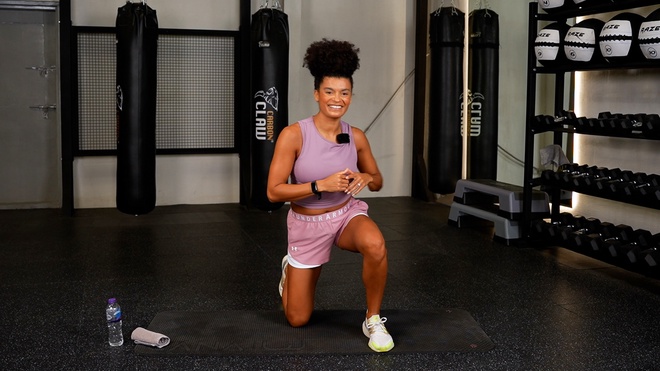
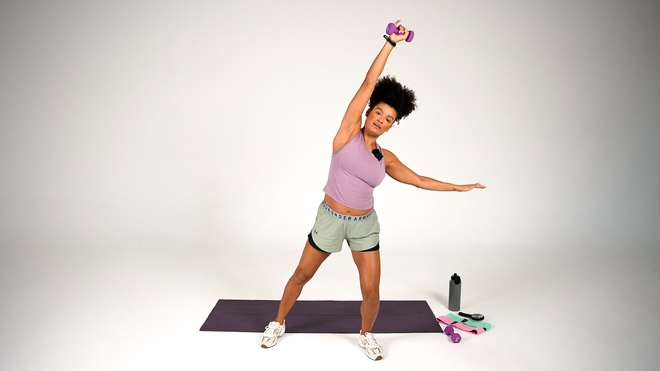
Browse Exercise Collections
Helpful For These Concerns
About the Trainer
Danielle Harrison
Full-Body Workouts Trainer
From: Boxing Full Body Burn