Mama Moves: Prenatal Pilates — Workout 1
Exercise Breakdown
16 exercises in Workout 1
Warm-up2 exercises1m 29s
“Squeeze the shoulder blades together, exhales to close.”
“Reach those arms all the way forward, round through the spine, hug your baby.”
Strength5 exercises6m 3s
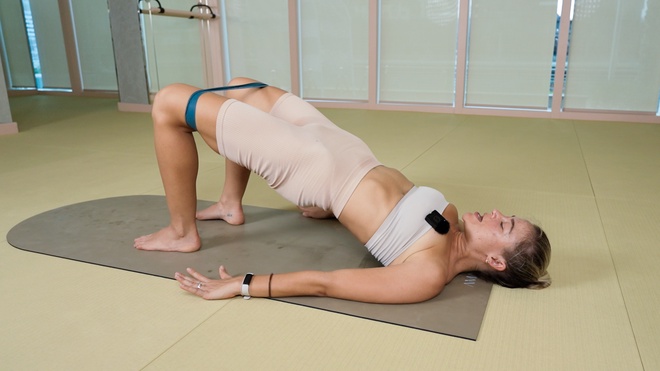
“Really push those hips out towards the side each time.”
“One pulse, cactus. One pulse, triceps.”
“Secondary focus into your core, squeezing through your leg.”
“Focusing into your left oblique as you exhale.”
“Keeping arms stick straight.”
Cardio1 exercise39s
“March on the toes. Heels high.”
Flexibility3 exercises4m 23s
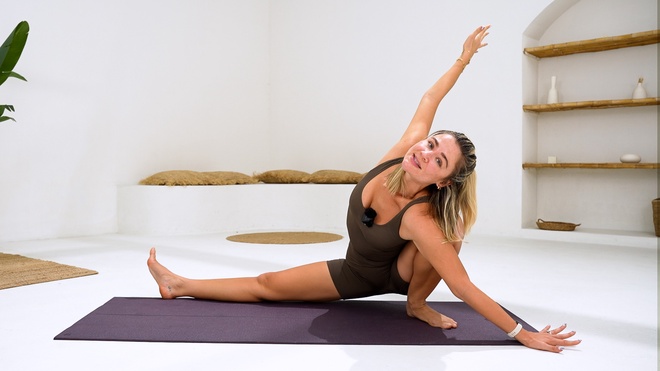
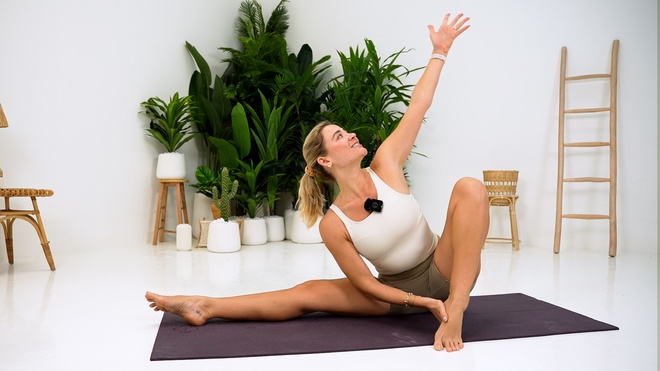
“Rotating or twisting through your thoracic spine.”
“Open up the hamstrings as you drop down towards your forward folds.”
“Sink your hips all the way back towards frog.”
Balance1 exercise49s
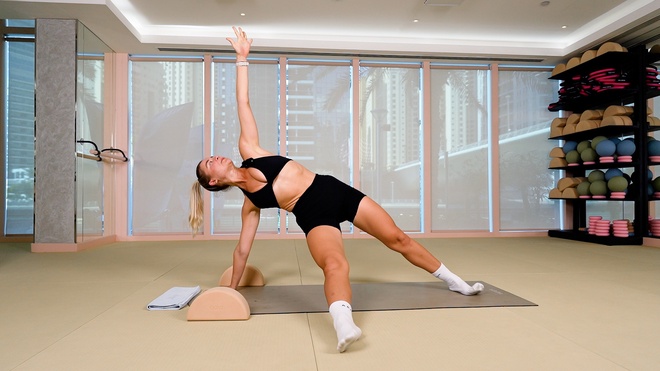
“Engage your abs.”
Cool-down1 exercise1m 13s
“Think about filling the lungs, the ribs, the belly, the abs.”
breathing1 exercise39s
“As you inhale, fill the lungs and the belly with air.”
yoga1 exercise39s
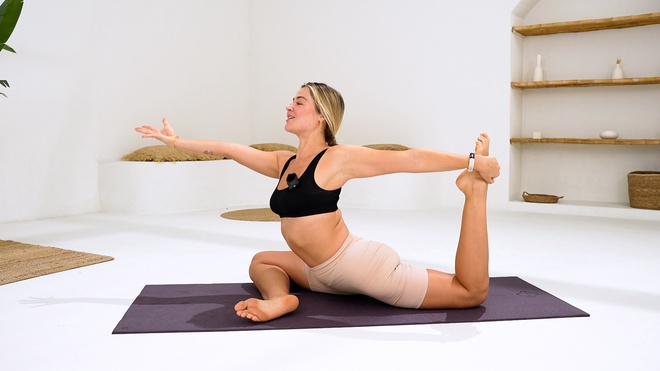
“Push the knees apart, continuing to drop the sacrum down.”
pilates1 exercise1m 24s
“Pull elbows towards knee, inhale, lengthen out.”
Muscles Targeted
Primary
Secondary
Equipment & Modifications
Equipment Needed
- mat
Don't Have Equipment?
You can substitute with:
Available Modifications
- add on arm weights or hand weights to make it more intense
- Raise your heels to march on the toes for more difficulty
- tap your nose or hold onto your earlobe to help with balance
- hold baby with one hand, opposite hand nice and tall
Coaching Highlights from Jessica Casalegno
“Reach those arms all the way forward, round through the spine, hug your baby — I tell every new client the same thing: if you can't feel the muscle working, slow down until you can. Speed is not the goal.”
Form
“This is one of your best breaths for labor. Some days you show up and everything clicks. Other days it's a fight from the first rep. Both count.”
Motivation
“A focused, experienced coach who balances challenge with accessibility, always offering modifications and form cues.”
Form
Health Benefits
Pregnant women in any trimester and new moms rebuilding from the inside out. Jessica Casalegno designed this 20-minute prenatal Pilates session for the specific demands of pregnancy and postpartum recovery: pelvic floor strength, deep core connection, hip mobility, and breath control. If you're dealing with diastasis recti, urinary leaking, or that disconnected feeling between your brain and your abs — this is where the rebuild starts. Safe, progressive, and evidence-based. Your body is doing extraordinary things. This workout supports that work.
pelvic floor weakness
90% relevantNeuromuscular re-education of pelvic floor muscles; Improved intra-abdominal pressure management; Enhanced body awareness and proprioception; Strengthening of synergistic core and hip muscles; Stress reduction to support pelvic floor function
maternal mortality risk
90% relevantpelvic floor integrity and function; cardiovascular health and endurance (low impact); stress reduction and parasympathetic activation; improved circulation and reduced edema; muscle strength and endurance for labor and postpartum recovery; body awareness and proprioception; postural support for pregnancy and childcare demands
urinary incontinence
90% relevantStrengthening pelvic floor muscles (Kegels, reverse Kegels); Improving core stability and intra-abdominal pressure management; Enhancing body awareness and neuromuscular control; Increasing muscle tone in supporting structures (glutes, adductors); Reducing impact on the pelvic floor
pregnancy trauma
90% relevantparasympathetic activation; pelvic floor rehabilitation; core stability; stress reduction; body awareness; trauma-informed movement; gentle strength building
postpartum rage
90% relevantparasympathetic nervous system activation; stress reduction; mind-body connection; pelvic floor rehabilitation; cortisol regulation; emotional regulation
Relevant For
Frequently Asked Questions
What does this prenatal Pilates workout target?
Pelvic floor, deep core, and core, hips, shoulders — the muscles that matter most during and after pregnancy. Jessica Casalegno focuses on controlled, breath-connected movements that strengthen without straining. EMG research by Chmielewska et al — shows Pilates activates the pelvic floor at levels comparable to targeted biofeedback training. That means these exercises are doing real pelvic floor work, not just going through the motions. This 20-minute session is designed to be safe at every trimester. This is one of the most effective postpartum abdominal exercises sessions in the program.
What equipment do I need for this workout?
You'll need: mat. Don't have these? thick towel, carpet work as substitutes — I've coached women through this with filled water bottles and it works. The resistance is what matters, not the brand. Jessica Casalegno shows form with standard equipment, but anything that adds load will do. Just make sure it's comfortable to grip — slippery objects and high-intensity moves don't mix. This pairs well with a core exercises for pregnant women approach. This pairs well with a pregnancy ab exercises approach.
Is this workout suitable for beginners?
Built for beginners. Jessica Casalegno demonstrates modifications throughout — options like: add on arm weights or hand weights to make it more intense; Raise your heels to march on the toes for more difficulty. The pace allows you to learn form before adding speed — I always tell new clients: your first month of any program is about neural patterning, not muscle exhaustion. Your brain needs to learn the movement before your body can load it. This workout respects that. This pairs well with a ab exercises during pregnancy approach.
How long is this workout?
Approximately 20 minutes, including warm-up and cool-down. Jessica Casalegno wastes zero time — 16 exercises, no standing around, no 3-minute rest periods. The ACSM recommends 150 minutes of moderate or 75 minutes of vigorous exercise per week. Two or three of these sessions gets you there. That's 40-60 minutes per week of actual exercise. The rest of your week is yours.
Are there modifications available?
For every exercise. Jessica Casalegno cues modifications as they come up: add on arm weights or hand weights to make it more intense; Raise your heels to march on the toes for more difficulty; tap your nose or hold onto your earlobe to help with balance — I'll say this once: using a modification is not failing. It's choosing the version that lets you maintain form for the entire set. A half-range pushup with a flat back beats a full-range pushup with a sagging spine every time. Pick the version where your technique stays clean.
Is Pilates safe during pregnancy?
Yes — and it's one of the most recommended forms of prenatal exercise. The 2019 Canadian Physical Activity Guidelines for Pregnancy specifically endorse Pilates and modified strength work. The key is modification as your pregnancy progresses: no lying flat on your back after the first trimester, no deep twisting, reduced range on hip flexion. Jessica Casalegno builds all of this into the programming. If you have a high-risk pregnancy or your doctor has restricted exercise, always get clearance first. Otherwise, moving is safer than not moving.
Will this help with pelvic floor strength?
That's one of its primary purposes. EMG research by Chmielewska et al — demonstrated Pilates activates the pelvic floor at levels comparable to dedicated biofeedback training. A 2020 RCT by Marques et al — found that combining pelvic floor exercises with hip strengthening — exactly what this prenatal Pilates does — is more effective than pelvic floor work alone. Your pelvic floor doesn't operate in isolation. It works with your deep core, your hip rotators, your diaphragm. This workout trains the whole system.
How often should I do prenatal exercise?
The Canadian guideline recommends at least 150 minutes of moderate physical activity per week during pregnancy. That's about three to four 40-minute sessions, or five to six shorter ones like this 20-minute workout. A meta-analysis on exercise during pregnancy found regular prenatal exercise reduces gestational diabetes risk, prevents excessive weight gain, and improves fetal outcomes — with no increased miscarriage risk. Daily gentle movement is ideal. Listen to your body, but don't underestimate what it can do.
Related Workouts & Topics
More from Mama Moves: Prenatal Pilates
More with Jessica Casalegno
Browse Exercise Collections
Helpful For These Concerns
About the Trainer
Jessica Casalegno
For Moms Trainer
From: Mama Moves: Prenatal Pilates