Bear Crawl: How-to, Benefits & Variations
The bear crawl targets core, shoulders, and quads. Start on all fours, lift knees one inch off floor, crawl using opposite hand and foot. Builds stability and coordination.
Bear Crawl: How-to, Benefits & Variations
Bear crawl shows up in every warm-up, every HIIT class, every bootcamp circuit. Trainers throw it in like filler. Nobody actually teaches it. I have watched this pattern repeat across 21 bear crawl occurrences in our video library, and here is what I noticed: the trainers who program it well spend more time on setup than movement.
Sophie Jones uses bear crawls in 16 separate segments across weight loss circuits, glow-up challenges, total body conditioning, and muscle tone sessions. Danielle Harrison programs them in low-impact HIIT and prenatal fitness. Linda Chambers puts them in a back health workout. That last one surprises people. A crawling exercise for back pain? It makes sense when you understand what the bear crawl actually demands: flat back, engaged core, shoulders stabilising against load, hips staying low. It is a moving plank that also builds coordination.
The bear crawl exercise targets core, shoulders, and quads simultaneously while forcing your opposite hand and opposite foot to coordinate. That contralateral patterning is something most gym exercises skip entirely. And the core demand is relentless because your knees never touch the ground.
Back Health: Workout 6
Linda Chambers
How to Do Bear Crawl
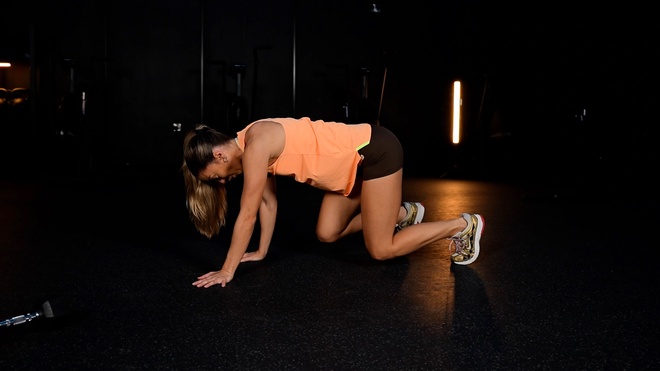
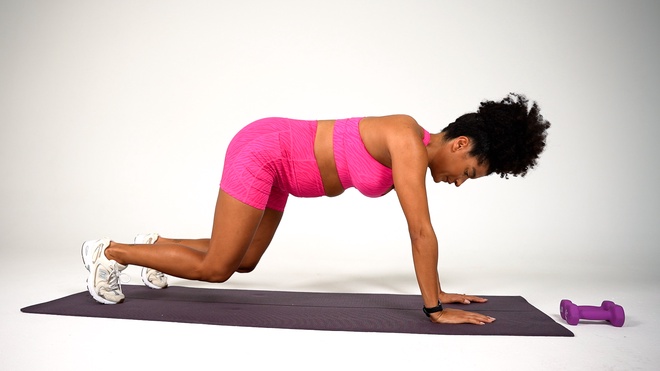
Start on all fours in a tabletop position. Hands directly underneath your shoulders, knees under your hips. Linda Chambers is specific about this: keep hands directly underneath shoulders for a stable base. Wrists stacked under shoulders, not out in front of them. If your hands drift forward, your shoulders take excessive load.
Lift your knees one inch off the floor. That is it. One inch. Sophie Jones repeats this in nearly every segment: my knee just has a small gap off the floor. Danielle Harrison echoes: lift up slightly. The instinct is to push your hips toward the ceiling like a downward dog. Resist it completely. Sophie: I don't wanna see any bums in the air.
Crawl forward using opposite hand and opposite foot simultaneously. Right hand and left foot move together, then left hand and right foot. Linda Chambers cues: opposite hand to opposite foot is going to move. Take small, compact steps. Sophie: nice, tight little steps, keeping the back nice and flat. Reaching too far breaks the flat-back position.
Reverse the crawl. Same pattern, moving backward. Sophie: couple of steps forward, couple of steps back. The reverse direction is harder because you cannot see where you are going and the coordination challenge increases. Most of our trainers program forward-and-back as a single set.
Maintain a flat back and low hips throughout the entire movement. Linda Chambers: the hips don't want to lift, we're trying to maintain the same bear plank. Sophie: bum down, engage the core. If your hips rise, your core stops working and your shoulders take the full load. If your hips sag, your lower back compresses. Flat. Low. Controlled.
Breathe steadily. The natural instinct is to hold your breath during bear crawl because the core demand is high. Fight it. Exhale as you step, inhale as you pause. Sophie: engage that core but keep breathing through it. Breath-holding spikes blood pressure and tanks your endurance within 10 seconds.
Muscles Worked
Primary
Core (rectus abdominis, transversus abdominis, obliques)
The core is working every single second your knees are off the ground. This is not a crunch. There is no rest phase. The bear crawl demands continuous anti-extension (preventing your lower back from sagging) and anti-rotation (preventing your torso from twisting as opposite limbs move). Sophie Jones says it best: you're really gonna get that nice, tight core engagement when you're close to the floor. The closer your knees hover to the mat, the harder your core works. A 2021 systematic review found closed-chain core exercises like the bear crawl activated the transversus abdominis more consistently than open-chain alternatives.
Shoulders (deltoids, serratus anterior, rotator cuff)
Your shoulders support roughly 50% of your body weight during the bear crawl while simultaneously stabilising against asymmetric loading as limbs move. The serratus anterior works overtime to keep your shoulder blades from winging. Linda Chambers teaches from a back health context, which is telling. Shoulder stability protects the spine. A systematic review of scapular stabilisation exercises found that closed-chain movements like crawling patterns improved shoulder function in women with dysfunction.
Quadriceps
Your quads hold a sustained isometric contraction to keep your knees hovering off the floor. The thigh-to-shin angle stays around 90 degrees for the entire set. That is a wall sit built into a crawling pattern. Sophie programs bear crawls into her muscle tone series and weight loss circuits precisely because the quad burn accumulates. Four rounds of bear crawls in Core Sweat 9 without the quads ever fully resting.
Secondary
Hip flexors
Each crawling step requires hip flexion to advance the leg forward. The iliopsoas fires every time you bring a knee toward your chest during the forward crawl. Not as dominant as in high knees, but present on every single step.
Triceps and chest
The upper body push muscles stabilise your arms against your body weight as you crawl. Similar demand to the top position of a push-up, sustained over the full duration of the set.
Glutes
The glutes extend the hip during the backward push phase of each step and stabilise the pelvis against the rotational forces of contralateral movement. They prevent your hips from dropping to one side as you shift weight.
Why this matters in perimenopause
The bear crawl hits a combination that matters specifically during perimenopause: core stability, shoulder resilience, and coordination. Core strength deteriorates with declining estrogen levels, contributing to lower back vulnerability. A systematic review of exercise in perimenopause found that multi-joint, closed-chain exercises produced superior functional outcomes compared to isolated movements. The bear crawl is about as multi-joint and closed-chain as it gets. Every limb is loaded. Every joint is stabilising. And the contralateral coordination (opposite hand, opposite foot) challenges the neuromuscular system in ways that protect against the balance and proprioception decline that accelerates during hormonal transition.
Coach's Tips
"Keep your hands directly underneath your shoulders for a stable base." Linda Chambers is precise about this. When your hands drift forward of your shoulders, you shift from a strong packed-shoulder position to an impinged one. The load moves from the deltoid and serratus anterior into the rotator cuff, which is not built for sustained weight-bearing. Hands under shoulders. Every time.
Linda Chambers
"Hover your knees just slightly off the floor; keep them as close to the mat as possible without touching." Sophie Jones says this in 12 separate bear crawl segments. The instinct is to lift the knees higher because it feels easier. It is easier because your core stops working at full capacity when your hips rise. Sophie: you're really gonna get that nice, tight core engagement when you're close to the floor. One inch. Not six.
Sophie Jones
"I don't wanna see any bums in the air. We come down, just a little space off the floor." Sophie repeats this correction more than any other cue during bear crawls. The pike-up is the most common error. It turns a total-body stability exercise into a quasi-downward-dog that your shoulders bear alone. Linda Chambers says it differently: the hips don't want to lift, we're trying to maintain the same bear plank. Same correction. Flat back, low hips.
Sophie Jones
"Move using opposite hand and opposite foot simultaneously to maintain balance." Linda Chambers teaches contralateral movement explicitly: opposite hand to opposite foot is going to move. This pattern is not intuitive. Many people default to same-side movement (right hand with right foot), which causes lateral sway and destabilises the torso. Opposite limbs create counter-rotation that keeps the spine neutral. If you are getting confused, slow down to one step at a time until the pattern clicks.
Linda Chambers
"This movement is suitable for prenatal exercise, but ensure you stop if you feel any abdominal coning." Danielle Harrison includes bear crawls in her Grow and Glow prenatal series with this specific caveat. The same applies postpartum and during perimenopause when pelvic floor and abdominal wall integrity matter. If you see a ridge forming down the midline of your abdomen during the crawl, drop your knees to the floor and rest. The exercise is pelvic-floor-friendly when done correctly, but not if you push through coning.
Danielle Harrison
"If you feel your form breaking, briefly drop your knees to the floor to reset." This is the universal bail-out that applies to everyone. Bear crawl form degrades before you feel fatigued. Your hips creep up. Your steps get sloppy. Sophie: not about speed, about control. The moment your back rounds or your bum lifts, drop the knees, reset the tabletop, re-engage your core, then lift again. Three clean reps are worth more than ten sloppy ones.
Sophie Jones
Why This Matters for You
Bear crawl targets three things that decline during perimenopause, and it targets all of them in one movement.
First: core stability. Estrogen decline reduces the support provided to connective tissue, including the structures around the lumbar spine. The result is increased vulnerability to lower back pain. Bear crawl trains continuous core engagement under load. Not crunches. Not sit-ups. Sustained anti-extension and anti-rotation that mimics the demands of real life. A systematic review of exercise in perimenopause found multi-joint exercises produced superior functional outcomes compared to isolated movements.
Second: shoulder resilience. Rotator cuff injuries increase in frequency during perimenopause as collagen quality in tendons declines with hormonal changes. Closed-chain shoulder loading (where your hands are fixed on the ground) is consistently shown to be safer for building shoulder stability than open-chain movements like overhead pressing. A systematic review found closed-chain scapular exercises improved shoulder function with lower injury risk.
Third: neuromuscular coordination. The contralateral stepping pattern (opposite hand, opposite foot) challenges proprioception and motor control. These systems decline with age and hormonal transition. A meta-analysis of balance training found coordination-based exercises reduced fall risk more effectively than single-plane balance work. The bear crawl is balance training that does not look like balance training.
One exercise. Three perimenopause-relevant systems. No equipment. Danielle Harrison includes it in prenatal fitness with appropriate modifications. Linda Chambers puts it in back health programming. The bear crawl belongs in perimenopause fitness for the same reasons.
Variations & Modifications
Bear Plank Hold (Static)
low-mediumHold the bear crawl start position without moving. Knees one inch off the floor, hands under shoulders, back flat. This is the foundation. If you cannot hold a static bear plank for 20 seconds with a flat back, you are not ready to crawl. Sophie programs this as the default entry point. The core demand is identical to a forearm plank but with added shoulder and quad engagement. Start with 3 sets of 15-second holds.
Bear Crawl Knee Lifts
mediumFrom the bear crawl position, alternate lifting one knee at a time toward the chest without crawling forward. Danielle Harrison programs this in her prenatal fitness series: we lift off the knees, one, two, three, four. Removes the coordination challenge of crawling while keeping the core anti-rotation demand. A stepping stone between the static hold and the full bear crawl. Appears in Grow and Glow Prenatal Fitness 3.
Bear Crawl Rounds (Progressive)
highMultiple rounds with increasing tempo or distance. Sophie Jones programs this in 14 Days Glow Up Challenge and Bringing Sexy Back: three rounds with the intensity building each time. Round 1 is controlled. Round 2 picks up pace. Round 3 is near-maximum effort with the shortest rest. Sophie: we're keeping that pace going now, building it up each time. The cumulative fatigue across rounds is where the real conditioning happens. Quads and shoulders burn progressively.
Lateral Bear Crawl
medium-highBear crawl moving sideways instead of forward and back. Same knee-hover position, but stepping hands and feet laterally. This adds an adductor/abductor challenge that the standard forward-back pattern misses entirely. The coordination demand is also higher because lateral movement with contralateral limbs is less intuitive. Excellent for hip stability and changing the training stimulus when standard bear crawls stop being challenging.
Slow Tempo Bear Crawl
highStandard bear crawl performed at half speed with 2-second pauses between each step. The modifications from our DB suggest: increase the distance of the crawl or slow down the tempo to increase time under tension for the quads and core. Slowing down removes momentum assistance and forces your muscles to hold position at the hardest part of each step. Two minutes of slow tempo bear crawl will fatigue muscle groups that fast crawling never touches.
Benefits
Total-body stability in one movement
The bear crawl exercise loads core, shoulders, and quads simultaneously while demanding coordination between all four limbs. No isolation. No rest phase for any muscle group. Linda Chambers programs it in her back health series because the movement pattern reinforces the same stability that protects the spine during daily activities: carrying groceries, lifting children, reaching overhead. A systematic review of core training found multi-joint exercises produced superior functional outcomes compared to isolated core work.
Contralateral coordination training
Opposite hand and opposite foot moving together. This cross-body patterning activates the neuromuscular connections between your brain and limbs in a way that single-plane exercises cannot. Coordination and proprioception decline during perimenopause. A meta-analysis of balance training in women found that exercises requiring cross-body coordination reduced fall risk more effectively than single-plane balance drills. The bear crawl is a coordination exercise that happens to also be a strength exercise.
Shoulder resilience under load
Your shoulders bear roughly half your body weight during bear crawl while moving through asymmetric loading. The serratus anterior and rotator cuff stabilise against shifting weight patterns with every step. This is closed-chain shoulder work, which research consistently shows is safer and more functional than overhead pressing for people with shoulder vulnerability. Your wrists get conditioned too, which matters for anyone who types all day.
Core anti-extension and anti-rotation combined
Most core exercises train one demand at a time. Planks train anti-extension. Pallof presses train anti-rotation. Bear crawl demands both simultaneously and continuously. The moment one limb leaves the ground, your core must prevent rotation. The entire time your knees hover, your core must prevent extension. Two stability challenges layered on top of each other with zero equipment.
Scalable from rehab to performance
Bear plank hold for someone rebuilding after injury. Standard crawl for general fitness. Progressive rounds with increasing tempo for conditioning. Our trainers program bear crawls in back pain rehabilitation (Linda Chambers), prenatal fitness (Danielle Harrison), weight loss circuits (Sophie Jones), and muscle tone challenges (Sophie Jones). That spread across difficulty levels and goals is rare for a single exercise.
Common Mistakes to Avoid
Hips rising into a pike position
Sophie Jones corrects this more than any other bear crawl error. She says it in at least 8 separate clips: I don't wanna see any bums in the air. Linda Chambers: the hips don't want to lift. When your hips rise, your core disengages and your shoulders take the full load. The fix is awareness: have someone watch you from the side, or set up a phone to record. Your hips should stay at the same height throughout the crawl. If they drift up, you are compensating for core fatigue. Drop the knees, reset, try again.
Taking steps that are too large
Sophie: small, tight, compact movements. Nice, tight little steps. Reaching with your hands or feet shifts your centre of gravity outside your base of support. That causes either a lateral weight shift (which your obliques cannot stabilise) or a forward lunge (which loads your wrists dangerously). Tiny steps. Think about moving one inch at a time. The exercise works because it is slow and controlled, not because you are covering ground.
Moving same-side hand and foot together
The bear crawl demands contralateral movement: right hand with left foot, then left hand with right foot. Many people default to ipsilateral (same side) because it feels natural. Same-side movement causes lateral sway and destabilises the spine. Linda Chambers cues this explicitly: opposite hand to opposite foot. If you cannot coordinate the pattern at speed, slow down to one step at a time and think: right hand, left foot, pause, switch.
Holding breath throughout the set
The bear crawl is demanding enough that your instinct is to brace and hold your breath. Sophie cues core engagement constantly: draw that tummy in, engage the core. But engagement is not the same as breath-holding. Breathe out as you step, breathe in as you settle. If you are holding your breath, your blood pressure spikes, your endurance crashes, and you will gas out in under 15 seconds. Keep breathing.
Workouts Featuring This Exercise

Frequently Asked Questions
Related Exercises
Bird Dog
Same contralateral patterning (opposite arm, opposite leg) with the same anti-rotation core demand. The difference: bird dog is performed from the knees, making it the natural regression before bear crawl. Master bird dog first, then progress to bear crawl.
Dead Bug
Anti-extension core exercise in the supine position. Bear crawl trains anti-extension prone. Together they cover both sides of the same stability demand. Dead bug is lower intensity and a good warm-up before bear crawl.
Plank
Static anti-extension hold that forms the foundation for bear crawl. If you cannot hold a plank for 30 seconds, you are not ready for bear crawl. If planks are too easy, bear crawl is the natural next step.
Mountain Climbers
Another quadruped crawling pattern that loads the core under movement. Mountain climbers are faster and more cardio-dominant. Bear crawl is slower and more stability-dominant. Different adaptations from a similar position.
Burpees
Full-body compound that includes a plank transition. If bear crawl builds your ground-based stability and coordination, burpees test it under explosive demand. Sophie Jones programs both in her conditioning circuits.
This exercise helps with
Get bear crawl in a guided workout
Access 10 workouts featuring this exercise, plus personalized plans from Dr. Wellls.
Your membership funds independent women's health research