Dumbbell Swings: Form, Benefits & Variations
Dumbbell swings: hinge at hips, swing dumbbell between legs, snap hips to drive weight to chest height. Targets glutes, hamstrings, core. Builds posterior chain power and cardio fitness.
Dumbbell Swings: Form, Benefits & Variations
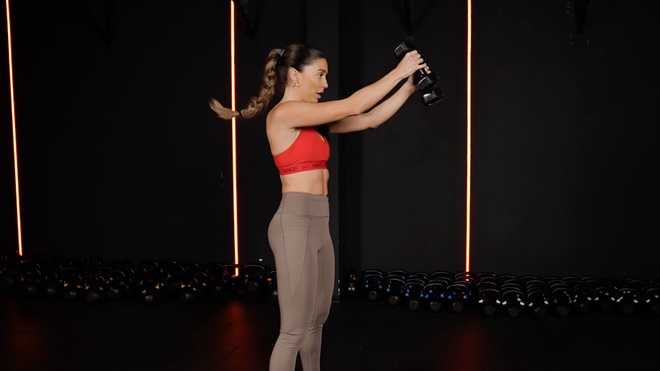
Pick up a dumbbell. Hold it with both hands. Swing it between your legs and snap your hips to drive it up to chest height.
That is the entire dumbbell swing exercise. Five seconds to explain. A lifetime to master.
I programme dumbbell swings into more workouts than almost any other posterior chain movement. Nineteen appearances across seven workouts in our library. Two certified trainers, Sophie Jones and Danielle Harrison, both build their sessions around it. Sophie uses it as a superset finisher in her 14-Day Glow Up Challenge, four rounds back to back. Danielle programmes it into Low Impact HIIT as a bridge between strength work and metabolic conditioning. The exercise shows up in weight loss circuits, full-body conditioning, and core sessions because it does not fit neatly into one category. It is strength and cardio and core work compressed into a single hip hinge.
The dumbbell swing is a kettlebell swing's more accessible sibling. Most women already own dumbbells. Most do not own a kettlebell. The mechanics are identical: hinge at the hips, load the hamstrings and glutes, then snap forward and let the weight float up on momentum your lower body generated. Your arms are along for the ride. A systematic review on kettlebell swing biomechanics confirmed that the hip hinge pattern produces peak glute and hamstring activation at the moment of hip extension, with minimal shoulder muscular effort. The dumbbell version replicates that pattern with equipment you already have in your living room.
Why this matters during perimenopause: posterior chain strength is the single biggest predictor of functional independence. Picking up a heavy bag. Standing up from a low chair without using your hands. Climbing stairs with groceries. Every one of these daily tasks is a hip hinge. When the glutes and hamstrings weaken, the lower back compensates, and that is when pain starts.
Low Impact HIIT 8
Danielle Harrison
How to Do Dumbbell Swings
Stand with your feet slightly wider than hip-width. Hold one dumbbell with both hands, arms hanging straight down in front of you. Sophie Jones: hold them dumbbells just out in front. Your grip should be firm but relaxed. The dumbbell is going to move fast, so make sure you have a secure hold without white-knuckling it.
Push your hips back and hinge forward, letting the dumbbell swing between your legs. Sophie: I'm coming back into a nice flat back position. I'm not going into a squat, I'm going into a hinge. Your knees bend slightly but your shins stay nearly vertical. The movement comes from the hips, not the knees. You should feel a deep stretch loading through your hamstrings as the dumbbell passes between your legs.
Snap your hips forward explosively to drive the dumbbell up. Sophie: drive behind, power through. Use the momentum. Danielle Harrison: squeeze those glutes as that dumbbell reaches chest height. The power comes entirely from your hips. Your arms stay relaxed and simply follow the momentum your lower body creates. Sophie: I'm not doing anything with my arms, they're just going with the movement.
At the top of the swing, stand tall. Squeeze your glutes and brace your core. Sophie: don't wanna squeeze the glutes and push forward, just squeeze the glutes, stand up straight. The dumbbell should float to roughly chest or eye height. Do not hyperextend your lower back. Sophie: I don't wanna overarch at the top. I wanna tuck in, and there, let it drop, squeeze.
Let the dumbbell fall naturally back into the hinge position. Sophie: control the weight on the way down, letting it fall naturally back into the hinge position. Exhale sharply as you snap your hips forward and inhale as the weight drops back. That sharp exhale engages your deep core and sets the rhythm for the next rep.
Muscles Worked
Primary
Gluteus maximus
The glutes are the engine of the dumbbell swing exercise. They fire maximally at the moment of hip extension, when you snap forward from the hinged position. A 2025 systematic review and meta-analysis on gluteus maximus hypertrophy confirmed that hip extension exercises with explosive force production are among the most effective protocols for glute development. Danielle Harrison's cue captures it: squeeze those glutes as that dumbbell reaches chest height. Sophie Jones echoes it across every session: really pinching my glutes together. The glutes do not gradually engage. They fire ballistically. That is what makes swings different from squats.
Hamstrings (biceps femoris, semimembranosus, semitendinosus)
The hamstrings load eccentrically during the hinge phase and assist the glutes concentrically during hip extension. Research on hip hinge biomechanics found that the hamstrings experience peak stretch loading at the bottom of the swing, making this a combined strengthening and lengthening stimulus. Sophie Jones cues it directly: find that nice stretch in the hamstrings. That stretch under load is what builds hamstring resilience for running, hiking, and carrying heavy objects.
Core (transversus abdominis, obliques, erector spinae)
The core braces isometrically throughout the entire swing cycle. It stabilises the spine during the rapid transition from flexion to extension. Sophie: butt tight, core tight, nice and strong. Danielle: squeeze the butt, squeeze the abs. The erector spinae maintains your flat back during the hinge. The transversus abdominis and obliques prevent rotational forces from pulling your torso off-centre. The sharp exhale at hip extension fires the deep core reflexively.
Secondary
Hip flexors and adductors
Control the width and depth of the hip hinge. The wider stance Sophie Jones uses for swings increases adductor involvement. The hip flexors decelerate hip extension at the top of the movement to prevent hyperextension.
Lower back (erector spinae, quadratus lumborum)
Maintain spinal neutrality under dynamic load. Sophie: I'm coming back into a nice flat back position. The lower back does not generate the swing force. It resists flexion and extension to keep the spine safe while the hips do the work.
Shoulders and forearms (grip)
The shoulders stabilise the arm position but do not lift the weight. Sophie: I'm not doing anything with my arms, they're just going with the movement. The forearms maintain grip on the dumbbell under centrifugal force. If your grip fails before your legs tire, the dumbbell is too heavy.
Why this matters in perimenopause
Dumbbell swings muscles worked include every major posterior chain muscle, which is where perimenopausal muscle loss hits hardest. A 2024 meta-analysis of resistance training in postmenopausal women found significant improvements in muscular strength, body composition, and functional performance. The ballistic nature of swings adds a power component that steady-state exercises miss. A 2023 study found that functional power training improved muscle power, functional fitness, and reduced pro-inflammatory cytokines in postmenopausal women. Power declines faster than strength during hormonal transitions, and swings train both simultaneously.
Coach's Tips
"I'm not going into a squat, I'm going into a hinge." Sophie Jones repeats this distinction in nearly every swing set she teaches. The squat drops your hips straight down. The hinge pushes them backward. If your knees are travelling forward over your toes, you are squatting the weight instead of swinging it. Push your backside toward the wall behind you. Your shins should stay almost vertical.
Sophie Jones
"I'm not doing anything with my arms, they're just going with the movement." Your arms are ropes attached to a cannonball. They do not pull, lift, or curl the dumbbell. Sophie Jones says it plainly: the power comes from the hips, the arms follow. If your shoulders are sore after dumbbell swings, you are muscling the weight up with your upper body instead of snapping your hips.
Sophie Jones
"Snap those hips. Butt tight, core tight, nice and strong." Sophie Jones cues the hip snap as the single most important moment in the swing. It is not a gradual stand-up. It is a sharp, explosive contraction of the glutes and hamstrings. Think about slamming a door with your hips. That speed and force is what drives the dumbbell up without arm effort.
Sophie Jones
"What I don't wanna see is an overarch. We're just coming up strong. Nice, neutral spine." Sophie Jones catches this mistake live in multiple sessions. Hyperextending your lower back at the top of the swing compresses the lumbar discs. Stand tall, tuck your pelvis slightly, squeeze your glutes. The movement ends when you are vertical, not when you are leaning backward.
Sophie Jones
"We're not driving the weight into the toes, we're just powering through." Sophie cues this in her Core Sweat finisher rounds. When fatigue sets in, your weight shifts forward onto the balls of your feet. That loads the knees instead of the hips. Keep your weight distributed through your whole foot, with a slight emphasis on the heels during the hinge phase.
Sophie Jones
"If you're not taking a weight, no problem. Just take it into a nice squat for me." Danielle Harrison offers this in her beginner sessions. If the hinge pattern feels unfamiliar, start with bodyweight hip hinges. Stand facing a wall about six inches away and push your hips back until your backside touches the wall. That is the hinge. Once you own that pattern, add the dumbbell.
Danielle Harrison
"If you've only got light dumbbells, press them both together." Danielle Harrison's clever workaround when your dumbbells are too light individually. Press two light dumbbells together flat-face-to-flat-face and hold them as a single unit. This doubles the load without buying new equipment. Sophie Jones also programmes double-dumbbell swings in her intermediate Total Body Conditioning sessions.
Danielle Harrison
"Exhale sharply as you snap your hips forward to engage your deep core." The breathing pattern is not optional. The sharp exhale at hip extension creates intra-abdominal pressure that stabilises your spine under load. Inhale on the way down as the dumbbell swings back. One breath per swing. If you are holding your breath, the weight is too heavy or the pace is too fast.
Sophie Jones
Why This Matters for You
The posterior chain is where perimenopause hits hardest. Glutes, hamstrings, lower back. These are the muscles that keep you upright, keep you moving, keep your spine stable when you carry heavy things. And they are the muscles that lose power fastest when hormones shift.
A 2024 systematic review and meta-analysis of resistance training in postmenopausal women found significant improvements in muscular strength, body composition, and bone mineral density. But here is the part most fitness content misses: it is not just strength that declines. Power, the ability to produce force quickly, drops even faster. A 2023 study on functional power training in postmenopausal women found that explosive exercises improved muscle power, functional fitness, and reduced pro-inflammatory cytokines. Dumbbell swings are explosive by nature. Every rep is a power production event. You cannot swing a dumbbell slowly and do it correctly.
Bone density matters too. A 2025 meta-analysis identified optimal resistance training parameters for improving bone mineral density in postmenopausal women, with load-bearing hip-dominant exercises ranking among the most effective protocols. The dumbbell swing loads the hip joint through a full range of motion under significant force. The femoral neck and lumbar spine, the two sites most vulnerable to osteoporotic fracture, are both loaded during every rep.
Then there is the metabolic component. Dumbbell swing benefits extend beyond muscle and bone. Research on EPOC (excess post-exercise oxygen consumption) shows that high-intensity resistance exercise elevates metabolism for hours after the session ends. Swings packed into the finisher of a workout, the way Sophie Jones programmes them in Core Sweat, create a metabolic afterburn that steady-state cardio cannot match.
Variations & Modifications
Bodyweight Hip Hinge
lowDanielle Harrison offers this as the entry point: no weight, just the hinge pattern. Clasp your hands in front of your chest and practise the hip-back, snap-forward movement until the pattern is automatic. This is where everyone should start. The hinge is a skill. Loading a skill you have not learned is how backs get hurt.
Double Dumbbell Swings
highSophie Jones programmes this in Total Body Conditioning 10, using both dumbbells simultaneously. The load doubles but the pattern is identical. Sophie: grab both of your weights for your swings now. The doubled load makes the eccentric hinge phase significantly harder on the hamstrings and demands more grip endurance. Reserve this for when single-dumbbell swings feel easy for 15+ reps.
Skier Swings
mediumSophie Jones uses this variation in Total Body Conditioning 3. Hold one dumbbell in each hand at your sides instead of both hands on one weight. Swing both arms back behind you (like a downhill skier pushing off poles) and snap forward. The load distribution changes the demand on the shoulders and forces each arm to track independently. Good for identifying left-right strength imbalances.
Superset Swing Ladders
highSophie Jones builds dumbbell swings into four-round superset ladders in her 14-Day Glow Up Challenge. Each round pairs swings with a different exercise, maintaining the swing volume while fatiguing different muscle groups between sets. By round four, grip and hamstring endurance are the limiting factors. This is metabolic conditioning disguised as strength work.
Benefits
Posterior chain power in a single movement
Dumbbell swings load the glutes, hamstrings, and core simultaneously through an explosive hip hinge. A systematic review on kettlebell swing biomechanics confirmed that the hip hinge pattern produces peak glute and hamstring activation at hip extension. The dumbbell swing exercise replicates this with equipment most people already own. One movement trains the entire back side of your body, the muscles responsible for posture, lifting, and lower back protection.
Cardio without the treadmill
Dumbbell swing benefits include a significant cardiovascular training effect. The ballistic nature of the hip snap drives heart rate up rapidly. A systematic review of metabolic resistance training found it comparable to traditional cardio for cardiovascular improvements, with the added benefit of muscle preservation. Sophie Jones programmes swings as finishers in her Core Sweat workouts specifically for this metabolic effect. Ten swings, rest, repeat. Your heart rate will tell you this is not just strength work.
Trains the hinge you use every day
Every time you bend forward to pick something up, you perform a hip hinge. Research on hip hinge biomechanics describes it as a foundational movement pattern that protects the lumbar spine during forward bending tasks. Dumbbell swings train this pattern under load and speed, building the reflexive hip-dominant movement that prevents you from rounding your lower back when you grab a heavy suitcase or lift a child off the floor.
Common Mistakes to Avoid
Squatting instead of hinging
Sophie Jones: I'm not going into a squat, I'm going into a hinge. The distinction matters. In a squat, your knees bend deeply and track forward. In a hinge, your hips push backward while your knees stay relatively still. Your shins should be nearly vertical throughout the dumbbell swing exercise. If your quads are burning, you are squatting the weight.
Lifting with the arms and shoulders
Sophie: I'm not doing anything with my arms. If your front deltoids are sore the next day, you were muscling the dumbbell up instead of letting hip drive do the work. Let your arms hang like ropes. The dumbbell floats up because your hips snapped forward, not because you pulled it.
Hyperextending at the top
Sophie: I don't wanna overarch at the top. I wanna tuck in. Leaning backward at the top of the swing compresses the lumbar spine. Stand straight, squeeze your glutes, tuck your pelvis slightly. The swing ends at vertical. Not past it.
Weight shifting to the toes
Sophie: we're not driving the weight into the toes. When fatigue builds, you start rocking forward. This transfers load from the hips and hamstrings to the knees and quads. Keep your weight mid-foot to heels, especially during the hinge phase. If your toes are gripping the floor, reset your weight distribution.
Workouts Featuring This Exercise
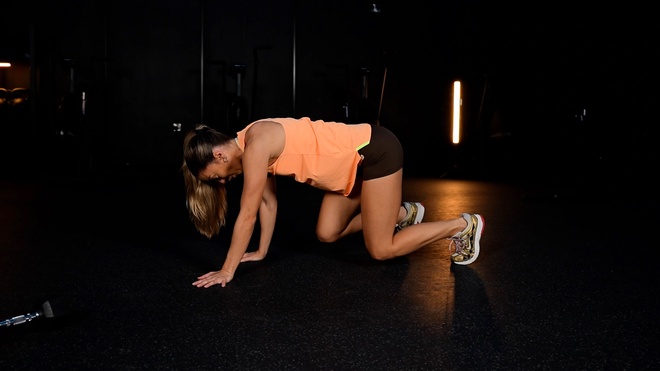
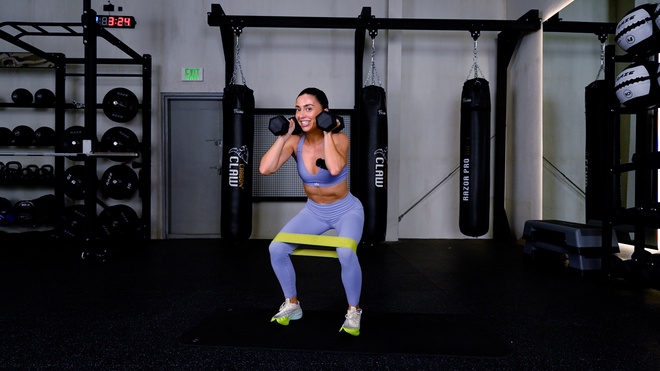
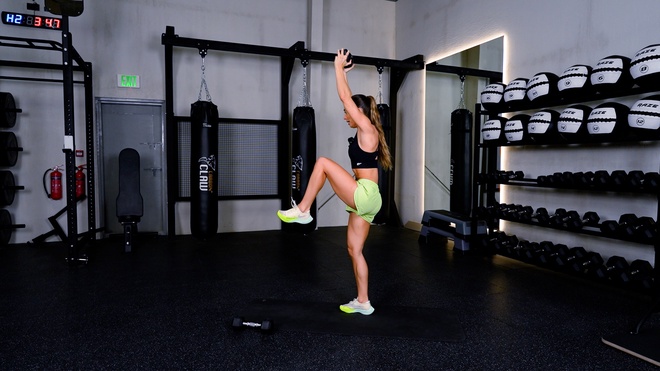
Join women building posterior chain power with 2 certified trainers across 7 workouts
Frequently Asked Questions
Related Exercises
Romanian Deadlift
The Romanian deadlift is a slow, controlled hip hinge. The dumbbell swing is a fast, explosive one. Together they train the same muscles at opposite ends of the speed spectrum. Programme deadlifts for strength, swings for power.
Glute Bridge
Glute bridges isolate hip extension in a supine position. Dumbbell swings load hip extension standing with momentum. If swings aggravate your back, bridges are the regression that keeps your glutes working.
Goblet Squat
Swings train the hinge. Goblet squats train the squat. Both use a single dumbbell. Pair them in a circuit for complete lower body coverage.
Good Morning
Good mornings are the slow, strict version of the hip hinge that swings make explosive. Use good mornings to build hinge technique, then graduate to swings for power.
Bulgarian Split Squat
Swings train bilateral hip power. Bulgarian split squats train unilateral leg strength. Combining both addresses symmetry and power in the lower body.
This exercise helps with
Get dumbbell swings in a guided workout
Access 7 workouts featuring this exercise, plus personalized plans from Dr. Wellls.
Join women building posterior chain power with 2 certified trainers across 7 workouts
Your membership funds independent women's health research