High Knees: How-to, Benefits & Variations
High knees: drive knees to hip height alternating legs, pump arms, land softly on toes. Works hip flexors, core, quads, calves. Cardio conditioning with zero equipment. Keep chest tall.
High Knees: How-to, Benefits & Variations
High knees look like running in place. They are not. Running is horizontal momentum with gravity doing half the work. High knees are vertical hip flexion against gravity with zero forward movement. The metabolic demand is completely different.
I have pulled the data on this one. Forty-two occurrences across 24 workouts in our library. Four certified trainers. Danielle Harrison uses them in boxing and low-impact HIIT. Sophie Jones puts them into weight loss circuits and total-body conditioning. Aylar Fetrati programs them as warm-up drills and combo intervals in advanced HIIT. The high knees exercise appears in beginner sessions and advanced sessions. In prenatal fitness and in boxing finishers.
That spread tells you something. High knees scale. They spike heart rate in under 30 seconds, they demand serious hip flexor work, they load your skeleton through impact, and they require exactly zero equipment. The only thing that changes between a beginner and an advanced version is speed.
Energize Your Day: Workout 5
Mish Naidoo
How to Do High Knees
Stand tall with your feet hip-width apart, arms relaxed at your sides. Sophie Jones starts every set the same way: bring them knees up towards the chest, nice and light on the toes. Weight forward on the balls of your feet. Not back in your heels.
Drive one knee up toward your chest, aiming for hip height or slightly above. Mish Naidoo cues: squeezing the core in, lifting it all the way. The knee should reach at least the level of your hip joint. Below that, you are marching, not doing high knees.
As one knee comes up, pump the opposite arm forward at chest height. Sophie: driving that knee up, nice strong arms on this. The arm drive is not decorative. It generates counter-rotation that keeps your torso stable and adds to the metabolic cost. Aylar Fetrati takes it further: lean back a little to allow for maximum knee height and core engagement.
Land softly on the ball of your foot and immediately drive the other knee up. Stay light. Sophie says it in almost every segment: nice and light on the toes. Landing heavy sends impact through your knees instead of letting your calves absorb it.
Maintain an upright chest throughout. Sophie: make sure you're not bending over. Get your chest upright, nice and tall. The moment you fold forward at the waist, your hip flexors lose their mechanical advantage and your lower back starts compensating. Danielle Harrison echoes: showing you side on with how high I've got that knee. Side view keeps you honest.
Breathe rhythmically. Coordinate your breathing with the tempo of your steps to manage your heart rate. Holding your breath during high knees causes blood pressure spikes and tanks your endurance within 15 seconds. Sophie: control that breathing, engage that core.
Muscles Worked
Primary
Hip flexors (iliopsoas, rectus femoris)
Your hip flexors do the actual work that makes high knees different from running. Every rep demands active hip flexion against gravity, pulling your thigh past 90 degrees. The iliopsoas is the deepest hip flexor and the primary mover. The rectus femoris (the only quad muscle that crosses the hip joint) assists. Over a 30-second set at moderate pace, that is 25-30 reps of loaded hip flexion per side. Most people sit all day with shortened, weak hip flexors. High knees force them to actually contract through full range.
Core (rectus abdominis, transversus abdominis, obliques)
Every trainer in our database cues core engagement during high knees. Sophie: engage that core, glutes tight. Mish Naidoo: squeezing the core in. The core stabilizes your torso against the rotational force created by alternating limb movement. Without core braking, your trunk would twist wildly with every knee drive. The faster you go, the harder your core works to prevent that rotation.
Quadriceps
The quads power both the upward knee drive (rectus femoris component) and the landing deceleration. They fire concentrically on the way up and eccentrically on each landing. This dual-action loading makes high knees a surprisingly effective quad conditioner, which is why Sophie programs them in her weight loss and total-body circuits.
Cardiovascular system
High knees are fundamentally a cardio exercise disguised as a leg drill. The simultaneous demand on hip flexors, core, calves, and arms creates a metabolic cost that drives heart rate into training zone 3-4 within 20-30 seconds. A 2023 meta-analysis found HIIT improved body composition in both pre- and postmenopausal women. High knees deliver that high-intensity stimulus with zero equipment and zero space requirement.
Secondary
Gastrocnemius and soleus (calves)
Your calves absorb every landing and provide the upward spring for each step. Staying on the balls of your feet (the universal cue across all four trainers) makes the calves the primary shock absorbers. This is also why high knees qualify as a weight-bearing impact exercise for bone health.
Shoulders and arms
The arm pump is not optional. Sophie: driving with those arms, nice strong arms on this. Active arm drive increases metabolic demand and stabilizes the torso through counter-rotation. Danielle Harrison adds dumbbells overhead in some variations, turning the arm component into real shoulder work.
Why this matters in perimenopause
High knees target two systems that decline during perimenopause. First, hip flexor strength. The iliopsoas weakens with prolonged sitting and hormonal shifts, contributing to anterior pelvic tilt and lower back pain. Active hip flexion against gravity directly addresses this. Second, cardiovascular fitness. As estrogen loses its cardioprotective effect, maintaining cardiovascular conditioning becomes critical. A 2023 systematic review found aerobic exercise improved both cardiovascular and mental health in postmenopausal women. High knees deliver cardiovascular intensity without leaving your living room.
Coach's Tips
"Drive your knees up toward your chest, aiming for hip height or slightly above." This is the defining cue. Danielle Harrison demonstrates it side-on: I want the knee ideally above the hips. Below hip height, you are marching. Above it, you are doing actual high knees. The difference in hip flexor activation is substantial. If you cannot reach hip height, slow down until you can. Speed means nothing if range is compromised.
Danielle Harrison
"Keep your chest upright and tall; avoid leaning forward or folding at the waist." Sophie says it in nearly every segment: we're not folding over, bring them up, nice and upright. The forward-fold error is the most common thing I see in these clips. When you hinge forward, your hip flexors lose their pulling angle and your lower back picks up the slack. If your chest drops, your knees cannot get high enough. They are linked.
Sophie Jones
"Lean back slightly to allow for maximum knee height and core engagement." Aylar Fetrati teaches a subtle posterior lean that most trainers do not mention. Leaning back a few degrees shifts your centre of gravity and creates more space for the knee to travel upward. It also dramatically increases the demand on your rectus abdominis. You will feel this in your abs within 10 seconds. You're going to lean back and bring your knees as high as possible, she cues.
Aylar Fetrati
"Pump your arms in opposition to your legs to drive more power and intensity." Sophie: driving that knee up towards my chest, nice strong arms. Danielle: high-knee march, opposite arm to leg. The contralateral arm swing generates counter-rotation that stabilizes your spine. It is also a significant calorie multiplier. Passive arms during high knees reduce the metabolic cost by roughly 15-20%.
Multiple trainers
"Stay light on your toes and land softly to protect your joints." I counted. Sophie says some version of light on the toes in 12 separate high-knees segments. It is clearly the correction she makes most often. Heel striking during high knees sends shockwaves through your knee and hip joints instead of letting your calf muscles absorb the impact naturally. If you can hear your feet, you are landing too hard.
Sophie Jones
"Knees are up. We're not doing any jumping, no crazy, forceful movements." Danielle Harrison uses this cue specifically in her low-impact sessions. High knees do not have to be explosive. The march version removes all impact while preserving the hip flexor work. Danielle: no problem, just step it. Intensity can come from knee height and arm speed without any jumping at all.
Danielle Harrison
"If this is too hard, and it's hard on your hips, you can just do marches." Aylar Fetrati offers this at every difficulty level. The high-knee march is the universal modification: same movement pattern, same hip flexor engagement, zero impact. Sophie echoes it: if it's easier to put your hands out in front, do that, driving the knees forward up towards the chest. Holding your hands at hip height gives you a target and a reality check on your range of motion.
Aylar Fetrati
"You can either do butt kicks, flicking the feet behind, or we can drive them knees forward, high knees." Sophie gives her participants a choice at the start. This is smart programming. Butt kicks are a hamstring-dominant alternative that removes the hip flexor demand. If hip flexors are fatigued or tight, butt kicks keep the cardio going while switching the load to different muscles entirely.
Sophie Jones
Why This Matters for You
High knees address two things that decline during perimenopause in ways most people do not connect to this exercise: hip flexor function and cardiovascular resilience.
Hip flexors weaken from prolonged sitting and hormonal shifts. The iliopsoas shortens. Anterior pelvic tilt sets in. Lower back pain follows. Most people try to stretch their way out of this. Stretching a weak muscle does not make it stronger. You need to strengthen through full range. High knees do exactly that, 25-30 reps of loaded hip flexion per side in a 30-second set.
Then there is the cardiovascular piece. Estrogen has a cardioprotective effect. When it declines, cardiovascular risk increases. A 2023 systematic review found aerobic exercise improved both cardiovascular and mental health in postmenopausal women. High knees push your heart rate into training zone 3-4 within 20-30 seconds. That is a cardiovascular stimulus you cannot get from walking.
A 2023 meta-analysis found HIIT improved body composition in women before and after menopause. High knees are one of the simplest HIIT tools available. No treadmill. No bike. No gym. Just drive your knees up and keep going.
And the impact loading is worth noting too. Each landing generates ground reaction force through the lower body and axial skeleton. A 2023 systematic review found high-impact exercises produced the strongest bone mineral density improvements in postmenopausal women. High knees are lower impact than box jumps but meaningfully more than walking. For women building up to higher-intensity plyometrics, this is the bridge exercise.
Two systems. Three benefits. Zero equipment.
Variations & Modifications
High Knee March (Low-Impact)
lowMarching in place lifting knees to hip height without any jump. Danielle Harrison programs this in her low-impact HIIT series: get the knees up nice and high, just step it. Same hip flexor engagement, same core demand, zero ground reaction force. The default modification for anyone with joint sensitivity or pelvic floor concerns. We program the march in 3 workouts.
High Knees with Twist
low-mediumHigh-knee march with torso rotation, reaching the opposite elbow toward the rising knee. Danielle Harrison cues: reach across, twist, wake up that back for me. This adds spinal rotation and oblique engagement on top of the hip flexor work. It is functionally a core exercise disguised as a warm-up. Ideal for anyone who sits at a desk all day with a stiff thoracic spine.
High Knee Hop
highStandard high knees performed with an explosive vertical hop on each step. Sophie Jones programs this in her Athlete Mode workouts: driving that knee up, find that nice little rhythm, like hop, hop, hop. The hop adds an airborne phase that increases ground reaction forces on landing and demands more from the calves and quads. Sophie programs 3 rounds with progressive intensity. By round 3: I want power. Don't make it floppy now.
High Knees to Mountain Climbers
highA combination interval starting with standing high knees and transitioning into mountain climbers on the floor. Aylar Fetrati programs this in her advanced HIIT sessions: we're gonna get down in a push-up position, just gonna go mountain climbers. The vertical-to-horizontal transition challenges coordination and spikes heart rate even higher than either exercise alone. Two rounds with progressive fatigue.
High Knees with Overhead Hold
mediumMarching high knees while holding dumbbells pressed together overhead. Danielle Harrison programs this in prenatal fitness: aiming to get the knees slightly above hip level while pressing weights overhead. The overhead hold fatigues the deltoids and challenges core stability in a new plane. Danielle later corrects: actually, just keep them directly above your shoulders, pressing together could feel uncomfortable. Start with light weights.
Lateral High Knees with Punch
highLateral movement with high knees followed by an upward punch. Danielle Harrison programs this in her boxing HIIT: knee, knee, drop, then you're gonna drive and punch up to the ceiling. Adds a lateral component that standard high knees miss entirely. The adductors and abductors work to decelerate lateral momentum while the hip flexors drive the knees up. Two rounds in the workout. A coordination challenge on top of a cardio challenge.
Benefits
Hip flexor strength against gravity
This is the high knees benefit that separates it from every other bodyweight cardio exercise. Each rep demands active hip flexion past 90 degrees against the full weight of your leg. No other standing cardio exercise loads the iliopsoas this directly. If you sit for 6-8 hours a day, your hip flexors are shortened and weak. High knees are the antidote: they force the muscle through full range under load, rep after rep.
Cardiovascular conditioning without equipment
Heart rate hits training zone 3-4 within 20-30 seconds of continuous high knees. A 2023 meta-analysis found HIIT improved body composition in women before and after menopause. High knees deliver that high-intensity cardiovascular stimulus in a 2-by-2 foot space with nothing but your body. Our trainers program them in 24 workouts precisely because they are the fastest way to spike heart rate between strength sets.
Weight-bearing impact for bone density
Every high-knee rep generates ground reaction force through your calves, knees, hips, and spine on landing. A 2023 systematic review found high-impact exercises produced the strongest improvements in bone mineral density in postmenopausal women. The impact from high knees is less than box jumps but more than walking. For women who are not ready for plyometrics but need more bone-loading stimulus than low-impact cardio provides, high knees sit in a productive middle ground.
Core anti-rotation under speed
Alternating limb movement at high speed creates rotational forces that your core must resist continuously. This is anti-rotation training under metabolic stress, which is harder than doing a static plank. Sophie cues it: engage that core, glutes tight, keeping that core engaged. The faster you go, the harder your core works. Your abs and obliques are under constant tension for the entire set.
Scalable from rehabilitation to advanced conditioning
High-knee march for post-injury return. Standard high knees for general fitness. High knee hops for power. Lateral high knees with punches for boxing conditioning. High knees to mountain climbers for metabolic overload. Our trainers program 9 different variations. That range, from gentle marching to explosive plyometrics, makes the high knees exercise one of the most versatile cardio drills in our library.
Common Mistakes to Avoid
Folding forward at the waist
Sophie and Aylar both correct this constantly. Sophie: make sure you're not bending over, get your chest upright, nice and tall. When you hinge forward, your hip flexors lose their mechanical advantage because the angle shortens. Your knees cannot physically reach hip height if your chest is pointing at the floor. Stand tall. The cue that works: imagine a string pulling the crown of your head toward the ceiling.
Knees only reaching thigh level (not hip height)
Danielle Harrison: I want the knee ideally above the hips. Below hip height, you are doing a jog in place, which is a different exercise with different muscle recruitment. If you cannot reach hip height at speed, slow down. Aylar: if it's really hard for you to pick your hips up, you can just do one movement at a time. Slow, full-range reps build more hip flexor strength than fast, shallow ones.
Landing heavy on the heels
Sophie says it in 12 separate segments: nice and light on the toes. Heel striking during high knees sends impact through the knee joint and hip socket instead of letting your calves absorb it. The calves are designed to decelerate landing forces. Your heel cartilage is not. Stay on the balls of your feet. If you can hear your feet hitting the floor, something is wrong.
Arms hanging limp at the sides
Sophie: driving with those arms, nice strong arms on this. Danielle: opposite arm to leg. Dropping the arm drive reduces the metabolic demand of the exercise and removes the counter-rotation that stabilizes your trunk. Active, powerful arm pumping can increase calorie burn by 15-20% compared to passive arms. Pump from the shoulder, not the elbow.
Workouts Featuring This Exercise
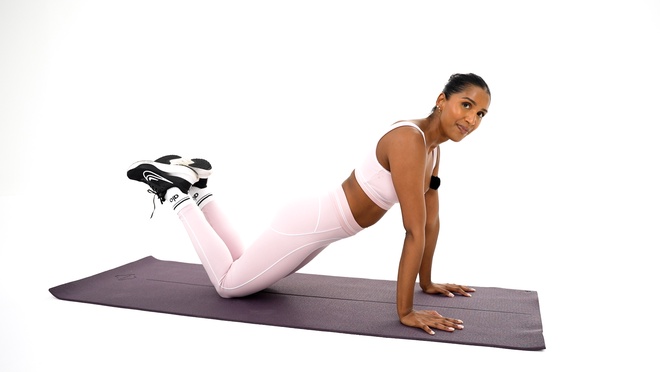
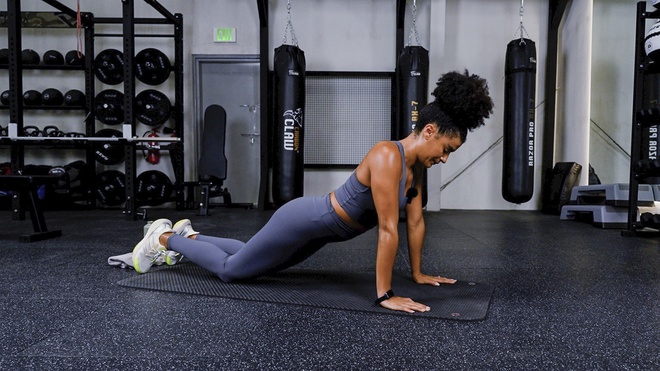
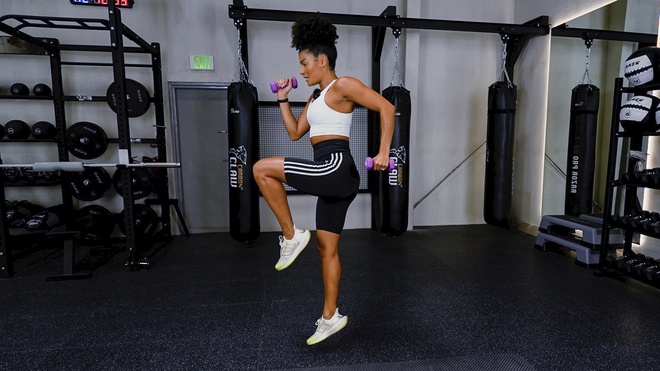
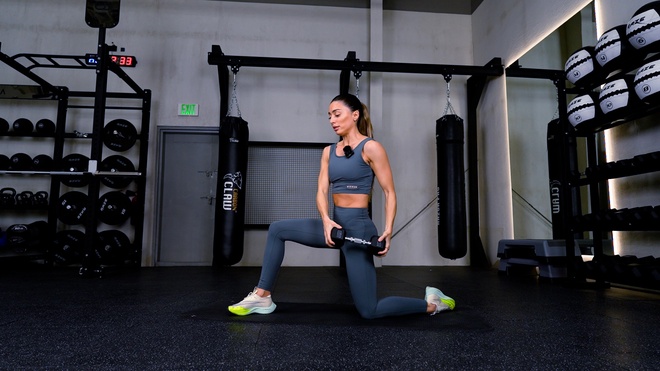
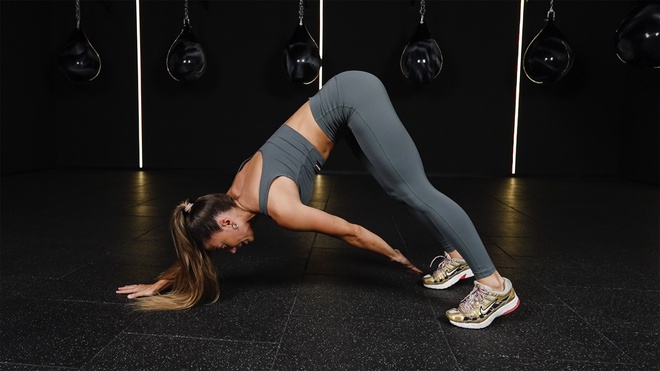
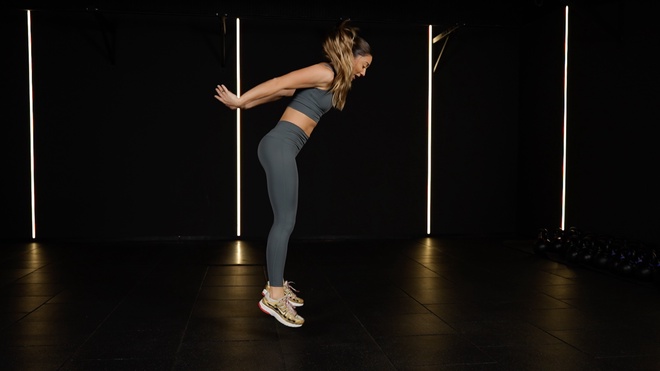
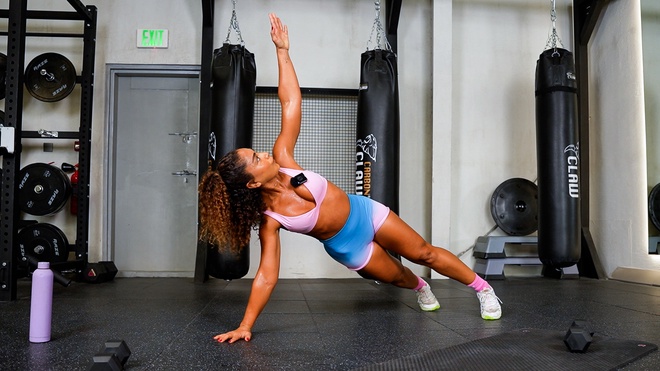
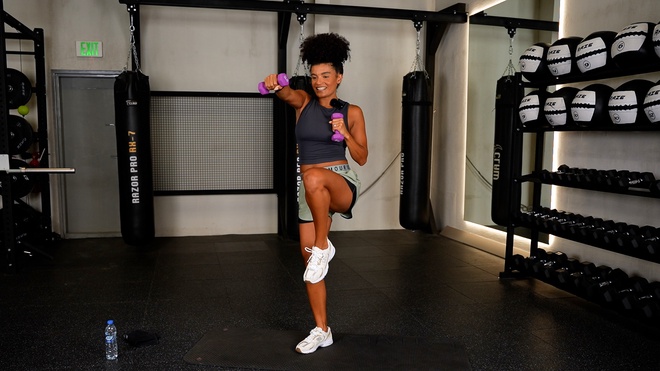
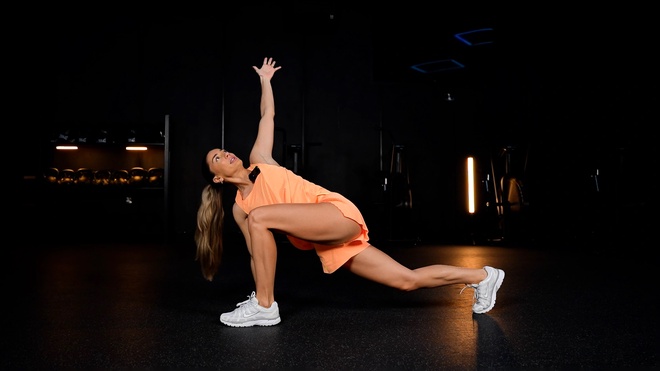
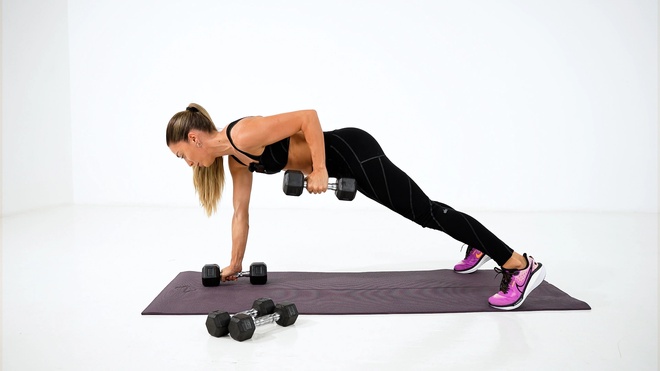
Join women building cardio fitness and hip flexor strength with 4 certified trainers across 24 workouts
Frequently Asked Questions
Related Exercises
Jumping Jacks
The other zero-equipment full-body cardio staple. Jumping jacks emphasize shoulder abduction and lateral leg movement. High knees emphasize vertical hip flexion. Pair them in alternating intervals for complete coverage.
Mountain Climbers
Horizontal hip flexion drill. Same muscles, different plane. Aylar Fetrati literally programs high knees to mountain climbers as a combo exercise. Going from standing to plank changes the loading angle entirely.
Burpees
Full-body plyometric progression that combines the vertical element of high knees with the horizontal push-up component. Higher metabolic cost, higher coordination demand.
Butt Kicks
Sophie offers butt kicks as a direct swap for high knees when hip flexors are fatigued. Same cardio pattern, different muscle emphasis. Butt kicks target hamstrings instead of hip flexors.
Jump Squats
Lower body plyometric with higher ground reaction forces than high knees. A natural progression for bone-loading intensity once high knees feel comfortable.
This exercise helps with
Get high knees in a guided workout
Access 10 workouts featuring this exercise, plus personalized plans from Dr. Wellls.
Join women building cardio fitness and hip flexor strength with 4 certified trainers across 24 workouts
Your membership funds independent women's health research