Knees To Chest: How-to, Benefits & Variations
Knees to chest: lie on your back, pull both knees toward your chest, wrap arms around shins, hold 20-30 seconds. Stretches lower back, glutes, hips. Relieves lumbar compression and sciatica.
Knees To Chest: How-to, Benefits & Variations
Every body already knows this stretch. You have done it without thinking about it. Waking up with a stiff back, rolling onto your side, pulling your knees toward your chest before you even open your eyes. That instinct is not random. Your nervous system defaults to this position because it decompresses the lumbar spine faster than anything else you can do lying down.
Thirty-four occurrences across our workout library. Nine certified trainers. Petra Kapiciakova programs the knees to chest stretch in Yoga for Back Relief and Yoga Before Bedtime. Mish Naidoo uses it in Daily Stretching and Morning Yoga Flow. Danielle Harrison slots it into Low Impact HIIT cooldowns. Sophie Jones finishes Athlete Mode sessions with it. Jessica Casalegno includes it in Yogalates. The exercise shows up in yoga, Pilates, HIIT, stretching, and strength cooldowns because lumbar compression does not care what style of workout created it.
The knees to chest exercise goes by other names: Apanasana in yoga, supine knee hug, reclined knees to chest. Nineteen variants in our library. All of them serve the same purpose: creating space between the vertebrae of your lower back so the discs, the nerves, and the muscles surrounding them can breathe.
Yoga for Back Relief: Session 1
Petra Kapiciakova
How to Do Knees To Chest
Lie flat on your back on a mat or any comfortable surface. Let your legs extend long. Take one full breath here. Feel the contact between your lower back and the floor. If there is a gap (and for most people, there is), this stretch is about to close it.
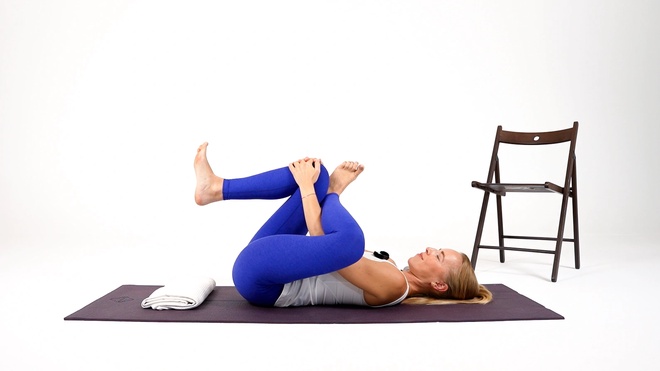
Bend both knees and draw them toward your chest. Wrap your arms around your shins, just below the kneecaps. Petra Kapiciakova cues it simply: lie flat on your back and draw your knees into your chest, giving them a gentle squeeze. The squeeze is what creates the lumbar flexion that decompresses the spine.
Keep your neck long and your shoulders relaxed against the mat. Do not hunch your shoulders up toward your ears. Petra is specific about this: keep your neck long and shoulders relaxed against the mat rather than hunching up. Your upper body stays quiet. All the work happens at the hips and lower back.
Breathe into the stretch. Inhale deeply into your lower back and exhale as you pull the knees slightly closer. Each exhale is an opportunity to deepen. You are not forcing range. You are letting your lower back open on its own schedule, one breath at a time.
Hold for 20 to 30 seconds, or 5 to 8 deep breaths. For a double knee to chest stretch, keep both knees pulled in simultaneously. For a single-knee variation, extend one leg flat on the floor and pull only the opposite knee toward the chest. Switch sides.
To release, slowly lower both feet back to the floor. Do not drop your legs. Control the descent. Petra Kapiciakova often transitions to gentle rocking or spine circles from here, which extends the benefit without adding effort.
Muscles Worked
Primary
Erector spinae (lower back)
The knees to chest stretch target muscles start here. The erector spinae runs along both sides of the lumbar spine and is the primary tissue that tightens from sitting, standing, and virtually every upright activity. Drawing the knees toward the chest puts the lumbar spine into flexion, lengthening these muscles under gentle passive load. A 2025 systematic review of exercise therapy for chronic low back pain confirmed that stretching-based interventions targeting lumbar extensors significantly reduce pain intensity and disability.
Gluteus maximus
The glutes are the largest muscle group in the body and they attach directly to the sacrum and pelvis. When you pull your knees to your chest, the glutes lengthen as the hip moves into deep flexion. This is relevant for anyone who sits most of the day, because prolonged sitting shortens the hip flexors and tightens the glutes in their shortened position. The stretch reverses that pattern.
Multifidus and deep spinal stabilizers
These small muscles run segment-to-segment along the spine. They stiffen when the lower back is compressed or guarded. The knees to chest exercise gently lengthens them through passive flexion. Petra Kapiciakova cues drawing small circles with the knees to massage the base of the spine and sacrum, which mobilizes these deep stabilizers in a way static stretching alone does not.
Secondary
Hip flexors (iliopsoas)
While the primary stretch targets the posterior chain, the hip flexors are involved in pulling the knees toward the chest. In the single-knee variation, the extended leg's hip flexor gets a gentle passive stretch. Mish Naidoo programs knees to chest alongside hip flexor stretches in daily sequences because the two areas are mechanically linked.
Piriformis and deep hip external rotators
When you widen your knees toward your armpits (Petra's modification cue for hip pinching), the piriformis and deep external rotators get loaded. This is directly relevant for sciatica: the sciatic nerve passes through or underneath the piriformis. A tight piriformis compresses it. The knee to chest stretch for sciatica works partly through this mechanism.
Why this matters in perimenopause
Declining estrogen affects the intervertebral discs directly. The discs rely on fluid exchange to maintain their height and shock-absorbing capacity. Estrogen receptors exist throughout spinal connective tissue. As levels drop during perimenopause, disc hydration decreases, facet joints stiffen, and the lumbar spine compresses more under daily loads. A 2025 systematic review and meta-analysis confirmed yoga improved menopausal symptoms including musculoskeletal pain. The knees to chest stretch creates the lumbar decompression that counteracts this hormone-driven stiffening without requiring strength, equipment, or warm-up.
Coach's Tips
"Lie flat on your back and draw your knees into your chest, giving them a gentle squeeze." Petra Kapiciakova repeats this across Back Relief and Bedtime Yoga. The squeeze is the stretch. People tend to hold their knees loosely, arms barely engaged. That half-hold does half the work. Wrap your arms around your shins and actually pull. The compression between your thighs and your abdomen is what drives lumbar flexion deep enough to reach the intervertebral discs.
Petra Kapiciakova
"Draw small circles with your knees to massage the base of your spine and sacrum." This is not decoration. The circles mobilize the sacroiliac joint and the facet joints of L4-L5 and L5-S1, the two segments that take the most load during standing and sitting. Petra programs circles in both directions: clockwise, then reverse. The asymmetry of real spinal stiffness means one direction always feels different. Pay attention to which side resists more.
Petra Kapiciakova
"Rock gently from side to side to release tension across the entire lower back." Side-to-side rocking adds a lateral flexion component that a static hold misses. The quadratus lumborum, the deep muscle connecting your pelvis to your lowest rib, only releases fully with lateral movement. Petra, Mish, and Sophie all use rocking as the next progression after the static hold. Five to ten gentle rocks per side.
Multiple trainers
"Inhale deeply into your lower back and exhale as you pull the knees slightly closer." Petra times the deepening to the exhale for a reason. When you exhale, the diaphragm relaxes, abdominal pressure drops, and the hip flexors can pull the knees closer without fighting internal resistance. Each breath cycle creates 2-3 millimeters of additional flexion. That is barely visible. But across ten breaths, it adds up to a noticeably deeper stretch.
Petra Kapiciakova
"Keep your neck long and shoulders relaxed against the mat rather than hunching up." When the lower back is in pain, people brace everything. Jaw, neck, shoulders. Petra catches this instinct. The moment your shoulders leave the mat, your thoracic spine flexes and your neck compresses. The stretch is supposed to decompress. Hunching redistributes the tension instead of releasing it. Head stays down. Shoulders stay down. The work is all in the hips.
Petra Kapiciakova
"If you feel pinching in the hips, widen your knees toward your armpits." This cue from Petra solves the most common complaint. Not everyone has the hip anatomy for a narrow knees-together position. Femoral head angle, acetabular depth, labral structure: all of it varies. Widening the knees changes the angle of hip flexion and takes pressure off the anterior hip capsule. Same stretch for the lower back. Different path for the hips to get there.
Petra Kapiciakova
Pull only one knee into the chest at a time while keeping the other foot flat on the floor. This is the single-knee version, and it is not a lesser stretch. It isolates each side of the lower back separately, which reveals asymmetries you would never notice in the double knee to chest stretch. If one side feels significantly tighter, that side needs more time. Alternate for 5 breaths per side before pulling both knees in together.
Multiple trainers
"Tense all your muscles for a moment, then release everything into the floor for total relaxation." Petra uses progressive muscle relaxation within the knees to chest position. Squeeze hard for 3 seconds, then let go completely. The contrast between maximal tension and total release creates deeper muscle relaxation than passive stretching alone. Your nervous system recalibrates what 'relaxed' actually means. This technique comes from clinical pain management protocols, not just yoga tradition.
Petra Kapiciakova
Why This Matters for You
Your lower back is getting stiffer and it is not just from sitting.
Estrogen receptors exist throughout the intervertebral discs, ligaments, and facet joint capsules of the spine. As estrogen levels decline during perimenopause, these tissues lose hydration, elasticity, and their ability to recover from daily compression. The disc between L4 and L5 takes the most load during standing and sitting. It is also the disc most affected by hormonal changes. A 2025 systematic review and meta-analysis of randomized controlled trials confirmed that yoga significantly improved musculoskeletal symptoms during menopause.
There is a pelvic floor connection. The pelvic floor muscles attach to the sacrum and coccyx. When the lumbar spine is stiff and compressed, it pulls the sacrum into a position that shortens the pelvic floor. Over time, this contributes to tension-related pelvic floor dysfunction: urgency, frequency, pain. The knees to chest stretch reverses the sacral position, lengthening the posterior pelvic floor. A 2025 meta-analysis of pelvic floor exercises in postmenopausal women found significant quality-of-life improvements. Lumbar mobility is part of the foundation.
And the sleep piece. Lumbar stiffness disrupts sleep because lying flat compresses the same structures that were compressed all day. Petra programs this stretch in Yoga Before Bedtime because it resets the lower back before sleep. A 2022 RCT found yoga decreased insomnia in postmenopausal women. The knees to chest stretch is the simplest entry point into that benefit: one position, sixty seconds, no warm-up required.
Variations & Modifications
Single Knee to Chest
lowOne knee pulls toward the chest while the opposite leg stays extended flat on the floor. This isolates each side of the lower back separately and reveals asymmetries. The extended leg also gets a gentle hip flexor stretch. Start here if pulling both knees feels too intense for your lower back.
Double Knee to Chest
lowBoth knees pulled simultaneously. The standard version. The double knee to chest stretch creates maximum lumbar flexion and decompression because both hips flex together, eliminating pelvic tilt. Petra Kapiciakova programs this as the default in every Back Relief session.
Knees to Chest Rocking
lowFrom the double-knee position, rock gently forward and back along the length of your spine. Petra and Mish both program rocking as the natural progression from static holding. The forward-back motion massages each vertebra sequentially and mobilizes the sacroiliac joint. Five to ten rocks, slow and controlled.
Knees to Chest Circles
lowDraw small circles with your knees while holding them against your chest. Petra Kapiciakova: draw small circles to massage the base of your spine and sacrum. Reverse the direction to ensure an even massage on both sides. This adds rotational mobilization to the stretch and targets the facet joints in ways a static hold cannot.
Knees to Chest with Ankle Rolls
lowWhile holding knees to chest, rotate your ankles in both directions. Mish Naidoo programs this in Daily Stretching sessions. The ankle rotations improve lower-leg circulation while the lumbar spine decompresses. Two stretches for the time investment of one.
Knees to Chest (Apanasana)
lowThe yoga name for the same position. Apanasana translates to 'wind-relieving pose' in Sanskrit. Petra Kapiciakova uses this term in her Yoga Before Bedtime series. The technique is identical, but the context is breath-focused: synchronized inhale (knees away slightly), exhale (knees toward chest). The rhythmic pumping action massages the abdominal organs.
Supported Knees to Chest (Block Under Sacrum)
lowPlace a yoga block under your sacrum before hugging the knees. This creates a passive inversion that tips the pelvis backward without muscular effort. The lower back decompresses under gravity rather than through active pulling. Useful for anyone with acute lower back pain who finds the standard version too intense.
Benefits
Lumbar decompression without leaving the floor
The knees to chest stretch benefits start with the simplest mechanical advantage: gravity-assisted lumbar flexion. Drawing both knees toward the chest separates the vertebrae of the lower back, creating negative pressure inside the intervertebral discs. This pulls fluid back into the disc space, improving hydration and shock absorption. A 2025 meta-analysis of exercise therapy for chronic low back pain found stretching and mobilization approaches significantly reduced pain intensity scores. The knees to chest exercise delivers that mobilization with zero joint loading.
First-line stretch for sciatica relief
The knee to chest stretch for sciatica works through two mechanisms. First, lumbar flexion opens the intervertebral foramen, the bony windows where spinal nerves exit. This reduces mechanical pressure on irritated nerve roots. Second, when you widen your knees toward your armpits (Petra's modification), the piriformis muscle stretches. The sciatic nerve runs through or beneath the piriformis in most people. A tight piriformis compresses the nerve. The stretch addresses both the spinal and muscular sources of sciatic pain simultaneously.
Resets the nervous system before sleep
Petra Kapiciakova programs knees to chest in Yoga Before Bedtime for a reason. Lumbar flexion activates the parasympathetic nervous system. The compression of the thighs against the abdomen stimulates the vagus nerve through abdominal pressure. A 2023 RCT found yoga poses and breath-focused stretching improved autonomic nervous system markers in postmenopausal women. The knees to chest stretch combines the vagal stimulation of abdominal compression with the calming effect of deep, slow breathing.
Reveals asymmetry before it becomes injury
The single-knee version exposes left-right imbalances in the lower back and hips. One side will always feel tighter. That asymmetry is information. It tells you which side is absorbing more of your daily postural load, which hip is doing more compensatory work, which part of your lower back is closer to a pain episode. Finding asymmetry in a controlled stretch is better than discovering it when you pick up a heavy bag off the floor.
Works across every training style
This is not a yoga-only stretch. Nine trainers program knees to chest across yoga, Pilates, HIIT cooldowns, strength training recovery, and dedicated stretching sessions. Danielle Harrison uses it after Low Impact HIIT. Sophie Jones finishes Athlete Mode with it. Jessica Casalegno includes it in Yogalates. The knees to chest exercise is modality-agnostic because lumbar compression is modality-agnostic.
Common Mistakes to Avoid
Lifting the head and shoulders off the mat
Petra Kapiciakova catches this in every session: keep your neck long and shoulders relaxed against the mat. When you lift your head, the thoracic spine curls forward and the neck compresses. You have traded lower back relief for neck strain. Your head, shoulders, and upper back stay flat on the floor. The only thing moving is your legs and the lumbar spine behind them.
Gripping the kneecaps instead of the shins
Hands belong on the shins, just below the knee. Pulling on the kneecap itself applies downward force directly onto the patella and can irritate the knee joint, especially if you already have patellar sensitivity. Wrap your hands around the front of your shins or interlace your fingers behind your thighs for a gentler grip that still drives the lumbar flexion.
Holding the breath during the stretch
Breath holding is a bracing response. Your nervous system interprets it as danger, and a braced nervous system will not let tight muscles release. Petra cues it explicitly: inhale deeply into your lower back and exhale as you pull the knees slightly closer. The exhale is the release mechanism. Without it, you are fighting your own protective reflexes.
Forcing the knees past the point of pinching
If you feel a pinch or sharp sensation in the front of the hip, your hip anatomy is telling you something. Petra's solution: widen your knees toward your armpits. This changes the angle of femoral flexion and bypasses the bony limitation. Not every hip socket allows deep narrow flexion. Widening the knees targets the same lower back muscles through a different hip path. Forcing through a pinch damages the labrum.
Workouts Featuring This Exercise
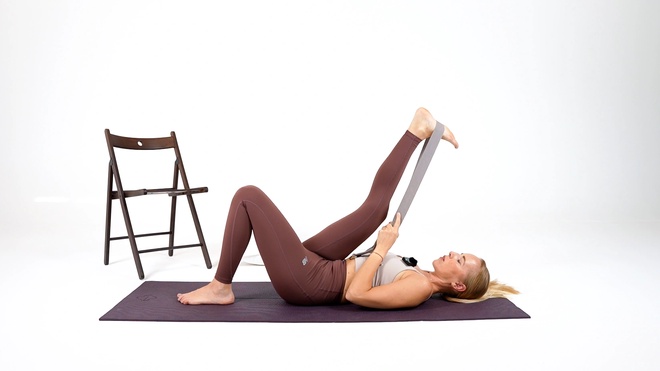
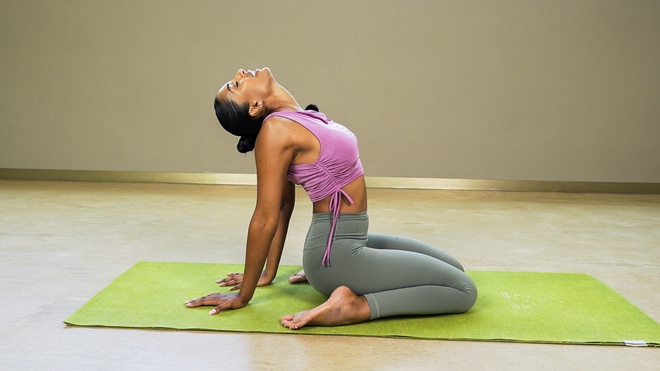
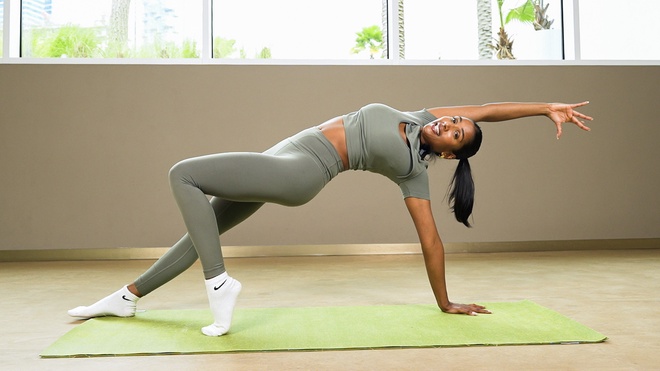
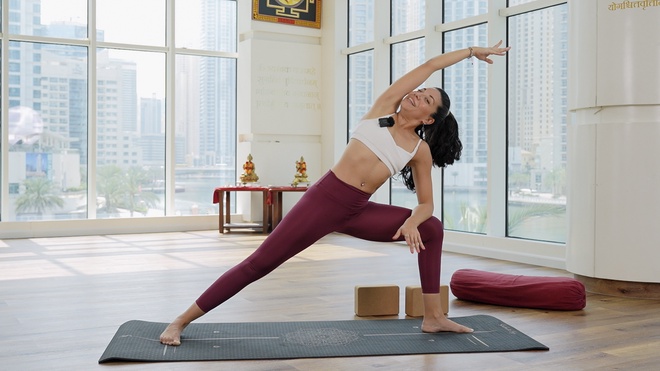
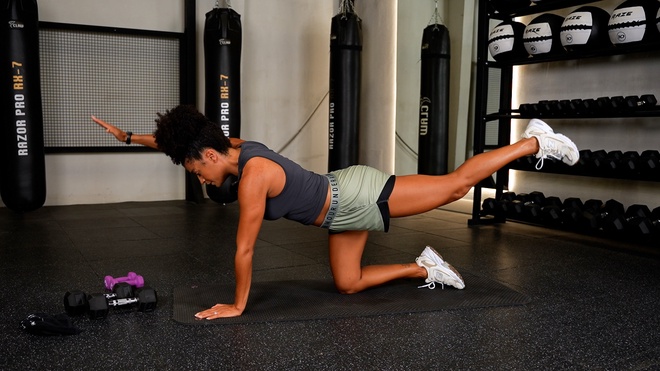
Join women relieving lower back pain and improving hip mobility with 9 certified trainers across 34 workout segments
Frequently Asked Questions
Related Exercises
Cat Cow
Cat cow moves the lumbar spine through flexion and extension dynamically, while knees to chest holds it in static flexion. Petra Kapiciakova programs both in her Yoga for Back Relief series. Together they address mobility and decompression.
Child's Pose
Another lumbar flexion stretch, but from a kneeling position. Child's pose adds a lat and shoulder stretch that knees to chest does not. The two positions target the same lower back muscles from different angles.
Pigeon Pose
Pigeon targets the piriformis and deep hip rotators. For anyone using the knees to chest stretch for sciatica, pigeon pose is the natural companion because it addresses the muscular component of sciatic nerve compression directly.
Hip Flexor Stretch
The hip flexors and the lower back are mechanically linked. Tight hip flexors pull the lumbar spine into extension, which compresses the same structures knees to chest decompresses. Mish Naidoo programs both stretches in the same daily sequences.
Glute Bridge
The active counterpart to the passive stretch. After decompressing the lower back with knees to chest, glute bridges strengthen the posterior chain that supports the lumbar spine. Stretch then strengthen: the sequence matters.
Get knees to chest in a guided workout
Access 10 workouts featuring this exercise, plus personalized plans from Dr. Wellls.
Join women relieving lower back pain and improving hip mobility with 9 certified trainers across 34 workout segments
Your membership funds independent women's health research