Seated Forward Fold: Form, Benefits & Variations
The seated forward fold stretches hamstrings, lower back, and calves. Sit with legs straight, hinge at hips, fold torso over thighs. Hold 60+ seconds. Also called paschimottanasana.
Seated Forward Fold: Form, Benefits & Variations
The back of your legs feel shorter than they used to. Sitting down, reaching for your toes, the floor seems further away every month. Your hamstrings have been shortening while you sat at a desk, drove a car, or curled up on the couch. And now the lower back has joined the complaint department, because tight hamstrings pull on the pelvis, and the pelvis drags the lumbar spine with it.
The seated forward fold, known in Sanskrit as paschimottanasana, is the most direct seated stretch for the entire posterior chain. Hamstrings, lower back, calves, glutes. You sit. You hinge. You breathe. That simplicity is deceptive. I've watched women force their foreheads toward their knees and miss the point entirely. The stretch happens at the hip crease, not the neck.
Jessica Casalegno teaches this in her Restore & Reset flexibility series. Petra Kapiciakova programs it into her Yoga for Back Relief and Yoga Before Bedtime sequences. Sophie Jones uses it in Fix Your Posture. Mish Naidoo tucks it into Tone & Stretch, Daily Stretching, and Morning Yoga Flow. Five different trainers. Fifteen different workout contexts. Flexibility, yoga, pilates, posture correction, bedtime wind-down. The seated forward fold crosses every category because tight hamstrings cross every body.
This is not the standing forward fold. Sitting removes balance from the equation. Your pelvis is grounded. Your spine is free to lengthen without worrying about toppling forward. That stability is what makes the seated forward bend a better hamstring stretch for most people than its standing counterpart.
Fix Your Posture: Session 7
Sophie Jones
How to Do Seated Forward Fold
Sit on your mat with both legs extended straight in front of you. Flex your feet so your toes pull back toward your shins. If your lower back rounds immediately, sit on a yoga block or folded blanket to elevate your hips. Petra Kapiciakova cues this setup in her Yoga Before Bedtime sessions: depending where your body allows you, maybe hug your pillow for support.
Inhale and grow tall through the crown of your head. Think of creating space between each vertebra. Petra's cue captures it: we are not focusing on bringing our belly or our head all the way down. We are focusing on lengthening. This is the step most people skip, and it changes everything about what happens next.
Exhale and hinge forward from your hips, not your waist. Imagine your hip bones tilting forward like a bowl pouring water. Keep your chest lifted as long as possible. Jessica Casalegno cues: see how low you can get your torso down towards your legs, lengthening the back and crawling the fingertips forward.
Walk your hands along your legs or the floor toward your feet. Rest them wherever they naturally land: shins, ankles, feet, or the floor beside your legs. Sophie Jones teaches this as a progressive crawl: walk them down as much as you can, until you start to feel that your spine is gonna round. That rounding is the signal to stop going deeper.
Hold the position for 30 to 90 seconds. With every exhale, allow your body to soften a fraction deeper. Do not bounce. Do not force. Petra cues the breath: with every exhale, allow your body to soften and fold a bit deeper, like you are becoming liquid. The hamstrings release on the exhale. Trust the process.
To come out, inhale and lift your chest. Walk your hands back toward your hips. Roll up slowly through the spine, stacking one vertebra at a time. Sit tall and notice the difference in your hamstring length.
Muscles Worked
Primary
Hamstrings (biceps femoris, semitendinosus, semimembranosus)
The seated forward fold is fundamentally a seated hamstring stretch. All three hamstring muscles lengthen as you hinge forward at the hips with straight legs. The semimembranosus and semitendinosus run along the inner back thigh. The biceps femoris sits on the outer back thigh. Together they resist the forward fold, and that resistance is exactly what stretches them. A systematic review on static stretching found that holds of 60+ seconds produce the most significant range-of-motion improvements, which is why holding this pose matters more than how far you reach.
Erector spinae (lower back)
The entire length of the spinal erectors stretches as your torso folds over your legs. The lumbar erectors bear the greatest load because the forward hinge creates the most flexion in the lower spine. This is why paschimottanasana appears in back-relief yoga sequences. Petra Kapiciakova programs it into both her Yoga for Back Relief and Yoga Before Bedtime series specifically for lower back decompression.
Gastrocnemius and soleus (calves)
When you flex your feet and pull your toes toward your shins, the calf muscles join the stretch chain. Jessica Casalegno cues: flex your feet, pull toes in towards your torso. That foot position extends the stretch past the hamstrings into the entire posterior line from heel to skull.
Secondary
Gluteus maximus
The glutes lengthen as the pelvis tips forward. This is a passive stretch, not an active contraction. For women who sit most of the day, this gentle lengthening helps counteract the compression the glutes experience in a seated position.
Hip adductors (wide-legged variation)
In the wide-legged seated forward fold variation, opening the legs creates an inner thigh stretch in addition to the hamstring work. Jessica Casalegno cues this version: open up your legs to be that wide leg, drop the chest in between your legs.
Why this matters in perimenopause
Hamstring flexibility doesn't decline evenly. It drops in clusters, and hormonal transitions are one of the biggest triggers. Estrogen influences connective tissue elasticity throughout the body. As levels fluctuate during perimenopause, the fascia surrounding the hamstrings and lower back loses some of its natural pliability. A study on exercise adaptations during perimenopause found that these physiological shifts alter exercise response and require specific training adjustments. The same seated forward fold you did at 30 may need longer holds, more warm-up, and gentler progression now. Then there is the cortisol-sleep-stiffness loop. Disrupted sleep raises cortisol. Elevated cortisol tightens muscles, and the hamstrings are particularly stress-responsive. You wake up stiffer than you went to bed, blame it on the mattress, and the real culprit is a nervous system running hot. A randomized controlled trial on yoga and menopausal symptoms found that regular practice improved both sleep quality and vasomotor symptoms. The seated forward fold fits this protocol perfectly: slow, sustained, breath-focused, calming.
Coach's Tips
"See how low you can get your torso down towards your legs, lengthening the back and crawling the fingertips forward." Jessica Casalegno teaches this progressive approach in her Restore & Reset series. The crawl is the technique. You don't drop into the full position. You inch toward it, gaining a centimetre with every exhale. The crawl is where the stretch actually happens.
Jessica Casalegno
"Think about lengthening the back of your neck, stretching the back of the feet, keeping the toes flexed." Jessica's cue addresses both ends of the posterior chain simultaneously. Most people collapse the neck forward and let the feet go limp. Flex the feet. Lengthen the neck. Now the entire line from skull to heel is under stretch.
Jessica Casalegno
"We are not focusing on bringing our belly or our head all the way down. We are focusing on lengthening." Petra Kapiciakova's most important cue. Depth is vanity. Length is the stretch. If you round your spine to get your head closer to your knees, you've traded the hamstring stretch for spinal compression. Keep the chest lifted and think horizontal, not vertical.
Petra Kapiciakova
"Hinging through your hips, lift your chest slightly, exhale, drop chest closer." This micro-lift-and-fold rhythm is the most effective way to deepen any seated forward bend without forcing. Each inhale creates a tiny bit of space. Each exhale uses that space. Sophie Jones uses this breath rhythm in Fix Your Posture. It turns a static hold into an active exploration.
Sophie Jones
"Walk them down as much as you can, until you start to feel that your spine is gonna do this. We don't want them rounding." The rounding is the line. Once your lower back rounds, the stretch migrates from the hamstrings to the spinal ligaments, and that is not where you want the load. If you cannot maintain a flat-ish back while reaching past your shins, stop at your shins. Your hamstrings are still stretching.
Sophie Jones
"The most important thing is that the knees are straight. So if you can't reach the feet, keep the knees straight." Bending the knees to reach further defeats the purpose. Straight legs are what creates the hamstring stretch. If the backs of your knees ache, place a rolled towel beneath them for slight support. But keep them straight.
"Depending where your body allows you, you're just gonna walk your hands, maybe hugging your pillow." Petra Kapiciakova uses a pillow or bolster in her bedtime yoga classes for a restorative seated forward bend. Place it on your thighs, fold over it, let it support your weight. The stretch still happens. The nervous system calms faster because the effort drops.
Petra Kapiciakova
"If it's too much for your back, you can open your legs to the sides to make more space." Moving from a straight-leg seated forward fold to a wide-legged position reduces the hamstring intensity and shifts some of the stretch toward the inner thighs. This modification also reduces lower back compression for anyone with disc sensitivity. Use it freely.
Why This Matters for You
I want to be direct about what happens to hamstring flexibility during perimenopause, because the standard advice (just stretch more) misses the mechanism entirely.
Estrogen modulates collagen synthesis and connective tissue hydration. When levels fluctuate, the fascia surrounding the hamstrings, the spinal ligaments, the deep hip structures all lose some of their pliability. A research review on exercise adaptations in perimenopause confirmed that physiological shifts during this stage alter exercise response and require specific training adjustments. Your seated forward fold during perimenopause is not the same pose it was a decade ago. It needs longer holds, gentler entry, and patience you did not used to require.
The sleep connection matters here. Disrupted sleep raises cortisol. Cortisol tightens the posterior chain. The hamstrings and lower back are among the most stress-responsive muscle groups in the body. You wake up stiffer, assume you slept wrong, and never connect it to the hormonal shift underneath. A randomized controlled trial found that yoga practice including forward bends improved sleep quality and reduced vasomotor symptoms. Paschimottanasana before bed is not indulgence. It is a direct intervention for the stiffness-sleep cycle.
And the lower back. A meta-analysis of mind-body exercises found significant improvements in perimenopausal symptoms and quality of life. The seated forward fold decompresses the lumbar spine, lengthens the hamstrings that pull on the pelvis, and activates the parasympathetic nervous system. Three problems, one position, ten minutes before bed.
Variations & Modifications
Seated Forward Fold (Cross-Legged)
lowCross your legs and fold forward from the hips. This reduces the hamstring load almost entirely and shifts the stretch toward the lower back and outer hips. Good entry point if straight-leg folding is too intense. Three instances in our workout library. It works as a desk-break stretch because you can do it on a chair.
Seated Single Leg Forward Fold
mediumExtend one leg straight. Bend the opposite knee and place the sole of that foot against your inner thigh. Fold over the straight leg. This isolates one hamstring at a time and reveals side-to-side imbalances. Jessica Casalegno teaches right leg and left leg versions in her Restore & Reset series. Most people have one side significantly tighter. This variation tells you which.
Wide-Legged Seated Forward Fold
medium-highOpen your legs into a wide straddle and fold your torso toward the floor between your legs. Targets the inner thighs and groin in addition to hamstrings. Jessica Casalegno cues: open up your legs to be that wide leg, drop the chest in between your legs. This is a pancake fold prep and a deeper challenge than the standard version.
Seated Forward Fold with Side Reaches
mediumFrom the folded position, walk your fingertips to one side, then the other. Jessica Casalegno cues: tiptoe fingertips to the right, back to center, over to the left. This adds a lateral spine stretch and targets the obliques and quadratus lumborum. Turns a purely forward stretch into a three-dimensional release.
Seated Forward Fold with Shoulder Stretch
mediumWhile folded, interlace your fingers behind your back and lift your arms away from your body. This opens the chest and anterior shoulders while maintaining the hamstring stretch. Good pairing for desk workers whose chest and shoulders are chronically shortened.
Seated Forward Fold (Virasana Variation)
mediumSit in virasana (kneeling with hips between heels) and fold forward over your thighs. This shifts the stretch from the hamstrings to the quadriceps and hip flexors while keeping the spinal decompression. One instance in our library. An interesting variation for anyone whose hamstrings are already mobile but whose quads and hip flexors are locked.
Benefits
Lengthens the entire back line of your body
The seated forward fold stretches from the soles of your feet through your calves, hamstrings, glutes, and up the entire length of the spine. No other single seated position covers this much territory. A systematic review on stretching modalities found that static holds produce meaningful range-of-motion improvements. This pose is a static hold by nature. You sit. You fold. The tissue releases.
Decompresses the lower back after sitting
Sitting compresses the lumbar discs. The seated forward fold creates gentle traction through the lumbar spine as your torso weight pulls the vertebrae apart. Petra Kapiciakova uses this in her Yoga for Back Relief series specifically to counter the compression of desk work. It is a good counter stretch for our lower back, as one of our trainers puts it.
Calms the nervous system before sleep
Forward folds are inherently calming. Your heart sits above your head, blood pressure signals shift, and the parasympathetic nervous system activates. Petra programs paschimottanasana into her Yoga Before Bedtime series for exactly this reason. A randomized controlled trial found that yoga improved both sleep quality and menopausal symptoms in perimenopausal women. The seated forward bend is a standard component of bedtime yoga protocols.
Reveals hamstring imbalances nobody warned you about
The single-leg variation exposes side-to-side differences in hamstring flexibility. One leg folds deeper. The other resists. That asymmetry often correlates with hip discomfort, SI joint irritation, or uneven gait patterns. Jessica Casalegno teaches both sides in her Restore & Reset series. Identifying the tighter side is the first step toward correcting it.
Common Mistakes to Avoid
Rounding the spine to reach further
This is the most common error in any seated forward bend. You round your back, your head dives toward your knees, and you feel like you're making progress. You are not. The stretch migrated from your hamstrings to your spinal ligaments. Sophie Jones catches it immediately: walk them down as much as you can, until you start to feel that your spine is gonna round. We don't want them rounding. Keep a flat back and stop wherever that flat back stops. Your shins are a perfectly fine destination.
Bending the knees to reach the feet
Touching your toes with bent knees is not a hamstring stretch. It is a spinal fold with no posterior chain benefit. Keep your knees straight. If you cannot reach past your shins with straight legs, that is your current range. A strap around the balls of your feet lets you hold something while keeping the legs honest.
Holding the breath and forcing depth
The hamstrings release on the exhale. If you hold your breath and push, the muscles guard harder. You end up fighting your own tissue. Petra Kapiciakova's cue solves it: with every exhale, allow your body to soften and fold a bit deeper, like you are becoming liquid. Make the exhale audible. If you cannot breathe smoothly, you have gone too deep.
Yanking on the feet or legs
Using your arms to pull yourself deeper bypasses the gradual release the hamstrings need. It also loads the lower back with force it was not prepared for. Rest your hands on your legs. Do not grip. Do not pull. Let gravity and breath do the work. Jessica Casalegno's crawl cue is the alternative: crawl the fingertips forward gradually. The crawl is gentle. The yank is not.
Workouts Featuring This Exercise
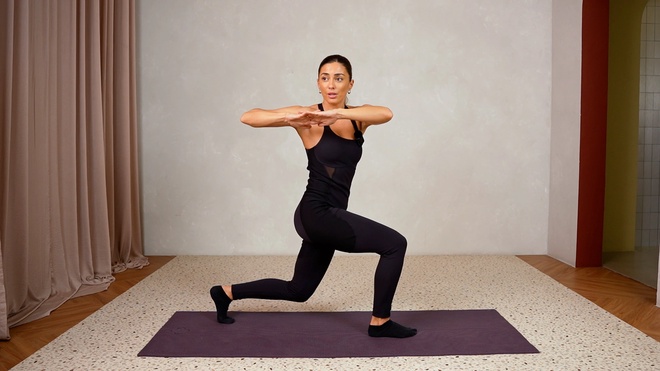
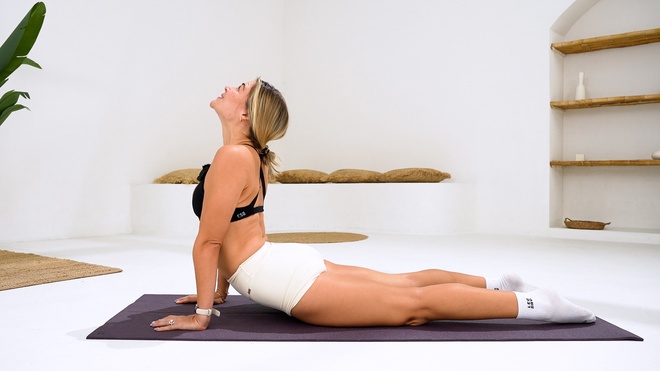
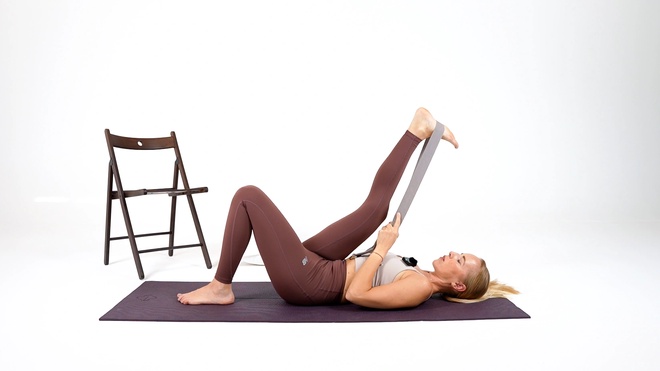
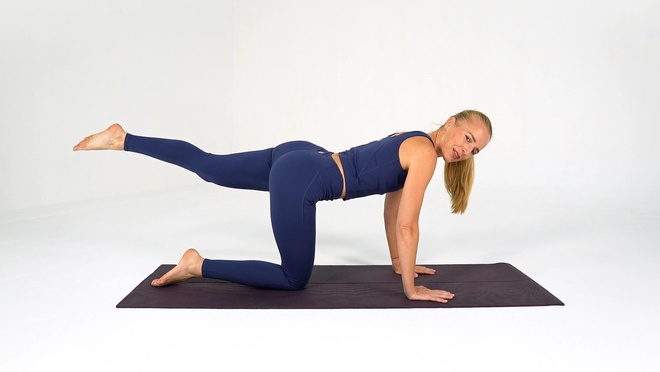
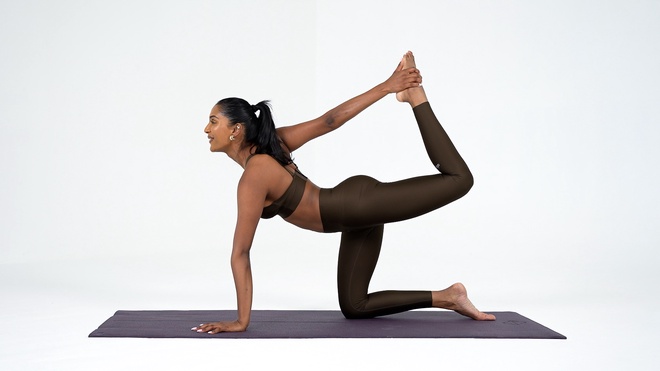
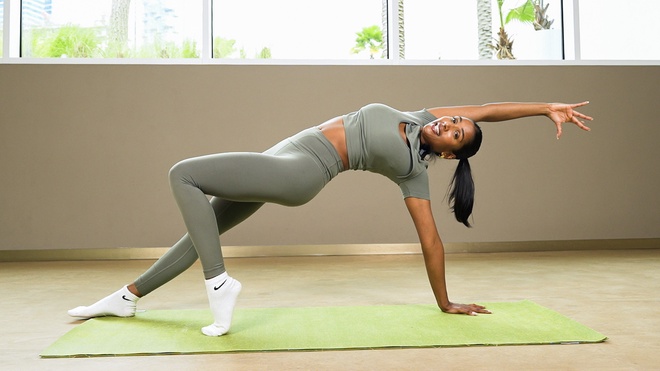
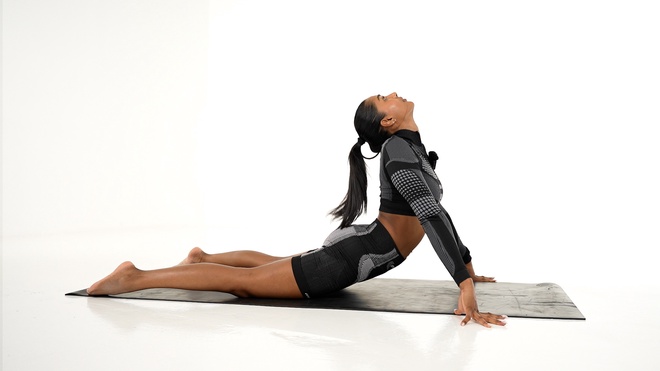
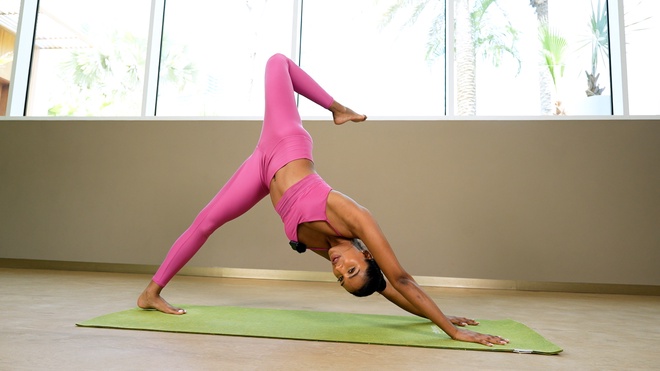
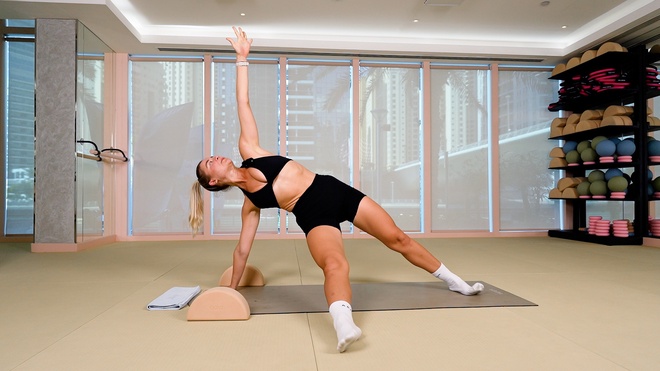
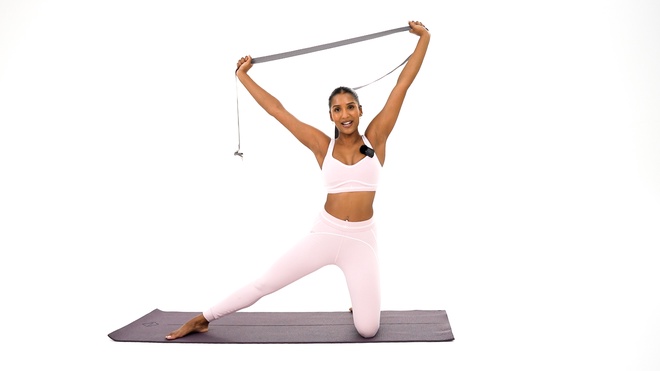
Join women lengthening their hamstrings, releasing lower back tension, and sleeping better with certified trainers
Frequently Asked Questions
Related Exercises
Hamstring Stretch
The standing version of hamstring lengthening. Pairs with seated forward fold to hit the same muscles from a different angle and with balance demand.
Forward Fold
The standing forward fold adds gravity and balance challenge. Targets the same posterior chain with more calf and ankle involvement.
Pigeon Pose
Where seated forward fold targets the posterior chain, pigeon targets the hip rotators and flexors. Together they cover the entire lower body flexibility picture.
Downward Dog
Another full posterior chain stretch but from an inverted position. Adds shoulder and upper back work to the hamstring and calf lengthening.
Cat-Cow Stretch
Mobilizes the spine dynamically before the sustained hold of seated forward fold. Good pairing in warm-up sequences.
This exercise helps with
Get seated forward fold in a guided workout
Access 10 workouts featuring this exercise, plus personalized plans from Dr. Wellls.
Join women lengthening their hamstrings, releasing lower back tension, and sleeping better with certified trainers
Your membership funds independent women's health research