Side Plank Hip Dips: How-to, Benefits & Variations
Side plank hip dips target obliques, QL, and glute-med. Start in a side plank, lower hips toward the floor, then drive up. Builds lateral core strength and hip stability.
Side Plank Hip Dips: How-to, Benefits & Variations
A static side plank is hard. Lowering your hips toward the floor and driving them back up is a different animal entirely.
Side plank hip dips, also called side plank dips or side plank hip lifts, add a controlled dip-and-drive motion to the standard hold. Instead of fighting gravity in one position, your obliques now contract and lengthen through their full range. That distinction matters. Isometric holds build endurance. Dynamic movement builds strength. This exercise does both.
Mish Naidoo cues it simply in our Tone and Stretch workout: "Imagine you're doing like a little side sit-up here, pushing those hips up towards the ceiling." That image clicks better than any anatomy textbook. Your bottom waist shortens as you lift, lengthens as you lower, and your obliques get worked through every degree of the motion.
Natalia Gunnlaugs programs side plank hip dips in both her Pilates and HIIT workouts. Sophie Jones includes them in her Bringing Sexy Back series. Three trainers, four workouts, eleven instances in our library. It is a staple because it works.
Tone and Stretch: Workout 6
Mish Naidoo
How to Do Side Plank Hip Dips
Lie on your side with your bottom forearm on the mat, elbow directly underneath your shoulder. Mish Naidoo cues: drop to your left forearm, stack your legs. The elbow position is non-negotiable. Too far forward loads the shoulder joint. Too far back strains the rotator cuff. Directly below the bony point of the shoulder.
Lift your hips off the floor until your body forms a straight line from head to feet. This is your starting position. Keep your hips and chest facing forward. Natalia Gunnlaugs specifically cues: try to keep the hips also facing forward so we're not back here. If your chest rotates toward the ground, the exercise changes entirely.
Inhale and slowly lower your hips toward the mat. Control the descent. Do not collapse. The lowering phase is where your obliques work eccentrically, lengthening under load. This is the part most people rush through. That is a mistake.
Exhale forcefully and squeeze your obliques to drive your hips back up. Mish Naidoo cues: exhale, lift. Sophie Jones adds: push those hips up, push those hips up. Aim to lift slightly higher than the neutral starting line. That peak squeeze at the top is where maximum oblique activation happens.
Repeat for reps, then switch sides. Side plank hip drops should feel like a controlled wave, not a jerky bounce. Slow down enough that you feel the burn in your side waist on both the lift and the lower.
Muscles Worked
Primary
Internal and external obliques
The obliques are the primary mover during side plank hip dips. During the dip phase, they lengthen eccentrically to control your hip descent. During the lift phase, they contract concentrically to drive your hips toward the ceiling. This concentric-eccentric cycle through the full range of motion is what makes side plank hip dips muscles worked more complete than a static hold. Mish Naidoo cues: I'm really squeezing through those obliques as I'm lifting them hips up. That squeeze is the concentric peak.
Quadratus lumborum
The deep lateral muscle connecting your lowest rib to the top of your pelvis. During each hip lift, the QL assists the obliques in lateral trunk flexion. During the dip, it works eccentrically to prevent collapse. This muscle is commonly implicated in one-sided low back pain. Training it dynamically through side plank hip lifts addresses weakness that static holds cannot fully reach.
Secondary
Gluteus medius
Stabilizes the pelvis while the hip moves through its dip-and-lift arc. A 2020 meta-analysis found that side-lying positions produce among the highest gluteus medius EMG activation levels. The dynamic component of hip dips adds a pelvic stabilization challenge that the static side plank does not.
Transversus abdominis and pelvic floor
The exhale-brace mechanism activates the TA and pelvic floor as co-contractors. A systematic review of diaphragmatic breathing and core stability confirmed this link. Every forceful exhale during the lift phase engages these deep stabilizers before the obliques even fire.
Deltoid and serratus anterior
Your bottom shoulder holds your upper body off the mat throughout the set. Mish Naidoo cues: push and squeeze, nice and strong with the arm. The serratus anterior keeps the shoulder blade flush against the ribcage. If your shoulder fatigues before your obliques, widen your base or drop to a knee-down modification.
Why this matters in perimenopause
Side plank hip dips muscles worked include the obliques, quadratus lumborum, gluteus medius, and pelvic floor. These muscles weaken disproportionately during hormonal transitions because they rarely get trained in isolation. A 2023 international expert position statement on resistance training for menopausal women recommended exercises targeting core stability and hip strength. Side plank hip dips hit both, with the added benefit of dynamic range training that static holds miss.
Coach's Tips
"Imagine you're doing like a little side sit-up here, pushing those hips up towards the ceiling." Mish Naidoo said this in her Tone and Stretch class, and it is the best cue I have heard for this exercise. Forget the anatomy for a second. Side sit-up. That mental image automatically drives the right muscle contraction without you overthinking which oblique does what.
Mish Naidoo
"Try to keep the hips also facing forward so we're not back here." Natalia Gunnlaugs catches the most common cheat. When fatigue sets in, the chest rotates toward the floor. The moment you rotate, your pectorals and rectus abdominis take over. The obliques lose their position of advantage. Hips forward. Chest forward. The side plank dip becomes a different exercise if you let that slip.
Natalia Gunnlaugs
Stack your shoulders directly over your elbow to protect the joint. This cue appears in our database across multiple trainers and across multiple exercise types. The elbow acts as the foundation for your entire upper body weight. Misalign it by even two inches and the load transfers into your shoulder socket instead of through your core.
Mish Naidoo
"Inhale as you lower the hips and exhale forcefully as you lift them back up." The exhale timing is not decorative. A systematic review confirmed that forceful exhale patterns drive intra-abdominal pressure and deep core activation. The exhale on the lift phase means your obliques get both the conscious squeeze and the reflexive TA engagement at the moment of peak effort.
Mish Naidoo
"If it helps you to keep one leg in front, you can do that for balance." Mish Naidoo offers this without any trace of judgment. Staggering the feet, top foot placed slightly in front of the bottom foot, creates a wider base of support. The oblique demand stays nearly the same. The balance demand drops. A solid option if your ankles or hips are not ready for stacked feet under dynamic movement.
Mish Naidoo
Drop your bottom knee to the floor for a modified side plank hip dip. This cuts the lever arm and reduces the load on both your shoulder and core. You still get the full dip-and-lift range of motion. You still train the obliques concentrically and eccentrically. Start here if a full side plank hip lift feels too unstable or if your shoulder fatigues within the first five reps.
Mish Naidoo
Why This Matters for You
Side plank hip dips hit three targets that hormonal transitions quietly erode.
Oblique strength through range. The obliques are lateral stabilizers. They keep your trunk from collapsing sideways when you carry a bag of groceries on one hip, reach across a car to grab something from the passenger seat, or catch yourself on an uneven sidewalk. A 2023 meta-analysis of core training showed a large clinical effect on low back pain. The lateral component is the piece most routines skip. Static holds train endurance. Side plank hip dips train the strength component.
Hip stability without machines. The gluteus medius fires throughout each rep to keep the pelvis level. A 2020 meta-analysis found side-lying positions produce among the highest glute-med activation levels. Stronger glute-med means more stability during single-leg activities: stepping off a curb, navigating a crowded parking lot, hiking on uneven ground.
Pelvic floor integration on autopilot. The exhale-lift pattern activates the transversus abdominis and pelvic floor as co-contractors. Every rep is a pelvic floor contraction embedded inside a core exercise. No separate Kegel routine needed.
Variations & Modifications
Modified Side Plank Hip Dip (Knee Down)
low-mediumBottom knee stays on the mat while you perform the hip dip motion. This cuts the lever arm and reduces shoulder load while preserving the full oblique contraction. A solid side plank hip dips alternative for anyone building up shoulder endurance or working around a wrist issue. The dip-and-lift motion stays identical. Only the base of support changes.
Side Plank Hip Dip from High Plank (Hand Position)
medium-highPerform the hip dip from your hand instead of your forearm, with your top arm extended toward the ceiling. This increases the distance between your hips and the floor, lengthening the range of motion and demanding more from the obliques on each rep. Natalia Gunnlaugs programs this in her Strong Pilates and HIIT Blast workouts. Only attempt this if you can complete 12 reps cleanly on your forearm first.
Side Plank Hip Dip with Staggered Feet
mediumPlace the top foot slightly in front of the bottom foot to widen your base of support. Mish Naidoo suggests this when balance becomes the limiting factor. The oblique demand is nearly identical to the stacked-feet version, but the wider base lets you focus on the squeeze without worrying about wobbling. A subtle change that makes a real difference.
Benefits
Dynamic oblique training that a static hold cannot match
A static side plank builds isometric endurance. Side plank hip dips build concentric and eccentric strength through the full range. Your obliques shorten as you lift, lengthen as you lower. This dual-phase loading creates a training stimulus that holding still cannot replicate. If you have plateaued on static holds, this is the progression. Side plank hip dips benefits include strengthened obliques through their complete range of motion.
Targets the side waist with zero spinal flexion
Most oblique exercises involve crunching or twisting the spine under load. Side plank hip dips work the obliques while the spine stays relatively neutral. For anyone with disc issues, a history of back pain, or instructions from a physio to avoid spinal flexion, this exercise trains the exact same muscles through a safer movement pattern.
Exposes left-right imbalances you did not know you had
You will do the same reps on both sides. One side will burn earlier. One side will feel less controlled. That asymmetry has been there for years. It shows up as one-sided back stiffness, a hip that shifts during squats, or a nagging ache that only appears on your left (or right). Side plank hip lifts both diagnose and treat the imbalance.
Pelvic floor activation built into every rep
The forceful exhale on each lift phase triggers the TA and pelvic floor co-contraction mechanism. A systematic review of diaphragmatic breathing and core stability confirmed this reflex. You do not need to think about your pelvic floor. The breathing pattern activates it automatically. Eleven reps per side means eleven pelvic floor contractions per side, embedded in an exercise that also trains your obliques and hips.
Common Mistakes to Avoid
Bouncing instead of controlling the movement
The most common error with side plank hip dips. Momentum replaces muscle contraction the moment you start bouncing off the floor. Slow the dip phase to a two-count descent. Pause at the bottom for a beat. Then exhale and drive up. Mish Naidoo cues: keep the movement slow and controlled. If you cannot slow down, you need fewer reps, not faster ones.
Rotating the chest toward the floor
Natalia Gunnlaugs catches this one: try to keep the hips also facing forward. When your chest opens toward the mat, the obliques lose their line of pull and the exercise degrades into a weak diagonal crunch. Place your top hand on your hip as a check. If the hand starts pointing at the floor, you have rotated.
Elbow too far in front of the shoulder
Your elbow is the foundation for your entire bodyweight. When it drifts forward, the shoulder joint absorbs force the muscles should handle. Check from above: the forearm points straight ahead and the bony point of your elbow sits directly below the bony point of your shoulder.
Not lifting high enough on the up phase
Mish Naidoo cues: drive those hips as high as possible toward the ceiling on every rep. Most people stop at the neutral line. The peak contraction happens above neutral. Think of it as one extra inch of lift at the top. That inch is where oblique activation is highest.
Workouts Featuring This Exercise
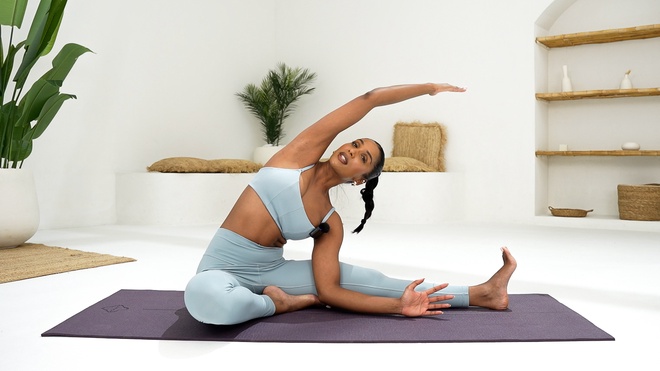
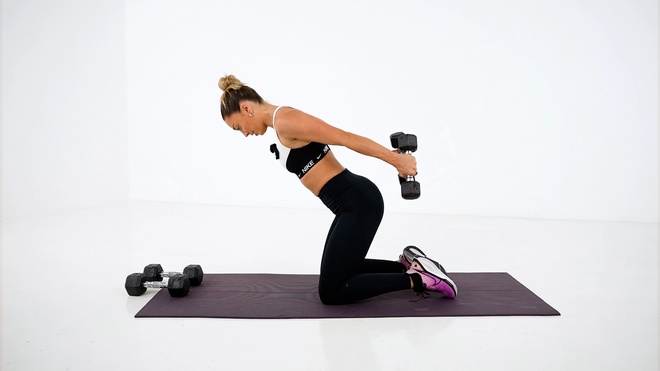
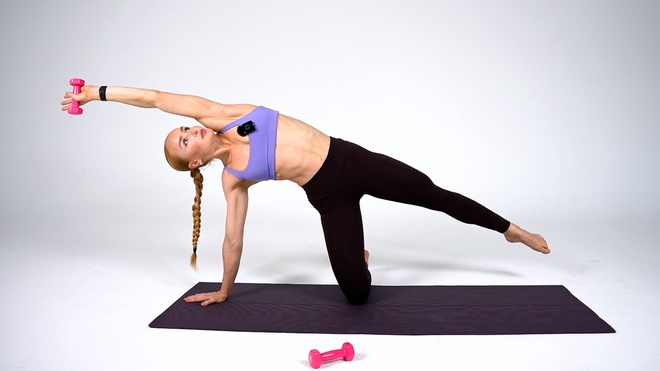
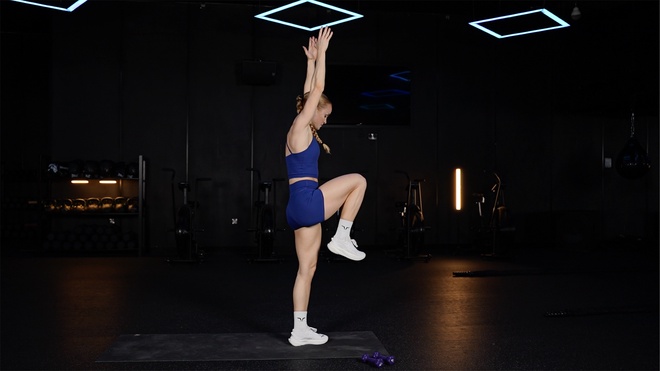
Join women building lateral core strength with 3 certified trainers across 4 guided workouts
Frequently Asked Questions
Related Exercises
Side Plank
The static foundation. Master the hold before adding the dynamic hip dip. Same lateral stability pattern, isometric instead of dynamic.
Plank
Trains anti-extension while side plank hip dips train anti-lateral flexion. Together they cover two planes of core stability.
Russian Twist
Another oblique-dominant exercise. Rotational pattern complements the lateral pattern of side plank dips. Pair them for complete oblique training.
Bicycle Crunches
Combines rotation with flexion for the obliques. A dynamic oblique exercise that pairs well with the lateral-flexion focus of side hip dips.
Glute Bridge
Strengthens glutes and hip stabilizers from a supine position. Complements the lateral hip stability trained by side plank hip dips.
This exercise helps with
Get side plank hip dips in a guided workout
Access 4 workouts featuring this exercise, plus personalized plans from Dr. Wellls.
Join women building lateral core strength with 3 certified trainers across 4 guided workouts
Your membership funds independent women's health research