Squat Hold: How-to, Benefits & Variations
A squat hold is an isometric exercise: lower into a squat and hold still. Trains quads, glutes, and core under sustained tension. No equipment needed. Start at 20 seconds, build to 60.
Squat Hold: How-to, Benefits & Variations
Most exercises reward movement. They count reps. They celebrate range of motion. The squat hold does something fundamentally different — it rewards stillness. You drop to the bottom of a squat, and you stay. Your muscles can't rest between reps, can't coast through momentum. The tension builds and then it keeps building.
That's the entire point of an isometric squat hold. Unlike a dynamic squat, where the muscle contracts and releases, this is sustained contraction — your quads firing at a fixed length against a fixed load. There's a distinction worth knowing: the squat hold is not the same as a wall squat hold. A wall sit uses the wall for posterior support, which reduces the work your erector spinae and glutes have to do. The freestanding squat hold demands everything from your own structure: legs, hips, spine, core — all under sustained tension without external help.
Resistance training meta-analyses consistently find that time under tension, not just rep count, drives quad and glute adaptation. A 2024 systematic review (Pubmed 38353251) found significant improvements in physical fitness, lean mass, and functional capacity from resistance training across postmenopausal women — and static holds are exactly that kind of functional, joint-sparing load.
Athlete Mode 8
Sophie Jones
How to Do Squat Hold
Stand with feet hip-width apart or slightly wider, toes turned out 15-20 degrees. Sophie Jones cues: feet hip-width, shoulders packed back, chest lifted before you even start moving.
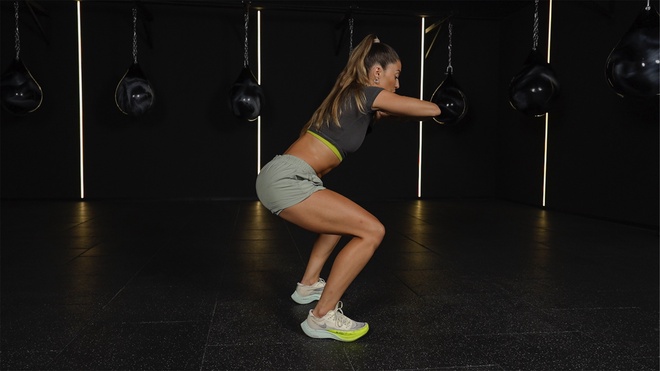
Inhale, brace your core as if bracing for a punch, then push your hips back and down. Lower until your thighs are parallel to the floor — or as close as your current mobility allows. Knees track over your second and third toes.
Pause here. Don't sink any further if your lower back rounds. The correct squat hold position has: chest tall, tailbone slightly tucked (not flared), weight through the heels, shins roughly vertical.
Actively squeeze your glutes together throughout the hold. This is not a passive rest position. Sophie cues: 'Squeeze your glutes together as you're holding.' Your core co-contracts to stabilize your spine under the load of your own body weight.
Pull your shoulder blades back and together. Rounded upper back shifts the centre of gravity forward and increases knee strain. Keep the gaze straight ahead, not down at the floor.
Breathe steadily throughout. Inhale through the nose, exhale slowly through the mouth. Holding your breath spikes intra-abdominal pressure and cuts the hold short. The breathing is part of the training.
Hold for 20-60 seconds, or for whatever duration your trainer programs. Stand up slowly and controlled — don't bounce out of it.
Muscles Worked
Primary
Quadriceps (vastus lateralis, vastus medialis, rectus femoris)
Sustain isometric knee flexion against gravity for the entire duration of the hold. All four quad heads are engaged simultaneously at roughly 90 degrees of knee flexion, which is the range where they work hardest. This is why the burn appears so quickly — there is no rest phase.
Glutes (gluteus maximus and medius)
Maintain hip extension and prevent collapse at the hips. Actively squeezing the glutes during the hold protects the lumbar spine by creating posterior pelvic tension. The gluteus medius fires to keep knees tracking properly over the toes.
Hamstrings
Assist hip extension at the bottom position and help balance the shear forces across the knee joint. Weaker hamstrings relative to quads is a common cause of knee instability — the squat hold strengthens the posterior chain under the same load.
Secondary
Core (transverse abdominis, obliques)
Stabilize the lumbar spine under sustained load throughout the hold. Without core engagement, the lower back arches or rounds, both of which are injury patterns.
Calves (gastrocnemius, soleus)
Maintain ankle stability and keep the heels grounded. If the calves are fatiguing, the heels lift — a sign the ankles need mobility work.
Hip flexors and adductors
Control pelvic tilt and prevent the knees from collapsing inward. Particularly engaged if you're holding a wide-stance or sumo-width squat hold.
Why this matters in perimenopause
Estrogen decline accelerates sarcopenia — specifically fast-twitch muscle fibre loss in the quads and glutes. Isometric holds recruit slow-twitch endurance fibres under sustained tension, which are exactly the fibres most relevant to functional leg strength, balance, and daily movement capacity. A 2022 meta-analysis (Pubmed 36283059) found resistance training significantly reduced menopausal symptoms and improved muscle mass in postmenopausal women. The squat hold is an efficient, no-impact way to put those mechanisms to work.
Coach's Tips
'Feet hip-width apart. Not letting my back round up.' That's the full cue from our trainers for the squat hold — and it contains everything that matters. Your back rounding is the canary in the coal mine. The moment it rounds, you've gone deeper than your current hip mobility allows, or your core has stopped doing its job. Shorten the hold before you let form break.
Sophie Jones
'Squeeze your glutes together as you're holding. Pull my shoulder blades back.' These two cues work together. Shoulder blades back = chest up = spine neutral. Glutes squeezed = hips supported = lower back protected. Skip one and the other becomes much harder to maintain. Get both right and the hold becomes almost meditative.
Sophie Jones
Keep your weight back in your heels rather than your toes. This is a knee-protection cue more than a form cue. Weight shifting to the toes pushes the knees forward past the toes, increasing patellofemoral compression. Heels grounded, weight distributed from heel to mid-foot — the knees thank you.
Sophie Jones
Aim for a right angle at the knees — thighs parallel to the floor, shins roughly vertical, hips sitting back rather than straight down. If you can't hit that angle without your heels rising or your lower back rounding, hold at the depth you can maintain with clean form. The angle will improve as hip mobility and quad strength develop.
Multiple trainers
'Inhale deeply through the nose and exhale as you maintain full body tension.' Breathing through the hold is what allows you to extend it. Breathe out slowly on the hard parts — when the legs are shaking, the exhale re-engages the deep core and buys you another 5-10 seconds of control.
Sophie Jones
'Lift one heel at a time while staying low to challenge your balance and calves.' This is a good mid-hold challenge once you can sustain 30 seconds comfortably. Alternating heel lifts add a calf and ankle stability element without breaking the quad and glute tension. It also forces each leg to briefly support more of the load.
Multiple trainers
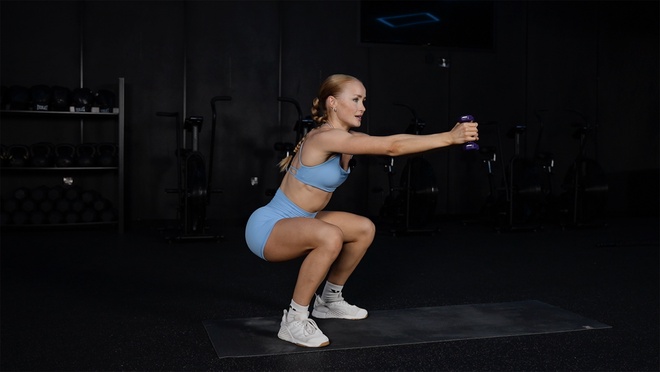
'Add a bicep curl or overhead press to engage the upper body while holding the squat.' Several trainers in our library program this — hold the bottom of a squat while performing arm work with light dumbbells. It increases total time under tension, adds a cardiovascular element, and is an efficient way to train both upper and lower body in a time-limited session.
Multiple trainers
If the burn is too intense and your form is breaking down before the time is up, stand up and reset. A 5-second reset and then back down is still better training than holding a compromised position for the full duration. Linda Chambers programs squat hold pulses after the static hold to push endurance past the point of comfort.
Linda Chambers
Why This Matters for You
During perimenopause, the conversation about exercise usually lands on cardio and weight management. But the more pressing problem is quieter: estrogen decline accelerates sarcopenia, specifically in the large muscle groups — quads, glutes, hamstrings — that determine how you move, stand, and stay upright when something unexpected happens. A 2022 meta-analysis of resistance training and menopausal symptoms (Pubmed 36283059) found significant improvements in muscle mass, physical function, and symptom burden. The squat hold is isometric work — no impact, no rapid direction changes, low joint stress — making it accessible through periods of joint sensitivity that many women experience as hormones shift.
There's a pelvic floor angle too. The squat hold position — knees bent, hips back, core engaged — is actually a mild pelvic floor activation posture. When you hold and breathe steadily, you're training the pelvic floor to manage intra-abdominal pressure under sustained load. That's different from a kegel. It's functional, integrated, and happens during real movement patterns rather than in isolation.
Variations & Modifications
Bodyweight Squat Hold
lowThe baseline version. No weight, no band, just you and gravity at the bottom of a squat. This is where to start if your legs are shaking at 10 seconds — it means your slow-twitch fibres are underworked, not that you're weak. Build from 15 seconds to 60 seconds before adding any external load. Jessica Casalegno programs chair squat holds in her Full Body Pilates series specifically as an entry point for this reason.
Banded Squat Hold
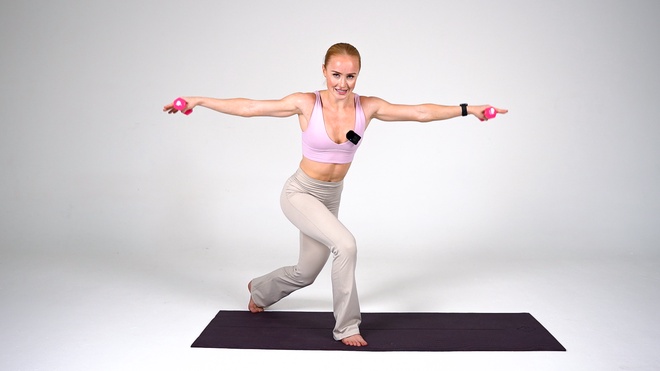
mediumPlace a resistance band just above the knees before you lower into the hold. Now your gluteus medius has to fight the band's pull for every second of the hold. This is exactly what several of our trainers use to build the lateral hip stability that protects knees during squats, walking, and single-leg movements. Sophie programs this in her Athlete Mode series. Push the knees actively outward throughout.
Squat Hold with Pulse
mediumHold the bottom position, then add tiny vertical pulses — an inch up, an inch down. Linda Chambers programs this in her Abs and Glutes series. The pulses break the isometric hold into something more metabolic, driving more blood into the quads and glutes while maintaining constant tension. It also extends how long you can sustain the exercise before full fatigue sets in.
Squat Hold with Heel Raises
mediumMaintain the low squat position and alternate lifting one heel off the floor at a time. This increases calf recruitment, tests ankle stability, and forces each leg to handle more load momentarily. It's a good progression once you've mastered 40+ second holds with clean form.
Squat Hold with Upper Body Work
medium-highHold a squat isometrically while performing bicep curls, overhead presses, or jab-cross punches with light weights. Multiple trainers in our library use this for time-efficient sessions. Your legs sustain the static lower-body work while your arms add cardiovascular demand. Natalia Gunnlaugs programs squat hold finishers with dumbbells in her HIIT Blast series.
Deep Squat Hold (Malasana variation)
low-mediumLower into a full deep squat — hips well below knees — with elbows pressing against the insides of the knees to open the hips. Sophie Jones programs this in Total Body Conditioning 9 as a hip mobility and hold. It targets the adductors and inner hips more than the standard hold and requires more ankle dorsiflexion. Not appropriate if you have knee pain at depth. Requires more hip mobility than the standard squat hold.
Benefits
Time under tension, without the joint impact
Quad and glute endurance that transfers directly
Bone density load without a barbell
A core exercise pretending to be a leg exercise
Common Mistakes to Avoid
Letting the back round
This is almost always a hip mobility problem, not a strength problem. If your lower back rounds at the bottom, you've gone past the depth your current hip flexors and hip capsule will allow. Hold at a shallower angle — thighs at 45 degrees instead of parallel — and work depth gradually over weeks. Sophie's cue: 'Not letting my back round up' starts with choosing the right depth, not just trying harder.
Weight shifting to the toes
Your heels should be planted throughout. If they're lifting, your ankles lack dorsiflexion or you're sitting too far forward. Try placing a thin folded towel under your heels as a temporary fix while you develop ankle mobility separately. Toes-forward weight shifts the load to the patella and anterior knee — where you don't want it.
Passive holding — not actively squeezing
A squat hold where you're just hanging in the hip flexors with a rounded spine is not productive and increases injury risk. The hold only works when you're actively squeezing your glutes, engaging your core, and pulling your shoulder blades back. If you're not feeling your quads burn, you're probably hanging passively. Reset your form, squeeze everything, and hold for 15 good seconds rather than 40 mediocre ones.
Knees caving inward
Valgus collapse at the bottom of a squat hold is a gluteus medius weakness indicator. Your outer glutes aren't generating enough lateral hip force to keep the knees tracking over the toes. Cue yourself to push the knees apart — 'spread the floor with your feet' — and consider adding a light resistance band above the knees to give the glutes something to push against.
Workouts Featuring This Exercise
Frequently Asked Questions
Related Exercises
This exercise helps with
Get squat hold in a guided workout
Access 8 workouts featuring this exercise, plus personalized plans from Dr. Wellls.
Your membership funds independent women's health research