HIIT Blast — Workout 9
Exercise Breakdown
14 exercises in Workout 9
Warm-up5 exercises2m 6s
“Relax the upper body all the way down, bringing one heel up at a time.”
“Deep breath in, look up. Exhale as you round the spine.”
“Activate those shoulders, and then we're gonna step back into a plank.”
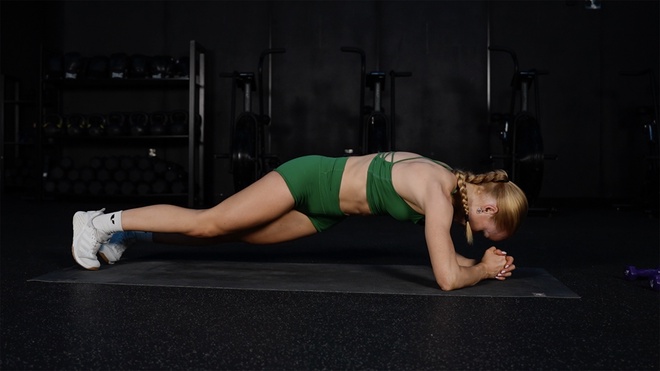
“Try to keep your knees off the mat. If you really need to, you can bring them down.”
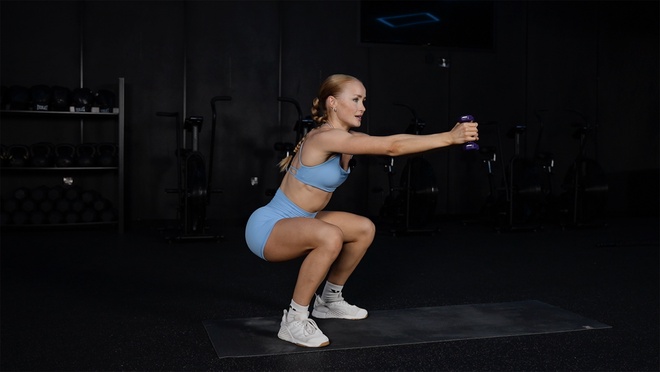
“Nice, low squats, and let's pick up the pace a little bit.”
Strength4 exercises2m 57s
“Punch as you come up. Right arm to the left, left arm to the right.”
“I want you to get into a nice depth on the push-ups.”
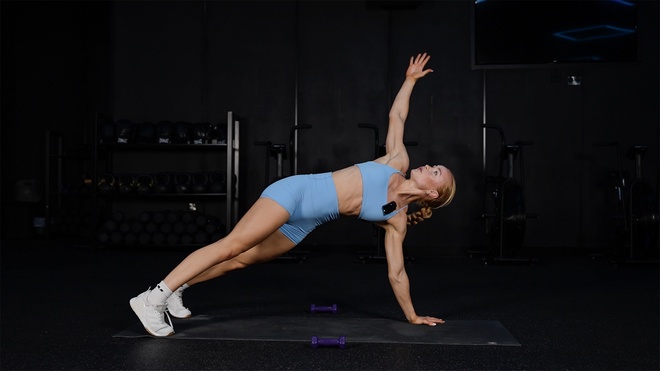
“Reach underneath and through, and then extend the arm up.”
Cardio3 exercises2m 59s
“Knee up. Come all the way back down into that tabletop.”
“If this is too much, you can always move on to just reverse lunges.”
“Final minute today — I know those shoulders are burning.”
Cool-down2 exercises2m 29s
“Press the left shoulder down as well... feel a good stretch in the right shoulder.”
Muscles Targeted
Primary
Secondary
Equipment & Modifications
Equipment Needed
- dumbbells
- mat
Don't Have Equipment?
You can substitute with:
Available Modifications
- Bring knees down to the mat if needed
- Use body weight instead of dumbbells
- Reverse lunges instead of jumps
- Perform push-ups on knees
- Add a dumbbell for extra resistance
- Place one leg in front for better balance
- Step feet in and out instead of jumping
Coaching Highlights from Natalia Gunnlaugs
“Press the left shoulder down as well... feel a good stretch in the right shoulder — I tell every new client the same thing: if you can't feel the muscle working, slow down until you can. Speed is not the goal.”
Form
“Keep a neutral spine, so no arching in the back, no rounding. This is non-negotiable — I've seen the injury that happens when you skip this step, and it's not worth the two extra reps.”
Safety
“Try to keep your knees off the mat. If you really need to, you can bring them down. Nobody gets a medal for collapsing halfway through. Pick the version where your form stays clean for the full set.”
Modification
“Final minute today — I know those shoulders are burning. Some days you show up and everything clicks. Other days it's a fight from the first rep. Both count.”
Motivation
Health Benefits
If your heart rate hasn't been above 'walking the dog' pace in months and you know it, this 15-minute session is where you start — I designed it for women who want cardiovascular conditioning without spending an hour on a treadmill. If you're in your 30s or 40s dealing with metabolic slowdown, weight creep, or that specific afternoon energy crash — HIIT addresses all three through the same mechanism. You'll need dumbbells, mat and the willingness to be uncomfortable for 45 seconds at a time.
cholesterol jump
90% relevantIncreases HDL (good cholesterol) and lowers LDL (bad cholesterol) through cardiovascular exercise.; Improves insulin sensitivity and glucose metabolism, which indirectly impacts cholesterol levels.; Reduces visceral fat, a key contributor to dyslipidemia.; Builds lean muscle mass, boosting metabolism and aiding in weight management.; Reduces systemic inflammation, a factor in cardiovascular disease progression.; Manages stress, which can influence cholesterol through hormonal pathways.
heart disease risk
90% relevantimproving cardiovascular efficiency; reducing blood pressure; improving cholesterol profiles; enhancing insulin sensitivity; reducing systemic inflammation; maintaining healthy weight
stomach cancer risk
90% relevantimproving metabolic health and insulin sensitivity; reducing chronic inflammation; maintaining a healthy body weight and reducing visceral fat; enhancing immune function; improving gut motility and microbiome diversity
gynecological cancer risk
90% relevantImproved insulin sensitivity and glucose metabolism; Reduced chronic inflammation; Enhanced immune function; Maintenance of healthy body weight and fat mass; Modulation of hormone levels (e.g., estrogen, androgens); Stress reduction and improved psychological well-being
heart health awareness
90% relevantimproving cardiovascular endurance; reducing blood pressure; improving cholesterol profiles; maintaining healthy weight; stress reduction; improving insulin sensitivity
Relevant For
Frequently Asked Questions
What muscles does this HIIT workout target?
Your core, shoulders, hamstrings take the biggest hit, with secondary work through quads, spine, glutes. But here's what most people miss about hiit workouts: the primary target is your cardiovascular system, not individual muscles. A 2024 meta-analysis by Dupuit et al — found HIIT reduces visceral fat in perimenopausal women more effectively than steady-state cardio. The 14 exercises in this 15-minute session with Natalia Gunnlaugs are designed to keep your heart rate in the 80-90% zone for short bursts. That's where the metabolic magic happens. Your muscles are along for the ride — and they benefit too.
What equipment do I need for this workout?
You'll need: dumbbells, mat. Don't have these? water bottles, canned goods work as substitutes — I've coached women through this with filled water bottles and it works. The resistance is what matters, not the brand. Natalia Gunnlaugs shows form with standard equipment, but anything that adds load will do. Just make sure it's comfortable to grip — slippery objects and high-intensity moves don't mix. This pairs well with a core and cardio workout approach. This pairs well with a core strengthening exercises approach.
Is this workout suitable for beginners?
This is rated intermediate, so it assumes some baseline fitness. But Natalia Gunnlaugs offers modifications: Bring knees down to the mat if needed; Use body weight instead of dumbbells. If you've been training consistently for 2-3 months, you're ready. If you're brand new, start with a beginner-level workout in this series and work up. Nobody benefits from ego-lifting into an intermediate session on day one. This pairs well with a high intensity workout for fat loss approach.
How long is this workout?
Approximately 15 minutes, including warm-up and cool-down. Natalia Gunnlaugs wastes zero time — 14 exercises, no standing around, no 3-minute rest periods. The ACSM recommends 150 minutes of moderate or 75 minutes of vigorous exercise per week. Two or three of these sessions gets you there. That's 40-60 minutes per week of actual exercise. The rest of your week is yours.
Are there modifications available?
For every exercise. Natalia Gunnlaugs cues modifications as they come up: Bring knees down to the mat if needed; Use body weight instead of dumbbells; Reverse lunges instead of jumps — I'll say this once: using a modification is not failing. It's choosing the version that lets you maintain form for the entire set. A half-range pushup with a flat back beats a full-range pushup with a sagging spine every time. Pick the version where your technique stays clean.
How many calories does a HIIT workout burn?
The honest answer: it depends on your weight, fitness level, and actual effort. A 15-minute HIIT session typically burns 200-400 calories for a 140-170lb woman working at true high intensity. But here's what matters more than the calorie number: EPOC. Excess post-exercise oxygen consumption. Dupuit et al.'s meta-analysis found HIIT triggers metabolic elevation for up to 24 hours after the workout ends. So the calories you burn during the session are just the opening act. The real metabolic work happens while you're making dinner.
Is HIIT safe for women over 40?
Yes — with appropriate modification and a proper warm-up, which Natalia Gunnlaugs includes. A 2024 systematic review by Huynh et al — found aerobic exercise (including HIIT) significantly improves cardiovascular health in postmenopausal women with no increase in injury rates when progressed appropriately. The key phrase is 'progressed appropriately.' Start with the modification. Build up over 2-3 weeks. If you have joint issues, swap jumping for stepping. HIIT means high heart rate, not high impact. Those are two different things.
How often should I do HIIT workouts?
Two to three times per week, with at least one rest day between sessions. Your body needs 48 hours to recover from genuine high-intensity work. If you're doing HIIT every day, you're either not going hard enough or heading straight toward overtraining. Mandrup et al — demonstrated that three sessions per week was the sweet spot for improving insulin sensitivity in menopausal women. More wasn't better. Recovery is not laziness — it's where adaptation happens.
Related Workouts & Topics
More from HIIT Blast
More with Natalia Gunnlaugs
Browse Exercise Collections
Helpful For These Concerns
About the Trainer

Natalia Gunnlaugs
Cardio Trainer
From: HIIT Blast