Pilates Burn — Workout 2
Exercise Breakdown
15 exercises in Workout 2
Warm-up2 exercises1m 19s
“Feel your shoulder blades, your scapula, pull apart, and then you're gonna squeeze them back together.”
“Tuck your chin in and look up towards the sky... find something in the middle.”
Strength5 exercises6m 26s
“Tilt your pelvis up, pull your ribcage down, and find a long line from our shoulders to our knees.”
“Your feet are apart and your knees are together... this internally rotates your legs.”
“Inhale, open. Exhale, squeeze. Really squeeze them together.”
“Exhale, tap, inhale, reach.”
“Rather than sink, lift away, shoulder blades pushing up to the ceiling.”
breathing1 exercise1m 4s
“As you exhale, pull it in and down... you should feel your abdominals contract.”
pilates7 exercises9m 55s
“Tuck your chin in first, and we start to peel up from the floor, one vertebrae at a time.”
“This position is called a C-curve because your spine should look like the big letter C.”
“As you cross your arms, your abdominals have to move a little bit. They shake a little bit. That's a good thing.”
“Your waistline is lifting away from the floor... stack your hips one on top of the other.”
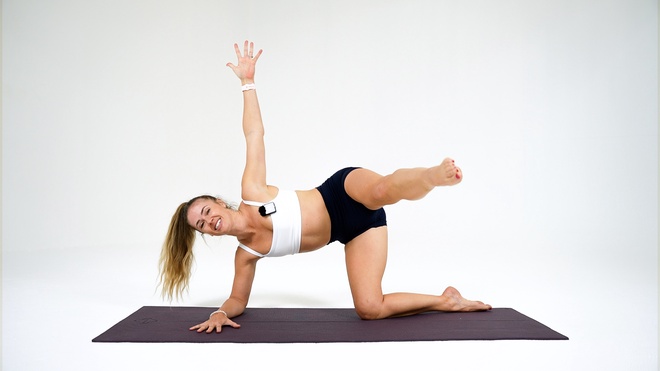
“Turn your toe down, and then do little lifts with the back of your leg.”
“Bring your elbow towards your knee, and then you kick it back out.”
“The only thing moving in your body should be from your shoulder joint.”
Muscles Targeted
Primary
Secondary
Equipment & Modifications
Equipment Needed
- mat
Don't Have Equipment?
You can substitute with:
Available Modifications
- Keep leg bent for easier variation
- Straighten leg to make it heavier
- Keep legs in tabletop for intermediate
- Reach toes out long for extreme challenge
Coaching Highlights from Lianna Brice
“Feel your shoulder blades, your scapula, pull apart, and then you're gonna squeeze them back together.”
Form
“Actively try to release your hip flexors and put all of the tension into your abdominals.”
Safety
“Reach your toes out nice and long for our last 15 seconds of work.”
Modification
“As you cross your arms, your abdominals have to move a little bit. They shake a little bit. That's a good thing.”
Motivation
“I specialize in movement that heals. Not the Instagram kind of healing — the kind where you actually address the tension pattern that's been giving you headaches for three years — I use anatomy as my guide, not aesthetics.”
Form
Health Benefits
Women navigating Pelvic Floor, low libido will find this session particularly relevant. The focus on core and shoulders addresses the specific tension patterns and movement deficits that often accompany these conditions. Some movement experience helps but is not required.
pelvic floor weakness
90% relevantpelvic floor strengthening; core stability; breathwork
low libido
90% relevantpelvic floor strengthening; blood flow to pelvis; body reconnection; parasympathetic activation
doctor dismissal
90% relevantParasympathetic nervous system activation to reduce stress and anxiety often associated with medical gaslighting.; Improved body awareness and interoception to help women better articulate symptoms and advocate for themselves.; Enhanced core strength and stability to build physical resilience and a sense of groundedness.; Increased self-efficacy and confidence through mastery of movement, empowering women to trust their own bodies.; Gentle strength building to support overall health and combat the physical toll of chronic stress.
motherhood burnout
90% relevantParasympathetic nervous system activation to reduce stress and anxiety; Improved body awareness and interoception to reconnect with self; Gentle strength building to combat physical fatigue and improve posture; Cortisol regulation through morning movement and mindful practices; Pelvic floor and core stability to address common postpartum physical stressors
dating after 40
90% relevantStress reduction and emotional regulation through parasympathetic activation; Improved body awareness, confidence, and self-perception; Enhanced posture and physical presence for increased self-assurance; Increased energy and vitality for social engagement; Development of lean muscle mass for metabolic health and body composition
Relevant For
Frequently Asked Questions
What muscles does this pilates workout target?
The primary focus here is core, shoulders, glutes. You will also feel work in your spine, hamstrings — I designed these 15 movements across 25 minutes so each body area gets attention without rushing through transitions. The pilates approach means controlled, deliberate loading — not speed. Many women use this as part of their core strengthening exercises routine. Many women use this as part of their pilates exercises at home routine.
What equipment do I need for this workout?
You'll want mat. Don't have one? A thick towel, carpet works fine — I've taught this sequence with improvised props more times than I can count. The movement matters more than the equipment. You can do this as a reformer pilates at home session.
Is this workout suitable for beginners?
This session assumes you know the basics. If you've been doing yoga or Pilates for a few months, you'll be fine. If you're brand new, start with one of the beginner sessions in this series first — I don't want you guessing at form — that's how injuries happen.
How long is this workout?
About 25 minutes, start to finish. That includes warm-up and cool-down — I never skip those, and neither should you. The main work covers 15 movements. Some days that flies by. Some days minute 20 feels like an hour. Both are normal.
Are there modifications available for this workout?
Yes. Modifications are cued throughout. Examples: Keep leg bent for easier variation; Straighten leg to make it heavier; Keep legs in tabletop for intermediate — I've been teaching long enough to know that the 'full expression' of a pose isn't the goal. The goal is finding the version that challenges YOUR body without breaking it. Use every modification offered. That's not weakness — that's intelligence.
What is the difference between Pilates and yoga?
The short answer: yoga emphasizes flexibility, breath, and mindfulness. Pilates emphasizes core control, precision, and muscular endurance. The real answer is messier. Modern yoga classes often include strength work. Good Pilates always includes flexibility. What matters is that THIS session targets the specific muscle groups and movement patterns that benefit women in their 30s and 40s. The label is less important than the outcome.
How many times per week should I do Pilates?
Joseph Pilates himself said three times per week — I agree with him on that. Your muscles need recovery time — especially your deep core stabilizers. Two to three sessions per week, with rest days or different movement types between. At your level, three sessions with one active recovery day works well.
Can pilates help with Pelvic Floor?
There is clinical evidence supporting pilates for Pelvic Floor. The mechanism: pelvic floor strengthening — I want to be honest though — movement is one piece. It's powerful, but it works best alongside sleep, nutrition, and stress management. If Pelvic Floor is significantly impacting your quality of life, talk to a specialist. This workout can be part of your plan, not your entire plan.
Why is breathing so important in pilates?
Breathing is not decoration. In pilates, your breath literally determines how deep you can go into a movement and how your nervous system responds. Exhale on effort, inhale on release — that's the basic pattern. But here is what most instructors don't say: if you can't breathe smoothly in a position, you've gone too far. Your breath is your honest feedback system. The diaphragmatic breathing in this session activates your parasympathetic nervous system — the 'rest and digest' mode that most women in their 30s and 40s desperately need more of. This session is particularly effective as a pilates abs workout option.
Related Workouts & Topics
More from Pilates Burn
More with Lianna Brice
Browse Exercise Collections
Helpful For These Concerns
About the Trainer
Lianna Brice
Pilates Trainer
From: Pilates Burn