Flutter Kicks: How-to, Benefits & Variations
Flutter kicks target lower abs, hip flexors, and deep core. Lie face up, press lower back flat, lift feet 6 inches, perform small alternating kicks. Builds core stability and pelvic floor support.
Flutter Kicks: How-to, Benefits & Variations
Can you hold your legs six inches off the floor for thirty seconds without your lower back peeling off the mat?
Most people cannot. They start strong, the legs hover, and within ten seconds the lumbar spine arches like a drawbridge. That arch means the core lost the fight. The hip flexors took over. The lower abs checked out.
Flutter kicks are the exercise that exposes this gap. Small, rapid, alternating leg kicks performed while lying on your back, with your lower back pinned to the floor the entire time. The lower portion of the rectus abdominis and the transversus abdominis have to fire constantly to prevent your pelvis from tilting forward. Unlike crunches, which use spinal flexion, flutter kicks demand spinal stability with dynamic limb movement. Your trunk stays still. Your legs do the work. Your core is the reason it all holds together.
I have watched Sophie Jones program flutter kicks into seven different Wellls workouts. She always says the same thing: push that tummy button down to the floor. That one cue separates a productive set from a back-wrecking one.
Body by Band: Workout 3
Sophie Jones
How to Do Flutter Kicks
Lie face up on a mat with your legs fully extended and arms at your sides. Press your entire lower back into the floor. Sophie Jones cues: belly button in toward the spine, arms flat by your sides. If you cannot feel your lower back flush against the mat, tilt your pelvis slightly by tucking your tailbone under.
Place your hands under your glutes for extra pelvic support. This is not cheating. Multiple trainers in our library use this setup. Danielle Harrison cues: either hands under your bum or behind your head. The hands-under-glutes position stabilizes the pelvis and reduces strain on the lumbar spine.
Lift both feet four to six inches off the floor. Point your toes. Keep your legs straight. Sophie Jones cues: point those toes, alternating the legs each time. If six inches feels impossible, start at twelve inches and work down over weeks.
Begin small, rapid, alternating up-and-down kicks. One leg rises as the other lowers. Keep the range of motion short. Natalia Gunnlaugs cues: just small kicks. Not large swinging motions. Think scissors, not pendulums.
Exhale steadily as you kick. Brace your core like someone is about to press a thumb into your stomach. If your lower back starts arching, your legs are too low. Raise them higher immediately.
Continue for 15-30 seconds or a set rep count. Lower both feet to the floor with control. Rest. Repeat.
Muscles Worked
Primary
Lower rectus abdominis
The muscle everyone calls their 'lower abs' is technically the lower fibers of the same rectus abdominis that crunches target. But flutter kicks hit this region differently. A 2023 systematic review found that exercises involving hip flexion with a fixed trunk preferentially activate the lower portion of the rectus abdominis. During flutter kicks, your trunk stays still while your legs move. That reversal of the crunch pattern shifts the demand downward. This is why people who can do fifty crunches still shake during thirty seconds of flutter kicks.
Transversus abdominis
The deepest abdominal layer. It wraps around your torso like a corset and creates intra-abdominal pressure to stabilize the spine. During flutter kicks, the TA must fire continuously to keep your lower back from arching off the mat. A systematic review linking diaphragmatic breathing to core stability confirmed that exhale-brace patterns directly drive TA activation. Every time Sophie Jones says push that tummy button down to the floor, she is cueing TA engagement.
Hip flexors (iliopsoas)
The hip flexors lift your legs against gravity. During flutter kicks, the iliopsoas works dynamically while the abdominals work isometrically. This is the exercise's trade-off. Sophie Jones coaches: try not to rely on them hip flexors, use that core. If the hip flexors dominate, you will feel burning in the front of your hips instead of your abs. The fix: raise your legs higher and slow down the kicks.
Secondary
Quadriceps
Keeping your legs straight during flutter kicks requires sustained quadriceps contraction. The rectus femoris, which crosses both the hip and knee joints, works double duty. It assists hip flexion while maintaining knee extension. If your knees start bending mid-set, your quads are fatiguing before your core.
Erector spinae (stabilizers)
While the abdominals press the lower back into the floor, the erector spinae co-contract to maintain spinal rigidity. This is not contradictory. The two muscle groups work in opposition to create a stable trunk. When the erectors overpower the abs, the back arches. That is the form breakdown every trainer watches for.
Why this matters in perimenopause
Flutter kicks muscles worked include the lower rectus abdominis, transversus abdominis, and hip flexors. These muscles matter more as hormones shift because estrogen decline accelerates visceral fat accumulation around the midsection. A 2023 RCT with postmenopausal women showed that resistance training reduced abdominal adipose tissue measured by MRI. But the deeper issue is not aesthetics. The TA is a primary stabilizer for the pelvic organs. Weak deep core muscles contribute to stress incontinence, which affects up to 50% of women during the menopausal transition. A 2025 RCT found that Kegel exercises combined with abdominal exercises produced significantly better incontinence outcomes than Kegels alone. Flutter kicks train the exact abdominal layer that supplements pelvic floor strength.
Coach's Tips
"Belly button in toward the spine, arms flat by your sides." Sophie Jones starts every flutter kick set with this cue in her Body by Band and Core Sweat programs. It sounds simple. It is the entire exercise. If your belly button lifts away from the floor, your core has disengaged and your hip flexors are running the show.
Sophie Jones
"Just small kicks, six every time. Come up in between." Natalia Gunnlaugs programs flutter kicks in controlled bursts during her HIIT Blast sessions. Short sets of six kicks, then a brief pause. This approach prevents the sloppy, momentum-driven kicking that happens when fatigue sets in. Controlled reps beat wild ones.
Natalia Gunnlaugs
"Lift that upper body off the floor ever so slightly." Sophie Jones adds this progression once the basic pattern is solid. Lifting the shoulders increases rectus abdominis demand by removing the upper-back anchor point. Only attempt this once you can keep your lower back flat during standard flutter kicks for a full 30 seconds.
Sophie Jones
"I don't want to see any arched backs here, okay? So roll the pelvis underneath." Sophie Jones delivers this firmly during Core Sweat. The pelvic tuck is non-negotiable. If your back arches, the load transfers from your abdominals to your lumbar discs. A 2022 systematic review confirmed that core stability exercises protect against low back pain, but only when performed with proper spinal alignment.
Sophie Jones
"If you start to arch like this, I want you to keep your legs higher up." Natalia Gunnlaugs demonstrates the mistake live and then shows the correction. Higher legs mean less lever arm. Less lever arm means less demand on the core. This is not easier. This is smarter. Train at the height where your back stays flat. Lower the legs by one inch per week.
Natalia Gunnlaugs
"If you need, bend those legs or bend those knees." Natalia Gunnlaugs offers this in HIIT Blast 3 without a hint of apology. Bent-knee flutter kicks cut the lever arm significantly. Your hip flexors take less load. Your core still has to stabilize. For anyone with tight hip flexors or lower back sensitivity, this is the right starting point.
Natalia Gunnlaugs
"Those of you that struggle with it low, you can bring it a little bit higher." Sophie Jones says this in Body by Band while her own legs hover at three inches. The gap between where your trainer works and where you start is normal. Raise the legs to 45 degrees if needed. Every week, lower them a fraction. The goal is progressive overload, not ego.
Sophie Jones
"Exhale steadily as you kick, keeping your core braced." Multiple trainers cue this across our library. The exhale is what locks the TA and pelvic floor into contraction. A 2023 systematic review confirmed that diaphragmatic exhale patterns drive deeper core activation. Holding your breath during flutter kicks spikes blood pressure and reduces core stability. Breathe out through the effort. Breathe in during rest.
Sophie Jones
Why This Matters for You
Flutter kicks address three things that quietly deteriorate as hormones shift.
Deep core stability. The transversus abdominis is the innermost abdominal muscle. It wraps around the torso and creates the pressure that supports your spine and pelvic organs. As estrogen fluctuates, core muscle quality declines. A 2023 international expert panel on resistance training for menopausal women specifically recommended exercises targeting core stability. Flutter kicks force the TA to fire continuously for the duration of every set.
Pelvic floor support. The pelvic floor does not work in isolation. It co-contracts with the TA during exhale-brace patterns. A 2025 RCT published in a peer-reviewed journal found that postmenopausal women who combined abdominal exercises with Kegel exercises had significantly better incontinence outcomes than those doing Kegels alone. Flutter kicks with proper breathing cues activate this exact chain.
Abdominal fat redistribution. Visceral fat accumulates around the midsection during the menopausal transition as estrogen drops. A 2023 RCT showed that 15 weeks of resistance training reduced abdominal adipose tissue in postmenopausal women, measured by MRI. Flutter kicks alone will not reverse visceral fat. But they are one piece of a core-strengthening routine that supports metabolic health.
Variations & Modifications
Tuck-up to Flutter Kicks
medium-highPerform a tuck-up (V-sit crunch) then immediately transition into six flutter kicks before tucking up again. Natalia Gunnlaugs programs this as a staple in her HIIT Blast workouts. She cues: reach up for the toes, come out. One, two, three, four, five, six. The tuck-up hits the upper abs concentrically while the flutter kicks challenge the lower abs isometrically. Two patterns, one continuous set.
Hollow Body Flutter Kicks
medium-highPerform flutter kicks while holding a hollow body position: arms extended overhead, shoulders off the floor, lower back pressed flat. Natalia Gunnlaugs uses this in her Strong Pilates series. The extended arms increase the lever arm on the upper body, demanding more from the rectus abdominis across its full length. If your arms float overhead and your back stays flat, your core is legitimately strong.
Leg Lowers with Flutter Kicks
mediumAlternate between controlled leg lowers and flutter kick bursts. Linda Chambers programs this combination in her Hybrid Yoga class. Leg lowers train eccentric control of the lower abs. Flutter kicks add dynamic speed work. Together they build both the strength and endurance components of lower core stability.
Hovering Knee Flutters
lowLie supine with knees bent at 90 degrees and perform small, rapid opening and closing motions with the thighs. Jessica Casalegno uses this in her Yogalates series. This is the gentlest flutter variation in our library. The bent-knee position reduces hip flexor demand and makes the exercise accessible for anyone recovering from lower back issues or building baseline core strength.
Benefits
Targets the lower abdominals that crunches miss
Crunches flex the spine. Flutter kicks stabilize it. Research shows that exercises involving hip movement with a fixed trunk preferentially recruit the lower fibers of the rectus abdominis. Flutter kicks benefits include reaching the part of your core that resists every crunch you throw at it. If your lower belly is the last area to respond to training, this exercise addresses it directly.
Builds isometric core endurance, not just strength
Your core's real job is not to crunch you into a ball. It is to hold your spine stable while your limbs move. Flutter kicks train this exact pattern. Your trunk stays still. Your legs move fast. A 2025 meta-analysis of core training for low back pain found that exercises emphasizing stability over movement produced significant pain reduction. Flutter kicks build the stamina that keeps your spine protected during long walks, household tasks, and standing at a kitchen counter.
Zero equipment, fits anywhere
A flat floor. That is the complete equipment list. No bench, no bar, no cables. Flutter kicks abs work happens in hotel rooms, living rooms, and the end of any workout as a finisher. Sophie Jones programs them into Beginner workouts and Natalia Gunnlaugs drops them into Intermediate HIIT circuits. Same exercise, different contexts. That versatility is rare.
Trains hip flexor endurance for everyday movement
Your hip flexors lift your legs with every step, every stair, every time you get out of a chair. Weak or tight hip flexors are implicated in anterior pelvic tilt and lower back pain. Flutter kicks train the iliopsoas through dynamic repetition at low load, building endurance without the tightening effect of heavy loaded hip flexion. A 2022 review of hip flexor assessment protocols highlighted that endurance, not just flexibility, determines hip flexor function.
Common Mistakes to Avoid
Lower back arching off the floor
The number one form failure. Sophie Jones addresses it explicitly: I don't want to see any arched backs here. Roll the pelvis underneath. If your back arches, your legs are too low for your current core strength. Raise them to 45 degrees. Place your hands under your glutes. Tuck the pelvis. The moment your lower back lifts, stop the set. Continuing with an arched back loads the lumbar discs, not the abs.
Kicking too wide and fast
Flutter kicks are not scissor kicks performed with wild abandon. Natalia Gunnlaugs cues: just small kicks. Keep the range to about 12 inches total. Smaller kicks maintain constant tension on the lower abs. Big, sweeping motions use momentum and shift the work to the hip flexors. Slow down. Shrink the range. Feel the difference in your midsection.
Holding the breath
Thirty seconds of isometric bracing invites breath-holding. Your blood pressure spikes. Your face turns red. Your core actually gets less stable because the diaphragm locks up. A systematic review confirmed that steady exhale patterns produce better TA activation than holding breath. Breathe out through pursed lips during the kicking phase. Breathe in during any rest pause.
Straining the neck by lifting the head too high
Sophie Jones cues: keep those shoulders off the ground. Not crank your chin to your chest. If you lift your head, keep it a subtle elevation. If your neck starts burning before your abs, rest your head on the floor. Neck strain is not core training. The exercise works with your head down. The shoulder lift is a progression, not a requirement.
Workouts Featuring This Exercise
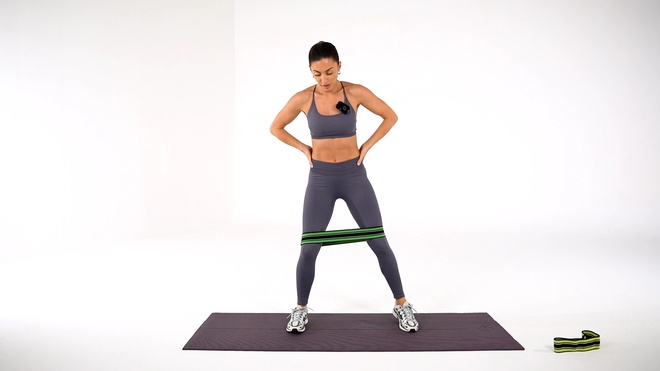
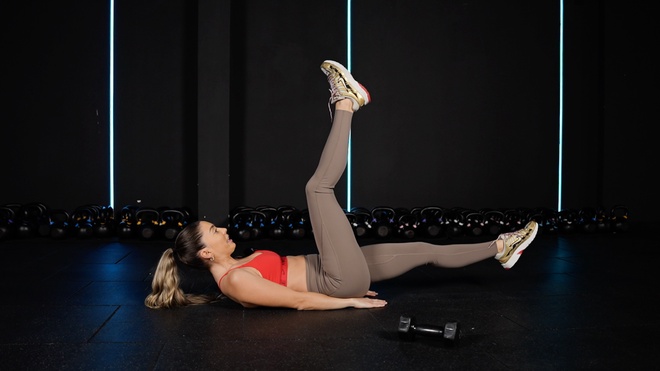
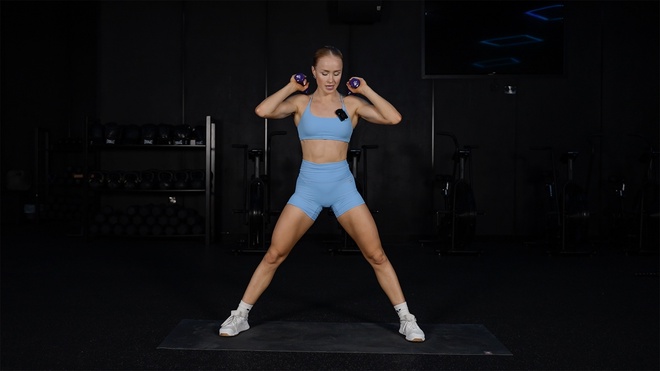
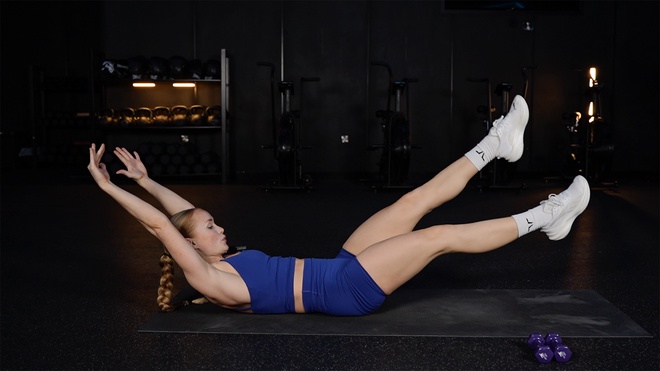
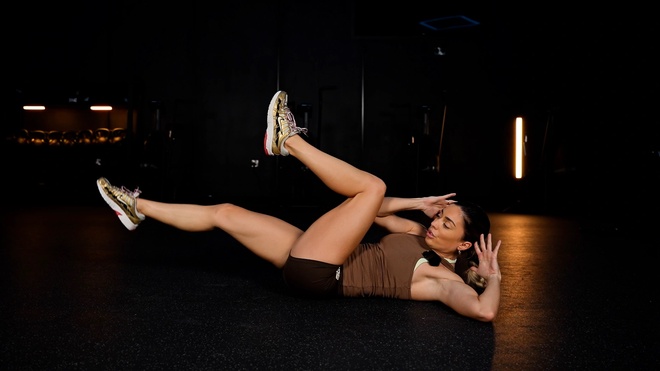
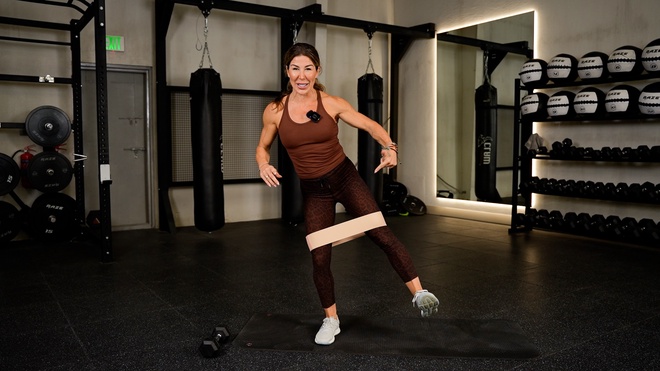
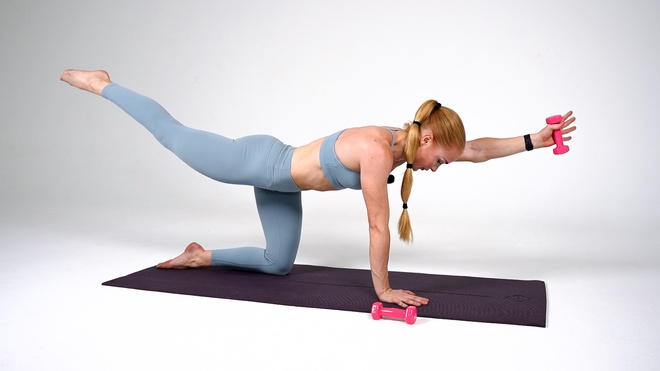
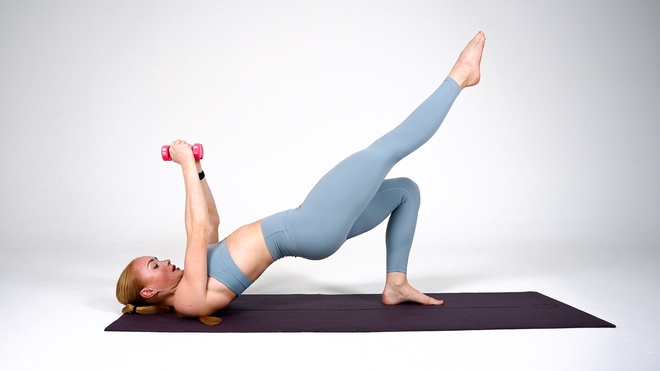
Join women building deep core strength with 6 certified trainers across 10 flutter kick workouts
Frequently Asked Questions
Related Exercises
Leg Raises
Both legs move together instead of alternating. Same lower ab target, higher difficulty. If flutter kicks feel easy, leg raises are the next progression.
Dead Bug
Another supine core exercise that trains anti-extension. Dead bugs use opposite arm-leg patterns. A safer alternative for anyone with lower back sensitivity.
Mountain Climbers
Dynamic core exercise with hip flexion. Performed in a plank position rather than supine. Adds a cardio component to the hip flexor and core demand.
Plank
The isometric core base. Planks train anti-extension statically. Flutter kicks add dynamic leg movement to the stability pattern. Pair them for a complete core circuit.
Bicycle Crunches
Dynamic core exercise that adds rotation. Bicycle crunches target the obliques while flutter kicks target the lower rectus abdominis. Different muscles, same lying position.
This exercise helps with
Get flutter kicks in a guided workout
Access 10 workouts featuring this exercise, plus personalized plans from Dr. Wellls.
Join women building deep core strength with 6 certified trainers across 10 flutter kick workouts
Your membership funds independent women's health research